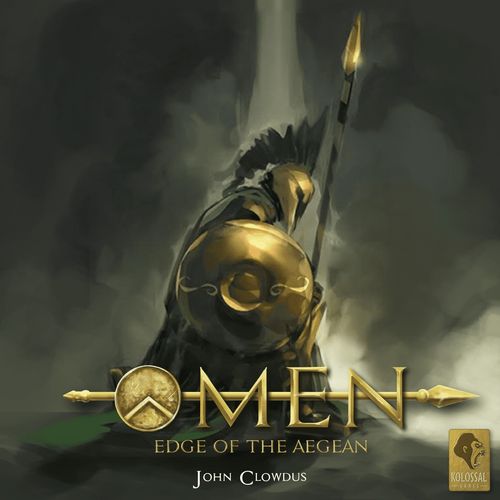
Omen: Edge of the Aegean
Omen: Edge of the Aegean Rulebook
Table of Contents
Table of Contents
Components
- 1 City board
- 22 Unit cards
- 4 Reference cards
- 6 Reward tiles
- 20 Coins
- 6 VP tokens
- 3 War-torn tokens
- Rulebook
Setup
- Place the City board between the two players.
- Shuffle the 6 Reward tiles and place 2 facedown on each of the three designated spaces on the City board.
- Place 1 War-torn token atop each of the three Reward tile stacks, with the peaceful side faceup.
- Shuffle all Unit cards and place them in a facedown deck in the designated area next to the City board.
- Place the 20 coins in their designated area next to the City board.
- Place the VP tokens near the City board.
- Each player draws 4 cards from the deck and takes 4 coins from the supply.
- Each player takes 2 Reference cards.
The game begins with the oldest player taking the first turn.
Emissary of War Variant
After the standard setup, each player selects 1 Unit card from their hand and places it facedown. This is the player's Emissary. Both Emissaries are then revealed. Each player sums the Cost, Offering, and Strength values of their Emissary. The player whose Emissary has the greatest combined value is the First Player for the game. In the event of a tie, the Emissary with the highest Strength value breaks the tie. If a tie still exists, the oldest player is the First Player.
The First Player moves their Emissary card to the discard pile. The other player returns his Emissary to their hand. The game then begins, with the First Player taking the first turn.
Gameplay
In Omen: Edge of the Aegean, two players will take turns gathering wealth, playing units, warring over cities and making offerings to the gods.
On their turn, the active player will proceed through the following steps in order:
- Wealth Step: Draw cards and gain coins.
- Surge Step: Play units from hand.
- War Step: Resolve conflicts in war-torn cities if any.
- Offering Step: Discard a card to draw cards and/or gain coins.
Play continues until all cities have been depleted of Reward tiles.
Players then compare their victory point (VP) totals, and the player with most is the victor!
Wealth Step
The Wealth Step represents the player gathering their forces and resources in preparation for the ensuing battle. During the Wealth Step, the active player gains coins and/or draws cards.
The active player has 3 Wealth actions to spend during their Wealth Step. Each Wealth action may be used to draw 1 Unit card or gain 1 Coin. Wealth actions may be used in any combination but all Wealth actions must be chosen prior to taking any Coins or cards.
For example, the active player may use 2 of their Wealth actions to draw 2 cards and spend 1 of their Wealth actions to gain 1 coin.
If the active player uses all of their Wealth actions to draw cards, they draw 1 additional card. If the active player uses all of their Wealth actions to gain coins, they gain 1 additional coin. This is called a Wealth Action Bonus.
NOTE: A player must decide how all of their Wealth actions will be spent prior to taking any coins or cards. This means they must decide to draw 4 cards or gain 4 coins before taking any of their Wealth actions if they wish to take advantage of the Wealth Action Bonus.
For example, the active player elects to use all 3 of their Wealth actions to draw cards. The player would draw an additional card (4 cards total) as a result of the Wealth Action Bonus.
If a player would draw a card but the deck has no cards, shuffle the discard pile and place it facedown in the designated space by the City board and draw from the newly shuffled deck. It is important to remember that the deck is shared between each player, while units in their hand and on their side of a city belongs to them respectively.
No player can gain more coins than are available in the supply.
NOTE: On the first turn of the game, the First Player receives 2 Wealth actions instead of 3. The player still receives a Wealth Action Bonus if all Wealth actions are used for the same action.
Surge Step
After the Wealth Step, the active player proceeds to the Surge Step. The bulk of the game takes place in the Surge Step. During this step, the active player spends coins to play Unit cards from their hand. Additionally, Reward tiles may be used for their godlike powers during this step.
- Unit Cost: Amount of coins required to play the unit to a city.
- Offering Value: Amount of cards and/or coins gained when discarded during the Offering Step.
- Strength Value: Amount of Strength contributed during conflict resolution in the War Step.
The most common way cards are played in Omen is to pay a unit's cost and add it to a city. The active player pays the needed coins, returning the spent coins to the supply, and adds the unit to their side of the play area in front of one of the three city spaces.
The active player may play as many units as they wish from their hand, into any city of their choice as long as all costs can be paid. However, a player can never have more than 5 units on their side of a given city. This is referred to as the city capacity. For the purpose of city capacity, Keres, Moirai, and Myrmidons count as 1 unit each, while COLOSSAL units (Automatons) count as 2 units. A player cannot play, move, or use any ability that would add a unit to their side of a city that is at city capacity.
In addition to playing cards from hand, once per Surge Step, the active player may use 1 of the Reward tiles they have earned. To do this, they flip the Reward tile in their play area faceup and resolve the ability. While Reward tiles grant players mighty powers, using their abilities reduces the VP value of the tile from 2VP to 1VP. This is noted on the bottom right corner of the Reward tiles.
- Reward Name: This does not have any functional impact upon the game.
- VP Value: Amount of points scored during end of game scoring. A tile that has been used is worth 1VP. VP = victory points.
- Reward Ability: The effect described on the tile is resolved at the time the tile is flipped. Once a tile has been used it cannot be used again.
Unit Card Types
In Omen: Edge of the Aegean, there are 4 different types of Unit cards: Myrmidons, Automatons, Keres, and Moirai. Each unit has abilities unique to their type. Below is a summary of each unit type:
Automatons: Units that are COLOSSAL and have the keyword ability TRIBUTE. After an Automaton is discarded as an Offering, that player may use its TRIBUTE ability.
Keres: Units with an ability that is resolved at the end of the Surge Step. Keres also have the keyword ability EXALT. After resolving a Keres ability, the active player checks if the condition to EXALT has been met. If so, EXALT a Keres, it is removed from its city, turned facedown, and a VP token is placed on it.
Moirai: Units that have a powerful ability that is resolved while the unit is in a city. Additionally, all Moirai have the keyword TREASURED. TREASURED units are worth 1 victory point at the end of the game if in a player's hand.
Myrmidons: Units that have a RALLY ability. After the active player adds a unit with RALLY to a city, they may pay the indicated cost and resolve its RALLY ability. Alternatively, after the active player adds any unit to a city, that player may pay the indicated costs and resolve the RALLY abilities on any of their units with RALLY in that city.
NOTE: All unit abilities are considered to be mandatory unless their text explanation contains the word may.
War Step
During the War Step, the active player resolves conflicts in any war-torn cities. First, the active player checks to see if any of the cities with Reward tiles are war-torn. A city is war-torn if an opponent has at least 3 units in the city and/or the sum of both players units total of 5 or more. When a city becomes war-torn, flip the War-torn token to its war-torn side to indicate so.
COLOSSAL UNITS: Automaton units all have the keyword COLOSSAL. A COLOSSAL unit counts as 2 units instead of 1 for the purpose of determining if a city is war-torn or not.
NOTE: A player may choose to play units into a city with no Reward tiles, but such a city will never be considered war-torn again.
If there are multiple war-torn cities, the active player decides the order in which the war-torn cities are resolved.
To resolve a war-torn city, each player adds the Strength values of all their units in that city. The player with the highest combined Strength is the victor, taking the top Reward tile from that city and placing it in their play area with the 2VP side faceup. The victor then destroys all but 1 of their units in that city, placing them in the discard pile. The loser of the conflict destroys all but 2 of their units from the city, placing them in the discard pile. Lastly, flip the War-torn token to its peaceful side.
In the event of a tie, the player with the highest total unit cost in that city is the victor. If players are tied for total unit cost, neither player is the victor, and both players must destroy all but 2 of their units in that city, placing them in the discard pile. Repeat the above steps until no war-torn cities remain.
COLOSSAL UNITS: If a player loses a conflict during the War Step, they must destroy all but 2 of their units. If the player chose to keep a COLOSSAL unit, it would be the only one they could keep in that city given that it counts as 2 units. Likewise, the victor in a conflict can only keep 1 unit, which cannot be a COLOSSAL unit as they are considered to be 2 units.
Offering Step
During the Offering Step, a player may offer one of the cards from their hand as a sacrifice to the gods. In return, they are granted additional coins and/or cards.
To make an Offering, the active player selects a Unit card from their hand and discards it. They then draw a number of cards and/or gain a number of coins equal to that card's Offering value.
At the end of this step, the active player discards cards from their hand until they have a maximum of 5 cards in hand. They then return coins to the supply until they have a maximum of 10 coins.
End of Game and Scoring
The game ends at the end of the active player's turn if no city has any remaining Reward tiles.
After the game's end is triggered, each player calculates their victory points. The player with the highest score wins, having proven to be the greater offspring of Zeus and worthy of the blessing of the gods.
Each player will score victory points in the following ways:
- Gain 2VP for each unused (facedown) Reward tiles in their play area
- Gain 1VP for each used (faceup) Reward tile in their play area
- Gain 2VP for each VP token they have earned
- Gain 1VP for each TREASURED unit in hand
In the event of a tie, the player with the most unused Reward tiles is the winner. If the players are still tied, the player with the most VP tokens is the winner. If the players are still tied, the player with the most TREASURED units in their hand is the winner. If the players are still tied, both players have earned the respect of the gods and share the victory.
Variants
Combining Omen Sets
When combining Omen: Edge of the Aegean with other sets from the Omen Saga, be sure to use any additional rules governing the use of those cards and components. For example, if using Oracle units and the Feat cards from Omen: A Reign of War with Omen: Edge of the Aegean, players would need to add the Portent Step and Feat Step into the structure of a turn. Simply follow the rules governing those Steps in Omen: A Reign of War to integrate them with Omen: Edge of the Aegean. Additionally, be sure to follow any alternate game end conditions that are a part of those rules.
Another exciting format is to combine Omen: Edge of the Aegean with Omen: Fires in the East. First shuffle all of the Reward tiles from both sets together. Now add 2 reward tiles to each city (3 Reward tiles for a longer game) and shuffle all of the units from both sets together. From this point on, follow all other rules governing both sets.
Drafting Variants
Omen offers 2 drafting variants to give players more control over their experience. Instead of a shared deck and discard pile, each player will have their own deck and discard pile once the game begins. Any unselected cards are returned to the box. When using either drafting variant, any ability that references "the deck" or "the discard pile" refers to the player's own deck or discard pile.
NOTE: When not using Omen: A Reign of War both draft variants require all units in Omen: Edge of the Aegean, Omen: Fires in the East, and Omen: Gifts of the Gods to be used.
Draft Variant 1: Each player draws 3 cards from a shared deck containing all the Unit cards, chooses 2, places them facedown, and then passes the remaining card to their opponent. This continues until each player has 30 facedown cards. Each player shuffles their 30 cards to form their deck. The game then begins as normal.
Draft Variant 2: 20 random cards are placed faceup in the middle of the play area. Randomly determine a player to select the first card. Each player selects 1 card until all cards have been selected. This is repeated two additional times, resulting in each player having a 30 card deck. Each player shuffles their 30 cards to form their deck. The game then begins as normal.