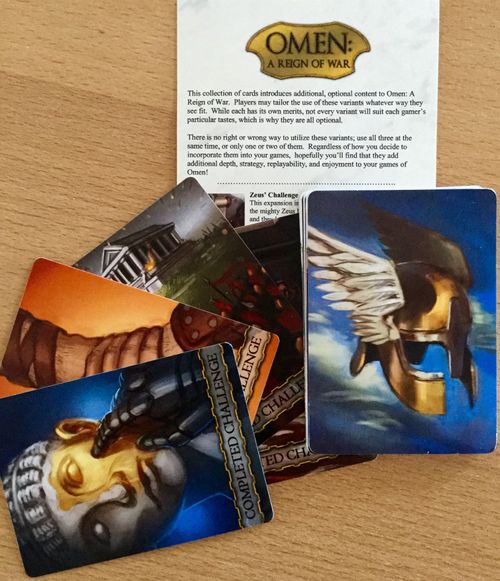
Omen: A Reign of War – Omega Edition extras
Omen: A Reign of War – Omega Edition extras Rulebook
Table of Contents
Table of Contents
General Terms
Short terms used throughout these rules are explained here.
- Draw pile: A stack of cards next to the players' play area that contains face-down cards.
- Discard pile: A stack of cards next to the players' play area that contains face-up cards.
- Lay out / play: Cards are taken from a player's hand and placed in the play area.
- Discard: Cards are taken from a player's hand and placed face up on the discard pile.
- Draw cards: The top card of the draw pile is taken into a player's hand. If more than the top card can be drawn, this is stated explicitly in the card text.
- Face-up cards: Cards lying with the picture side up / played face up.
- Face-down cards: Cards lying with the picture side down / played face down.
- Play from hand face up: Cards are taken from a player's hand and placed face up in the play area.
- Discard from hand face up: Cards are taken from a player's hand and placed face up on the discard pile.
- The hand: The cards in a player's possession that he normally holds in his hand.
Setup
Remove all Spirit and Hero cards from the draw pile. Shuffle the remaining 48 Unit cards and place them as a face-down draw pile on the right side of the play area. Place the 25 coins next to the draw pile in the coin supply.
Translator's note: the English base rulebook gives 20 coins for the coin supply; this document is transcribed as printed (25 coins).
Each player takes one of the 6 Feat cards and places it face up in his play area. Place the three City cards face up in the middle of the shared play area. Shuffle the 12 Reward cards and place 4 face down on each of the City cards.
Finally, each player draws 4 Unit cards, takes 4 coins into his personal coin supply, and takes a Reference card.
Note: There are also 6 Relic cards, 6 Challenge cards and 5 Whim cards. These cards are used for the corresponding game variants.
The oldest player begins the game.
Emissary of War: Alternative / Optimal Starting Rules
Each player chooses one Unit from his hand and places it face down in front of himself. This card is the player's Emissary of War.
As soon as both players have played their Emissary, both Emissaries are revealed. The three stat values of the Unit (Cost, Offering value and Strength) are added together for each Emissary. The player whose Emissary has the highest total value is the first player for the current game. In the event of a tie, the Emissary with the highest Strength value wins. If this value is also tied, the oldest player becomes the first player of the game.
The first player places his Emissary on the discard pile. The second player takes his Emissary back into his hand, and the first player begins the game with his first turn.
The Cards
Omen revolves around playing cards, which are explained in this chapter according to their card type.
Note: The cards of the individual expansions are explained in the corresponding chapters.
Cities
City cards represent the three cities. During the game, players play Units onto the side of each city facing that player. Each city begins the game with 4 Reward cards lying face down on it. One of the main goals of the game is to obtain these Reward cards.
Cities limit the number of Units on each side facing a player to 5 Units. This is called the City limit.
Rewards
Reward cards represent the blessings granted by the gods and lie face down on the 3 City cards at the start of the game. Once the players have fought battles within the cities, they add these Reward cards to their hands.
Each Reward card can be used once per game for a powerful effect. The 6 different Reward cards have different effects. Once a player has played a Reward face up in his play area and used its effect, he must turn it face down.
Note: Only one Reward card per player may be played per round.
At the end of the game, players receive victory points based on the Reward cards they own:
- Reward cards in hand: 2 victory points each.
- Played Reward cards: 1 victory point each.
A player can never force the other player to discard a Reward card.
Feats
Feat cards represent challenges set by the gods. Each player has the same 6 face-up Feats. Successfully meeting these challenges is the key to victory. As soon as a player has achieved a Feat, the corresponding card is turned over to its reverse side.
At the end of the game, players receive victory points based on the Feats they have achieved:
- Achieved (turned over) Feat cards: 2 victory points each.
Units
The 5 Unit types of Omen are explained in this chapter. These cards are played during the Surge phase in order to obtain Rewards and achieve Feats. Each Unit, regardless of its type, has three stat values; Spirits are the only Unit with a fourth stat value.
- Cost (yellow): The number of coins a player must spend to play the Unit.
- Offering value (red): The number of cards or coins a player receives when the Unit is discarded during his Offering phase.
- Strength (blue): This value decides which player wins the War for a city.
Soldiers
Soldiers are played from a player's hand into a city of his choice, onto the side of the chosen city facing him.
As soon as a Soldier enters a city, its ability is carried out.
Beasts
Beasts can be played from a player's hand in two different ways:
- Directly onto the side of a city facing the player. In this case, the card effect of the Beast is ignored.
- To use the card effect, the Beast must be discarded directly.
Oracles
Oracles are played from a player's hand into a city of his choice, onto the side of the chosen city facing him. The card effect of an Oracle is triggered in the Omen phase.
Spirits
Spirits are played from a player's hand into a city of his choice, onto the side of the chosen city facing him.
Spirits have two different card effects, one of which the player selects as soon as the Spirit enters a city, and carries out immediately. In addition, each card has a Summoning cost, which the player can pay in order to use both card effects and then discard the Spirit.
Spirits cannot be enraged.
Heroes
Heroes are discarded from a player's hand in order to use their card effects. Unlike the other Unit types, the card effects of Heroes can be used outside the Surge phase of the current player. All Heroes cost 0 coins.
At the end of the game, players receive victory points for Heroes:
- Hero cards in a player's hand: 1 victory point each.
Object of the Game
In Omen, the players take on the roles of rival brothers who are determined to bring the Greek islands under their dominion. The players have access to powerful Units and can spend coins to play Units in various ways, with every path leading to one goal: victory in the game.
Playing the Game
Omen is played over several rounds. Each player plays his turn in alternation, consisting of six phases. Rounds are played until either:
- there are no more Reward cards lying on two cities, or
- a player has achieved 5 of his 6 Hero cards (turned over).
Translator's note: the German text of this condition reads "Heldenkarten" (Hero cards). The End of the Game section below, and the sense of the rule, refer to the Feat cards ("Heldentatenkarten"), so this is most likely a mistranslation of the Feat cards. It is transcribed as printed here.
During a player's round, that player is the active player and the other player is the opposing player.
The six phases of a round are always carried out in numbered order. As soon as a player has carried out the 6th phase, his round ends and the next player's round begins.
Phase 1: Wealth
This phase represents gathering strength and resources in preparation for the battle that follows. During this phase, the active player receives coins or draws cards.
The active player has 3 actions during this phase. With each of these actions he may:
- draw 1 Unit from the draw pile, or
- take 1 coin from the coin supply.
These actions may be combined freely by the active player. If the active player uses all of his actions to draw Units, he receives one additional Unit. This action bonus also applies if the active player uses all of his actions to receive coins, and as a result receives a bonus fourth coin.
During the first round of the first player, that player only receives 2 actions.
Phase 2: Surge
During this phase, the active player places his Units in the cities, using their effects, and receives Rewards from the gods, in order to thwart the plans of the opposing player. The bulk of the game itself takes place in this phase.
During this phase, the active player may spend his coins to play Units from his hand. In addition, the active player may play Reward cards from his hand.
Placing Units in Cities
In order to play a Unit from his hand, the active player must choose one of the three face-up cities and lay the Unit on the side of the city facing him. After that, the active player must return the cost of the Unit in coins from his supply to the coin supply.
If the Unit is a Soldier, its effect is carried out.
Note: The effects of Soldiers must be carried out, unless the effect text contains the word "may". Effects always take effect when entering a city, even if the Unit has been moved from one city to another city.
The active player may play as many Units into any cities as he wishes, and is only limited by the number of coins in his coin supply and the Unit limit of the respective cities.
A player may never have more than 5 Units lying on the side of a city facing him, where the individual Unit types count as follows:
- Soldiers, Oracles, Spirits, Heroes: 1 Unit
- Beasts: 2 Units
A player may not play Units into a city once the City limit of 5 Units has already been reached on the side of the city facing him.
Discarding Beasts
Regardless of the fact that Beasts are a strong addition to the other Units, Beasts can be discarded from the active player's hand in order to trigger their respective card effect. To do this, the active player must return the cost of the Unit in coins from his supply to the coin supply, carry out the card effect, and discard the respective Beast from his hand.
Using Rewards
During the Surge phase, the active player may once play a Reward card from his hand face up in his play area, carry out the respective card effect, and then turn the card face down.
Phase 3: Omen
During this phase, the card effects of the Oracles in the active player's play area may be carried out. The card effects of each Oracle are carried out once, one after another, during this phase.
Phase 4: Feats
The active player begins this phase by checking whether the conditions of one or more of his face-up Feat cards have been met. If the conditions of one or more Feat cards have been met, the active player announces the fulfilment of these and turns them face down.
There is no limit to the number of Feat cards that can be fulfilled per round, although fulfilling more than one per round is said to be very difficult.
Phase 5: War
During this phase, the winner is determined in cities gripped by war. A city is gripped by war when:
- the active player has at least 3 Units lying on his side of the city, and/or
- a total of at least 5 Units lie on both players' sides of the city combined.
Note: When determining the total number of Units per side, remember that Beasts count as 2 Units.
Note: The opposing player does not need to have Units lying in the respective city when the active player reaches the total of 5 Units on his side.
To determine the winner, each player adds together the Strength values of the Units played on his side. The player with the higher total Strength takes the top Reward card from the affected city into his hand and discards all Units on his side of the affected city except for 1 Unit. The player with the lower total Strength discards all Units on his side of the affected city except for 2 Units.
Note: When discarding Units, remember that Beasts count as 2 Units and must therefore be discarded by the winning player.
In the event of a tie, the player with the most Soldiers wins the Strength comparison in the affected city. If the tie cannot be resolved in this way, neither player wins this war, and each player must discard all Units on his side of the affected city except for 2 Units.
Repeat these steps within this phase until there are no more cities gripped by war.
Phase 6: Offering
During this phase, the active player may discard one of his hand cards and sacrifice it to the gods in order to receive additional resources. For the Offering value of the discarded card, the active player receives the corresponding number of cards from the draw pile into his hand, or the corresponding number of coins from the coin supply. The active player may freely choose the division between cards and coins.
At the end of this phase, the active player must reduce his hand to 7 cards, discarding Units and playing Reward cards face down into the play area of the active player. Finally, the active player must return coins to the coin supply until he has at most 10 coins left in his personal coin supply.
End of the Game and Scoring
A game of Omen ends at the end of the active player's round if one of the following two conditions is met:
- The opposing player has 5 fulfilled Feat cards lying in his play area, or
- 2 or more cities no longer have any Reward cards, or
- only 2 Challenge cards remain lying face up next to the draw pile.
As soon as the game ends, the players receive victory points, and the player with the highest total of victory points has proved to be the better son and receives the blessing of the gods.
Players receive victory points for:
- each Reward card in the hand: 2 victory points
- each Reward card lying face down in the respective play area: 1 victory point
- each face-down Feat card in the respective play area: 2 victory points
- each turned-over Feat card (see: Relics of Olympus) in the respective play area: 1 victory point
- each Hero card in the hand: 1 victory point
- each Challenge card lying face down in the respective play area: 3 victory points
- each Relic card on the side of a city facing the respective player: 1 victory point
In the event of a tie, the player who has the most face-down cards lying in his play area wins.
Additional Rule: Enraged
Enraged ("enraged") is a status effect, an ability of some Units that can enrage other Units; only Beasts cannot be enraged.
When a Unit is enraged, it is placed face down and becomes a Beast with a Strength of 4 and no card effects. Translator's note: the German text reads "wird diese mit der verdeckt" (garbled); "placed face down" is the meaning given here. At the end of the Offering phase, all enraged Units on the active player's side are turned back face up, and the original card texts and values apply again.
Note: Enraged Units count as Beasts and are therefore counted as 2 Units during the War phase.
Note: A Unit cannot be enraged if doing so would cause the respective City limit to be exceeded.
Optional Units
Omen offers two additional optional Unit types: Spirits and Heroes. Small Box Games recommends using these additional Unit types once you have gained a good feel for the three original Unit types (Soldiers, Beasts and Oracles).
Alternative Game Modes (Drafting)
To give the players more control over the Units that can be drawn and played, Omen offers two alternative game modes. Both modes require shuffling and using all 66 Units. Each player gets his own draw pile and discard pile. All Units not selected by the players are returned to the game box for the current game. When one of the alternative game modes is used, all card texts that refer to the draw pile or discard pile instead refer to the personal draw pile and personal discard pile of each player.
Variant 1
Each player draws 3 cards, chooses 2 of these cards and places them face down in a pile, and passes the remaining card to the other player. This continues until each player has a pile of 30 cards. These 30 cards are then shuffled and used as the personal draw pile.
Variant 2
20 random cards are shuffled and placed face up in the middle of the play area. Each player then chooses one card in turn, until all cards have been selected from the card pile. This process is repeated three times in total, so that each player has a set of 30 cards. These 30 cards are then shuffled and used as the personal draw pile.
Expansions
Omen includes three expansions that introduce new card types into the game.
Zeus' Challenge
This expansion adds Challenges as a card type: tasks set by the mighty Zeus himself. There are 6 Challenges in total, and at the start they are all placed face up next to the draw pile.
When Challenges are used, there is a further phase in the turn sequence, which takes place for each player after Phase 4: Feats. In this phase, the active player checks whether he has met the conditions of a Challenge, and if so, he may lay it face down next to his Feat cards. A player may only fulfil one Challenge per round. At the end of the game, Challenges are worth 3 victory points.
Challenges also add a further condition for ending the game: the game ends when only 2 Challenges remain face up next to the draw pile. In addition, the players may agree that two of the three possible end-game conditions must be met.
Tyche's Whims
This expansion adds the Whim cards, which offer the players abilities during the game and either cost or grant victory points at the end of the game. These cards are shuffled at the start of the game and placed in a further face-down draw pile.
After the first player has been determined, the opposing player may draw up to 3 Whim cards, choose one of these Whim cards and pass it to the first player, who adds it to his hand. The remaining two Whim cards stay with the opposing player.
The ways in which Whim cards may be played are described on each card. A Whim card is played face up during the game phase stated on the card. After its card effect has been carried out, the Whim card is placed face up next to the Whim draw pile. Whim cards count normally towards the number of hand cards during the Offering phase. As with Reward cards, no player may force another player to discard Whim cards.
At the end of the game, each player reveals his hand cards face up and gains or loses victory points, depending on the text of the Whim card.
Relics of Olympus
This expansion provides the players with Relic cards: powerful artefacts taken directly from the peak of Olympus, to help the players dominate ancient Greece. Each Relic offers a unique effect: some are passive, some affect both players, and others are triggered or are optional.
All 6 Relic cards are placed face up next to the draw pile at the start of the game.
During the Feats phase of the active player, if he has achieved one or more Feats during his turn, then instead of turning one of his Feat cards face down, he may obtain a Relic. To do this, instead of turning the achieved Feat face down, he rotates the Feat card 90 degrees. He then selects a Relic from the side of the play area and places it face up on his side of any City.
Rotated Feats still count as achieved Feats for the conditions for ending the game. However, any Feat that has been rotated cannot be achieved again by the player and is worth only 1 victory point at the end of the game. Each Relic card the player has at the end of the game is worth 1 victory point.
Each city may have at most one Relic card lying on it. If a further Relic card is played onto the same city, the Relic card already lying there must be returned to the face-up Relic cards next to the draw pile.
Rules Clarifications
- Revealed cards are discarded, unless the card text describes a different procedure.
- Drawing revealed cards into the hand, or taking revealed cards from the discard pile back into the hand, does not count as drawing a card.
- The discard pile is public: each player may look at all cards in it at any time.
- When the draw pile has no further cards, the discard pile is shuffled immediately to form the new draw pile.
- Players may play Units onto cities that no longer have any Reward cards lying on them. However, such cities can no longer be gripped by war.
- The first player may receive a bonus in the Wealth phase.