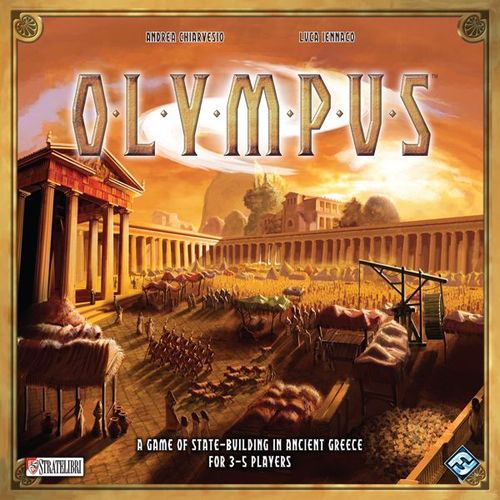
Olympus
Olympus Rulebook
Table of Contents
Table of Contents
- Game Overview
- Object of the Game
- Game Components
- Component Overview
- Setup
- Playing the Game
- The Worship Phase
- The Upkeep Phase
- Winning the Game
- Divine Favors
- Demeter (Goddess of Agriculture)
- Artemis (Goddess of the Hunt)
- Poseidon (God of the Sea)
- Athena (Goddess of Wisdom)
- Aphrodite (Goddess of Love)
- Ares (God of War)
- Hephaestus (God of Manufacturing)
- Apollo (God of the Sun and the Arts, but also the Plague-Bringer)
- Zeus (King of the Gods)
- Hera (Queen of the Gods)
- An Example Worship Phase
- Other Rules
- Buildings
- Notes About the Symbols
- Common Buildings
- A Note from the Designers
Game Overview
In Olympus, three to five players take on the roles of the leaders of Greek city-states and must guide their city-states to supremacy. Players use their priests to obtain the favor of the Greek gods on behalf of their city-states. With this favor, players can advance the material and cultural progress of their city-states or bring war and pestilence upon their enemies.
Object of the Game
When at least four of the six Glory cards have been claimed, the player with the most victory points wins the game.
Game Components
Olympus includes the following components:
- 1 Game Board
- 5 City-state Sheets
- 183 Cards, including:
- 165 Common Building Cards (33 per player color)
- 12 Unique Building Cards
- 6 Glory Cards
- 25 Wooden Priest Pawns (5 per player color)
- 35 Wooden Marker Discs (7 per player color)
- 60 Wooden Resource Cubes (20 each of yellow, red, and blue)
- 1 Wooden Starting Player Marker
- This Rulebook
Component Overview
This section describes the components of the game in detail.
Game Board: The game board shows three major areas: a list of deities inhabiting Mount Olympus, spaces for unique Building cards, and a scoring track that runs around the outside edge of the board.
City-state Sheets: These sheets track the progress of each player's city-state and contain areas to hold the player's priests and resources.
Common Building Cards: These cards represent common buildings and other achievements. Each player's deck of Common Building cards is identical to each other player's deck.
Unique Building Cards: These cards represent special buildings, each of which can only be built by a single player.
Glory Cards: These cards match the six progress tracks on the city-state sheets and are awarded to the first player whose marker reaches the end of each corresponding track.
Priest Pawns: Players use these wooden pawns to indicate on which gods their city-states are focusing their worship.
Victory Point and Progress Markers: These wooden discs mark how far players have advanced on their progress tracks and the victory point track.
Resource Cubes: These cubes represent the three types of resources available in the game: grain (yellow), meat (red), and fish (blue).
Starting Player Marker: This wooden marker indicates which player is the starting player for the round.
Note: The quantity of resources is unlimited. The resource cubes provided should be sufficient, but if more are needed feel free to substitute any convenient item.
Setup
Follow the steps below to set up the game:
-
Place Game Board: Place the game board in the central play area, within easy reach of all players.
-
Place Unique Building Cards: Place one Unique Building card in each of the 12 spaces for them on the game board. The order of these cards is irrelevant.
-
Place Resource Cubes: Separate the resource cubes into three pools according to type (grain, meat, and fish) and place them near the game board to create a supply.
-
Place Glory Cards: Place the six Glory cards in a stack near the game board.
-
Take Player Components: Each player chooses a player color and takes:
- 1 City-state Sheet
- 33 Common Building Cards (in his color)
- 5 Priests Pawns (in his color)
- 7 Progress Markers (in his color)
- 3 Resource Cubes (one of each type)
Return any unused city-state sheets, Common Building cards, and wooden pieces not chosen by the players to the game box.
-
Place Priests: Each player places three of his priests in the top three spaces (the light blue squares) of the clergy area on his city-state sheet. Players leave the bottom two spaces (the green and pink squares) empty for now. Each player places his remaining two priests aside in his own supply. They may become available to the player later in the game.
Setup Diagram (Three-Player Game)
- Player Play Area
- City-state Sheet
- Progress Markers
- Priest Pawns Supply
- Starting Resource Cubes in Warehouse Area
- Starting Priest Pawns in Clergy Area
- Common Building Deck
- Grain Supply
- Meat Supply
- Fish Supply
- Glory Cards
- Starting Player Marker
- Victory Point Markers and Track
- Deity Area
- Unique Building Area
City-State Sheet Anatomy
- Starting Clergy Spaces
- Additional Clergy Spaces
- Warehouse Area
- Progress Tracks
- A. Culture
- B. Population
- C. Military
- D. Agriculture
- E. Hunting
- F. Fishing
- Columns
- Production Progress Tracks
- Glory Card Award Space
- Tribute Area
Playing the Game
Olympus is played over a series of rounds, each of which is divided into two phases. The phases of each round are as follows:
- Worship Phase: Players use priests to earn the favors of the Olympian deities.
- Upkeep Phase: Players resolve certain building effects and prepare for the next round.
All players must complete the Worship phase before the Upkeep phase begins. When all players have completed the Upkeep phase, a new round begins with a new Worship phase.
The Worship Phase
During this phase, players send their priests to worship the Olympian deities. As players place priests on the game board, the gods and goddesses grant their favors.
The player with the starting player token is the first active player. He must begin a ceremony to worship one of the deities by placing a priest in that deity's Alpha space on the game board. The other players may then opt to join that ceremony by placing a priest in that deity's Beta space. When that ceremony is complete, the player to the active player's left becomes the new active player and begins a new ceremony. All players have an opportunity to participate in every ceremony, as long as they have priests available in the clergy area of their city-state sheet. When all players have used all of their available priests, or when every deity has been worshipped with a ceremony, the Worship phase ends.
Ceremonies
During the Worship phase, the active player must use one of his available priests (those found in his clergy spaces) to begin a worship ceremony. He can only use priests from his city-state sheet (priests already on the game board or in the player's supply cannot be used). If the active player has no priests available or if all deities already have priests assigned to them, he must pass his turn. If all players pass, the Worship phase ends and the Upkeep phase begins.
To begin a ceremony, the active player takes one of his priests from his city-state sheet and places the priest on the Alpha space adjacent to the deity of his choice.
Note: Each deity can only be worshipped once each round. If a priest is already in the Alpha space for a deity (the color of the priest does not matter), no one else can begin a ceremony there. The active player must choose a different deity to begin a ceremony for instead.
After the active player has placed his priest, each of the other players in turn order (starting to the active player's left and proceeding clockwise) may have one of his available priests join the ceremony. To do so, the player places his priest on the Beta space for that deity. The active player can never place his priest on the Beta space. That option is limited to players whose priests are joining a ceremony that has already been started. Each ceremony can have a maximum of one priest of each color in it (i.e., a player may never have more than one of his priests in a particular ceremony).
Note: Each Alpha space can host only one priest, while each Beta space can be occupied by any number of priests, but only one priest of each color.
Once all players have chosen whether or not to place a priest at the ceremony, the worshipped deity immediately grants favors to all players who placed priests at that ceremony, in turn order starting with the active player. The most powerful favor is granted to the priest who began the ceremony and is on the Alpha space. (See "Divine Favors" for more details about favors.)
Once all favors have been granted by that deity, the player to the active player's left becomes the new active player and must use one of his available priests to begin a new ceremony (if he does not have any available priests, he must pass his turn). Players continue starting and joining ceremonies until all players pass on their turn.
Example: Carl is the active player, so he must begin a new ceremony. He wants to increase his grain production, so he places one of the priests from his city-state sheet on the Alpha space next to Demeter. In turn, each of the other players may choose to place a priest on Demeter's Beta space. Mandy and Greg each place one of their priests on the Beta space. Jenna chooses not to do so. After the others have chosen, Carl receives the favors in the Alpha space (moving his agriculture progress marker up one space and then producing grain; see "Divine Favors"). Mandy and Greg each receive the favors in the Beta space (either moving their agriculture progress markers or producing grain). Jenna does not receive any favors from Demeter.
Starting and Joining a Ceremony
- The yellow player starts a ceremony to Demeter by placing one of his priests in the Alpha space.
- The green and blue players join the ceremony by each placing one priest in the Beta space.
The Upkeep Phase
The Upkeep phase is divided into the following steps:
- Apply Warehouse Limit
- Apply Population Limit
- Use Buildings
- Collect Tribute
- Gather Priests
- Check for Game End
All players complete each step before proceeding to the next step. Usually, players can complete each step simultaneously, but if the order is important, the player with the starting player token begins and then play proceeds clockwise to his left.
1. Apply Warehouse Limit
During this step, each player must check to see whether the number of resources stored in his warehouse exceeds his warehouse limit of 5. If a player has more than five resources in his warehouse, he must immediately discard the excess resources to their corresponding supply (he chooses which ones to discard). Note that tributes (all the resources in a tribute area) are not yet in a warehouse, so they do not count towards the warehouse limit.
Example: Jenna has three grain, two meat, and two fish cubes in her warehouse. She must discard two cubes of her choice to the supply so as to not exceed the warehouse limit of 5.
2. Apply Population Limit
In this step, each player must check to see whether any of his progress markers are advanced further on their progress tracks than his population progress marker. The space his population progress marker occupies determines his current population limit. The player must move his progress markers further advanced than his population limit back on their tracks so that they are even with his population progress marker.
The culture progress marker is an exception to this rule and is unaffected by the population limit. The population limit never causes a player to move his culture progress marker back.
Example: Greg has culture 4, population 3, military 4, agriculture and hunting at 2, and fishing at 4. His population limit is 3, so he must reduce both military and fishing to 3. He does not move his culture progress marker back, even though it is further advanced than his population progress marker.
3. Use Buildings
In this step, players resolve the effects of any Building cards with the text "In the Upkeep phase." If a player owns more than one such building, he resolves the effects in the order he prefers.
Example: Mandy has built a "Trade Route," so she can exchange one fish cube for a meat cube and a grain cube during the Upkeep phase.
4. Collect Tribute
If there are any resources in the tribute area on a player's city-state sheet (gained from winning a war, see "Ares (God of War)"), he moves them into his warehouse. They now belong to him and can be used normally.
Example: Carl won a war this turn, so he has two fish cubes in his tribute area. At this point in the Upkeep phase, they are added to his warehouse. Even though this brings his total to six cubes, he does not have to discard any cubes since players collect tribute after the warehouse limit is applied in Step 1.
5. Gather Priests
Each player returns his priests on the game board to his supply. Then each player takes his priests for the next round from his supply and places them in the clergy area of his city-state sheet. Each player always takes his three starting priests (which are placed on the blue squares of his clergy area).
A player gains an additional priest if his population progress marker is on the "6" space of its track or higher. The player places his priest on the pink square of the clergy area marked with a population icon. He also gains an additional priest if his culture progress marker is on the "8" space of its track or higher. The player places his priest on the green square of the clergy area marked with a culture icon. These two conditions are independent, and a player can benefit from both of them. Thus, a player with a 6+ population and a 8+ culture takes five priests during this step and places them in his clergy area.
Example: Mandy's culture progress marker is on the "8" space, and her population progress marker is on the "5" space. She takes four priests to use this round (3 starting + 1 for high culture). If she can increase her population to 6 next round, she will take five priests that round.
Note: Each player determines the number of priests he has available only during this step of the Upkeep phase. So, if a player fulfills or no longer fulfills the conditions for having additional priests during the Worship phase, he does not immediately update his number of available priests.
Example: When Greg advances his population progress marker to the "6" space, he does not immediately take a new priest. On the other hand, if it was on the "6" space or higher during the Upkeep phase, but it is moved back to the "5" space or less by a plague (see "Apollo") or other effects, Greg does not immediately lose a priest.
6. Check for Game End
If the players have claimed a total of at least four Glory cards among them, the game ends. See "Glory Cards."
If the players have not claimed a total of at least four Glory cards, the starting player passes the starting player token to the player to his left, and a new round begins with a new Worship phase.
Winning the Game
When a player claims the fourth Glory card, the game ends at the end of that round (see "Glory Cards" below). Players finish playing out that round (including the Upkeep phase), and when the round is complete, the game is over. Each player must then calculate his total victory points.
Each player earns bonus victory points based on how far each of his progress markers advanced on its track: each marker scores victory points equal to half of its current position (rounded down).
Players then add these bonus victory points to their victory points from the victory point track. The player with the highest victory point total wins! If tied, the tied player who has the most total resources left wins. If still tied, the tied player with the fewest buildings in play wins. If the tie persists, the tied players share the victory.
Example: When the game ends, Jenna has population 4 (worth 2 points), culture 7 (worth 3 points), military 1 (worth 0 points), and each production progress marker at 6 (worth 3 points each). She receives a total of 14 bonus victory points, which she adds to the victory points she has already accumulated on the victory point track.
Divine Favors
The deities dwelling on Mount Olympus offer different favors to the priests who perform ceremonies to worship them. The favors granted are listed according to god in this section. Zeus and Hera are listed last, as their favors are easier to comprehend once the others are fully understood.
Each deity lists the favor for the priest in the Alpha space first, followed by the favor given to each priest in the Beta space.
Demeter (Goddess of Agriculture)
- Alpha: The player advances his agriculture production progress marker one space and then produces grain by taking the amount of grain (yellow cubes) shown on the space currently occupied by his agriculture production progress marker from the supply.
- Beta: The player either advances his agriculture production progress marker one space or produces grain by taking the amount of grain (yellow cubes) shown on the space currently occupied by his agriculture production progress marker from the supply.
Receiving Divine Favors
- The red player occupies Demeter's Alpha space, and the green player occupies her Beta space.
- The red player receives Demeter's Alpha favor. He advances his agriculture production progress marker one space and then produces grain. He receives two grain cubes.
- The green player receives Demeter's Beta favor. He can either advance his agriculture production progress marker one space or produce grain. He chooses to advance his agriculture progress marker one space.
Artemis (Goddess of the Hunt)
- Alpha: The player advances his hunting production progress marker one space and then produces meat by taking the amount of meat (red cubes) shown on the space currently occupied by his hunting production progress marker from the supply.
- Beta: The player either advances his hunting production progress marker one space or produces meat by taking the amount of meat (red cubes) shown on the space currently occupied by his hunting production progress marker from the supply.
Poseidon (God of the Sea)
- Alpha: The player advances his fishing production progress marker one space and then produces fish by taking the amount of fish (blue cubes) shown on the space currently occupied by his fishing production progress marker from the supply.
- Beta: The player either advances his fishing production progress marker one space or produces fish by taking the amount of fish (blue cubes) shown on the space currently occupied by his fishing production progress marker from the supply.
Athena (Goddess of Wisdom)
- Alpha: The player advances his culture progress marker two spaces.
- Beta: The player advances his culture progress marker one space.
Aphrodite (Goddess of Love)
- Alpha: The player advances his population progress marker two spaces.
- Beta: The player advances his population progress marker one space.
Ares (God of War)
When a player sends a priest to worship Ares, he must decide either to advance his military progress marker or declare war on his opponents:
- Alpha: The player advances his military progress marker two spaces, or advances his military progress marker one space and declares one war, or does not advance his military progress marker and declares two wars. The player does not declare the targets of the wars at this time, only that the specified number of wars are going to occur.
- Beta: The player advances his military progress marker one space, or he does not advance his military progress marker and instead declares one war. The player does not declare the target of the war at this time, only that a war is going to occur.
War: Once all players have had the option to worship Ares, all players who chose to advance their military progress markers do so. Then players resolve all declared wars. Starting with the active player and proceeding clockwise to the left, each player who declared a war announces his target (which must be a single opponent). If the owner of a priest on the Alpha space declared two wars, he must choose two different targets.
Each player declaring war (the attacker) calculates his military total, which is determined by adding the value of the space his military progress marker occupies to any bonuses from buildings he has built. He then compares his military total to that of his target (the defender).
If the attacker has the higher military total, he takes a number of tributes equal to the difference between the two totals.
Each tribute is a resource owned by the defender and chosen by the attacker that was won in a war. The attacker moves the resource from the defender's warehouse into the attacker's tribute area. If the defender does not have enough resources, the attacker takes all resources the defender owns.
Note: A player does not own resources in his tribute area, so those resources cannot be taken as tribute if that player is defeated in a war, and they cannot be spent or used in any way (for example, to build a building).
If the attacker has the same military total as the defender, but he is on the Alpha space, he is considered to be victorious by 1 point and still gains one tribute.
If the attacker has the same military total as the defender and is not on the Alpha space, or if the attacker has the lower military total, he is repelled. He neither gains nor loses any tribute.
Example: Jenna has a military value of 4 (as her military progress marker is on the "4" space of its track). In addition, she has built the "Fleet" common building. She declares war on Greg, who only has military value of 2. Greg does not have a "Fleet," so his military total is also 2. However, Jenna's "Fleet" adds 1 to her military value, so her military total is 5. Jenna has the higher military total and is victorious in the war. She subtracts Greg's military total from hers, resulting in a difference of 3. Jenna takes three resources in Greg's warehouse and moves them to her tribute area.
Hephaestus (God of Manufacturing)
- Alpha: The player builds up to two buildings (see "Buildings" below).
- Beta: The player may build one building.
Building: All buildings in the game are represented by cards. Each player has his own deck of 33 Common Building cards with backs corresponding to his player color. In addition, there are 12 shared Unique Building cards that are available for all players to build. All buildings of both types are built following the same rules; they are simply taken from a different location. Each player can build each of the Common Building cards from his own Building deck, regardless of what buildings other players have built. However, each of the Unique Building cards can only be built by one player.
Note: The word "building" is used for simplicity, even when the improvement shown on the card is not a building at all (such as a fleet).
Building Card Anatomy
- Culture Requirement
- Card Title
- Card Type
- Resource Cost
- Victory Points
- Building Effects
- Card Number
- Player Color
All buildings share the following common characteristics:
Culture Requirement: A player can only build a building if the marker on his culture track is on a space with a number equal to or greater than the number printed here.
Card Type: This text indicates whether a Building card is common or unique.
Card Title: Each building has a name that identifies it.
Resource Cost: In order to build a building, the player must pay the cost in resource cubes shown here. If the symbol is a "wild" symbol, the player can spend any resource to pay this cost.
Victory Points: Most buildings immediately award the player one or more victory points when he builds it. He advances his victory point marker the appropriate number of spaces on the victory point track.
Building Effects: Almost all buildings have one or more game effects. Usually, these effects are resolved immediately after the player builds the building. However, some buildings have a long-lasting benefit that the player can use for the rest of the game.
The player chooses which building he wants to build and takes the matching card. He checks that he has the minimum culture required, pays the resources shown (from his warehouse to the supply), and places the card faceup next to his city-state sheet. He immediately scores the victory points indicated on the card (advancing his marker that many spaces on the victory point track). The effects of the building also occur immediately. Most buildings grant a one-time bonus as soon as it is built, but others have a lasting effect.
If a player wants to build one of the unique buildings (assuming he has enough culture and pays the required resources), he takes the card from the game board and places it near his own city-state sheet. Each unique building can be built by only one player during the game (there is only one copy of each Unique Building card).
All players can build each Common Building card once (from their own deck of cards).
See "Buildings" for notes about the buildings and their effects.
Example: Mandy wants to build the "Lyceum" from her deck of Common Building cards. She has culture 4, so she meets the requirements. To pay the resource cost, she takes one grain, two meat, and one fish from her warehouse and returns them to the supply. She places the "Lyceum" faceup next to her city-state sheet and advances her victory point marker 3 spaces on the victory point track. Now she receives the benefits of the building effects: her population and culture markers both advance one space on her progress tracks.
Apollo (God of the Sun and the Arts, but also the Plague-Bringer)
When a player places his priest on Apollo's Alpha space, he must declare whether he is going to worship Apollo as the God of the Sun or as Apollo the Plague-Bringer.
As the God of the Sun, he grants the following favor:
- Alpha: The player scores 2 victory points.
- Beta: The player scores 1 victory point.
As the Plague-Bringer, he grants the following favor:
- Alpha: The player initiates and is protected from the upcoming plague and also scores 1 victory point.
- Beta: The Player is protected from the upcoming plague.
Plague: Once all players have had the option to worship Apollo, if he has been invoked as the Plague-Bringer, a terrible plague affects all of Greece: each player not protected from the plague loses one third (rounded down) of his population (and immediately moves his population marker backward accordingly).
The protection granted to whoever worships Apollo lasts only for the current round. If the Plague-Bringer is invoked again in a later round, only those who worship him on that occasion are protected.
Example: Mandy places her priest on Apollo's Alpha space and invokes him as the Plague-bringer. Jenna places her priest on Apollo's Beta space so that she will be protected from the plague. Greg chooses not to do so. When Mandy resolves Apollo's favor, Jenna and Mandy are unaffected by the plague. However, Greg is affected by the plague and loses one third of his population (rounding down). He moves his population progress marker from the "5" space to the "4" space on his population progress track.
Zeus (King of the Gods)
- Alpha: The player chooses any two favors from the list of favors below. They can be the same or different, but are subject to the following restrictions:
- The player cannot advance the same progress marker twice.
- The player cannot produce the same resource twice.
- The player cannot both advance his military marker and declare a war. He can only do one or the other.
- Beta: The player chooses any one of the favors from the list of favors below.
When Zeus grants favors, players choose from the following list below:
- Advance one of his progress markers one space (population, culture, military, agriculture, hunting, or fishing).
- Produce any one resource type (grain, meat, or fish; see Demeter, Artemis, and Poseidon for details on how to resolve production).
- Declare one war (see Ares for the rules about wars, but note that if the attacker is tied with the defender he gets nothing, even if his priest on the Alpha space. Also remember that the target of the war is not declared until the war is resolved; such resolution happens only after all the worshippers of Zeus have received their favors).
- Build one building (see Hephaestus for the rules about buildings).
- Score 1 victory point.
Hera (Queen of the Gods)
- Alpha: The player may either advance any two of his agriculture, hunting, or fishing production progress markers one space each or produce any two resource types (grain, meat, or fish; see Demeter, Artemis, and Poseidon for details on how to resolve production).
- Beta: The player may either advance any one of his agriculture, hunting, or fishing production progress markers one space or produce any one resource type (grain, meat, or fish; see Demeter, Artemis, and Poseidon for details on how to resolve production).
An Example Worship Phase
In the first turn of a three-player game, Jenna is the active player and sends her first priest to worship Athena, placing it in Athena's Alpha space. Carl is on her left and wants to worship Athena as well, so he places a priest in the matching Beta space. Greg prefers to save his priest, and he declines the option to worship Athena. Now Athena grants her favor: Jenna immediately moves her culture progress marker forward two spaces, reaching culture 3, while Carl moves his culture progress marker once reaching culture 2.
Now Carl must send a priest to worship a deity. He chooses Ares, and while placing the priest on the Alpha space, Carl declares that he is going to advance his military progress marker only once so he can also declare a war (he does not choose his target yet). Greg follows by sending a priest to the Beta space to advance his military progress marker one space, and Jenna does the same. Now Carl resolves the war: he attacks Greg. Their military totals are tied, but since Carl is on Ares's Alpha space, he still manages to win by 1. He takes one resource cube of his choice from Greg's warehouse and places it on the tribute area of his own city-state sheet (he chooses the meat).
Greg is now the active player and places a priest on the Alpha space of Demeter. No one else worships Demeter. Greg advances his agriculture production progress marker to the second space of its track and produces grain, taking the amount of grain resources pictured there (one cube).
Jenna is again the active player and sends her last priest to worship Zeus (placing it on the Alpha space). Carl follows (on the Beta space) and so does Greg (also on the Beta space). Jenna receives two benefits. First, she builds the "School." She has the required culture of 3 and pays a grain and a fish to the supply to play the "School" Building card faceup near her city-state sheet. She immediately scores 1 victory point (as shown on the "School" Building card). Also, she advances her culture progress marker one space. Carl would like to build the "Temple of Ares," but although his culture is high enough, he does not have the second meat he needs to build it. The one he pillaged in war is not yet available (it will be moved from his tribute area into his warehouse only during the Upkeep phase). So, he chooses to advances his population progress marker one space. Greg would like to declare a war, but since he would merely tie (both opponents have the same military total as he does), he opts for a victory point instead.
Carl would become the next active player, but he has no more priests available so he must pass.
Greg becomes the active player and sends his last priest to worship Apollo (on the Beta space), choosing Apollo's Plague-bringer aspect. The other two players both have no priests left, so no one can follow him. Apollo gives Greg 1 victory point and strikes both Jenna and Carl with the plague. Jenna has population 2, so she loses nothing (one third, rounded down). Carl has population 3, so he moves his population progress marker back one space.
All players have now used all of their priests, so the Worship phase is over and the Upkeep phase begins.
Other Rules
This section contains rules not explained in other parts of this rulebook.
Glory Cards
There are six Glory cards – one for each of the six progress tracks. The first player to reach the last space of each progress track (for example, the "10" space of the culture track) is awarded the matching Glory card. The player takes the appropriate card from the stack of Glory cards and places it near his city-state sheet. The player immediately scores 2 victory points (as indicated by each card).
Each Glory card is awarded only once and is never lost, even if the progress marker that earned it is moved backward later.
When the fourth total Glory card is awarded among the players, the game ends (at the end of that round).
Glory Card Anatomy
- Progress Track
- Progress Track Space
- Victory Points
- Card Text
- Card Number
Progress Limits
Columns mark the population, culture, and military progress tracks on the city-state sheets. These columns indicate progress limits. A player cannot advance his progress marker past a column on a progress track unless he owns a building allowing him to do so.
The progress limits and the buildings necessary to surpass them are listed below:
- A player's population cannot increase beyond 5 unless he builds an "Agora."
- A player's culture cannot increase beyond 4 without a "School," and cannot increase beyond 7 without a "Library."
- A player's military cannot increase beyond 3 without the "Barracks," and cannot increase beyond 6 without an "Army."
Whenever the player's progress marker would move past one of these columns, but is not allowed to do so because he hasn't built the required building, the progress marker simply advances as far as the progress limit permits (there is no compensation for advancement that was wasted).
Each progress marker's advancement is also limited by the length of its progress track, and it can never go beyond the last space of the track.
Example: Mandy's population progress marker is on the "4" space when she starts a ceremony to Aphrodite by placing a priest on the Alpha space. Aphrodite's favor allows Mandy to advance her population progress forward two spaces. Her population progress marker will advance two spaces to the "6" space if Mandy has the "Agora," but will only advance one space to the "5" space if she does not.
Example: Mandy's population progress marker is on the "9" space when she next places a priest on Aphrodite's Alpha space. Her population progress marker advances one space to the "10" space. She cannot advance her population progress marker two spaces because advancing one space brings her marker to the final space of the track. In addition, Mandy receives the corresponding Glory card since she is the first player to have a progress marker reach the final space of the population progress track.
Example: Greg's agriculture production progress marker is on the "8" space of the agriculture production progress track when he uses a priest to begin a ceremony to Demeter (on the Alpha space). His agriculture production progress marker cannot advance any further, but he still produces grain (four cubes in this case).
Example: Carl's population progress marker is on the "4" space, his culture progress marker is on the "4" space, and he does not have any buildings. If he builds the "Lyceum," his population progress marker advances to the "5" space, but his culture progress marker does not advance to "5" because he has not built a "School").
Buildings
During the game, players use their resources to build a variety of buildings, represented by Building cards. Each player has his own set of Common Building cards, which only he can use during the game. Each player's deck of Common Building cards is identical. However, 12 Unique Building cards are placed on the game board at the beginning of the game. Each Unique Building card can be built by only one player during the game. Unique Building cards are treated like Common Building cards in all other ways, but their benefits are generally more powerful.
Note: When a player builds a building that allows him to wage war ("Peloponnesian League," "Oracle," and "Acropolis"), the player does not declare the target of the war when he builds one of these buildings. He only announces that a war will occur. He declares the target and resolves the war only after the current ceremony is complete (and all favors have been given to players who sent priests).
Example: Greg uses the favor of Hephaestus to build the "Peloponnesian League" from his deck of Common Building cards. Any opponents who also sent a priest to worship Hephaestus (and who haven't already received his favor) may still spend their resources to build before Greg chooses the target of the war and the war itself is resolved.
Following is a list of all of the buildings in the game, with an explanation of their effects:
Achaean League: An alliance of city-states in northern Greece. If a player has the "Achaean League" during Step 3 of the Upkeep phase, he counts his priests that are on Beta spaces of any gods or goddesses. If he has at least two, he may advance one of his progress markers one space.
Acropolis: The highest part of a city-state. During Step 3 of the Upkeep phase, the "Acropolis" grants its player the Beta favor of the deity with the fewest worshippers. If there is a tie for the fewest, the player chooses which favor to receive. Deities with no worshippers (if there are any) automatically have the fewest worshippers.
The deity the player receives this benefit from is not considered to be "worshipped." So, the effects of the "Temple of Athena" or "Temple of Aphrodite" are not triggered by this effect.
If the player owns the "Temple of Zeus" and uses the "Acropolis" to receive his favor, he receives Zeus's Beta favor instead.
If the player owns the "Temple of Hera" and uses the "Acropolis" to receive her favor, he receives her Beta favor instead.
Agora: A public square and marketplace. If a player builds an "Agora," his population may increase beyond 5.
Amphitheatre: An open air venue for dramatic performances. If a player has an "Amphitheatre" during Step 3 of the Upkeep phase, he counts his priests that are on Beta spaces of any gods or goddesses. If he has at least two, he receives 1 victory point.
Aqueduct: When producing resources, the player's production progress marker is considered one space further up the track than it actually is. If the player's production progress marker is already on the last space of the track, he only receives the normal production for that space (four resource cubes).
Army: If the player has both an "Army" and a "Barracks," his military may increase beyond 6.
Barracks: If a player builds a "Barracks," his military may increase beyond 3 but not beyond 6, unless he also has built the "Army."
Bouleuterion: The council chamber of a city-state. If a player has a "Bouleuterion" during Step 3 of the Upkeep phase, he may pay any one resource cube from his warehouse to advance one of his progress markers one space. He may only do this once each round.
Colony: When a player builds the "Colony," he may advance any three of his progress markers one space each.
Delian League: The alliance of city-states led by Athens. If a player has the "Delian League" and wins a war (as the attacker), and the defender cannot pay all of the tribute that he is due, the attacker receives the rest of the tribute from the supply (he must take all of the defender's resources first, before taking any from the supply).
Example: Mandy defeats Carl in a war by 3 points, but Carl only has two fish cubes. Because Mandy has the "Delian League," she may take any one cube from the supply, in addition to both of Carl's fish cubes.
Farm: The player advances his markers on the agriculture, hunting, and fishing production progress tracks by one each when he builds the "Farm."
Fleet: The "Fleet" adds to its player's military value, but does not move his progress marker. So, he receives this benefit even if his progress marker could not normally advance (because he lacks the proper building or because it is already on the eighth space).
Example: Greg has a military of 3 and he has a "Fleet." Even though he does not have a "Barracks," he fights wars with a military total of 4 when he attacks any player who does not also have a "Fleet."
If a player has a "Fleet" and his priest is on Ares's Alpha space, he does not receive both tie-breaker effects: he still only wins ties by 1 point.
Gardens: The player advances his hunting production progress marker by one space when he builds the "Gardens."
Goldsmith: During Step 3 of the Upkeep phase, the player may spend any one resource cube from his warehouse to earn 1 victory point. He may only do this once each round.
Gymnasium: A place for athletes to train for the Olympic Games. If a player builds a "Gymnasium," the minimum culture he needs to build any building is reduced by 1.
Harbor: The player advances his fishing production progress marker by one space when he builds the "Harbor."
Library: If a player has both a "Library" and a "School," his culture may increase beyond 7.
Lyceum: The school directed by Aristotle. If a player builds the "Lyceum," he advances his population and culture progress markers by one space each.
Marble Quarry: When a player has a "Marble Quarry," his cost for all buildings (common and unique) are reduced by one resource of his choice. The "Marble Quarry" does not discount its own costs (since the benefit does not take affect until after it is paid for and built).
This effect is mandatory. The player cannot choose to pay the full building cost.
Militia: The player advances his population and military progress markers by one space each when he builds the "Militia."
Oracle: When a player builds the "Oracle," he immediately receives the Alpha favor of any one deity he chooses. If the player chooses Apollo, he can only select his God of the Sun aspect (and gain 2 victory points). He cannot choose to cause a plague.
If the player chooses Ares and he declares war on another player, he receives the tie-breaker benefit normally granted to a priest in Ares's Alpha space. (See the note at the beginning of the "Buildings" section on declaring war.)
Parthenon: The temple devoted to Athena in the city-state of Athens. When a player builds the "Parthenon," he advances his culture progress marker by one space. Also, for the rest of the game, he can use resources in his tribute area as if they were in his warehouse.
Peloponnesian League: The powerful alliance of city-states led by Sparta. When a player builds the "Peloponnesian League," he advances his military progress marker two spaces and then may declare a war. (See the note at the beginning of the "Buildings" section on declaring war.)
Philosophy: This card does not cost any resources, but the player still must meet the culture requirement in order to build it.
Starting with the player to the builder's left, each player in turn must declare if they want a free resource (and which one) from the supply. The builder receives an identical resource cube from the supply for each resource taken by his opponents. The players place these resources in their warehouse. If no opponents take resources, the builder does not gain any resources from "Philosophy."
The effect of "Philosophy" is instantaneous, so all players can use the resources they get right away.
Example: Mandy placed a priest on the Alpha space of Hephaestus and uses her first build action to build "Philosophy." Two of her opponents choose to take resources from the supply, so Mandy receives two resources also. When she uses her second build action, she can use these resources, since they are placed in her warehouse. Similarly, both of her opponents who chose to take a resource from the effect of "Philosophy," if they followed her to the Hephaestus ceremony (placing priests on the Beta space), may use that resource to pay the cost to build a building.
Road System: The player advances his population progress marker one space when he builds the "Road System."
School: If a player builds a "School," his culture can increase beyond 4, but not beyond 7 unless he also has built the "Library."
Statue: The player advances one of his three production progress markers one space (his choice) and advances his culture progress marker one space when he builds the "Statue."
Temple of Aphrodite: When the player worships Aphrodite (i.e., places a priest on either her Alpha or Beta space), in addition to the normal favor, he also receives two resources of his choice. If his population is 10, he receives three resources (total) of his choice. He receives the third resource even if worshipping Aphrodite just raised his population to 10.
Temple of Apollo: If a player builds the "Temple of Apollo," he is not affected by the plague for the rest of the game.
Temple of Ares: When the player wins a war, if he has any priests left in his supply, he may move one of them to his city-state sheet to use later in the round. The "Temple of Ares" has no effect if all of the player's priests are already in play. Remember that all priests are returned to the player's supply during the Upkeep phase, so any priests gained through the "Temple of Ares" are not permanent additions: they can only be used during the current round.
Temple of Artemis: When a player builds this building, he advances his hunting production progress marker one space and then produces meat by taking the amount of meat (red cubes) shown on the square currently occupied by his hunting production progress marker from the supply. In addition, for the rest of the game, he can use meat resource cubes as any type of resource (meat cubes are "wild" for him).
Temple of Athena: When the player worships Athena (i.e., places a priest on either her Alpha or Beta space), in addition to the normal favor, he may also immediately advance any one progress marker one space. If his culture is 6 or more, his opponents must each also reduce one of their progress markers one space. Remember: A progress marker on the first space of its track cannot be moved backwards. His opponents must choose progress markers that can be moved, if possible. If worshipping Athena raises the player's culture to 6 or more, the negative effect to his opponents occurs. But if worshipping Athena only raises his culture to 5, and he uses the benefit of the "Temple of Athena" to raise it to 6, the negative effect does not occur.
Temple of Demeter: When a player builds this building, he advances his agriculture production progress marker one space and then produces grain by taking the amount of grain (yellow cubes) shown on the square currently occupied by his agriculture production progress marker from the supply. In addition, for the rest of the game, he can use grain resource cubes as any type of resource (grain cubes are "wild" for him).
Temple of Hades: When a player builds this building, his opponents must each either move two of their progress markers backward one space each or lose 3 victory points. Each opponent chooses which penalty to suffer. Remember: A progress marker in the first space of its track cannot be moved backward. Each opponent must choose two progress markers that can be moved backward, if possible (unless he chooses to lose 3 victory points instead). If a player only has one progress marker that is not already on the first space of its track (and chooses the move-back option), he only moves that progress marker back one space and suffers no other penalty. If all of a player's progress markers are on the first space of their tracks, he suffers no ill-effects. If a player chooses to lose 3 victory points, but he does not have that many, he only loses the victory points he has. His score cannot go below "0," and he suffers no other effects. This effect is instantaneous, so any player that is still waiting to gain a favor from the current deity is affected by the "Temple of Hades" before he receives his favor.
Temple of Hephaestus: This building allows the player to spend 1 victory point as any type of resource when he builds a building. He can only use this benefit once per building built (i.e., he cannot spend multiple victory points instead of resources for the same Building card). The "Temple of Hephaestus" cannot discount its own costs (since the benefit does not take affect until after it is paid for and built). This effect is optional. The player can choose whether or not to use it each time he builds. He may not spend victory points he does not have (i.e., his victory point score cannot go negative).
Temple of Hera: When the player receives Hera's Alpha favor, he receives the benefit of her Beta favor instead.
Temple of Hestia: This building has no effects, but it is worth several victory points.
Temple of Poseidon: When a player builds this building, he advances his fishing production progress marker one space and then produces fish by taking the amount of fish (blue cubes) shown on the space currently occupied by his fishing production progress marker from the supply. In addition, for the rest of the game, he can use fish resource cubes as any type of resource (fish cubes are "wild" for him).
Temple of Zeus: When the player receives Zeus's Alpha favor, he receives the benefit of his Beta favor instead.
Tholos: A round temple sanctuary. The "Tholos" reduces the player's requirements to earn extra priests during Step 5 of the Upkeep phase by one each. He now only needs a population of 5 or higher (instead of 6) and a culture of 7 or higher (instead of 8).
Trade Route: During Step 3 of the Upkeep phase, the player may exchange one of his resources for the other two. This building has no effect if the player has no resources in his warehouse during Step 3 (remember that tributes do not move to the warehouse until Step 4, so they cannot be used).
The effect of the "Trade Route" is optional and may be used only once per round (exchanging a grain for a meat and a fish, or exchanging a meat for a grain and a fish, or exchanging a fish for a grain and a meat).
Trispastos: A crane using three pulleys. When a player builds the "Trispastos," he may also immediately build any two buildings with a culture requirement of 1. These buildings are free. The player receives all victory points for and the full effects of both buildings.
If the player has already built six of the seven buildings, he only builds the one he is missing.
If he has already built all seven, the "Trispastos" has no effect.
Well: The player advances his agriculture production progress marker by one space when he builds the "Well."
Wonder: When a player builds the "Wonder," he removes all of his priests that are on Beta spaces of the game board (regardless of which deity) and returns them to his city-state sheet. He may use these priests again during this Worship phase. The effect of the "Wonder" is mandatory. The player cannot choose to leave any of his priests on Beta spaces of the game board.
Workshop: When a player builds the "Workshop," he chooses one of the following benefits: he advances his military, agriculture, hunting, or fishing progress markers by one space, or he produces resources of any one type, or he earns 1 additional victory point. If he is the first player to build a "Workshop," he chooses two different benefits from the list instead of only one.
Notes About the Symbols
This rulebook uses pictogram symbols throughout for the six progress tracks, the three resources, and several recurring game concepts. They are rendered here in words.
The culture, population, military, agriculture, hunting, and fishing symbols represent the six progress tracks on the city-state sheet. A squared symbol by itself indicates the player must advance his progress marker one space on the corresponding track.
The wild production symbol indicates the player must advance one of his production progress markers of his choice (agriculture, hunting, or fishing) one space.
The grain, meat, and fish symbols represent the three types of resources: grain, meat, and fish. When they are on the left side of a Building card, they represent the cost of that building (the number near the symbol is the quantity of that type of goods that must be paid). When they are on the game board or inside the effect text of a Building card, these symbols indicate the player produces one of the three types of resources (grain, meat, or fish – see "Demeter," "Artemis," and "Poseidon" for details on how to resolve production). When they are on the city-state sheet, the symbols represent how many cubes of that resource the player receives when producing – see "Demeter," "Artemis," and "Poseidon" for details on how to resolve production.
The amphora ("wild resource") symbol can represent any one resource (grain, meat, or fish). When a player is paying a cost that includes this symbol, he chooses which type of resource cube to spend. If he is receiving resources from the supply that include this symbol, he chooses the type of resource he receives.
Note: If the cost of a building includes multiple wild-resource symbols, the player paying the cost does not have to pay resources of all the same kind. For example, to build an "Agora," a player must spend two wild resources. He could use two identical resources, or two different ones, as he prefers.
The wild production symbol (a multicolored version) indicates the player must produce any one type of resource of his choice (grain, meat, or fish – see "Demeter," "Artemis," and "Poseidon" for details on how to resolve production).
The victory point symbol represents one victory point.
The war symbol represents war. It allows the player to declare a war against another player. The defender of the war is not declared until after all favors from the current deity have been received.
The advance-any-track (yellow arrow) symbol indicates the player must advance any one of his progress markers of his choice one space. He is still subject to the standard limitations to progress.
The retreat-any-track (blue arrow) symbol indicates the player must move any one of his progress markers backward one space. The owner of the progress marker chooses which track is affected. Note: If the player's culture level drops below the value required to build a building he already owns, nothing happens to the building (since players check the culture level prerequisite only when they first build the building). A progress marker on the first space of its track cannot be moved backward. If a building forces all players to move a progress marker, the player who owns the building is the first to move, and then the other players choose in clockwise order.
The Alpha symbol indicates the "Alpha" favor space of a deity, or the benefits a player receives when he places one of his priests there.
The Beta symbol indicates the "Beta" favor space of a deity, or the benefits a player receives when he places one of his priests there.
The Zeus symbol represents the favor of Zeus.
The build symbol represents the option to build a building.
The plague symbol represents the plague of Apollo.
The protection symbol represents protection from the plague of Apollo.
Common Buildings
| Title | Culture Req. | Cost | Description | VP |
|---|---|---|---|---|
| Agora | 1 | 2 wild | Your population can increase beyond 5. | – |
| Barracks | 1 | 1 grain, 1 fish | Your military can increase beyond 3, but not beyond 6. | 1 |
| Gymnasium | 1 | 1 grain, 1 meat | Your minimum culture required to build buildings is reduced by 1. | 1 |
| Well | 1 | 2 grain | Increase 1 agriculture. | 1 |
| Gardens | 1 | 2 meat | Increase 1 hunting. |
Common Buildings, Continued
| Title | Culture Req. | Cost | Description | VP |
|---|---|---|---|---|
| Library | 5 | 2 meat | If you have the "School," your culture can increase beyond 7. | 1 |
| Goldsmith | 5 | 2 grain | In the Upkeep phase, you may pay 1 resource to get 1 victory point (once per turn). | 1 |
| Bouleuterion | 5 | 2 fish | In the Upkeep phase, you may pay 1 resource to get advance-any-track (once per turn). | 1 |
| Philosophy | 5 | – | When built, each opponent may also receive 1 resource of choice. If he does, you get the same resource. | 1 |
| Farm | 5 |
A Note from the Designers
Olympus is, for all of its many features, a typical worker placement game. There is no luck factor, careful planning is required, and there are multiple pathways to victory.
You will probably need a few plays to discover working strategies, and individual games can be entirely unlike previous ones with just a few different choices made in the first few game rounds. What did not work in one game may prove to be efficient next time, thanks to different choices by your opponents or small adjustments on your side.
Also, Olympus incorporates a level of direct interaction quite unusual for this type of game. Some players may love this aspect of the game, while others may like it significantly less. We designed this game to let the players control the extent of such interaction. We have seen different playtesting groups enjoy the game by creating their own play environment. Groups focused on resource gathering and building development make limited use of wars and the plague, while other groups have more fun with a higher level of aggression. For times when both types of players are present in the same group, we gave ways for the more peaceful players to counter aggressive approaches, without making it impossible for a focused military strategy to win. Anyway, sitting on a stockpile of goods while your neighbor is amassing a huge army (and you aren't) isn't a smart move…