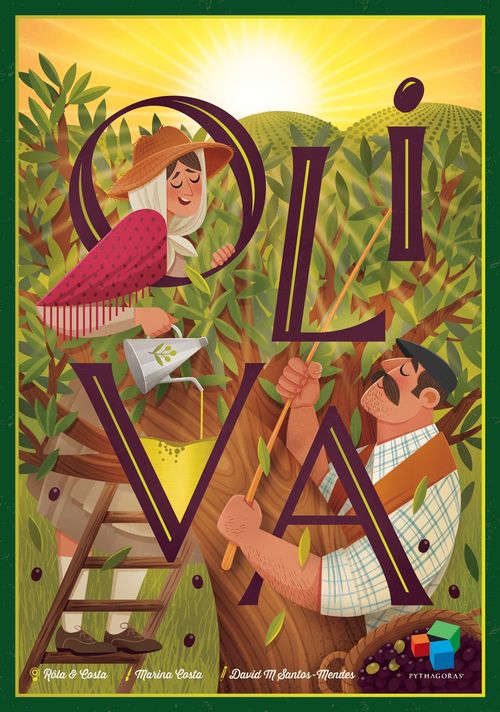
Oliva
Oliva Rulebook
Table of Contents
Table of Contents
Overview
In Oliva, you take on the role of a farmer competing to become the most successful olive oil producer in Portugal. By managing your farm, you harvest olives, press them into olive oil, and export it worldwide.
During your turn, you select and reveal action cards to perform their corresponding actions. Your actions become more powerful based on the cards visible on all players' boards.
Oliva is played over a certain number of rounds based on the player count. After the final round is completed, the farmer with the most victory points is the winner.
Components
- 40 olive cubes (black)
- 20 olive oil cubes (yellow)
- 1 active player marker
- 1 starting player marker
- 4 individual boards (1 per player)
- 40 Escudo coins (30x 1$, 10x 5$)
- 36 basic action cards (9 per player)
- 1 scorepad (double-sided)
- 63 market cards: 24 global market cards + 39 nation market cards
- 9 nation bonus cards
- 40 special cards: 28 special action cards + 12 special scoring cards
- 4 market exchange rate cards
- 4 starting resource cards (only used in the variable setup variant)
- 15 Automa cards (only used in the solo mode)
Notes
The olive cubes, olive oil cubes, and coins are unlimited. If there is a shortage during the game, use any suitable replacements.
Escudo was the currency in Portugal before the Euro.
In case the scorepad runs out, you may download a digital version from the Pythagoras website.
General Setup
-
Place the 4 market exchange rate cards in a vertical column in the center of the table, arranging them from lowest to highest value from top to bottom.
-
Shuffle the market cards and create a face-down deck to the left of the topmost market exchange rate card.
- 2a. Display 3 market cards face-up in a row to the right of the first market exchange rate card to create the premium glass bottle market.
- 2b. Do the same for the second market exchange rate card to create the tin container market.
- 2c. Repeat for the third market exchange rate card to create the bulk olive oil market.
-
In a 2-player game, before shuffling the special cards, remove any cards with the 2-player symbol in the bottom right corner and return them to the game box.
-
Shuffle the special cards and create a face-down deck to the left of the bottommost market exchange rate card.
- 4a. Display 3 special cards face-up in a row to the right of the fourth market exchange rate card.
- 4b. If any special scoring cards are revealed, set them aside and continue revealing cards until you have 3 special action cards in the market grid. Afterward, shuffle any set-aside special scoring cards back into their deck.
-
Shuffle the 9 nation bonus cards and create a face-down deck using only a certain number of cards, based on the number of players:
- 2 players — 6 cards
- 3 players — 4 cards
- 4 players — 3 cards
Player Setup
A. Randomly assign the starting player marker. This marker will not exchange hands during the game.
B. Give the active player marker to the player who holds the starting player marker. The active player marker will pass clockwise during the game.
C. Provide each player with an individual board, 4$ in Escudo coins, 2 olive cubes, 2 olive oil cubes, and a complete set of 9 basic action cards matching their individual board color.
D. Each player shuffles their basic action cards and create a face-down deck to the left of their individual board.
E. Simultaneously, all players draw the top 2 cards from their deck and display them face-up in the topmost spaces of their individual board.
F. In a 2-player game, shuffle a third set of 9 basic action cards and create a face-up deck near the general supply. Take the top card from this deck and place it face-up to the right of the deck, creating a display of 2 visible cards.
Round Start
At the start of each round, reveal 1 nation bonus card from the top of the deck and place it above the market grid. Since nation bonus cards are only revealed at the beginning of new rounds, the number of rounds in the game matches the number of nation bonus cards in the deck, which was determined during setup based on player count:
- 2 players — 6 rounds
- 3 players — 4 rounds
- 4 players — 3 rounds
Consequently, when you reveal the last nation bonus card from the deck, you trigger the final round. In addition to tracking the remaining rounds, these cards serve for scoring purposes at the end of the game.
Anatomy of a Nation Bonus Card
- In the center, an illustration depicts one of these nation flags: Greece, Italy, Morocco, Spain, Turkey.
- In the bottom right corner, a number shows how many cards of that nation are in this deck.
Cycle Start
After a new nation bonus card is revealed, each player draws 5 action cards from their individual deck (to the left of their individual board) into their hand. Simultaneously, players select 2 cards from their hand as their intended actions and place them face-down in the 2 empty bottommost spaces of their individual board.
Finally, players discard their remaining 3 cards face-down into their discard pile (to the right of their individual board). If your draw deck runs out, shuffle your discard pile to create a new face-down deck on the left of your board and continue drawing as normal.
Example: Round start. João, the starting player, initiates the first round by revealing and displaying a Morocco nation bonus card. He draws 5 basic action cards from his deck, selects 2 to play, and discards the remaining 3. Meanwhile, all other players simultaneously draw their cards, make their selections, and discard.
Player Turn
On your turn, you must select and reveal 1 of the face-down action cards from the bottommost spaces of your individual board to perform its corresponding action.
After revealing your action card, check for matching action symbols on any players' face-up cards (including your previous cards). During your turn, you may activate your revealed card and/or any number of cards showing the matching action symbol, provided you have the necessary resources to do so.
You may choose to forfeit your selected action if you cannot or do not want to perform it, which ends your turn. You are not required to activate all cards showing the matching action symbol. In either case, your action card remains face-up on your individual board, allowing all players to use it for additional activations in future turns. Play then passes clockwise to the next player.
In a 2-player game, when checking for matching action symbols, include the symbols shown on the 2 visible basic action cards near the general supply, treating them as if they belonged to a third player.
Basic Actions
You start with a complete set of 9 basic action cards for use throughout the game. These cards feature 6 distinct action types, with some types appearing on multiple cards.
Although you select your basic action cards in advance, you only perform their corresponding action when revealing them face-up during your turn.
Anatomy of a Basic Action Card
- At the top, an illustration represents the action.
- At the bottom, a symbol depicts what you gain from performing the action.
Harvest
When you reveal a harvest card, perform its action to harvest olives. Check for matching action symbols on any players' face-up cards (including your previous cards). You may activate your revealed card to take 1 olive cube from the general supply and place it near your individual board. In addition, or instead, you may activate any number of cards showing the matching action symbol to take additional olive cubes from the general supply.
Example: Basic harvest action. Patrícia reveals a basic harvest card that allows her to collect 1 olive cube. Looking at visible matching harvest symbols, she finds 1 on Tatiana's board, 2 on André's board, 2 on João's board, and 1 on her own board. Patrícia decides to activate all those cards to collect 7 olive cubes from the general supply.
Pressing
When you reveal a pressing card, perform its action to press olives into olive oil. Check for matching pressing symbols on any players' face-up cards (including your previous cards). You may activate your revealed card to return 2 olive cubes from your personal area to the general supply to receive 1 olive oil cube. In addition, or instead, you may activate any number of cards showing the matching pressing symbol to perform additional pressings.
Example: Basic pressing action. João reveals a basic pressing card that allows him to perform the pressing action once. Since there are no matching pressing symbols visible on any player's board, he activates only the newly revealed card to convert 2 olive cubes into 1 olive oil cube from the general supply.
Provision
When you reveal a provision card, perform its action to earn income by selling other farm products such as potatoes and wine. Check for matching provision symbols on any players' face-up cards (including your previous cards). You may activate your revealed card to take 1 coin from the general supply and place it near your individual board. In addition, or instead, you may activate any number of cards showing the matching provision symbol to take additional coins from the general supply.
Example: Basic provision action. Patrícia reveals a basic provision card that allows her to perform the provision action once. Since there are no matching provision symbols visible on any player's board, she activates only the newly revealed card to collect 1 coin from the general supply.
Sale
When you reveal a sale card, perform its action to sell olive oil to the market. There are 3 similar sale cards, each corresponding to a different market, identified by the illustration from the corresponding market exchange rate card. Although each sale card targets a different market, they all function the same way.
Market Exchange Rates
In addition to specifying which row of the market grid corresponds to each market, the market exchange rate cards establish the cost of selling to market cards based on their position within their row.
Anatomy of a market exchange rate card
- In the top right corner, each market exchange rate card features a unique identification number.
- At the top, an illustration represents the corresponding market.
- At the bottom, a symbol depicts the cost in olive oil cubes to sell to the market:
- a. Selling to the leftmost market card costs 1 olive oil cube.
- b. Selling to the central market card costs 2 olive oil cubes.
- c. Selling to the rightmost market card costs 3 olive oil cubes.
Global Market Cards
To perform a sale to a global market, return the required olive oil cubes from your personal area to the general supply, based on the card's position in its corresponding market. Then, take the global market card you sold to and place it face-down in your discard pile to the right of your individual board.
If matching action symbols are visible on any players' face-up cards (including your own), you may activate them to perform additional sales, up to a maximum of 3 sales total. After completing all sales, slide any remaining cards to the left toward the lowest cost and refill any empty spaces in the market grid with new cards from the deck.
Anatomy of a global market card
- At the top, a symbol indicates how many victory points the card is worth at the end of the game.
- In the center, an illustration depicts one of these global markets: Asia, Europe, Africa, North America.
Nation Market Cards
To perform a sale to a nation market, follow the same procedure as with the global markets — pay the required olive oil cubes based on the market exchange rate and take the nation market card to your discard pile. If matching action symbols are visible on any players' face-up cards (including your own), you may activate them to perform additional sales, up to a maximum of 3 sales total.
Anatomy of a nation market card
- At the top, an illustration depicts one of these nation flags: Greece, Italy, Morocco, Spain, Turkey.
- At the bottom, a symbol depicts a bonus action.
- In the bottom right corner, a number shows how many cards of that nation are in this deck.
Bonus Actions
As an alternative to taking a nation market card for yourself, you may dismiss it from the market grid to perform its depicted bonus action.
Without paying the olive oil cost shown on the corresponding market exchange rate card, take a nation market card from its market row and place it face-up above the market grid with the nation bonus cards you reveal at the start of each round, grouping it with others showing the same nation flag. Even though you do not pay any cost, this still counts as 1 sale.
When you convert a nation market card into a nation bonus card, you may perform the bonus action depicted in the bottom of the card, following the usual rules for that specific action.
Example: Basic sale action. André reveals a basic sale card corresponding to the tin container market that allows him to perform the sale action once. With a matching sale symbol visible on Patrícia's board, André may sell to the tin container market twice. For his first sale, he chooses the global market card in the first column, returning 1 olive oil cube to the general supply as shown on the tin container market exchange rate card. After placing this global market card in his discard pile, André uses his second activation to dismiss the nation market card from the third column, moving it above the market grid. He activates its bonus to take the first special scoring card from the display, adding it to his discard pile. As that card does not depict a cost, André ends his turn by sliding the remaining tin container market card left and refilling the two empty spaces with new cards from the market deck.
Purchase
When you reveal a purchase card, perform its action to buy an upgrade for the farm. If matching action symbols are visible on any players' face-up cards (including your own), you may activate them to perform additional purchases, up to a maximum of 3.
Special Action Cards
To purchase a special action card from the market, return the required coins from your personal area to the general supply. The cost is determined by the bottommost market exchange rate card, based on the card's position in its row. As with the other 3 markets, the cost increases from left to right, but uses coins rather than olive oil cubes. After paying, take the purchased card and place it face-down in your discard pile.
Anatomy of a special action card
- In the top right corner, a symbol may show how many victory points the card is worth at the end of the game. Alternatively, it may show a quality seal or olive oil cruet symbol, which serve only for scoring purposes at the end of the game.
- At the top, an illustration represents the action.
- At the bottom, a symbol depicts what you gain from performing the action.
- In the bottom right corner, a symbol may indicate if the card should be removed in a 2-player game.
After completing all purchases, slide any remaining cards to the left toward the lowest cost and refill any empty spaces in the market grid with new cards from the deck.
Special Scoring Cards
When refilling the market, place any revealed special scoring cards below the market grid. Keep revealing cards until you have 3 special action cards in the market grid. To purchase a special scoring card from the market, pay the cost shown on the card itself rather than the market exchange rate card cost. This cost may require coins, olive cubes, a combination of both, or nothing at all. After paying, take the purchased card and place it face-down in your discard pile.
Anatomy of a special scoring card
- At the top, a symbol indicates how many victory points the card is worth at the end of the game each time you fulfilled its requirement (see appendix 'Special scoring cards').
- At the bottom, a symbol may show the card's purchase cost.
- In the bottom right corner, a symbol may indicate if the card should be removed in a 2-player game.
While both special action cards and special scoring cards use the same purchase action, the empty spaces for special scoring cards below the market grid are not refilled at the end of your turn.
Example: Basic purchase action. Tatiana reveals a basic purchase card that allows her to perform the purchase action once. With no matching purchase symbols visible on any player's board, Tatiana activates only the newly revealed card to buy the second special action card from the market, returning 2 coins to the general supply as shown on the corresponding market exchange rate card. After adding the purchased card to her discard pile, Tatiana slides the rightmost card left and refills the empty space with a new card from the special deck. During refilling, Tatiana reveals 2 consecutive special scoring cards, which she places below the market grid before drawing another card from the special deck to complete the market.
Disposal
When you reveal a disposal card, perform its action to dismiss a card as olive pomace. Check for matching disposal symbols on any players' face-up cards (including your previous cards). You may activate your revealed card to select one of your cards from your deck, discard pile, or individual board and place it face-down in a pile below your individual board. If you remove a card from your deck, shuffle it afterwards. In addition, or instead, you may activate any number of cards showing the matching disposal symbol to dismiss additional cards as olive pomace.
Although cards dismissed as olive pomace never return to your draw deck for the remainder of the game, you still score any victory points they provide. Dismissing cards simply helps make your deck more efficient by reducing the number of actions available to select and reveal during your turns.
Example: Basic disposal action. André reveals a basic disposal card that allows him to perform the disposal action once. Since there are no matching disposal symbols visible on any player's board, he activates only the newly revealed card to dismiss a global market card from his discard pile, placing it below his individual board as olive pomace.
Special Actions
During the game, you purchase special action cards from the market to improve your deck, which starts with only basic actions. Most special actions are upgraded versions of the basic actions, and they match when checking for matching action symbols as long as they show the same illustration.
Harvest
When you reveal an upgraded harvest card, follow the standard rules for harvest actions, but harvest 2 olive cubes at a time instead of just one.
Pressing
When you reveal an upgraded pressing card, follow the standard rules for pressing actions, but benefit from a better exchange ratio as shown on the card.
Provision
When you reveal a provision card with an alternative symbol (either a truck or a factory), your earnings are based on the activity shown on the card. Follow the standard rules for provision actions, but you may receive coins, olive cubes, olive oil cubes, or a combination of these resources.
When a provision card displays 2 alternative activities, you must choose only 1 to collect your earnings. Only the symbol of your chosen activity counts toward matching action symbols.
Sale
When you reveal a sale card with multiple market symbols, you must choose only 1 market to sell olive oil to. Only the symbol of your chosen market counts toward matching action symbols.
Purchase
When you reveal a purchase card with the renewal symbol, before performing your action to buy an upgrade for the farm, you may first discard any number of special action cards from the bottommost market in the market grid. Place these cards in a discard pile near the market grid.
After discarding, slide any remaining cards to the left toward the lowest cost and refill any empty spaces with new cards from the deck. Place any revealed special scoring cards below the market grid and keep revealing cards until you have 3 special action cards in the market grid. Then, proceed with your purchase action following the standard rules.
Disposal
When you reveal an upgraded disposal card, follow the standard rules for disposal actions, but you may dismiss 2 cards as olive pomace simultaneously instead of just one.
Round End
Oliva is played over a certain number of rounds based on the player count. Each round consists of as many cycles as there are players, with each player starting one cycle holding the active player marker.
Note: what is a cycle?
As the active player, you start your turn by revealing one action card from your individual board and performing its action. Play continues clockwise, with each player taking their turn. When play returns to you, you reveal and perform your second action, followed again by all other players in clockwise order. This completes a cycle — a series of interleaving turns, with each player taking exactly 2 non-consecutive turns within a cycle.
Cycle End
At the end of each cycle, all players move the 2 topmost action cards from their individual board face-down to their discard pile. Then, all players move their 2 bottommost action cards face-up to fill the 2 topmost spaces on their individual board.
Finally, the active player passes the active player marker clockwise. The round continues until that marker returns to the player holding the starting player marker, indicating that each player has completed one cycle as the active player. The game ends when there are no more nation bonus cards in the deck at the end of a round.
In a 2-player game, whenever the active player marker passes, draw the top card from the deck near the general supply. Place it face-up to the right of the deck, on top of any previous cards, maintaining a display of 2 visible cards. If the deck runs out, shuffle its cards to create a new face-up deck and continue drawing as normal.
Example: Round end. Tatiana reveals a basic purchase card and takes her turn. As the last player in turn order to perform a second action, the current cycle ends. All players simultaneously discard their topmost cards from their individual boards and move their bottommost cards up. André passes the active player marker to João, ending the round since the active player marker has returned to the player holding the starting player marker.
Game End
The final round is triggered when you reveal the last nation bonus card from the deck at the start of a round. All players then perform their turns normally, and the game ends after that round. This occurs upon:
- 6 rounds in a 2-player game
- 4 rounds in a 3-player game
- 3 rounds in a 4-player game
Regardless of player count, you will play exactly 24 action cards during the game. After the final round, proceed to final scoring.
Example: Game end. Tatiana reveals a basic purchase card and takes her turn. As the last player in turn order to perform a second action, the current cycle ends. Since there are no more nation bonus cards in the deck, the game ends.
Final Scoring
Note: olive pomace
Cards dismissed as olive pomace still provide you victory points. Before calculating your final score, flip these cards face-up, maintaining them below your individual board and separate from your other cards.
To calculate the final score, record each player's victory points (VP) on the scorepad as follows:
- Add up all your remaining resources: Escudo coins, olive cubes, olive oil cubes, and cards dismissed as olive pomace. Divide the total by 3, rounding down, to get VP.
- Add the VP values shown on all your global market cards.
- Add any VP values shown on your special action cards.
- Score VP based on the requirements of each of your special scoring cards.
- For each nation, count how many cards from that nation are above the market grid and multiply by your total number of matching nation market cards to calculate VP.
The player with the most victory points is the winner.
Example: Final scoring. Patrícia calculates her final score: 2 VP from remaining resources; 24 VP from global market cards; 2 VP from special action cards; 2 VP from special scoring cards; 27 VP from nation market cards. Therefore, Patrícia ends the game with a total of 57 VP.
Tie Breakers
In case of a tie, the winner is the tied player with the most remaining olive oil cubes. If there is still a tie, the tied player with the most remaining coins wins. If there is still a tie, the tied players share the victory!
Variable Setup Variant
The variable setup variant of Oliva is recommended if you want to experience the game with each player starting with different quantities and types of resources.
Set up the game following the standard rules, with these exceptions:
A. Shuffle the 4 starting resource cards and display them face-up in a column near the market.
B. In a 2-player game, remove any special action cards with the 2-player symbol in the bottom right corner and return them to the game box.
C. Shuffle the special action cards and reveal 4 cards one at a time, placing each to the right of a starting resource card to form pairs.
D. Beginning with the starting player and proceeding in turn order, each player:
- D1. Chooses one of the card pairs formed above.
- D2. Takes the resources depicted in their starting resource card from the general supply.
- D3. Shuffles their special action card into their deck of basic action cards.
Solo Mode
In the solo mode, you face off against an Automa opponent. The goal is to determine which one of you will become the most successful olive oil producer in the region.
General Setup
Set up the game for 2 players as usual, with these adjustments:
- Shuffle the 12 special scoring cards and randomly remove 4 of them to the game box without looking at them.
- Remove all special action cards with the 2-player symbol to the game box. Shuffle the remaining special action cards with the 8 leftover special scoring cards. Create a face-down deck to the left of the bottommost market exchange rate card.
- Take both the starting player marker and the active player marker.
Automa Setup
Follow these steps to set up the Automa:
- Place an individual board in the center of their designated play area.
- Shuffle the 15 Automa cards and create a face-down deck to the left of their board.
- Draw 2 cards from their deck and display them face-up in the topmost spaces of their board.
Automa Turn
You are always the starting player and will alternate turns with the Automa, performing your turns as usual.
Anatomy of an Automa card
- At the top, symbols that contribute to matching action symbols during your turn.
- At the bottom, the action that the Automa performs during their turn.
On the Automa's turn, reveal the top card from their deck and activate the action depicted in the bottom section of that card. When their draw deck is depleted, shuffle their discard pile to create a new face-down deck on the left of their board and continue as normal.
When performing their action, the Automa takes cards from the market to their play area. The Automa card shows which market and card position to take from. When the card shows all 4 markets, the Automa takes the cheapest card from each market. For special scoring cards, the Automa takes either the leftmost or rightmost card, as shown on their card.
The Automa dismisses all cards they take as olive pomace, except for nation market cards, which are placed above their board. If the Automa would have more nation market cards than displayed nation bonus cards, place the excess card above the market grid as a nation bonus card instead.
As in the standard mode, at the end of each cycle, move your 2 topmost action cards from your individual board face-down to your discard pile. Then, move your 2 bottommost action cards face-up to the 2 topmost spaces on your individual board. Repeat this process for the Automa.
Game End (Solo)
The game ends when there are no more nation bonus cards in the deck at the end of a round. Calculate your final score by recording your victory points (VP) on the scorepad as usual. Then, compare it to the table below to assess your performance as an olive oil producer.
| Rank | Score |
|---|---|
| Apprentice | < 25 VP |
| Average | 25 – 35 VP |
| Good | 36 – 45 VP |
| Master | > 45 VP |
Appendix: Special Scoring Cards
- 1 VP for each of your remaining Escudo coins. It costs 1 olive cube to purchase and does not play in 2-player games.
- 2 VP for each of your remaining olive oil cubes. It costs 1 olive cube to purchase and does not play in 2-player games.
- 2 VP for each olive oil cruet symbol on your special action cards. It costs 2 coins to purchase.
- 2 VP for each quality seal on your special action cards. It costs 2 coins to purchase.
- 5 VP for each of your complete sets of 4 different global market cards. It costs 2 coins to purchase.
- 2 VP for each of your nation market cards depicting the Greece flag. It costs 1 coin to purchase.
- 2 VP for each of your nation market cards depicting the Italy flag. It costs 2 coins to purchase.
- 2 VP for each of your nation market cards depicting the Spain flag. It costs 1 olive cube and 1 coin to purchase.
- 2 VP for each of your nation market cards depicting the Turkey flag. It has no purchase cost and does not play in 2-player games.
- 3 VP for each of your nation market cards depicting the Morocco flag. It costs 1 coin to purchase and does not play in 2-player games.
- 1 VP for each of your nation market cards depicting any flag. It costs 2 coins to purchase.
- 1 VP for each of your cards dismissed as olive pomace. It costs 3 coins to purchase.
Quick Reference
Player turn
You must select and reveal 1 action card.
- Check for matching action symbols.
- Perform its corresponding action: harvest, pressing, provision, sale, purchase, disposal.
Basic actions
- You start only with basic action cards.
- They feature all 6 distinct action types.
Special actions
- You purchase them from the market.
- Most are upgraded versions of basic actions.
Game end
After the last nation bonus card is revealed:
- 6 rounds (2-player games).
- 4 rounds (3-player games).
- 3 rounds (4-player games).
- Players complete current round.
- Each player plays exactly 24 action cards.
- Proceed to final scoring.