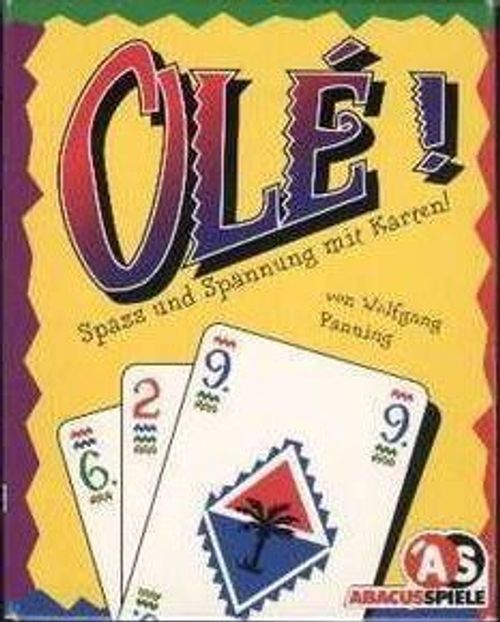
Olé!
Olé! Rulebook
Table of Contents
Table of Contents
Components
- 56 cards
- 18 chips
- 1 set of rules
The Cards
The back of the cards show one red half and one yellow half. The faces of the cards show a number, from 1-15 in Green and Blue or from 1-13 in Red and Yellow. The lines above and below the numbers show the order of the four colours, thus at the beginning of the game the colours are always ranked RED, BLUE, GREEN, YELLOW. Later in the game however, using the loser's privilege, the order of the colours may be reversed so that Yellow becomes the top colour and the order is YELLOW, GREEN, BLUE, RED.
The Loser's Privilege
The player who has had the most minus points in the previous round has the right, after examining their cards, to reverse the order of colours as above. If two or more players have had an equally bad result in the previous round, then the one with the worst overall total may choose. Once the decision has been made, all players should turn their cards round so that the colour of the top half of the back of the cards matches the colour chosen as best.
Preparation
Players will need a pen and pencil to keep score. The cards used depend on the number of players and can be determined from the following table:
| Number of Players | Red | Blue | Green | Yellow | Total Cards | Cards per Player |
|---|---|---|---|---|---|---|
| 3 Players | 1-8 | 1-10 | 1-10 | 1-8 | 36 | 12 |
| 4 Players | 1-8 | 1-10 | 1-10 | 1-8 | 36 | 9 |
| 5 Players | 1-9 | 1-11 | 1-11 | 1-9 | 40 | 8 |
| 6 Players | 1-11 | 1-13 | 1-13 | 1-11 | 48 | 8 |
| 7 Players | 1-13 | 1-15 | 1-15 | 1-13 | 56 | 8 |
| 8 Players | 1-13 | 1-15 | 1-15 | 1-13 | 56 | 7 |
Choose a dealer. They shuffle the cards and deals them out equally to all players. Players should arrange their cards so that all the red/yellow sides face in the same direction, red uppermost. In the first round Red is always the most valuable colour.
Players must always hold their cards so that the other players can see how many they have left. The player with the lowest value card starts. They place it face up on the table and so start a discard pile. Since Red is the highest colour in the first round, the lowest card is the Yellow "1". All other cards discarded are placed on this pile. Now the dealer chooses one of their cards and discards it, then the player to their left takes their turn. If during a later round the loser chooses to reverse the suit order, then the lowest card will be the Red "1".
The Game
Whenever a player takes their turn, they must either discard a card or take a penalty chip. Each penalty chip counts as 5 minus points at the end of the round. The choice of card to discard is determined by the uppermost card on the discard pile, (the "table" card). The card played must always rank higher than this card.
Three Rules determine which cards rank higher. (In all examples we assume that the colour order is Red highest, then Blue, Green, Yellow.)
Rule 1
The colour of the card played ranks higher than the colour of the table card, and the number on it is equal or lower than that on the table card. In this case, the player's turn ends there and the player to their left takes the next turn. Example, if the table card were Yellow "7"; then Green "4", or Blue "7" or Red "1" would rank higher and so would be a legal discard.
Rule 2
The number on the card played is higher, but it's colour ranks lower or is the same as that of the table card. The player finishes their turn and the next player plays.
Example: The table card is the Red "5", in this case a Yellow "6", a Blue "9" or a Red "6" would be a legal play.
Rule 3
Both the number on the card and its colour are higher than the table card. This is the start of a series. A series may allow a player to discard up to five cards in their turn. The player takes another turn; they must play another card or take a penalty chip. Your turn ends when you play a card that beats in either suit or number, but not both. If you cannot do that, you take a penalty. Therefore, if a Yellow "2" is on the table, you could play Green "3" - Blue "4" - Red "5" - Green "6". Alternatively, you could just do Red "5" - Green "6" for a series of 2. Important: Rule 3 is not valid on the first turn! (that of laying the lowest card.)
Once a player plays a card that no one can follow, each player takes a penalty chip in turn until play returns to the player who last discarded. If they can follow their previous play, they do so, and play continues (possibly creating the above situation again). If the last discarding player cannot follow their previous play, they take a penalty, and the round ends, because each player has taken a penalty in turn.
Game End
The round ends, either when one player discards their last card, or when no player has a legal card to play, leading to a round where all players take a penalty chip.
Scoring
Each player collects minus points equal to the sum of the numbers on the cards left in their hand, plus 5 minus points for each penalty chip they have taken. The player with the least minus points wins. Players ought to play as many rounds as there are players and add the points for each round to determine an overall winner.
Tips
It is a good idea to play a few rounds with Red as the top colour before changing, things, to allow the players to get used to the order of the colours. In addition, it is always easier if you arrange the cards into their colours and rank them by number within the suit.
High number cards in high rank suits are easier to get rid of, and often force the next player(s) to take penalty chips. In addition, they score more minus points than lower numbered cards if you are left with them.
Lower valued cards on the other hand are harder to discard and often ease things for the next player.
A card from the top suit will only allow the next player to get rid of, at most, one card. Getting rid of several cards in a series improves your chances of going out first, but may also mean having to pick up penalty chips.
If the penalty chips run out during a round, players should make a note on paper of their minus points.