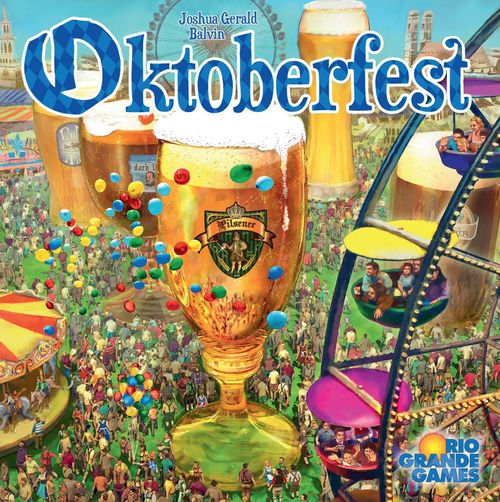
Oktoberfest
Oktoberfest Rulebook
Table of Contents
Table of Contents
Game Summary
In Oktoberfest, players act as artisanal brewmasters seeking to supply the festival with the most consumed types of beer. The game plays over the course of one day at the festival and is divided into three phases: morning, afternoon, and evening. During each phase, players bid to supply various types of beer to the tents. The winner of each auction decides what type of beer is supplied to which tents. Players then vote on which tents are closed, awarding points to the players who have supplied the most barrels of a specific type. After ten tents have been closed, the player with the most points wins!
Game Setup
-
Place the game board at the center of the table. Place the scoring tokens and gate blockers next to the board.
-
Place the six decks of single-barrel cards on the appropriate spaces of the game board. Place the six beer tokens below the matching single-barrel decks.
-
Place one patron token on each of the ten patron track spaces.
-
Give each player one privacy screen, a matching player token, five patron tokens, and the appropriate number of coins according to the number of players:
- 3 players: 20 coins each
- 4 players: 18 coins each
- 5 players: 16 coins each
Return remaining coins and patrons to the box – they will not be needed for the game. Players should keep coins, patrons, and barrel cards hidden behind their privacy screens throughout the game.
-
Place the tent blocker on any one tent space of the game board. This space will not be available until the afternoon phase of the game.
-
Stack the beer supply deck as follows:
- Place all cards numbered 1, 2, 3 and 4 in one deck and shuffle well. Lay nine cards from this deck onto the gate spaces in three vertical rows, then shuffle the three tapped-out cards with the remaining deck. Place this deck face down on the draw pile space.
- Place the 5 and 6 cards to the side. These cards will be added to the deck during the afternoon phase.
- Place the 7 cards to the side. These cards will be added during the evening phase.
-
Last, shuffle the double-barrel cards. Each player draws two. If any player draws two cards of the same beer type, he draws a replacement. Then shuffle the duplicate card with the remaining double-barrel cards. Once all players have two different double-barrel cards, return the remaining cards unseen to the box. Keep these cards secret. They will not be used until a tent is closed.
NOTE: When playing with three players, use only one set of six double-barrel cards (one of each type). There will be no cards left over.
Gameplay
The thirstiest player goes first. Give that player the start player marker.
The game is played over one day of the festival and has three phases: morning, afternoon, and evening. Each phase has multiple player turns.
On each turn, a player may choose one of three options:
- AUCTION SUPPLY CARDS
- SELL ONE BARREL
- CLOSE A TENT
After a player has taken a turn, he passes the start player marker to the next player in clockwise order.
NOTE: This serves as an important reminder of who is currently the active player, especially during auctions when the active player is not the auction winner. Play always passes from the active player, not the auction winner.
1. Auction Supply Cards
Especially at the beginning of the game, most turns will be spent auctioning supply cards. The supply deck contains 49 cards, seven of each of the six beer types and seven wild cards. These cards represent the types of beer players can supply to the various tents during the course of the day. Each type of beer and the wild cards have exactly one card with each of the values 1-7.
NOTE: No 5, 6 or 7 cards will come into play until the afternoon or evening (see AFTERNOON/EVENING, pages 6-7).
The AUCTION SUPPLY CARDS action has four parts:
- AUCTION SUPPLY CARDS
- PLACE SUPPLY CARDS
- SUPPLY BARRELS
- REFILL THE EMPTY GATE
Auction Cards
The active player places the auction marker on one of the three gates. All three cards of that gate are now up for auction.
The auction goes around one time, beginning with the player to the auctioneer's left. Players bid by placing coins in front of their screens. Each subsequent player must raise the current high bid or pass. Once the auction comes back to the auctioneer, that player has two choices:
-
Accept the highest bid, taking the bid coins behind his screen and allowing the high bidder to play the cards/supply barrels
OR
-
Pay the high bidder an amount of coins equal to the high bid +1 coin to play the cards/supply barrels himself.
All other bidders take their coins back behind their screens.
NOTE: It is possible for all other players to pass. In this case, the auctioneer plays the cards for free.
Place Supply Cards
The winner of the auction takes all three cards from the auctioned gate and chooses one of them to discard. The player places the two remaining cards according to the following rules:
- He must place both cards on different tent spaces.
- If either tent space already contains one or more cards, place the new supply card on top of the previously placed card(s).
- He may place cards on top of other cards of any beer type, but he must stack the cards from lowest to highest value (for example, a 4 supply card can be played on top of a 1, 2, or 3 card – and of any beer type – but not on another 4 or anything higher than 4).
- There is no limit to the number of values that can be skipped when placing a card (i.e., a 7 card can be placed on a 1 card, effectively skipping the other card values).
NOTE: When a tent closes (see CLOSE A TENT, page 5), the last type of beer placed onto the tent (i.e., the type of beer on top of the tent) claims the full value of points of the entire tent. (For example: a tent is stacked with the following cards: a 1 stout, a 3 pilsner, a 5 dark lager, and a 6 Weissbier. If this tent is closed, the full value of all cards (15) will be awarded to Weissbier as it was the last card played before the tent was closed).
The Auction winner must always place both cards, even if he decides not to supply barrels for either card (see SUPPLY BARRELS, page 4).
Cards played on top of other cards are splayed slightly so the full value of all cards in the tent is visible.
Wild Cards
Players place wild cards following the same rules as other beer supply cards.
Next to each supply of barrel cards is a token for that type of beer. When a player places a wild card onto a tent, he selects one of the available tokens and places it on top of the wild card. The wild card is now considered to be that type of beer for scoring/supplying barrels.
If a player places a card on top of a wild card with a beer token, he places the token back below the matching barrels. It is immediately available for use on another wild card (even on the same turn/tent).
If a tent is closed with a wild card on top, the beer token does not go back to the supply but is returned to the box and is not available for the remainder of the game.
Supply Barrels
Last, the auction winner decides how many barrels to supply for each of the cards played. For each barrel the player supplies, he takes a matching single barrel card from the appropriate stack behind his screen. Barrel cards are the only way for players to score points (see CLOSE A TENT, page 5).
Each supply card is treated separately when resolving the SUPPLY BARRELS action. The number on the supply card determines how many barrels may be supplied:
- 1 or 2 value Supply card: 1 barrel
- 3 or 4 value Supply card: 1-2 barrels
- 5 or 6 value Supply card: 1-3 barrels
- 7 value Supply card: 1-4 barrels
Depending on the number of barrels supplied, the auction winner must also pay coins. Players place paid coins in the space above the single barrel cards of the type supplied. In this way, players keep coins paid for various types of beer separate.
- 1 Barrel: 1 Coin
- 2 Barrels: 3 Coins
- 3 Barrels: 5 Coins
- 4 Barrels: 7 Coins
NOTE: The act of supplying a barrel is represented by paying coins/taking barrel cards; nothing is actually placed in the tents when taking this action. Players keep acquired barrel cards behind their screens.
The type of barrels supplied must match the beer type of the supply card (i.e., Stout barrels can only be supplied/acquired after placing a Stout supply card – or a wild card with a Stout token – into a tent). Each type of beer has an intentionally limited supply of ten barrel cards.
Example 1: Trev wins an auction and places a 3 Pilsner card and a 5 Stout card into tents. He decides to supply two barrels of Pilsner (the maximum allowed by a 3 value supply card) by paying three coins above the Pilsner barrel stack and taking two Pilsner barrels behind his screen. He also decides to supply a single barrel of Stout (he could supply up to three) and takes one Stout barrel, placing one coin above the Stout barrels.
Example 2: Kallin plays two Stout cards. He decides to supply a single barrel for each. He pays one coin for each (total: two coins) and takes two Stout barrels behind his screen.
A player may decide to purchase fewer barrels or no barrels for each played card.
Refill the Empty Gate
Last, the active player draws three cards to fill the empty gate. He draws and places the cards one at a time, checking to see whether the TAPPED-OUT conditions have been met before the next card is drawn (see TAPPED-OUT, page 7).
NOTE: If, when refilling the empty gate a player draws the last card, he must then shuffle the discard pile to create a new draw pile. In the rare case that there are not enough supply cards to completely fill an empty gate (i.e., there are only 1 or 2 cards left in the draw pile, even after shuffling the discard pile), do not refill the gate. Instead placed a closed gate marker on the empty gate.
Check to make sure at least two cards from each gate can be placed (see PLACE SUPPLY CARDS, page 4). Place a "closed gate" marker on any gate that has two or more cards that cannot be played. If all three gates are closed, no more auctions can take place until other tents become available in the afternoon/evening rounds. Players must choose between the other two actions.
Example: There is one empty tent on the board. The top cards of the other tents are 3, 3, 4, 5, and 6. The first gate has supply cards numbered 1, 6, and 7. All 3 cards from this gate can be placed so it remains open. The second gate has supply cards numbered 1, 1, and 3. Because two cards must be placed into different tents, only one of these cards (if placed in the empty tent) is playable. Place a "closed tent" marker on this gate – these cards cannot be auctioned.
After the active player has filled the gate he passes the start player marker to the player on his left (keeping in mind this may not be the auction winner).
2. Sell One Barrel
The second action a player can choose is to sell a single barrel acquired during an earlier turn to the supply (players may never sell the double-barrel cards they drew at the beginning of the game). When selling a barrel, the player can decide to take all the money in the space above the type of beer returned, or half (rounded-up) of the money above any other type of beer.
Because no new money comes into the game, this action allows players to retrieve coins that have been previously spent supplying barrels.
The active player then passes the start player marker to the player on his left.
3. Close a Tent
The third action a player may select is to close a tent. Closing a tent is the only way for players to gain victory point tokens. When a player chooses this action, he takes all patron tokens from the next available space on the patron track (beginning with the first yellow morning space) behind his player screen and an auction begins.
Similar to an auction of supply cards, bidding for which tent will close begins with the player to the left of the active player and goes around only one time. However, rather than using coins, an auction to close a tent uses patron tokens.
Beginning with the player to the left of the active player, each player places any number of patron tokens (players begin the game with five) in a single stack on top of any tent he wishes to close. The player places his marker on top of the bid (players keep their bids clearly separate).
When placing patron tokens:
- No two tents can have the same number of patron tokens (for example, if the first player placed three patron tokens on a tent, the second player can either add any number of patron tokens to that same tent, or place one or two, or four or more patron tokens on another tent).
- Players may place fewer patron tokens than the current highest value on another tent, hoping that a later player will add patron tokens to the tent.
- Each player must place all patron tokens they choose to play on a single tent.
Once all other players have bid (or passed), the active player gets the final word as to which tent closes. He can either allow the tent with the most patron tokens to close, or he can add patron tokens to any tent (following the rules above) to influence the closing of a different tent.
NOTE: Passing is allowed. However, if all other players pass, the active player MUST still play a patron token and close a tent. This only happens if all other players have passed; otherwise the active player can choose to pass, allowing the tent with the most patron tokens to close.
Once the active player has chosen to add patron tokens to any tent (or not), the tent with the most patron tokens is closed. Players add up the value of all cards in the tent. The type of beer on top of the tent (the card with the highest numeric value) scores points equal to the value of all the cards combined. Players must then show all barrels they have of this type of beer (including double-barrel cards) to all other players. The player with the most barrels takes victory point tokens equal to the total value of the tent. The player with the second most barrels also scores (half of this value rounded up). If playing with four or five players, third place points are also awarded (half of the second-place value, rounded up). In a three-player game, no third place points are awarded.
In case of a tie, all tied players take the full value for that position. Second and third places are still awarded.
Players hide their victory point tokens behind their screens until the end of the game.
Players with patron tokens on tents that did not close now take back their bids. Additionally, all players who did not bid on the closed tent divide the patron tokens played on the closed tent equally among themselves (including players who bid nothing).
If there are patron tokens left after each taking player has taken an equal number, the players place the extra patron tokens one at a time on the patron track. Place any remaining patron tokens that cannot be divided equally one at a time on the patron track, beginning with the last (evening) spaces (e.g., with three patron tokens remaining, place one on the last "close a tent" space, then place one on the second to last, then the third to last). Each occupied space on this track should have 2 patron tokens before any of them receive a third token. Once all occupied spaces have 2 patron tokens, begin again with the last (evening) space, placing a third patron token on this space (see illustration below). Never place patron tokens on empty spaces of the track—spaces on this track that have been previously emptied remain empty for the rest of the game.
NOTE: This track reminds players how many tents still need to close before the game ends.
NOTE: No patron track space can ever have more than three patron tokens. In the event that extra patron tokens would cause a space to hold more than three, discard the excess tokens from the game.
Finally, flip all cards in the now-closed tent face down. Players may place no more cards in this tent until later in the day (see AFTERNOON/EVENING, pages 6-7).
If, in closing a tent, the patron track moves the game into the next phase of the game (afternoon after the 3rd tent is closed or evening after the 6th tent is closed), follow the directions below. If not, the active player passes the start player marker to the player on his left.
Afternoon and Evening
AFTERNOON: After the first three tents have been closed and scored, the game progresses to the afternoon phase of the game.
- Return all cards from the three face-down (closed) tents to the box. They are not needed for the rest of the game. This will also clear three new tent spaces for players.
- Remove all closed gate markers.
- Shuffle together the 5 and 6 value cards, the draw pile, the discard pile and all cards currently in the gates. This forms the afternoon draw pile. Replenish all three gates from this deck, then shuffle all three tapped-out cards with the remaining draw pile to form the afternoon draw pile (if any remaining tapped-out cards are drawn when replenishing the gates, they are disregarded and are shuffled into the new draw pile).
- Remove the tent blocker. For the rest of the game, all six tent spaces will be available.
Any cards in tents that did not close remain. Pass the start player marker clockwise to the next player (the player to the left of the player who took the final CLOSE A TENT action in the morning phase).
EVENING: After three additional tents have been closed, the game progresses to the evening phase of the game:
- Return all cards from the three face-down (closed) tents to the box. They are not needed for the rest of the game. This will also clear three new tent spaces for players.
- Remove all closed gate markers.
- Shuffle together: the 7 value cards, the draw pile, the discard pile, and all cards currently in the gates. This forms the evening draw pile. Replenish all three gates from this deck, then shuffle all three tapped-out cards with the remaining draw pile to form the evening draw pile (if any remaining tapped-out cards are drawn when replenishing the gates, they are disregarded and are shuffled into the new draw pile).
NOTE: During the evening phase of the game, four tents will be closed.
Pass the start player marker clockwise to the next player (the player to the left of the player who took the final CLOSE A TENT action in the afternoon phase).
Tapped-Out
When a player draws the first tapped-out card, he places it to the side of the board. Nothing happens until a second tapped-out card is drawn.
When a player draws the second tapped-out card, game-play immediately halts (no further cards are drawn). Players check to see which tent has the highest value supply card on top. Discard all cards in this tent. If multiple tents are tied, discard the cards from the tent with the highest total value (all cards in the tent). If multiple tents have the same total value, discard the cards from all tied tents.
Shuffle all cards from the discarded tent(s) together with all cards in the discard and draw piles to form a new draw pile.
NOTE: Do not add the tapped-out cards back into the deck. This will happen at the beginning of the next game phase (i.e., tapped-out can only happen once per morning/afternoon/evening phase).
From this new draw pile, players continue to replenish the gate. If a player draws the third tapped-out card, it is placed to the side of the board with the other two and has no effect.
End of Game
The game ends after the tenth tent is closed and scored. The patron track serves as a reminder for how many tents need to close before the end of the game. The player with the most points is the winner!
In the event of a tie, the player with the highest combined total of remaining coins and patron tokens is the winner. If there is still a tie, the players tied rejoice in their shared victory!
Scoring
| Value of tents (1st place points) | 2nd place points | 3rd place points (only in a 4-5 player game) |
|---|---|---|
| 1 or 2 | 1 | 1 |
| 3 or 4 | 2 | 1 |
| 5 or 6 | 3 | 2 |
| 7 or 8 | 4 | 2 |
| 9 or 10 | 5 | 3 |
| 11 or 12 | 6 | 3 |
| 13 or 14 | 7 | 4 |
| 15 or 16 | 8 | 4 |
| 17 or 18 |