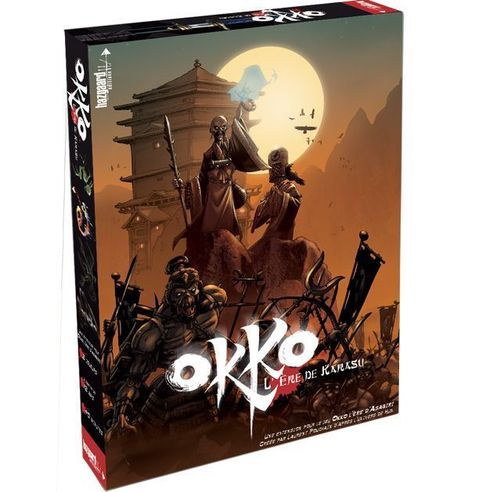
Okko: Era of the Karasu
Okko: Era of the Karasu Rulebook
Table of Contents
Table of Contents
Components
This box contains:
The floor tiles: 6 new modular floor tiles which can be used with those from the base box.
The characters: 20 new characters represented by cutouts. Each cutout has a front face that determines its orientation.
The Kami: 4 tokens which represent the 4 Kami of Fire, Earth, Air and Water. Both sides of a Kami token are used during the game. One side represents the celestial Kami when summoned by a Demon Hunter sorcerer. The other side represents the same Kami corrupted when summoned by an Evil Creature sorcerer.
- Celestial Kami of Fire / Corrupted Kami of Fire
- Celestial Kami of Water / Corrupted Kami of Water
- Celestial Kami of Earth / Corrupted Kami of Earth
- Celestial Kami of Air / Corrupted Kami of Air
The profile cards: 20 character profile cards and 4 profile cards for the Kami.
The equipment cards: 12 equipment cards which represent the gear you can give your characters, such as spells or magical items.
The scenario cards: 14 scenario cards which offer players new tactical challenges.
The honor tokens: 8 honor tokens used when playing in campaigns.
The door tokens: 3 simple door tokens and 1 double door token. One side represents the opened door and the other side represents the closed door. The door tokens allow the creation of openings between two floor tiles or the closing of doors during a scenario.
The Sorcerers
In Okko, each sort of character has a role. Civilians inspire warriors and grant an extra inspiration die, warriors use inspiration dice to fight, and sorcerers have the power to re-roll these inspiration dice.
Recruiting a Sorcerer in One's Band
Sorcerers are not warriors but have a place in the game as they allow players to change the inspiration dice and summon Kami. A band may only recruit a single sorcerer.
Sorcerer Skills
Sorcerers may change the elements thanks to their Sorcerer skill:
Sorcerer: Action - the sorcerer can re-roll 2 inspiration dice which have not yet been used.
- The sorcerer cannot re-roll inspiration dice which were used this phase.
- The sorcerer cannot re-roll inspiration dice which have been put in reserve.
- Once the dice are rolled, the elements obtained replace the elements previously rolled and may be used normally.
Summoning
The most powerful sorcerers can summon a Kami thanks to their Summoning skill:
Summoning: Action - the sorcerer rolls the inspiration die. The result designates which Kami answers his prayers.
- The sorcerer cannot use this skill if he or she is in an enemy's control zone.
- The sorcerer cannot use this skill if the band already contains a Kami. If that Kami disappears, the sorcerer can summon a new one.
The sorcerer rolls the inspiration die used to activate the Summoning. The result determines which Kami is summoned:
-
Fire result: the Kami of Fire is summoned.
-
Earth result: the Kami of Earth is summoned.
-
Air result: the Kami of Air is summoned.
-
Water result: the Kami of Water is summoned.
-
Prayer (no-effect) result: the sorcerer's prayer has no effect.
-
If the Kami is summoned by a Demon Hunter sorcerer, the summoned Kami appears in its celestial form.
-
If the Kami is summoned by an Evil Creature sorcerer, the summoned Kami appears in its corrupted form.
-
If the summoned Kami is already controlled by the enemy band, it leaves that band and joins that of the sorcerer who has just summoned it.
When a Kami is summoned, the player puts the token representing that Kami on a square adjacent to the sorcerer and with the facing of his choice. This square cannot be hindering terrain, nor may it be occupied by a character. Moreover, the Kami is considered to have already been activated. The profile card of the Kami is added to those of the band to which the sorcerer who has just summoned it belongs.
Example: Noshin has rolled a Fire die during his Summoning and thus summoned the Fire Kami. The player places the Kami on a square adjacent to Noshin. The Kami cannot move, nor use its action during this turn as we consider it as having already been activated.
The Kami
The Kami are magical creatures with considerable magical powers. They are useful allies in battle, as long as one knows how to use their powers.
Summon a Kami
Only a sorcerer with the Summoning skill may summon a Kami. Once summoned, the Kami joins the sorcerer's band. A Kami is not bound to the sorcerer who summoned it. If the latter is disabled, the Kami remains in existence.
Activating a Kami
The Kami fight, move and are activated normally. They are magical characters who have the following peculiarities:
- The Kami are represented by tokens and not by cutouts. A side of the token represents the Kami under its celestial form, the other side under its corrupted form.
- The profile card of a Kami does not have a shaken side. One side represents the Kami under its celestial form, the other under its corrupted form.
- If a Kami becomes shaken or disabled, it disappears and leaves the band. It can be summoned again. Its loss grants no Zeni to the opponent.
- The facing of a Kami is represented by a red dot on the token.
- A Kami cannot use any inspiration dice to increase its characteristics, nor can it hold any dice in reserve.
Note: the scoring icon in this booklet is printed without a word. It is the Zeni coin, the same value-currency used on the base game's profile cards and in its scoring rules.
Kami Skills
The Kami all have an Influence skill tied to their element:
Influence: All friendly characters adjacent to the Kami have +1 to their Movement value.
The Kami all have a major skill tied to their element:
Typhoon: Action - All enemy characters within 3 squares of the Kami must test their Movement. If they fail, they become shaken. The Kami disappears.
- Shaken enemies who fail their resistance test are disabled.
- After having used its major skill, the Kami disappears. Its profile card leaves the band and its token is removed from the game board. It can be summoned again.
Resistance Tests
To resist the powers of the Kami, characters must test their characteristics: Attack, Defense, Movement or Willpower.
A character who tests one of his characteristics rolls a 6-sided die and must obtain a result equal to or lower than the value of his characteristic. The character can of course use an appropriate skill or use an inspiration die to add +1 to the value of his characteristic.
Example: The Undead Warrior tests its Movement to resist the Typhoon started by the celestial Kami of Air. The Undead Warrior has a Movement value of 3. It uses the Air die it had put in reserve and adds +1 to its Movement value. It rolls a die and ends up with 4. The test is successful, it does not become shaken.
According to the sorcerer summoning them, Kami have different personalities. Corrupted Kami are aggressive but their powers are more limited; celestial Kami are more fragile, but have greater range with their powers.
Playing Without a Scenario
Here's a detailed way to play Okko without a scenario from one of the adventure books. This method, more complete than that in the rulebook, changes the budget of the bands, uses scenario cards and allows players to play a campaign.
Players each roll a 6-sided die. Whoever rolls highest becomes player A, the other player becomes player B.
1. Compose the Bands
The character profile and equipment cards are placed face-up on the table. Player A chooses one, then his opponent picks one, and so on, until both bands reach a value of 18 Zeni. The rules for band composition remain unchanged. Once his band is composed, each player adds a free equipment card to his band.
2. Construct the Board
Player A chooses and places a map tile on the table. His opponent places one next to it, and so on, until a square game board is made.
3. Choose the Scenario Card
Player A draws a scenario card which he reads out loud. The effects of the card are applied to both bands.
4. Deploy the Bands
Player A chooses one side of the game board as a deployment zone. His opponent has the opposite deployment zone. Players deploy their characters in order starting with player A.
Diagram: Red is player A's deployment zone; blue is player B's deployment zone.
5. Play
Player A begins the game. The game lasts 6 turns. Each character disabled earns the opponent its value in Zeni (the value of any equipment is included). Some cards change the victory conditions. At the end of the game, players count the Zeni earned to find out who is the winner.
6. Use the Campaign Rules to Evolve the Bands
If playing in a campaign, players manage the evolution of their characters.
Playing a Campaign
Between two parts in a series of adventures, the bands must take the time to take care of their dead and bind their wounds. Here are simple rules to simulate the experience gained by the characters in a band between two adventures.
After an adventure, each character will choose an action:
- Heal: If the character is disabled or shaken, he checks the Heal table to take care of his wounds.
- Pray: If the character is vigilant, he can pray to the Kami and consult the Honor table.
- Seek: If the character is vigilant, he can search the game board. The character draws 3 equipment cards and keeps 1 of these. If he cannot use any of them, he draws 3 more cards. If he already had equipment, he chooses which one to keep.
Equipment cards used during an adventure are lost.
Heal
A character who decides to heal rolls a 6-sided die and consults the Heal table. The result of the die indicates the state in which he'll start the next adventure.
| Heal | 1 | 2-4 | 5-6 |
|---|---|---|---|
| The character was disabled. | Dead* | Shaken | Vigilant |
| The character was shaken. | Shaken | Vigilant | Vigilant |
*Dead: The character is replaced by one or more characters of equivalent value (equipment included). If this character was unique, it will not be able to be recruited again for the remainder of the campaign.
Honors
A character who prays to the Kami rolls an inspiration die and consults the following table.
- Experienced (Fire result): The character can re-roll its combat die but must keep the second result.
- Skillful (Air result): The character adds +3 to its Movement value.
- Determined (Earth result): The character remains vigilant if it was supposed to become shaken after an attack.
- Courageous (Water result): The character does not need to roll a die, it automatically succeeds its Willpower test.
- Prayer (no-effect result): The prayer remains unanswered.
Honors are represented by tokens next to the profile cards. An honor is lost if it is used or if the character is disabled. A character may only have one honor at a time. If the character already has an honor, it chooses which one of the two it keeps.
The Door Tokens
Door tokens may be used in two ways.
To Make the Floor Tiles More Modular
By placing an open door token between two floor tiles, you can create an opening.
Diagram: Two floor tiles side by side. The opening of tile A faces a wall on tile B and vice versa. An open door token placed at the border between tiles A and B opens a passage in the wall. Now characters can move between the tiles.
To Close Openings
Residences in Pajan are always open to the blowing winds. By placing closed door tokens, you can partition rooms and add an additional layer of tactics to the game.
A closed door is like a wall: it stops retreats, lines of sight and prevents movement. A character who wants to open a door must face it at the beginning of its activation. The character can then, if it decides to, open the door and remove the door token. The character is then activated normally.
Example: Okko begins his activation facing a door. He can open it (the token is removed) and attack the Oni Geisha who is now in front of him.
A door, once opened, cannot be closed again!
Doors do not hinder movement but slow it down, as a character cannot open a door while moving. If he wants to pass through a door, he must finish his movement facing it and wait until the next turn to open it.