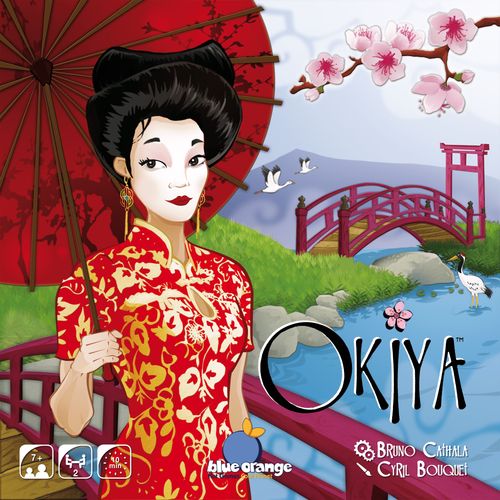
Okiya
Okiya Rulebook
Table of Contents
Table of Contents
Components
- 8 red geisha tokens
- 8 black geisha tokens
- 16 imperial garden tiles, consisting of 4 sets.
Each set is composed of 4 tiles which all show the same plant species: Maple leaf, Cherry tree, Pine tree, Iris.
Each tile of the set always shows one particularity: Rising Sun, Tanzaku (Japanese flag), Birds, Rain.
Aim of the Game
In order to receive the grace of the emperor you have to be the first to realize one of the three winning conditions:
- Realize a row of 4 geishas of your color in the imperial garden (it can be a vertical, horizontal or diagonal row)
- Realize a square (2x2) of four geishas of your color in the imperial garden
- Block your opponent, so that he can't move anymore.
Preparations
Shuffle the 16 garden tiles carefully, and randomly put them face up into a square of 4x4. Each player takes the 8 geisha tokens of his color. The players place their geisha tokens on opposite sides of the garden.
How to Play
In the first game the first player is chosen randomly. In the next rounds it is always the one who has lost the previous game. The first player chooses a tile from the garden. It has to be a border tile (that means that the starting player is not allowed to choose one of the 4 middle tiles in the first turn). The active player removes the chosen tile and puts it face up on the table. Then he places one of his geisha tokens on this position.
The garden tile which is taken out of the garden defines the rules for the second player. The next player must place his geisha token according to the rules. He can only remove a tile which shows the same vegetation as the previous removed tile, or the same particularity as the previous removed tile.
Example: The removed tile is an Iris tile. The next player can remove any other Iris tile, or any tile showing the same particularity (for instance, a Tanzaku tile) as the removed tile.
The next player removes a garden tile according to the rules and replaces it with a geisha token of his own. He places the removed tile face up on the table. Again this tile defines the rules for the other player.
Example: Black has decided to remove a tile bearing a Tanzaku. The red player can now remove any tile with a maple leaf, or any tile with a Tanzaku.
The game continues like this until one player achieves one of the winning conditions:
Realization of a vertical, horizontal or diagonal row of 4 geishas of his color:
Example: Black wins because he has realized a horizontal row of 4 geishas of his color.
Realization of a square of 4 geishas of your color:
Example: Red wins because he has realized a square of 4 geishas of his color.
Block your opponent, so that he can't move anymore:
Example: It is black's turn. The rule says that he must remove either a tile with a pine tree or a tile showing a bird. There is no tile left respecting those conditions. Black can't remove a tile and therefore loses the game.
End of the Game
Depending on how much time you would like to spend with the game you can choose one of the following three alternatives:
- Single game: you only play one game. The winner of the round wins the game.
- Match in three sets: The match continues until one of the players has won 3 games.
- Match of victory points: The winner of a game gains as many victory points as there are garden tiles left in the garden. The game ends when one player achieves 10 points (for longer matches you can play until one achieves 15 or 20 points).
Some Comments Concerning the Illustration of the Game
The illustrations of the game are created to pay homage to a traditional Japanese card game called "Hanafuda" (literally flower card game).
This card game contains poetic elements. The inscriptions of the Tanzakus form kind of a mini poem in which the sound pattern changes according to the order in which you read them:
The spring arrives unexpectedly
The geese awake
The leaves move in the wind
In the pine trees