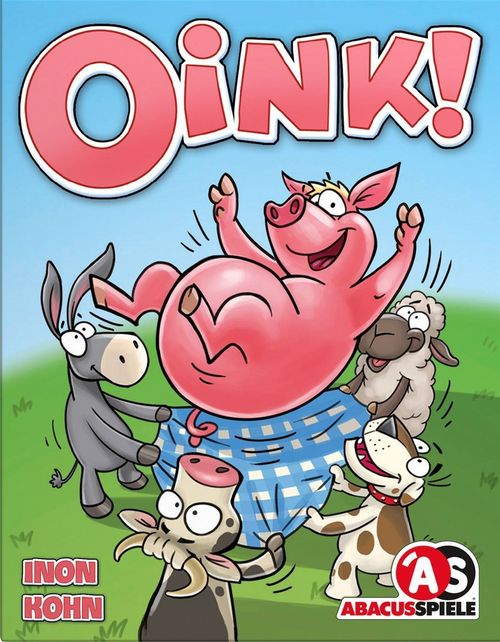
Oink!
Oink! Rulebook
Table of Contents
Table of Contents
Game Components
90 cards:
- 14 dogs, 14 cats, 14 cows, 14 donkeys, 14 sheep, 14 chicks (two identical cards of each animal, with values from 0 to 6)
- 6 pigs (all with value 7)
Setup
- Shuffle all 90 cards and deal them out evenly to the players. Cards are placed face down in each player's personal deck. Players must not look at their cards, their own or anyone else's.
- Leave a space in the middle of the table for the discard pile, within reach of everyone.
- If playing with 4 players, return 2 random cards to the box without looking at them, then deal the remaining 88 cards evenly among the players.
Hands
Before the game, each player decides which hand they will use to slap the discard pile. Slapping the discard pile is allowed only with that hand. Do not hold it over the table in advance; keep it farther away, for example under the table.
Note: you may agree with the other players before the game where and how to keep your hands. The main thing is to play in a way that brings the most enjoyment!
Playing the Game
The game is played in several rounds. Turns pass clockwise. The first player is the one who was last in the village.
Each player has a personal deck in front of them. On your turn, reveal the top card of your personal deck and immediately place it in the center of the table, on the discard pile. Lay the card neatly so the cards underneath it stay covered.
Important: so that no player gains an advantage, reveal the card as shown in the illustration, with the face of the card turned away from yourself.
Hint: the faster you reveal the card, the sooner you will see which animal is on it.
After placing a card on the discard pile, pass the turn to the next player. This continues until someone slaps the discard pile with their hand. You may slap on your own turn or on another player's turn, but only if one of the three conditions below is met.
Two Identical Animals
If two cards with the same animal are placed in a row on the discard pile, immediately slap the discard pile with your hand and make that animal's cry. The values on the cards do not matter in this case.
Cries: Moo! (cow), Baa! (sheep), Co-co-co! (chicken), Hee-haw! (donkey), Miaow! (cat), Woof-woof! (dog).
Two Cards Adding Up to 7
If two cards placed in a row on the discard pile have values that add up to 7, immediately slap the discard pile with your hand and cry "Oink!".
Pig
If a card showing a pig appears on the discard pile, immediately slap the discard pile with your hand and cry "Oink!". It does not matter which card lies below it.
Note: if both of the first two conditions are met at the same time (two identical animals in a row and values adding up to 7), quickly slap the discard pile and make the cry of the animal shown on the card.
After a Slap
If you are the first to slap the discard pile and your cry is correct, you take all the cards from the discard pile. Place them face up in your winning pile, next to your personal deck.
Important: if you slapped first but made the wrong cry, the covered cards do not go to you. They go to the player who slapped second, provided that player also did not make a mistake in their cry.
If you make a mistake in your cry, make the monkey: scratch your head with your hand and shout "U-a-u-a!". Then continue the game.
Variant (agree before the game whether this rule applies): if you make a mistake in your cry, take one card from your winning pile and place it at the bottom of the discard pile. If you do not yet have a winning pile, make the monkey as described above.
When a player takes the discard pile, the round ends. That player goes first in the next round.
If during a round you run out of cards in your personal deck, you remain in the game. You skip your turn, but you may still slap the discard pile if one of the three conditions above is met.
End of the Game
If at the end of a round any player has no cards left in their personal deck, the game ends immediately.
If during a round all players have no cards left in their personal decks, the game also ends immediately. In this case, nobody receives the cards from the discard pile into their winning pile.
Scoring
Once the game has ended, count the points. All players place their winning piles side by side and compare their heights. The player with the tallest winning pile wins.
If the heights appear to be equal, count the cards. The player with more cards wins. If the number of cards is also equal, the players share the victory.