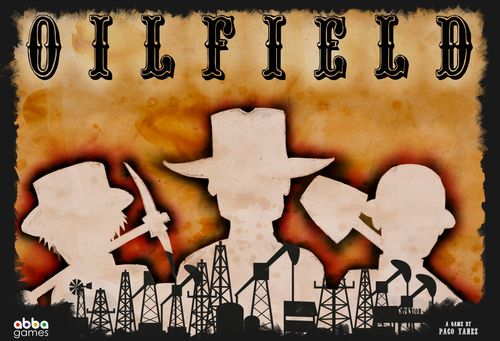
Oilfield
Oilfield Rulebook
Table of Contents
Table of Contents
Content
- 1 Game board
- 5 Player tiles (refinery)
- 50 coins
- 24 Building tiles: 7 Tower types, 2 Refinery expansion tiles
- 12 Lease cards: 3 Dallas, 4 Austin, 5 Pecos
- 25 Private action cards
- 5 workers
- 20 Lease markers
- 1 1st Player card
- 1 Cloth bag
- 30 Investment markers
- 49 Black cubes
- 21 Light blue cubes
- 1 Grey cube: strike
- 3 Orange cubes
- 3 Oilfield markers
- 2 Orange disks (government markers)
- 1 rulebook
Overview
In Oilfield, you will play the role of an oil tycoon in America during the 30's, trying to gain wealth and exploit rich oilfields in Texas, by selling the natural gas and oil you drill at the best prices.
But of course, you are not alone, other brave entrepreneurs like yourself will try to get the most benefits from their investments too.
The target of the game is to be the player with the largest number of victory points (VP) at the end of the game.
You will have the chance to perform 2 actions each round of the game, a public action and a private action. These actions include acquiring leases on terrains to exploit them, building extraction towers to drill the resources, selling your products in the local and national markets, investing wisely in the stock market, etc.
Your success will be determined by how you manage these actions to achieve the maximum number of VP's.
Setup
In your first game, we recommend not including the advanced tower tiles. These tiles are marked with a hat in their faces for easy spotting.
- Put all the black and light blue cubes in the cloth bag.
- Place the game board in the center of the table, at reach for all players.
- Each player chooses a color and receives 5 action cards, 1 worker, 4 lease markers and 6 investment markers of the chosen color.
- Also, give each player $20 and leave the rest of the coins next to the game board, forming the bank.
- All players place an investment marker of their color in square "0" of the VP track.
- Each player takes the refinery tile of their color, as well as two random resource cubes from the bag, that go into the player's warehouse.
- Then, fill each of the 3 regions in the game (Austin, Dallas & Pecos) with resources from the bag. Place as many as needed, depending on the number of players (see chart below).
- Once all the players have drawn their 2 random resources, and each oilfield on the board has been filled, put the grey cube into the cloth bag, along with the other cubes.
- Shuffle the building tiles forming a pile face down. For 3 player games, take out of the building deck 1 building tile of each type of basic tower, advanced tower and refinery expansion (see the Refineries and Extraction Towers section of this rulebook), as they won't be used in the game. Turn as many as you need to create the building market. At the beginning of a game, if you draw 3 identical extraction tiles, shuffle one of them back into the building pile, and draw a new one.
- Shuffle the lease cards and place it face down next to the board. Then, turn 4 cards to form the lease market.
- Leave the three orange investment markers next to the board.
- Place the three oilfield markers in the oilfield track.
- Place $1 in the reserved space of the "Subsidy" action.
- Finally, choose by your favorite method a player to be the 1st player at the beginning of the game, who will then receive the 1st player card.
Brief Action Description
During the game, the players will take turns to perform actions on the board. You need to perform your actions in a logical order to gain benefits and evolve in the game.
As an example, before building an extraction tower in a region, you must acquire a permit from the Government (Lease), and only after building your tower will you be able to start drilling the fuel.
You can perform two actions each round, first a public action, and then a second action that is chosen privately, so the other players won't have much options to react to this private action.
The public action is played on the board, and the private action is chosen from an identical set of action cards that each player has; you place your private action card face down on the table, and you will only reveal it when the time comes.
Let's take a quick look at the main possible actions (further in this rulebook, you will find a detailed explanation):
LEASE – Public and private action. Through bidding, you may acquire rights to build infrastructures in the oilfields to drill oil and/or natural gas.
BUILD – Public and private action. You decide to build some kind of extraction tower or refinery expansion to operate with, from the ones available. There are different priced towers, depending on how efficient they are.
DRILL – Public and private action. With this action, you can put your towers to work and drill fuel from the oilfields. The efficiency of this action depends on the type of tower you have built.
LOCAL (Local Market) – Public and private action. Once you have drilled some resources, you can sell them to obtain benefits. Perform this action to sell in the local market at a fixed price.
NATIONAL (National Market) – Private action. Instead of selling them in the local market, you can also take your resources to the national market, where you can get better prices. But be careful, the prices in the national market vary depending on the offer, so you will need to choose this action wisely.
1ST PLAYER – Public action. If you want to be the 1st player, choosing your public action before the rest of the players, and performing your private actions first, this is the action you will want to perform.
SUBSIDY – Public action. If you've ran out of money, or if you need some extra cash, with this action you may get some money from the government.
INVEST – Public action. With your initial budget, or with the money you've earned during the game, you can perform this action to buy investments that will give you VP's.
How to Play?
The game develops in several rounds, during which the players will choose and perform their actions. Each round is divided in 3 phases:
Action Selection Phase:
In this first phase of the game, the players will choose the 2 actions they will perform that round.
- Public action: Beginning with the 1st player, each player places its worker in one of the available action spaces on the board. There can only be one worker in each space of the board, so if the action you want to perform is already occupied, you won't be able to choose that action this round.
- Private action: When all players have chosen their public action, each of them picks an action card from their hand and places it face down next to their refineries.
Once all players have chosen their 2 actions, the next phase begins.
Note: The "Drill" square marked as 5p is only used in 5 player games, and the square marked 4p/5p in the action "Local" is only used in 4 or 5 player games.
Public Actions Phase:
During this phase, the players will execute their public actions. These actions are executed in the order indicated in the board. Starting with the leftmost action ("Lease"), and from top to bottom, the player's actions are executed. Each time an action is performed, the player doing the action recovers his worker from the board and places it next to the refinery.
Private Actions Phase:
Once all public actions have been executed, perform all private actions. Every player turns face up their private action card, revealing what is the chosen action for this phase. Next, the actions are performed in turn order, starting with the initial player and in clockwise order.
During its turn, a player has no obligation to perform a chosen action; the action cannot be changed, but the players can decide to pass their turns, losing those actions.
Once all players have performed their two actions, the round ends. Replenish the markets and oilfields, if necessary.
Then, start a new round with a new action selection phase.
Note: Public actions are chosen in turn order, but they are executed according to the board's action order. Private actions are chosen by all players at the same time, but they are performed in turn order, starting with the current initial player.
Action Description
As previously stated, a player can perform 2 actions each round, the first one is selected publicly, and the second one is chosen privately, but in both cases, the effect is the same.
A player can repeat the same action one round, if he chooses it both as a public and a private action.
LEASE – Public and private action
To begin production, the first thing you need is to acquire a lease, giving you the rights to exploit one of the oilfields in the game. These exploitation rights are acquired through this action, that can be chosen as a public or a private action.
If you select it as a public action, choose from the available prices the amount you are willing to pay for a new lease. Next, place your worker in the free space with the price you are bidding.
When executing this action, the highest bidder will play first, followed by the next highest bid, and so on. Each player pays the selected quantity, chooses a lease card from the ones available and leaves it next to his refinery (each lease card gives 1 VP at the end of the game). Finally, the player leaves a lease marker of his color next to a free territory in the oilfield indicated in the lease card.
There is only one bid each round, so the initial sum you bid for is the final price you will offer that round.
If you choose this action as a private action, you will only pay $5, but you will only have available whatever lease cards are left after the public actions phase.
It may happen that by the time this private action is executed, there are no lease cards left; in this case, the player cannot buy a lease card, losing the action, but he won't have to pay anything.
Example: In a 4 player game, on the first round, the available lease cards are: 1 Pecos, 2 Austin & 1 Dallas.
Daniel & Julia choose "Lease" as their public action. Daniel is the first player and bids $5. Julia goes next and bids $7. When solving these actions, Julia will choose first because she offered a highest sum. She pays $7 and takes one of the 4 available lease cards. She takes Dallas and places a lease marker of her color in one of the free leases in Dallas. Then it's Daniel's turn, who pays $5 and takes one of the 3 available lease cards. Daniel chooses Pecos, and places his lease maker in one of the 5 available leases in Pecos. From now on, both players have the rights to build 1 extraction tower in their respective leases.
The players keep their lease cards in their game area until the end of the game, because each lease card in your possession will give 1 VP at the end of the game.
BUILD – Public and private action
With this action, the players can buy extraction towers from the market to build in their free leases, and refinery's expansions to extend their warehouse.
When choosing this action, either publicly or privately, a player can buy one of the available tower or refinery expansion tiles from the market. The player pays the indicated price on the top section of the tile, and places it in the appropriate place; if the purchase was an extraction tower, it is placed in an empty lease owned by the active player, if it's a refinery expansion, it is placed next to the players refinery (there is no limit to the number of refinery expansions a player can have).
When building a new tower, the player can immediately perform a "Drill" action with that tower (see description below).
Players cannot build in a lease if there is already a tower built there. If the player doesn't have any free leases to build in, or if there are no available building tiles left (that he can pay for) when performing this action, the action will be lost. The extraction towers cannot be withdrawn once built.
DRILL – Public and private action
With this action you can make your factories extract the fuel from the oilfields in the board, where you have at least one extraction tower.
When performing this action, either publicly or privately, the player can drill resources with all his extraction towers, as long as he has enough free space in his refinery's warehouse to store them. For each tower in his possession, the player can take as many resources as indicated in the building tile from the oilfield where it's built, and add them to the free spaces in his warehouse.
If there are not enough resources in the oilfield, the player takes the ones available (from the type indicated in the building tile). In the same way, the player can only take as many resources as he can store in his refinery.
Example: Anna has a tower in Austin, with a drilling capacity of two oil barrels. When solving her Drill action, she takes 2 black cubes from Austin's oilfield, and adds them to her refinery. She can do this because she has enough free space in her refinery; if she only had one free space, she would've only taken one barrel.
Example 2: Daniel has a tower in Dallas, with a drilling capacity of three oil barrels. In Dallas' oilfield there are only 2 black oil cubes and 1 light blue natural gas cube, so when solving his "Drill" action, he only takes the 2 black cubes, regardless of having more free space in his refinery's warehouse and that his tower has a larger drilling capacity.
LOCAL (local market) – Public and private action
With this action, the players will have the option to sell their resources in the local market. The local market has fixed prices, so you will know the exact prices when selling there.
When performing this action, either publicly or privately, you can sell as many resource cubes from your refinery as you want, being able to sell all the resources in your warehouse or only one.
Depending on what the player is selling, he will receive either money or VP's.
- For each oil barrel = $2.
- For each natural gas barrel or for two oil barrels = 1 VP.
Example: Anna has 3 oil barrels in her refinery. She can choose to either sell all 3 oil barrels for $6, or sell 1 for $2 and the other 2 for 1 VP. Daniel has 2 barrels of natural gas and 1 barrel of oil. He can sell the oil for $2 and the gas for 2 VP.
All resources sold this way go back into the resource bag.
Local Market Supervisor: The player sitting to the right of the 1st player (the last player in turn order) will be the Local Market Supervisor. Each time a player, other than the Supervisor, uses the local market, the Supervisor will receive $1 from the bank.
NATIONAL (national market) – Private action only
As a private action, players can sell their resources in the national market.
In the national market, the prices vary depending on the current offer, so when performing this action you have to see how many players have chosen to do it this round. The chart on the board will tell us how much is paid for the barrel that round, depending on how many players have chosen "National" as their private action.
All resources sold this way go back into the resource bag.
1ST PLAYER – Public action only
At the start of the game, pick a player to the be the 1st player. This player will be the first to choose his public action and to perform his private action. To earn this important benefit, choose 1st player as your public action and you will receive the 1st player card until another player takes it from you.
This action has immediate effect, so in the next private action phase, the player will already perform his private action first. Take the 1st player card and place it next to your refinery after performing this action.
SUBSIDY – Public action only
At the beginning of the game, and at the start of every new round, the Government offers a subsidy of $1, that is added to the reserved space for this purpose on the board, under the "Subsidy" action square.
This money is cumulative, and so the available quantity will increase round after round, until a player takes it.
By doing this public action, a player can take all the money in that space and add it to his personal reserve.
INVEST – Public action only
To transform your earnings into VP's, this public action will allow you to acquire investments. These investments grant VP's at the end of the game. There are three different types of investments depending on their value: 5 VP, 3 VP & 2 VP. You can only do this action once per round.
Chose what investment you want to acquire (5, 3 or 2) and pay the indicated price, on the first visible price square available of that investment's track. Once paid, place one investment marker of your color in that space, and add to your VP track as many points as that investment's value.
No other player can pay that price for that investment, and the next higher price will be the one to pay in subsequent "Invest" actions.
Example: Anna (red color) acquires an investment of 3 VP's, and pays $6 to the bank. Then, she places one of her investment markers on the square marked $6 of that track, and advances her VP marker 3 spaces. From that moment on, the next player to acquire a 3VP investment will have to pay the next price, in this case $7.
Selling investments: Players can sell their investments back to the Government any time they want. Doing this has no action cost. The selling price is the current price for that investment in the board's chart.
When an investment is sold, the player recovers his investment marker from the track, receives from the bank the current price, and moves his VP marker back as many spaces as the value of the sold investment. Finally, place a Government investment marker (orange) in the now free space, leaving the current price unchanged for that investment.
Example: After a few rounds, Anna needs to sell her 3VP investment for which she paid $6. Martin, the blue player, has acquired 2 investments of 3 VP, for which he paid $7 and $8, respectively. The next visible price is $9, so that is the price Anna will get for selling back her investment to the Government. Once Anna has received the money from the bank, she recovers her investment marker from the track, places a Government marker instead, and she moves her VP marker 3 spaces on the VP track.
Note: The price of investments never goes down. Use the Government markers to substitute the recovered players' markers, specially when the rightmost marker is the one being recovered (the one covering the highest paid price).
Refineries & Extraction Towers
Refineries:
Each player receives a refinery that they will receive at the beginning of the game, with a storing capacity of 3 fuel barrels. Any resource can be stored in the warehouse (both oil and natural gas).
At the end of the game, having a section of your warehouse full of resources gives you 1 VP.
Refinery expansions:
With the action "Build", you can purchase expansions for your warehouse, amongst other buildings. Once built, it allows you to store 2 additional resource barrels in your refinery.
At the end of the game, having a full refinery expansion gives you an additional VP.
Extraction towers:
There are 5 types of basic extraction towers, with different prices and extraction capabilities.
- Small tower: Costs $5 and it allows you to extract 2 barrels of oil from the oilfield where it was built in.
- Medium tower: Costs $8 and it allows you to extract 3 barrels of oil from the oilfield where it was built in.
- Mixed tower: Costs $10 and it allows you to extract 1 barrel of oil and 1 barrel of gas from the oilfield where it was built in. Additionally, it allows you extract a second barrel of either gas or oil, at the player's choice.
- Small local tower: Costs $7 and it allows you to extract 1 barrel of oil OR 1 barrel of gas from the oilfield where it was built in. The drilled resource goes straight to the local market, giving the player $2 if he drills oil or 1 VP if he drills gas.
- Medium local tower: Costs $13 and it allows you to extract 3 barrels of oil from the oilfield where it was built in. Additionally, it drills a barrel of gas that goes straight into the local market, giving the player 1 VP.
The moment you build an extraction tower, that tower performs a free "Drill" action, extracting some resources right from the start, without having to spend an action on doing it.
Replenishing
During the game, the resources in the oilfields, lease cards and building tiles may need to be replenished. If you need to, do this in between rounds or phases, depending on the case.
Building tiles:
Before beginning a game, and at the start of each new round, place as many tower tiles as you need to fill the building market, according to the number of players.
- 3 players: The market is formed by 5 building tiles.
- 4-5 players: The market is formed by 6 building tiles.
Lease cards:
Before beginning a game, and at the start of each new round, place as many lease cards in the lease market as you need to have 4 lease cards available in the market.
Oilfields:
Each round, at the start of a new phase, check if an oilfield has ran out of oil (black cubes). If that's the case, advance the marker of that oilfield, and take from the resource bag as many cubes as you need to replenish the oilfield, according to the number of player.
- 3 players: 10 resource cubes.
- 4 players: 12 resource cubes.
- 5 players: 14 resource cubes.
The moment to replenish an oilfield is at the end of the current phase in the round. For example, if an oilfield runs out of oil barrels during the public actions phase, players cannot drill oil from that oilfield; they can only extract gas (if there is any left and have the right extraction towers to do it) until the beginning of the following private action phase. In the same way, if an oilfield is depleted during the private action phase, the oilfield will remain empty until the start of the next round.
If a player chose "Drill" as his action, and there are no available resource cubes left for him, he loses his action.
Strike!:
If at the time of replenishing an oilfield, the grey cube is drawn, the workers of that oilfield will go on strike during the next action phase, and they will not work. The players won't be allowed to drill resources from that oilfield. In the next action phase, the strike ends and the grey cube goes back into the resource bag (there can be more than one strike per game).
As an example, at the end of the public actions phase an oilfield is depleted. While replenishing that oilfield the grey cube is drawn out of the bag, and so during that next private action phase, nobody can drill resources from that oilfield until the next public actions phase.
On the same way, if you need to replenish the oilfield after the private actions phase, players won't be allowed to drill in that oilfield until the next private action phase.
Each time you need to replenish the resources from an oilfield, move the oilfield marker for that oilfield in the oilfield track. Once the marker reaches the end of the track, that oilfield is depleted and won't be replenished anymore.
The moment 2 oilfields are completely empty, the game is about to finish.
End of the Game
Once two oilfields have been completely depleted, the end of the game starts. This means finishing the current round, and playing a last full round, after which the players will count their VP's.
The players will earn VP's during the game by acquiring investments or selling your resources. Add to those VP's the following:
1 lease = 1 VP
At the end of the game, each player receives 1 VP for each lease card in their possession (regardless of it having a tower built or not). Move the VP marker as many spaces as lease cards the player owns.
1 full warehouse (basic refinery or expansion) = 1 VP
For each warehouse or warehouse expansion that the player has filled with resource cubes at the end of the game, he gets 1 VP. It is considered that a warehouse is full, when all of its storage spaces have resource cubes on them (either gas or oil). Move the players' VP marker as many spaces as full refineries he owns.
Example: Julia bought a refinery expansion. At the end of the game, she has 2 unsold oil cubes, so she can fill the two storage spaces in her refinery expansion and earn 1 VP. If she had another 3 barrels, she would be able to fill her basic refinery as well, getting an additional VP, for a total of 2 VP's. If she didn't have the refinery expansion (which has 2 storage spaces), she would get nothing for her 2 remaining barrels, given that the basic refinery's warehouse has a capacity for 3 barrels, so it wouldn't be full.
Being the player with most money = 2 VP
Once all other VP have been assigned, the player with more money in total at the end of the game will get 2 additional VP's. If there is a tie, all tied players will receive 1 VP instead of two. Advance the VP marker of the player/s one or two spaces in the VP track.
After making the final count, the player with more victory points (VP) will be the winner of the game.
If there is a tie, the player with less money wins.
If there is still a tie, the player with less lease cards will be the winner.
Advanced Towers
Oilfield includes a set of tiles for advanced players, to add more variety to your games. These tiles are marked with a hat in their face for easy locating.
To use all the potential of this advanced towers, it is recommendable to have played a few games to learn the basic rules, prior to including them in the game. We recommend taking them out of the game for your first games, or if you are introducing new players to the game.
- Gas refinery expansion: Costs $8 and it allows you to sell natural gas in the national market ("National" action). The player owning this expansion, can sell the gas he has stored in his warehouse with the action "National", getting the same money per gas barrel as if it were an oil barrel. Also, if you want to, you can store in your refinery the gas barrels that other towers send straight to the local market with a "Drill" action, instead of selling them directly, giving you the chance to store them and sell them later in a "National" action. This tile is a refinery expansion, and so it is placed next to the refinery, not in a free lease space.
- Small national tower: Costs $10 and adds an oil barrel from the oil field to those you are going to sell that turn, and it goes straight to the national market. IMPORTANT: this tower doesn't extract resources with the action "Drill" (or at the time of building it), it extracts resources with the action "National". When solving your "National" action, you must sell at least one barrel from your warehouse. If you do, take one additional oil barrel from the oilfield where this tower was built, and send it straight to the national market, without having to store it in your refinery. When doing so, receive one additional coin from the market.
Example: Daniel has built a small national tower in Pecos. When performing his "National" action, we sells 2 oil barrels from his warehouse. Because of this, he can extract one additional oil cube from Pecos, that goes straight to the national market, without going through the player's warehouse. Daniel is the only player selling in the national market this turn, so he receives 13 coins in total, $4 for each of the three barrels, plus one extra coin for the small national tower.
- Government tower: Thanks to an agreement with the Government, this tower is free to build, and it allows you to extract 1 barrel of natural gas that goes straight to the local market (giving the player 1 VP). The first time the oilfield it's built in needs to be replenished, the player will have to pay $10 to liberate the tower and use it's full potential. If he does, the owner of this tower will continue extracting 1 barrel of natural gas that goes to the local market, plus 2 additional oil barrels that go to the refinery's warehouse. When you build this tower, place one of the orange discs in the marked zone of the building tile. Once you pay the rights to use it, take the orange disk off, revealing the full effect of the tower. If the player doesn't have the money, or doesn't want to pay the price of the tower, when the oilfield is being replenished, he loses the tower and the lease where it was built. In this case, put both the building tile and the lease card back in their respective markets, that are now available for any player. Remember that you can always sell your investments whenever you want, without having to spend an action to do it.
Note: It may happen that because of this there might be more building tiles or lease cards available in the market than the usual for that number of players.
2 Player Variant
Oilfield is a game for 3 to 5 players, but with this variant, you will be able to play with only 2 players, without losing anything from the original gameplay and feelings of the game.
2 player setup:
- Prepare a set of components for a dummy player: Choose a color that neither of the players is going to use, and take the worker and three lease markers of that color. Get the set of private action cards of that color as well. Take from the deck of lease cards one card of each oilfield, and leave them in the table at reach. You won't need money, point or investment markers nor a refinery for the dummy player.
- Get the rest of the game ready for a 3 player game, with the exception that the lease market will only have 3 available cards and only 2 refineries will be used in the game.
- From the building tiles you put aside at the beginning of the game (see setup for three players), take 1 Small local tower, 1 Small tower and 1 Medium tower. Place them randomly one in each oilfield, and put a lease marker of the color of the dummy player in each of them.
- Shuffle the deck of private action cards of the dummy player, and randomly take a card. Place the dummy player's worker in the corresponding public action in the board (if the card is "National", take another card). If the action is "Lease" place it in the $5 square.
The rules are very similar to those of a three player game (oilfields are replenished with 10 resources), with the following changes:
Public Actions
Except for the first turn, and before the players choose their actions, the dummy player's worker will move one space to the right on the public action track. This does not trigger any action, it's only used to block the players. If the worker was in one of the "Invest" spaces, move him to "Lease" in the $5 square.
After that, the players pick and execute their public actions normally, in turn order (don't retrieve the dummy player's worker from the board).
Private Action
Before the players reveal their private actions, shuffle the dummy player's deck of private action cards, and take one randomly. Depending on the card, do the following:
- "Lease": Take all cards from the lease market, shuffle them back into the lease cards' deck, and deal 3 new cards to form the market again (regardless of how many cards were left).
- "Build": Take all building tiles from the market, shuffle them back in the building tiles' deck, and draw 5 new buildings to form the market (regardless of how many tiles were left).
- "Local": The Local Market Supervisor (the last player) earns $1.
- "National": Affects the prices of the national market, as if there were an additional player selling that turn.
- "Drill": The 1st player shuffles the 3 lease cards that were set apart at the beginning of the game and the other player takes one randomly. Reveal the card, and perform a "Drill" action in that oilfield, using the extraction tower of the dummy player. If it is a Small Local tower, drill a cube of natural gas, if possible, if not take oil. The resources drilled this way go back into the resource bag.
After this, the players will perform their private actions normally.
Optional: Reveal the dummy player's action card at the same time as the players', executing his action in-between one player and the next ("National" will still affect both players), thus giving more importance to being the 1st player.
The rest of the rules apply normally, including the rules for the end of the game and the final scoring.