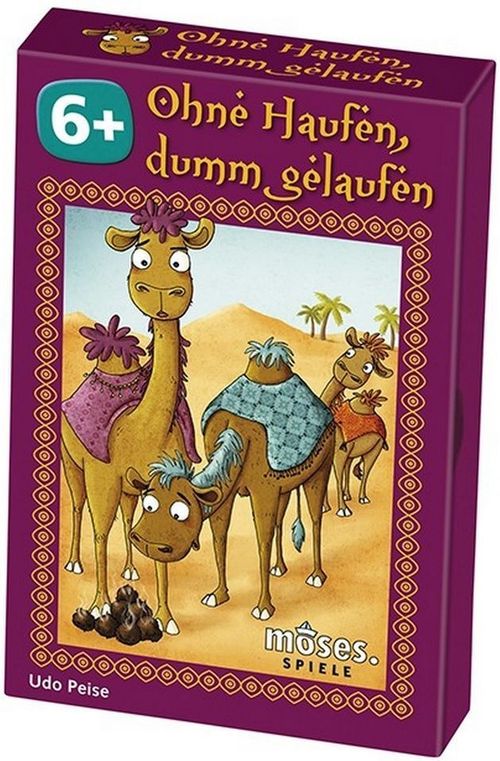
Ohne Haufen, dumm gelaufen
Ohne Haufen, dumm gelaufen Rulebook
Table of Contents
Table of Contents
Game Material
- 72 dromedary cards
- 4 leader-of-the-herd cards
- 7 numbered counters (made of FSC® certified wood)
Getting Ready to Play
Each player receives one leader-of-the-herd card and places it in front of him. The remaining leader-of-the-herd cards are placed back into the box. Since they are printed on both sides, you may choose which side you want to play with.
Shuffle the dromedary cards and make stacks of approximately the same size. The number of stacks must always be one more than the number of players. For example, if two people are playing, then you must make three stacks. Place the stacks face down in the centre of the table so that they can easily be reached by all players.
Pick a counter bearing the number 3 out of the seven numbered counters and place it, number uppermost, near the stacks of cards. Mix the remaining six counters and put them to one side, face down.
You Need to Know
A caravan consists of one leader of the herd, three to six different coloured dromedaries and one pile of poo.
The leader of the herd is pictured on the leader-of-the-herd card together with the front half of a dromedary. The dromedary halves have a different colour on each leader-of-the-herd card.
The matching dromedary halves and the piles of poo can be found in the dromedary cards, which are stacked in the centre of the table. The dromedary cards are always composed in such a way that, on the left of the picture a rear end and on the right of the picture a front end, or a pile of poo can be seen.
How to Play
The game consists of seven rounds, in which everyone plays simultaneously. No doubt, you are asking yourselves how you are supposed to know, how many dromedaries you have to look for in each round. Dead easy! The figures on the numbered counters tell you how many. You have to find a varying number of dromedaries in each round. It is always between three and six.
It is only in the first round that you are always looking for three dromedaries and a pile of poo. The player who did everything right and was the fastest, receives the numbered counter lying face up, as his reward. Before each following round, turn over any one numbered counter to show how many dromedaries must be searched for.
So remember: you only gain points when your caravan consists of one leader of the herd, the given number of dromedaries and the pile of poo, and if you were the fastest player.
By the way: There are no multi-coloured dromedaries. And, there is only one dromedary of any one colour in each caravan!
Everything OK? Good, then off you go! The youngest player gives the start command: "Caravan go!" Each player grabs a random stack of cards from the centre of the table and looks for the rear end to match up with the half a dromedary pictured on his leader-of-the-herd card. There are two options:
- Wow, drop to your knees: You have found the colour-matched rear end and lay it alongside your leader-of-the-herd card or dromedary card. Immediately place the stack back in the centre of the table and grab the next one, since you can only take one dromedary card out of the stack in a single go.
- For poo's sake: You haven't found the colour-matched rear end. Never mind: Quickly place the stack back and grab the next one! The hunt goes on!
You have found the number of dromedaries shown on the numbered counters? Super! Then you just need the pile of poo now! Search for it, fast! Once you've found it, add it to your caravan and call out straight away: "No poo, bad luck for you!" Then all players look together, to see that you've done everything right: does the number of animals correspond with the number on the numbered counter? Are all the dromedaries single-coloured? Is there only one of each colour? Have you found the pile of poo? Then, this is what happens next:
- Everything correct: Well done! You are rewarded with the numbered counter lying face up. Draw a new numbered counter and place it face up in the centre of the table. Re-shuffle the dromedary cards after each round and make new stacks, so you don't remember which stack a particular card is in. This time, the player on your left gives the start command.
- Oh dear, something isn't right: You called out "No poo, bad luck for you!", but your co-players have found an error in your caravan? Then, you drop out of that round and must wait, until the other players have finished playing that round and one of them has completed his caravan.
Tips
In the second round, turn your leader-of-the-herd cards over. In the third round, pass your leader-of-the-herd card across to the player on your left. In the fourth round, turn them over again. In the fifth round, pass them to the player on your left again and so on. That way, you have a new starting situation in every round.
If two or three players are playing, then you can use the leader-of-the-herd cards which you had placed back in the box.
How the Game Ends
The game ends after seven rounds. Add up the numbers on your numbered counters. The player with the most points is the winner and is Master of the Dromedary Hunt.
Variant for Younger Players (from 5 years)
The rules of the basic game apply, but with the following amendments:
- Instead of making stacks, place all the cards, face down, in the centre of the table.
- You may only use one hand to search for the matching dromedary card. Only one card may be turned over and viewed at a time. If you find the correct dromedary card, lay it alongside the leader-of-the-herd or the dromedary card. If it doesn't match, place it back in the centre of the table, face down.
- There may be several dromedaries of the same colour in one caravan.
Transcriber note: the last bullet of the younger-players variant is printed as-is and contradicts the basic rule that each caravan has only one dromedary of any one colour. It is transcribed as printed, not resolved. Two printed typos are corrected in the text: "leader-of-the-heard" (p. 3) is written "leader-of-the-herd", and "commando" (p. 3) is written "command".