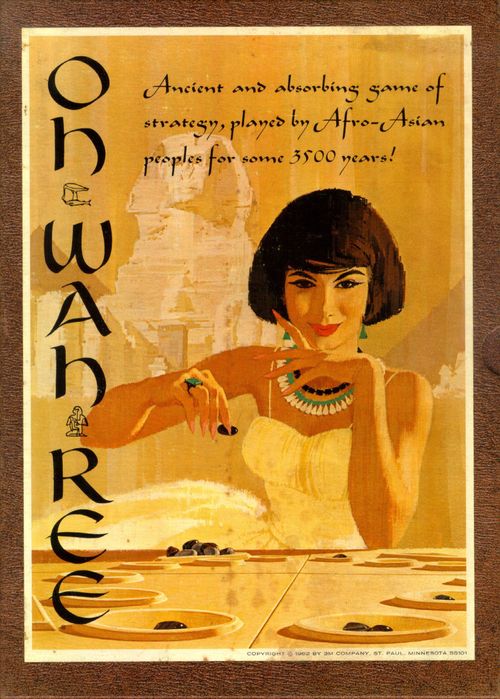
Oh-Wah-Ree
Oh-Wah-Ree Rulebook
Table of Contents
Table of Contents
- Terms for Oh-Wah-Ree
- Setup and Basic Moves (All Versions)
- Standard Oh-Wah-Ree
- Standard Oh-Wah-Ree Sample Game
- Coastal Oh-Wah-Ree
- Coastal Oh-Wah-Ree Sample Game
- Dog-Gone Oh-Wah-Ree
- Dog-Gone Oh-Wah-Ree Partial Sample Game
- Oriental Oh-Wah-Ree
- Oriental Oh-Wah-Ree Sample Game
- Pendulum Oh-Wah-Ree
- Pendulum Oh-Wah-Ree Partial Sample Game
- Arabian Oh-Wah-Ree
- Arabian Oh-Wah-Ree Sample Game
- Grand Oh-Wah-Ree
Terms for Oh-Wah-Ree
- Sowing: Act of dropping pebbles one at a time into each consecutive pit.
- Lap: Consists of scooping all pebbles out of a pit and sowing them. Lap ends when the last pebble from the pit has been sown.
- Turn: Each turn is made up of one or more laps.
- Source pit: Pit from which a lap begins.
- Storage pit: Large corner pits (4) used for storing captured pebbles.
- Nest egg (see Arabian Oh-Wah-Ree): Made when last pebble on lap brings contents of pit to four pebbles. Laps do not begin from nest eggs.
Setup and Basic Moves (All Versions)
Players divide the circle of 12 pits equally with each player's pits in sequence. Each player selects the color markers he wishes to use and stakes out his "territory" by placing one marker above each pit. An equal number of pebbles are placed in each pit (amount varies with version played).
Players take turns in clockwise rotation; laps are played counterclockwise (unless otherwise indicated). First player is chosen by flipping a coin or drawing lots.
Each player's turn is made up of one or more laps. A player begins a lap by scooping all the pebbles out of a pit and sowing (dropping) them one at a time into each consecutive pit. The lap ends when the last pebble from a pit has been sown.
Much of the strategy of OH-WAH-REE lies in remembering the number of pebbles in various pits so that the most advantageous moves (to capture and to avoid capture) may be made. A player may count pebbles only by looking at a pit. Once pebbles have been removed from a pit, the player must sow from that pit.
Standard Oh-Wah-Ree
STANDARD OH-WAH-REE involves capturing 2 and 3 pebbles from an opponent's pits while trying to prevent the opponent from capturing pebbles from the player.
Setup: For two players, 4 pebbles in each pit; for three players, 5 pebbles; for four players, 6 pebbles. One lap per turn. One round. Play counterclockwise for two players, either direction for three and four players, but only one direction per turn.
Play: A turn begins from any of the player's pits. If pit from which a lap began contains 12 or more pebbles, the player (upon reaching this pit again) omits it from the sowing, sows the 12th pebble in the following pit and continues sowing any remaining pebbles in his hand.
A player captures pebbles when a lap ends in an opponent's pit making its contents 2 or 3 pebbles. These pebbles are put in player's storage pit. If pit from which a capture is made is preceded (clockwise) by an unbroken sequence of pits also containing 2 or 3 pebbles, player also captures these pebbles. This backward chain reaction stops when the next pit (clockwise) does not contain 2 or 3 pebbles or, if the pit is in the player's territory.
A player having pebbles in his pits must play. The game ends when one player cannot play because his pits are empty or, in a three- and four-man game, when two players in succession cannot play. Any pebbles remaining in a player's territory become that player's property.
Player with the most pebbles wins the game.
Standard Oh-Wah-Ree Sample Game
The basic moves are the same for all versions of OH-WAH-REE. Capture moves will vary with the version chosen. Once you learn to play STANDARD OH-WAH-REE you should be able to play any OH-WAH-REE version. Why not try all versions of the game before selecting a favorite?
Each of the following diagrams illustrates the first move printed directly beneath. The twelve circles are the playing pits. The colored dots are the markers used to indicate to whom the pits belong. The four large corner pits are for storing captured pebbles.
- Player A (red) empties one of his pits and sows the four pebbles, one by one, into four adjacent pits, moving counterclockwise.
- Player B (green) sows four pebbles from his pit, B6.
- A sows six pebbles from A2.
- B sows four from B5.
- A sows eight from A3.
- B captures five pebbles from two of his opponent's pits, and places them in a storage pit. Notice that the "backward chain reaction" stopped when B reached his own pits.
- A retaliates by capturing six pebbles, placing them in a storage pit.
- B attempts to set up A1 and A2 for pebble capture by sowing B1.
- A captures four pebbles. This time, the chain reaction stops at a pit with more than three pebbles.
- B reinforces chance to capture by sowing from B2.
- A sows one pebble to capture two.
- B, sowing from B3, captures three pebbles.
- A should empty A2 to prevent capture. Alas, thinking "tidily", he empties well-fed A4, leaving himself only seven pebbles.
- B, sowing from B6, captures seven pebbles, crippling A.
- A makes the best of it.
- B stalls by playing B3.
- A must play A5.
- B vacates B1.
- A has but one move: A6.
- B empties B1. A's pits are empty. The game is over. B totals the pebbles in his storage pit with those in his playing pits: B wins, 34 to 14.
Coastal Oh-Wah-Ree
COASTAL OH-WAH-REE is similar to pit-and-pebble games played by various tribes of Africa's Gold Coast. The difference between COASTAL and STANDARD OH-WAH-REE is that in COASTAL when one player is out of pebbles his opponent is forced to play into his pits.
Setup: Four pebbles in each pit. Two players. One lap per turn. One round. Play counterclockwise.
Play: A turn begins from any of the player's pits. If pit from which a lap began contains 12 or more pebbles, the player (upon reaching this pit again) omits it from the sowing, sows the 12th pebble in the following pit and continues sowing any remaining pebbles in his hand.
A player captures pebbles when the last pebble is sown in an opponent's pit making its contents 2 or 3 pebbles. The pebbles are put in player's storage pit. If pit from which a capture is made is preceded (clockwise) by an unbroken sequence of pits also containing 2 or 3 pebbles, player also captures these pebbles. This backward chain reaction stops when the next pit (clockwise) does not contain 2 or 3 pebbles or, if pit is in the player's territory.
The player must leave his opponent a pit from which to play. If all the opponent's pits are empty, a player must make a move which gives his opponent at least one pebble with which to play. If he fails or is unable to do so, he forfeits all the pebbles in his pits to his opponent. If a stalemate occurs, players may agree to end the game, each keeping the pebbles in his pits.
Player with the most pebbles wins.
Coastal Oh-Wah-Ree Sample Game
This game is a variation of Standard OH-WAH-REE. Each player has 1 lap per turn.
- Player A: A1 / Player B: B5
- Player A: A2 / Player B: B2 (B captures 2 pebbles from A1.)
- Player A: A6 (A captures 2 pebbles from B5.) / Player B: B6 (Tries to set up possible captures.)
- Player A: A5 / Player B: B1 (B captures 4 pebbles from A2 and A1.)
- Player A: A4 (A captures 3 from B5) / Player B: B4
- A5 (Captures 3 pebbles from B1) / B3
- A3 / B5 (Captures 3 from A2)
- A4 (Captures 2 from B1) / B6
- A5 (Captures 2 from B3) / B2 (B captures 2 from A2)
- A1 (A captures 2 from B1) / B6
- A4 (Should have moved A1 to avoid capture.) / B4 (B captures 2 from A1)
- A3 / B5
- A6 (A not only sets up B but himself as well.) / B6 (Captures 8 from pits A3, A2 and A1.)
- A5 (Captures 7 from B3, B2, and B1.) / B4
- A4 / B5
- A5 (Saves pebbles to sow into B when B is out of pebbles.) / B6 (Captures 2 from A1.)
- A6 (A must sow into B's pits as B has no pebbles.) / B4 (B is unable to sow into A's pits; as A is out of pebbles, B forfeits the 4 pebbles remaining in his pits to A.)
A wins 25 to 23.
Dog-Gone Oh-Wah-Ree
DOG-GONE OH-WAH-REE is patterned after the games played in many countries of western Africa. This version differs from STANDARD OH-WAH-REE in that four pebbles are captured at a time from any pit on the board.
Setup: Four pebbles in each pit. Two, three or four players. Several laps per turn. Several rounds for two players; one round for three or four players. Play counterclockwise.
Play: A turn begins from any of the player's pits. If a lap ends in a pit containing other pebbles, the contents of this pit are scooped up to begin a new lap.
A turn ends when a lap ends in an empty pit or in any pit making its contents 4 pebbles. (These 4 pebbles are captured.) If while sowing, the contents of a pit are brought up to 4 pebbles, the player owning that pit immediately puts these pebbles in his storage pit.
When three or four play, the game ends when 2 players in succession have no pebbles with which to play. Player with the most pebbles wins.
When 2 play, round ends when one player in his turn is unable to play. Player with the most pebbles (including pebbles from storage pit and those remaining in pits) wins. For next round, players put 4 pebbles in each pit. Winner of previous round removes a pit marker from his opponent's left hand pit and replaces it with his own. This pit now belongs in his territory. The winner of each round occupies one of his opponent's pits in the next round. Rounds continue until one player occupies 11 pits or until players agree to end the game. Player with the most pits at end of game wins.
Dog-Gone Oh-Wah-Ree Partial Sample Game
As this version consists of several laps to the turn, begin a new lap from each pit shown unless otherwise indicated. The last pebble of the first lap should end in the pit from which a new lap begins.
-
Player A: A5 (Four pebbles are sown from this pit with the last pebble sown in B3.)
- B3 (The five pebbles in this pit are lifted for a new lap. Last pebble is sown in A2.)
- A2 (A sows the five pebbles.)
- B1 (All 6 pebbles are sown.)
- A1 (Six pebbles are sown. The last pebble is sown in B1.)
- Turn ends in B1 (An empty pit.)
Player B: B5, A5, B2, A3, B5, A1 (A takes the 4 pebbles from A2 and puts them in his storage pit.)
- A4 (B takes the pebbles in pits B1 and B3 and puts all 8 pebbles in his storage pit.)
- Turn ends in A1 (An empty pit.)
-
Player A: A6. Turn ends in A4 (An empty pit.) Player B: B1. Turn ends in B2 (B captures 4 pebbles from B2.)
-
Player A: A1, A3. Turn ends in A6 (An empty pit.) Player B: B6 (A puts the 4 pebbles in A5 in his storage pit.), B5. Turn ends in A2 (B captures the 4 pebbles in A2.)
-
Player A: A6, B2, B4 (A puts the pebbles from A4 in his storage pit.) (B puts the pebbles from B3 in his storage pit.) Turn ends in B4 (An empty pit.) Player B: B4, B5. Turn ends in A1 (B captures the pebbles from A1.)
At this point A has 12 pebbles in his storage pit, 1 pebble in pits A2, A5, and A6, and 2 pebbles in pit A3. B has 24 pebbles in his storage pit, 3 pebbles in pits B1 and B6, and 1 pebble in pit B2.
Oriental Oh-Wah-Ree
ORIENTAL OH-WAH-REE is based on concepts of pit-and-pebble games played in the Orient. This version is similar to a game played by women of Malaya. Captures can be made of several pebbles at a time. Players also obtain pebbles by sowing into their storage pits. In this version it is advisable to keep as few pebbles as possible in the pits to avoid capture of large numbers of pebbles at one time.
Setup: Six pebbles in each pit. Two or four players. Several laps per turn. Several rounds for two players, one round for four players. Play clockwise.
Play: A turn begins from any of player's pits. If a lap ends in a pit containing other pebbles, the contents of this pit are scooped up and sown. When a lap ends in an opponent's empty pit, the turn ends.
If a lap ends in a player's empty pit, the last pebble and any contents of the pit across from it (see diagram below) are captured and put in player's storage pit.
As each player while sowing reaches his last pit (clockwise), he sows the next pebble in his storage pit before continuing sowing in opponent's pits. He does not sow in his opponent's storage pit. If a lap ends in a storage pit, player begins a new lap from any of his pits. Play never begins from storage pits.
For four, game ends when 2 players in succession cannot play because they have no pebbles in their pits. Other players keep any pebbles remaining in their pits.
For two, round ends when all pebbles are in storage pits. Each player puts six pebbles into each of his pits. If a player is unable to put six pebbles in all of his pits, he marks unfilled pits by putting a colored marker in them. Unfilled pits are out of play that round. Players put surplus pebbles in their storage pits. (Surplus pebbles are kept separate from captured pebbles and not counted to determine winner of round. They are used to fill pits before a round if needed.) Play continues as for first round. Rounds are played until one player is unable to fill even a single pit.
| Pit | Captures | Pit | Captures |
|---|---|---|---|
| A1 | B6 | B1 | A6 |
| A2 | B5 | B2 | A5 |
| A3 | B4 | B3 | A4 |
| A4 | B3 | B4 | A3 |
| A5 | B2 | B5 | A2 |
| A6 | B1 | B6 | A1 |
Oriental Oh-Wah-Ree Sample Game
As this version consists of several laps to the turn, begin a new lap from each pit shown unless otherwise indicated. The last pebble of the first lap should end in the pit from which a new lap begins. Remember, each time a player reaches the last of his pits he must sow a pebble in his storage pit before continuing his sowing. The storage pit is indicated by "SP".
-
Player A: A6 (A sows his six pebbles clockwise from A6.)
- SP (The last pebble is sown in the storage pit allowing him to begin a new lap from any of his pits.)
- A5 (A chooses his pit to begin a new lap.)
- B5 (A's last pebble from the previous lap ends in B5. He remembered to sow in his storage pit before sowing into B6.)
- A4 (A did not sow into B's storage pit.)
- B2 (Since A put a pebble in his storage pit before crossing into B's territory his last pebble ends in B2.)
- SP (Last pebble from B2 is sown in A's storage pit.)
- A3 (A begins his new lap from A3.)
- A6 (A sows the 3 pebbles from A6.)
- Turn ends in A3 (A captures all pebbles in A3 and B4.)
Player B: B2, B1. Turn ends in B4 (B captures all pebbles from B4 and A3.)
-
Player A: A6, A5, SP (A has a choice of pits from which to begin a new lap.), A4, SP, A1, SP, A1, SP, A3, SP, A1, SP, A4. Turn ends in A3 (A captures pebbles from A3 and B4.)
Player B: B1, SP, B3, B6, A1, B5, A6, A2, B2, A3, B4, A6. Turn ends in A3 (An empty pit.)
-
Player A: A1, B5, B1, SP, A1, SP, A5, B4, B2. Turn ends in A5 (A captures only 1 pebble from A5 as B2 is empty.)
Player B: B1, SP, B6, SP, B1, SP, B3, A2. Turn ends in B3 (B captures all pebbles from B3 and A4.)
-
Player A: A1, B6, B4, B1, A5, A3, B5, A6, A1, B6, B4, B2, A3. Turn ends in A1 (A captures only 1 pebble as B6 is empty.)
Player B: B3, SP, B1, A5, A2. Turn ends in B4 (B captures pebbles from B4 and A3.)
-
Player A: A1, SP, A4, SP, A1, SP, A3, A2, SP, A1, SP, A6. Turn ends in A4 (A captures pebbles in A4; B3 is empty.)
A is out of pebbles so B continues playing until he sows the remaining pebble in his storage pit.
A wins 39 to 33.
Pendulum Oh-Wah-Ree
PENDULUM OH-WAH-REE is a more complicated version which is similar to the games played by some of the tribes in Kenya, East Africa. Though the captures are similar to the captures of ORIENTAL OH-WAH-REE, strategically setting up captures becomes quite a feat as laps are played first in one direction and then in the opposite.
Setup: Five pebbles in each pit. Two or four players. Several laps per turn. One round. Play clockwise and counterclockwise.
Play: Each player lifts all pebbles from one of his pits and puts three pebbles in the next pit (either direction) and two pebbles in the pit beyond it. A player begins his turn from any of his pits. As his turn begins, each player may choose to sow his pebbles clockwise or counterclockwise. If a lap ends in a pit containing other pebbles, the contents of this pit are scooped up and sown in the direction opposite the previous lap. (Thus, on a turn the player sows first in one direction, then the other until the turn ends.)
If a lap ends in an empty pit in the opponent's territory, the turn ends. If sowing extends to opponent's pits and returns to player's pits and ends there in an empty pit, the player captures this last pebble and any pebbles in the pit across from it (see diagram below).
Game ends when one player has lost all pebbles in his pits or, in a four-player game, when two players in succession cannot play because they have no pebbles. If game ends in a stalemate, players may agree to end the game.
Player with the most pebbles wins.
| Pit | Captures | Pit | Captures |
|---|---|---|---|
| A1 | B6 | B1 | A6 |
| A2 | B5 | B2 | A5 |
| A3 | B4 | B3 | A4 |
| A4 | B3 | B4 | A3 |
| A5 | B2 | B5 | A2 |
| A6 | B1 | B6 | A1 |
Pendulum Oh-Wah-Ree Partial Sample Game
As this version consists of several laps to the turn, begin a new lap from each pit shown unless otherwise indicated. The last pebble of the first lap should be sown in the pit from which a new lap begins. The direction of the lap is indicated as being clockwise or counterclockwise.
A places 3 pebbles from A5 in A6 and 2 pebbles from A5 in B1. B places 3 pebbles from B4 in B3 and 2 pebbles from B4 in B2.
-
Player A: A6 counterclockwise (A sows the 8 pebbles from A6.)
- A2 clockwise (A must sow in the direction opposite that of the previous move.)
- B2 counterclockwise (A continues to sow.)
- Turn ends in A5 (A captures the pebble in A5 and any pebbles in the pit across from it, B2. B2 contains no pebbles so A captures only one pebble this time.)
Player B: B3 counterclockwise. Turn ends in B2 (B captures the pebble in B2 and all pebbles from A5.)
-
Player A: A3 counterclockwise, B4 clockwise, A5 counterclockwise, B1 clockwise. Turn ends in B1 (An empty pit.)
Player B: B6 clockwise, A2 counterclockwise, A6 clockwise, B5 counterclockwise. Turn ends in B5 (B captures all pebbles from B5 and A2.)
-
Player A: A6 counterclockwise, B1 clockwise, A3 counterclockwise, B3 clockwise. Turn ends in A3 (A captures all pebbles from A3 and B4.)
Player B: B2 clockwise, A1 counterclockwise, A2 clockwise, B5 counterclockwise, A1 clockwise, B4 counterclockwise, B6 clockwise, A5 counterclockwise, A4 clockwise, B3 counterclockwise, A2 clockwise, B4 counterclockwise, A4 clockwise, A2 counterclockwise. Turn ends in A4 (An empty pit.)
-
Player A: A6 counterclockwise. Turn ends in A2 (A captures all pebbles from A2 and B5.)
Player B: B6 counterclockwise, B1 clockwise, B4 counterclockwise, B6 clockwise. Turn ends in B4 (B captures pebbles from B4 and A3.)
-
Player A: A1 clockwise, A4 counterclockwise, B2 clockwise. Turn ends in A1 (A captures pebbles from A1 and B6.)
Player B: B5 clockwise, B1 counterclockwise. Turn ends in B5 (B captures no pebbles as he never sowed into A's pits.)
-
Player A: A5 clockwise, B5 counterclockwise, A1 clockwise. Turn ends in B5 (An empty pit.)
Player B: B5 counterclockwise, B6 clockwise, B2 counterclockwise, B5 clockwise, B3 counterclockwise, A4 clockwise, A1 counterclockwise, A3 clockwise, B4 counterclockwise, A6 clockwise, B6 counterclockwise, A4 clockwise, A1 counterclockwise. Turn ends in A6 (An empty pit.)
At this point A has 23 pebbles in his storage pit and B has 27. There are 2 pebbles in pits A3 and B4, 1 pebble in pit A2 and 5 pebbles in pit B5.
Arabian Oh-Wah-Ree
ARABIAN OH-WAH-REE is similar to the game played by Arabs in the Sudan. Players attempt to make nest eggs in which to "store" pebbles. In this version captures can be made only if a lap ends in an opponent's nest egg.
Setup: Four pebbles in each pit. Two, three or four players. Several laps per turn. Several rounds for two players; one round for three and four players. Play counterclockwise.
Play: A player may begin his turn from any of his pits. A turn ends when a lap ends in an empty pit.
If the last pebble sown brings the contents of that pit up to four pebbles, the pit becomes player's nest egg. Nest eggs may be made anywhere on the board. The player making the nest egg marks it by putting one of his colored markers in it. Pebbles may be sown in the nest egg, but a lap may never begin from one.
If a lap ends in a nest egg belonging to the player, his turn ends; if, in the nest egg of an opponent, the player captures two pebbles from this nest egg and puts them in his storage pit. He then begins a new lap from any of his pits (except a nest egg). If a lap ends in an opponent's nest egg from which all pebbles have previously been captured, player must leave the last pebble in the nest egg (capturing nothing) and his turn ends. Play continues until the only pebbles remaining on board are in nest eggs. Player with the most pebbles in his storage pit and nest eggs wins.
When two play, succeeding rounds may be played. Starting from their last left-hand pits, players fill as many pits with four pebbles as they are able with pebbles from their nest eggs and storage pits. Players may sow from all the pits they put four pebbles in. If a pit remains unfilled, both players put their remaining pebbles in it. If player with fewer pits puts two or more pebbles in this pit, it belongs to him. If he only adds one pebble, the pit belongs to his opponent. All nest egg markers are removed and players mark their pits (if they have gained any).
Game ends when one player owns 10 pits or, when players agree to end the game. Player with the most pits wins.
Arabian Oh-Wah-Ree Sample Game
As this version consists of several laps to the turn, begin a new lap from each pit shown unless otherwise indicated. The last pebble of the first lap should be sown in the pit from which a new lap begins.
-
Player A: A5 (Four pebbles are sown from A5. The last is sown in pit B3.)
- B3 (The 5 pebbles in this pit are sown with the lap ending in A2.)
- A2 (The last pebble from A2 is sown into B1.)
- B1 (The last of B1's 6 pebbles is sown in pit A1.)
- A1 (This lap ends in B1.)
- Turn ends in B1 (An empty pit.)
Player B: B3, B4, A5, B2, A3, B5, B2, B4. Turn ends in A1 (B marks his nest egg, A1.)
-
Player A: A2, A6. Turn ends in A5 (A has made a nest egg in this pit.)
Player B: B4, B5, A2, A4. Turn ends in A4 (An empty pit.)
-
Player A: A3, B2, B5, A1 (A captures 2 pebbles from B's nest egg, A1. As A captured 2 pebbles from B's nest egg, he may begin a new lap.), A4, A6, B3. Turn ends in A4 (An empty pit.)
Player B: B1, A3, A5 (B captures 2 pebbles from A's nest egg, A5.), B4 (B begins his new lap from B4.). Turn ends in A2 (B makes a nest egg in this pit.)
-
Player A: A4. Turn ends in A6 (An empty pit.)
Player B: B6, A5 (B captures 2 pebbles from A's nest egg, A5.), B1 (As he may choose any pit to begin a new lap after capturing pebbles, B chooses B1.). Turn ends in B2 (B makes a nest egg in B2.)
-
Player A: A6, B2 (A captures 2 pebbles from this nest egg.), A4 (A chooses A4 to begin his new lap.). Turn ends in A6 (An empty pit.)
Player B: B5, A3, A6. Turn ends in B2 (B ends in his own nest egg.)
-
Player A: A4. Turn ends in A5 (A ends in his own nest egg.)
Player B: B1, B3, B6. Turn ends in A3 (An empty pit.)
B wins 33 to 15.
In next round B fills 7 pits, A fills 4 pits. As A puts 3 pebbles into the unfilled pit and B only adds 1 pebble, this last pit belongs to A in the second round.
Grand Oh-Wah-Ree
GRAND OH-WAH-REE can be played with all versions of OH-WAH-REE except PENDULUM and ORIENTAL OH-WAH-REE. In GRAND OH-WAH-REE the capture of pits is more important than the capture of pebbles.
Setup: The setup is the same as described in the previous versions. One round. (GRAND ARABIAN OH-WAH-REE for two players may have several rounds.)
Play: Play commences as in other versions of OH-WAH-REE with one basic variation. In addition to capturing the pebbles, the pit itself is captured. The capturing player replaces his opponent's marker with one of his own color. This pit belongs to the capturing player unless it is recaptured by an opponent.
Game ends as it would for the specific version being played. The player with the largest number of pits wins. Pebbles are counted only in case of ties.