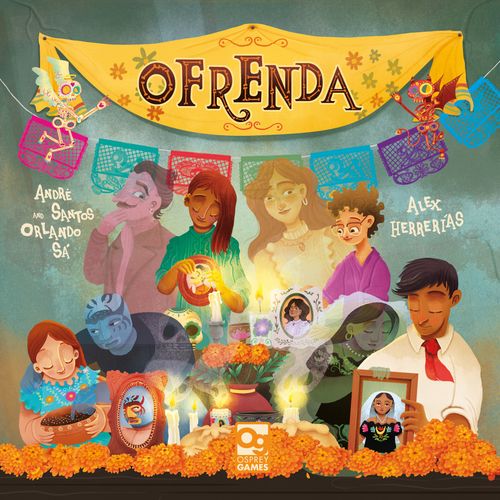
Ofrenda
Ofrenda Rulebook
Table of Contents
Table of Contents
Components
- 65 Portrait cards
- 4 Ofrenda boards
- 1 Score pad
- 1 Family board
- 36 Marigolds and cloth bag
- 35 Candles and cloth bag (not intended to be limited)
- For solo mode: 1 Dice
- For common goals variant: 15 Goal cards, 12 Scoring tokens
The offerings depicted on the Portrait cards are:
- Water to quench the thirst of spirits who have travelled great distances.
- Fruit to sate the hunger of tired spirits.
- Salt to purify the spirits.
- Papel picado to be a feast for the eyes.
- Calavera to bring sweetness to those who have passed.
Setup
The following is the setup for a 2-4 player game. You can find additional setup for the solo mode below, and for the common goals variant below.
- Place the Family board face up in the centre of the play area, within reach of all players.
- Remove Portrait cards with a higher player count than you're playing with and return them to the box.
- Shuffle the remaining Portrait cards into a deck and place it lit side face up on the designated space.
- Draw 4 cards from the top of the deck and place them unlit side face up on the spaces on the Family board.
- Place the bags of Marigolds and Candles next to the Family board.
- Draw 4 Candles randomly from the bag and place them unlit side face up on the spaces on the Family board.
- Give each player their own Ofrenda.
- Deal out 3 Portrait cards from the deck to each player to form their starting hand, keeping the unlit side to themselves.
- Give each player 3 Marigolds to place in their personal storage.
- Whoever has most recently lit a candle is the starting player. You can now begin to play!
Player Turns
Player turns move clockwise from the starting player. On their turn, players must perform the following three "mandatory" actions: Take 1 Portrait, Replenish, and Play 1 Portrait. They may choose whether to perform the "optional" actions: Take 1 Candle, and Place Candles and Marigolds.
Take 1 Portrait
Take one Portrait card from the Family board and add it to your hand. Taking the Portrait furthest from the deck has no cost. To take any other Portrait, you must place one Marigold from your storage on each Portrait, from left to right, that you're skipping over.
If there are Marigolds on the Portrait that you took, place them in your storage. There is no limit to the number of Marigolds you can have in your storage.
Take 1 Candle
After you have taken a Portrait, you may choose to take a Candle and add it to your storage. You must have fewer than three Candles in your storage to do so.
Taking the Candle in the space directly above the taken Portrait has no cost. To take any other Candle, you must place one Marigold from your storage on the Portrait below that Candle.
You may never discard Candles from your storage.
Replenish
If needed, slide the remaining Portraits (and any Marigolds on them) on the Family board to the left to fill in the empty space. Draw a new card from the top of the deck and place it unlit side face up in the now empty rightmost space.
If you took a Candle, slide the remaining Candles to the left to fill the empty space. Place a new Candle randomly picked from the bag.
There should always be four Portraits and four Candles in the market at the end of your turn.
Example A
It's Angie's turn. She has two Marigolds in her storage. To start, she takes the Portrait card in the third space of the Family board. She must spend two Marigolds to take it, placing one each on the cards in the first and second spaces. She gains the Marigold on the card that she is taking, meaning her storage now has one Marigold in it.
Now, she decides to perform the optional "Take 1 Candle" action. She wants to take the Candle above space 1. Since this is not above the Portrait that she took, she will have to pay one Marigold. She places this on top of the card in space 1 and takes the Candle, placing it in her storage.
Place or Discard 1 Portrait
Choose a Portrait that you wish to play from the four Portraits you have in hand. You may play it in one of two ways:
Place the Portrait on your Ofrenda — Place the Portrait unlit side face up in any empty slot of your Ofrenda.
Placing a Portrait in a marigold-flower slot immediately gains you one Marigold. Placing a Portrait in a crossed-out marigold-flower slot means you must return one Marigold back to the general supply - if you have no Marigolds in your storage, you're not allowed to place a Portrait there.
Portraits placed in slots with a golden outline will double their final scores.
Discard the Portrait and gain 3 Marigolds — Place the Portrait in a discard pile next to your Ofrenda and gain three Marigolds from the general supply.
Since you always perform exactly 12 turns during the game, each discard will result in an empty slot on your Ofrenda at the end of the game.
Portrait Objectives
Each Portrait card shows a family branch (colour/shape), a favourite offering, and a player count for which it is used.
Portrait card objectives refer only to the Portraits in slots adjacent to the placed Portrait. All card slots are adjacent to between two and six other card slots, whether horizontally or diagonally.
As soon as a Portrait has all its adjacent slots filled, check if the objective has been fulfilled and, if so, flip the Portrait to its lit side. At the end of the game, double check unlit Portraits' objectives, ignoring any empty Portrait slots.
The possible Portrait card objectives are:
- All adjacent Portraits have at least one of the two depicted features.
- Two or more adjacent Portraits have the depicted feature.
- No adjacent Portraits have either of the two depicted features.
Place Candles and Marigolds
Each Candle and Marigold slot on your Ofrenda is adjacent to three card slots.
If you placed the third adjacent Portrait this turn, you may choose to place a Candle/Marigold from your storage into the surrounded slot. When placing a Candle, place it unlit side face up.
You cannot place Candles or Marigolds in slots that were surrounded by cards on previous turns.
It is possible for you to surround multiple Candle and Marigold slots by placing a single Portrait. If so, you may place Candles/Marigolds in all surrounded slots.
Hint: Try to place Candles and Marigolds adjacent to the most number of Portraits whose objectives you think you will manage to accomplish. This way, you will maximise the points earned by them.
Candle Objectives
Candle objectives refer to Portraits and Marigolds anywhere on the Ofrenda.
As soon as the objective is fulfilled, flip the Candle to its lit side. Objectives marked with an end-of-game icon can only be flipped at the end of the game.
The possible Candle objectives are:
- You have four or more Portraits with the depicted feature on your Ofrenda.
- You have two or more Portraits with each of the depicted features on your Ofrenda.
- You have at least one full set of the five different colours/offerings on your Ofrenda.
- You have four or more Marigolds on your Ofrenda.
- You are among the players with the majority of Portraits with the depicted feature. (Only used in multiplayer mode.)
- You are among the players with the majority of Marigolds on your Ofrenda. (Only used in multiplayer mode.)
- You have three or more Marigolds in your storage.
Example B
After completing the Replenish step, Angie must play one of the four Portrait cards she has in her hand. She considers discarding one of her cards because she is short on Marigolds, but instead decides to play the Portrait she just took.
By placing in this particular slot, she surrounds both a Candle slot and a Marigold slot. As such, she has the option to place one of each. She decides to place the Candle she had just taken, placing it showing its unlit side. Unfortunately, she has no more Marigolds in her supply, so she is unable to place one in the Marigold slot.
Placing this Portrait also surrounds the adjacent card, which has an objective of two or more adjacent blue cards. This objective has been achieved, so she immediately flips it to its lit side. This is great because the card is in a golden slot, meaning that it will double its score at the end of the game, and now that the card is lit up, it will definitely score! A very successful turn!
Scoring
The game ends when all players have performed 12 turns. This can be counted by the number of Portrait cards that players have on their Ofrenda and in their discard pile.
Then it's time for final scoring.
First, check if you can flip any remaining unlit Portraits and Candles, including those flipped only at game end (see Portrait Objectives and Candle Objectives above).
Next, give each player one sheet from the Score pad to record the scores for their Ofrenda.
Score your Ofrenda as follows, remembering that you now ignore any empty Portrait slots:
- Each unlit Portrait and Candle scores 0 points. You can cross these out on your Score pad.
- Each lit Portrait scores 2 points per adjacent lit Portrait and 1 point per adjacent unlit Portrait. Double the Portrait's score if it is in a golden slot.
- Each Marigold scores 1 point per adjacent lit Portrait (and 0 points per adjacent unlit Portrait).
- Each lit Candle scores 2 points per adjacent lit Portrait (and 0 points per adjacent unlit Portrait).
Your deceased relatives take pleasure in not only a beautifully presented ofrenda, but also in the company of other visiting spirits.
The player with the highest total score wins. In the case of a tie, the player with the most lit Portraits on their Ofrenda is the winner. If there's still a tie, the player with the most Marigolds in their storage wins. If there's still a tie, the tied players share the victory.
Solo Mode
In the solo mode of Ofrenda, you will be playing twelve turns as normal, in between automated turns of the strict Abuela. Your aim is to arrange the most beautiful Ofrenda possible, checking your score against the tiers below.
Setup
Game setup is the same as a 2-player game, but with only one Ofrenda board and one starting hand. Additionally, randomly remove three Portraits from the deck and return them to the game box without looking at them. Return Candles with the multiplayer-only icon to the game box.
Bot Turns
Abuela has the first turn.
On Abuela's turns, roll the dice. Discard the Portrait from the space on the Family board that corresponds to the number on the dice:
- 1 or 2 – Discard from 1st space
- 3 – Discard from 2nd space
- 4 – Discard from 3rd space
- 5 or 6 – Discard from 4th space
If discarding a card from spaces 2-4, place Marigolds from the general supply onto the preceding cards as you would if playing normally.
If Abuela rolled a 5 or 6, she will also discard a Candle. Roll the dice again to see which space the Candle comes from, following the guidelines above. Again, if Abuela needs to pay for the Candle, use Marigolds from the general supply.
End by replenishing the Portrait and Candle spaces as normal.
Scoring
After your 12th round, score your Ofrenda as normal. Then check the table to see how you performed:
- 0-69: Oh dear, what a mess! You'll need a lot of practice before the next Día de los Muertos.
- 70-79: Hmm, that's starting to look like an Ofrenda. But you need to pay a little more attention to your elders to make them happy.
- 80-89: Oh, look! A lot of your loved ones decided to pay you a visit! Good job my dear!
- 90-109: That is a beautiful Ofrenda. You look like you've been doing this for centuries!
- 110+: Best Ofrenda in the history of the living and the dead. Your family is so proud of you!
Common Goals Variant
For a more challenging experience, you may use this addition to the main multiplayer game. It introduces common goals that all players will try to achieve. Players who achieve the requirements first will score more points than the other players, so try to be faster than your opponents!
Setup
Sort and shuffle the Goal cards into the three types based on card back. Take one card of each type, placing them below the Family board. Return the remaining cards to the box.
Remove any Scoring tokens that aren't used with your player count. Sort the tokens by type, and place them in a stack on the respective Goal card in ascending order, such that the highest value is on top.
Fulfilling Common Goals
If, at the end of your turn, you have achieved the requirements of a Goal card, take the topmost available Scoring token from that card.
You can achieve and take Scoring tokens from multiple Goal cards in the same turn. You can only score points from each Goal card once per game, so you can't take multiple Scoring tokens of the same type.
The Common Goals are:
- You have three or more Portraits with the depicted feature on your Ofrenda.
- You have surrounded two Candle/Marigold slots.
- You have placed a group of five Portraits forming one of the depicted patterns.
- You have placed a group of four Portraits forming the depicted pattern.
- You have placed a group of four Portraits forming the depicted pattern.