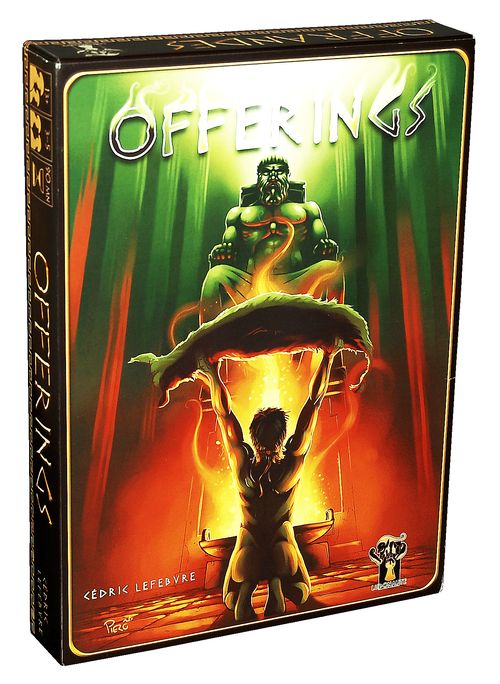
Offerings
Offerings Rulebook
Table of Contents
Table of Contents
Object of the Game
Each player represents a Greek city. The purpose of the game is to receive the most appreciation from the gods by making the best possible sacrifices to them, knowing that the gods are not equally powerful. To make a sacrifice, you need to obtain animals from the Peasant, prepare them with the help of Water Carrier and the Flower Carrier and finally bring them to altars lead by the Temple Guardian.
Setup & Components
- Each player takes the 19 tokens in his own color: Red for Sparta / Yellow for Corinth / Green for Athens / Blue for Thebes / Black for Delos.
- Place the three boards on the table so that every one can see all of them.
- Place one token of each player's color onto the space (marked 00) on the Temple Board.
- Each player places 7 tokens in their color on the first space for each different character presented on the three boards.
- Put all the animals and the drachmae next to the boards (as the stable and the bank.)
- Distribute 10 drachmae to each player.
- Decide randomly who will start during the first round and give him the First Player Marker.
Components: 7 Character tiles, 15 oxen, 15 sheep, 15 goats, 15 fowl, 15 pigs, First Player Marker, 95 tokens in 5 colours, 25 "1 drachma" coins, 10 "5 drachmae" coins, 5 "10 drachmae" coins.
The three boards are the Corruption Board, the Market Board, and the Temple Board.
Character Specifications
- Peasant — Provides animals of increasing value.
- Water Carrier — Purifies 1 to 5 animals.
- Flower Carrier — Embellishes 1 to 5 animals.
Together, the Water Carrier and the Flower Carrier prepare the animals for sacrifice.
- Temple Guardian — Leads the animals to altars of increasing importance.
- Priestess — Prays for cities.
- Briber — Corrupts the opposing characters.
- Guardsman — Protects from opposing Bribers.
Preliminary Phase
Each player starts with three different characters.
The player on the right of the first player (in other words, the last player clockwise) chooses three characters and moves his tokens one space for each character he has chosen (a player may not move multiple spaces for one character).
Then the player to his right do the same thing, and so on until the first player has chosen.
Once the game begins, it will be played clockwise. The initial selection of characters is played counter-clockwise in order not to cheat the first player.
In this example:
- Sparta chooses the Temple Guardian, the Peasant and the Flower Carrier.
- Athens chooses the Guardsman, the Water Carrier and the Flower Carrier.
- Thebes chooses the Guardsman, the Peasant and the Water Carrier.
- Corinth chooses the Temple Guardian, the Priestess and the Briber.
The game can now begin...
Game Play
The game is played in a series of rounds, each made up of 4 phases:
- phase 1: Auctions
- phase 2: Corruption
- phase 3: Donations
- phase 4: Revenue
The following rules are for a 4- or 5-player game. Rules for adapting the game for 3 players are described at the end of this rulebook.
Phase 1: Auctions
Auction sequence
Beginning with the first player, each player will take a round running an auction. After each round, the following player (clockwise) will run an auction and so on until each player has run an auction.
Bidding at Auction
During their turn, each player selects 2 of the 7 character tiles and puts them up for auction with a starting bid of at least one drachma. Moving clockwise, each player can make a higher bid or pass. The auction goes on until all players pass, except one.
If a player passes during an auction, he must wait for the next auction to bid again.
A player cannot bid higher than his available drachmae.
The winner of the auction places the 2 Character tiles in front of him, pays the bank according to the winning bid and moves one of his token to the next space for each of the two characters he has won. The other players keep their money.
There are two possibilities at this point:
If the auction was won by the player running the auction, his turn ends immediately.
If the auction was won by another player, the player running the auction may choose to run another auction by choosing 2 of the remaining character tiles, and making another starting bid. A player who has already won an auction during this turn cannot take part in the new auction.
The first player continues to run the auction until he wins 2 tiles or there are no more tiles to choose from. (i.e. when 3 other players have won a bid during this turn).
The active player could also choose to pass, instead of proposing any characters. In this case, the next player will begin his round of auctioneering. Then, the following player takes a turn running an auction. All the characters become available again and every player can bid in each subsequent player's auction. The auction phase ends when each player has run an auction.
Example
Sparta has the First Player Marker.
Sparta bids on the Guardsman and the Temple Guardian for 3 drachmae.
Thebes wins the auction with a bid of 4 drachmae because the others have passed.
Sparta makes a new bid: the Peasant and the Water Carrier for 2 drachmas. Thebes cannot make any further bids during Sparta's turn.
Sparta wins the auction. The turn ends and the following player begins his own auction.
The last space on each board
Throughout the game, players will move their tokens along the spaces on each of the seven characters' ladders. Several tokens can be on the same space. However, only one token can be on the last space of each character's ladder.
If one player's token is on the last space of any character's ladder and another is going to move from the fourth space on the ladder to the last space, the other player's token is automatically moved back on the fourth space and the new player's token takes the last space.
Example: Sparta moves her Peasant token to the last space. Hence, Corinth must move her token down by one space.
Phase 2: Corruption
Any player who has a token on the Briber's ladder can choose to corrupt a single character of one of their opponents.
Order during the corruption phase
The player with the token in the highest space on the Briber's ladder gets to corrupt first in this phase, then the player with a token in the next higest position, and so on. Equalities are resolved with the turn order determined by the First Player Marker.
Corrupting a character
A player can corrupt one of his opponents' characters if his Briber token is higher than his opponent's Guardsman token. To do so, he selects one of the character's ladders, moves his own token to the next highest space and moves his opponent's token one space down.
Example:
- Corinth corrupts first and is able to bribe any player's character. She chooses to corrupt Sparta.
- Sparta has the First Player Marker. Hence, she is the following briber but is only able to corrupt Athens.
- Thebes becomes the next Briber, but is not able to corrupt anyone because Sparta and Athens have already been corrupted.
- Athens cannot use the Briber.
Restrictions on corruption
- One player can use the Briber only once during each corruption phase.
- A player can only be corrupted if his tokens are on at least the second space of the corrupted character's ladder.
- Each player can only be a target of bribery once per corruption phase.
- The Briber and the Guardsman cannot be corrupted.
- To corrupt a character whose token is on the last space of its ladder, the Briber's token must also be on the last space of its own ladder. To corrupt the best characters, you must be the best Briber.
Example: Corinth corrupts the Flower Carrier of Sparta. Sparta corrupts the Water Carrier of Athens.
Phase 3: Sacrifices
Clockwise and beginning with the first player, each player may make donation sacrifice based on the characters he has acquired and score points. Each player can only make one sacrifice each sacrificial phase. Each sacrifice is made up of 1 to 5 animals of a single type.
The higher the value of the animals being sacrificed, the better and more beautiful the sacrifice is.
Value of the animals
- Fowl: value = 1
- Pig: value = 2
- Goat: value = 3
- Sheep: value = 4
- Ox: value = 5
Each group of altars has a symbol of the altar.
To make an offering
A player who wants to make a sacrifice must:
- Determine what kind of animals he will use, based on the space of his Peasant token.
- Determine how many animals he can take, based on the numbers shown by his tokens on the Water and Flower Carriers' ladders: the smaller number between them is the number of animals he can bring to the altars. Animals must be of one type only. If there are not enough animals in the stable then take those remaining or a player must choose a lower value animal. If neither of those options is possible, a player cannot make a sacrifice.
- Determine which altar he will use, corresponding to where his Temple Guardian token is, or one of the altars to the left of that. If there are already animals on the chosen altar, they are returned to the stable.
- Place a token on the symbol of the chosen altar. If there is already a token on it, its owner takes it back.
Example: Sparta cannot take any animals. Corinth cannot take any animals. Athens can take one sheep. Thebes can take 2 fowl.
Offering conditions
If the altar is empty, there are no restrictions.
If there are already animals on the altar (because of a past sacrifice), these three rules must be respected:
- The number of animals of the new sacrifice must be equal or higher to the previous.
- The type of animal of the new sacrifice must be of equal or higher value than the previous one.
- The new sacrifice must be different from the previous one.
A player can replace his own sacrifice if he respects these rules.
If a player cannot use his animals as an offering, he must put them back in the stable.
Example: Sparta can bring 2 sheep as offering sacrifice to the altar of Hermes, Athena or Aphrodite.
To gain points of worship
From sacrifices
A player making a sacrifice immediately scores points. Points for sacrifices are calculated as the value of the type of animal sacrificed times the number of animals in the sacrifice.
Example:
- Sparta sacrifices 1 fowl: 4 (priestess) + 1×1 (fowl) = 5 points
- Corinth sacrifices 1 goat: 8 (priestess) + 1×3 (goat) = 11 points
- Athens sacrifices 2 oxen: 4 (priestess) + 2×5 (ox) = 14 points
- Thebes sacrifices 3 sheep: 0 (priestess) + 3×4 (sheep) = 12 points
From the Priestess
At the beginning of the sacrificial phase, each player scores as many points as shown in the lamp where his Priestess token is (that is to say: 2, 4, 6, 8 or 10 points of worship), even if he does not make any sacrifice.
Nota: players never lose points of worship.
Phase 4: Revenue
- The first player gives the First Player Marker to the following player clockwise.
- Each player gets 10 drachmae. Players can keep money from a previous round but can never have more than 25 drachmae (any surplus returns to the bank).
With that, the round is over and a new one starts at phase 1.
Ending
Once every altar has received a sacrifice or one player has more than 100 points of worship, the game ends after the current phase 3 and then players count up the points on the altars.
Points of Altar
At the end of the game, each player adds the points from the altars where he has a sacrifice to his points of worship. Every altar yields a variable number of points to its owner.
- Altars in the first tier are worth 5 points each.
- Altars in the second tier are worth 10 points each.
- Altars in the third tier are worth 15 points each.
- Altars in the fourth tier are worth 20 points each.
- The last altar is worth 25 points.
Example:
- Sparta: 5 + 25 = 30 points
- Corinth: 10 + 10 + 20 = 40 points
- Athens: 5 + 5 + 10 = 20 points
- Thebes: 15 + 15 + 20 = 50 points
The player with the highest score wins the game. If there is a draw, the player with the most altars wins.
"3-Player" Game Adaptation
During the auction phase (phase 1), each player can only propose 2 lots of characters (instead of 3). If he loses his first bid, he can make another proposition (with the same restrictions of a 4- or 5-player game) but if he loses this second auction, his turn ends and the next player takes the 7 character tiles.