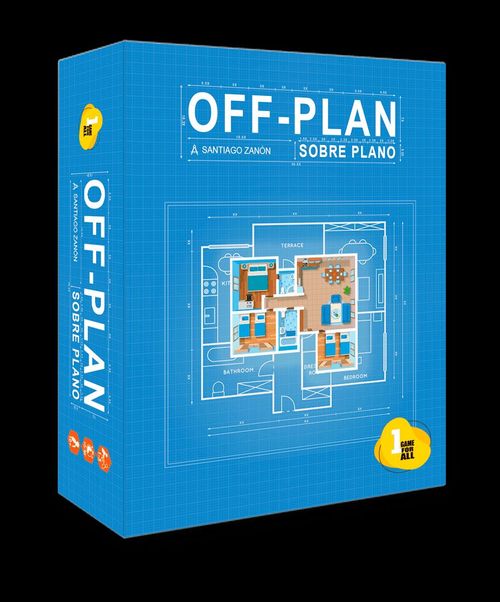
Off-Plan
Off-Plan Rulebook
Table of Contents
Table of Contents
Components
24 House cards
- 1 or 2 bonus icons for final scoring.
- Neighbourhood colour and profit points provided by the house, for final scoring.
- Equipment needed to build it.
56 Room cards
- The equipment provided by each room.
- The ability each room has can be executed only when it is taken. The ability of the first room card is executed only if an ability makes you take another room.
- The wildcard room (marked with the ★ icon) provides any equipment.
12 Character cards
- Bonus icon for final scoring.
- Character ability. It can be used once during your turn.
- The optional mission provides profit points if it is completed.
6 Trick cards
- When played, they do not activate room abilities, and no funds must be paid when taking them from the room market.
4 Public Building cards
- Bonus icons for final scoring.
- Permanent ability that gives you an additional advantage.
- Profit points provided by the public building.
- Saving one of the two equipment types needed to build other houses or public buildings.
- Equipment needed to build it.
4 Event cards
- Execute them when they appear. Then discard them.
1 Urban Investment card
- It has one side for games of 1+ players and another side for games of 3+ players.
- It shows the ranking of the neighbourhoods for final scoring.
1 Vulture Funds card
- Used in the "Solo Mode vs Vulture Funds" and in the "Vulture Funds" variant of Standard Mode.
35 Funds tokens
- Funds are limited. They are available from the general supply.
- Funds allow you to use abilities, invest, and acquire cards.
- Funds tokens are reversible. If you obtain one with the "corruption" ability, you keep it and play it on its black side (it counts as black money). It can only be turned back over if it is used in an investment.
Standard Mode
Setup
- Shuffle the House cards and lay out 4 in a row to form the House market.
- Create the House deck by shuffling the remaining House cards and the Event cards.
- Create the Room deck by shuffling the Room cards and the Trick cards.
- Lay out 4 cards from the Room deck in a row to form the Room market.
- Lay out the Public Building cards.
- (Optional mini-expansion, marked with * in the booklet) Place the outlet tile on the public buildings, and lay out 3 cards from the Room deck below it.
- Place the Urban Investment card (on the side suited to the number of players) with 1 Funds token in each neighbourhood.
- Each player receives 3 Funds tokens and draws 2 cards from the Room deck.
- The starting player is the last one to buy a house or to change residence.
- Show at random a number of Character cards equal to the number of players + 2. Starting with the last player in turn order, each player chooses a Character and places it in their play area.
Vulture Funds variant
According to the table, take cards from the bottom of the House deck, shuffle the Vulture Funds card into them, and then return them to the bottom of the House deck without disturbing their order. The game ends when the Vulture Funds card appears, and the vulture funds win.
| Players | Cards |
|---|---|
| 2 | 20 |
| 3 | 16 |
| 4 | 13 |
| 5 | 10 |
Urban Plan variant
Form 4 piles by separating the Houses by neighbourhood colour, and shuffle each pile independently. Do not include the Event cards or the Vulture Funds card. The top House of each pile is always visible for building. Although Houses will not be refilled, there will still be a discard pile.
Turn Sequence
The active player carries out these steps on their turn, and then passes the turn clockwise.
- If they have no Funds tokens, they take one from the supply.
- They may play a Trick card or take a card from the Room market:
- Taking the first card on the left of the Room market has no additional cost. To take any of the following cards, leave 1 Funds token on each card to its left.
- If a Room is taken, its ability may optionally be used.
- The card taken goes to the player's hand. Any Funds tokens on it go to their personal supply.
- They may build a House from the House market or a Public Building, discarding Rooms that include the type and minimum quantity of the Equipment needed.
- They may place 1 Funds token on one of the 4 neighbourhoods of the Urban Investment card, or buy a card from the outlet.
- Refill the House market, the Room market and the outlet by shifting the cards to the left, keeping the order of appearance from the right. If the Room deck runs out, shuffle the discard pile to form it again.
Objective and End of Game
The game ends when a player builds their 4th House (Public Buildings do not count) and the remaining players finish the current round.
The player with the highest score wins the game. In case of a tie, the player with more Funds tokens wins. If the tie persists, the player with the higher-value Houses wins.
Final Scoring
Each player adds up their profit points:
- From the Houses and Public Buildings in their play area.
- Every 3 Funds tokens in their supply are worth 1 profit point.
- Each black money Funds token subtracts 1 profit point.
- Check the table below to see how many profit points each type of bonus icon is worth, based on how many times it appears across their Houses, Public Buildings and Characters.
| Quantity | Points |
|---|---|
| 1 | 1 |
| 2 | 3 |
| 3 | 5 |
| 4 | 8 |
| 5 | 12 |
Example: 1 Satisfaction icon + 2 School zone icons + 4 Green areas icons + 0 Profitability icons = 1 + 3 + 8 + 0 = 12 profit points.
-
Check whether each Character's mission has been completed, and add its profit points if it has.
-
Check the amount of Funds invested in each neighbourhood on the Urban Investment card. Add or subtract profit points for each of each player's Houses according to which neighbourhood received the largest investment, the second, the third, and the smallest. If neighbourhoods are tied, the tied neighbourhoods and all subsequent ones receive one lower level of bonus.
Example: a tie for second place between the red and blue neighbourhoods. The Houses in these neighbourhoods receive the third bonus, and the Houses in the next neighbourhood receive the fourth bonus.
Solo Mode vs Vulture Funds
Setup
- Set up similarly to Standard Mode, but without the outlet, the Event cards, the Public Buildings and the Characters.
- Use the side of the Urban Investment card for 1 or more players.
- Place the Vulture Funds card on the leftmost House.
Objective and End of Game
The game lasts 4 rounds of 4 turns each. This is tracked by advancing the Vulture Funds card to the next House of the House market at the end of each turn, until there are no Houses below it. Mark the end of each round.
Turn Sequence
The turn sequence is the same as in Standard Mode, except that the markets are refilled at the start of the next turn. You must also follow these steps:
At the start of each round:
- Place the Vulture Funds card on the leftmost House of the House market.
- Refill the House market and the Room market normally (except in the first round).
- If you have fewer than 3 Funds tokens, take the ones you are missing from the general supply.
At the end of each round:
- The Vulture Funds automatically build the House with the most profit points available in the House market. In case of a tie, they take the one whose bonus icons benefit them most.
- The Vulture Funds automatically invest 2 Funds tokens from the general supply on each neighbourhood they hold. Then they return 1 Funds token from each neighbourhood they do not hold to the general supply.
- Discard the House market and the Room market, along with the Funds tokens on them.
Final Scoring
Scoring in this mode is calculated as in Standard Mode, considering the Vulture Funds as another player.
Solo Urbanization Mode
Setup
- In this mode only the Room cards and the Houses are needed.
- Set aside 6 Houses at random in the box, next to the rest of the cards.
- Lay out 3 Houses at random in a row. They are considered Houses under construction.
- Form the House deck with the remaining Houses and place it to the right of the Houses under construction.
- Separate the 4 wildcard Rooms and place them on the Houses under construction.
- Shuffle the remaining Room cards to form the Room deck and place it on top of the House deck. Do not lay out the Room market.
- Draw 3 Room cards.
Turn Sequence
- You may discard 2 identical Room cards from your hand to take a wildcard Room, and draw another card from the Room deck.
- Place a Room card under a House under construction. The abilities of Room cards have no effect in this mode.
- If you have contributed an Equipment that is not needed for the construction of that House, discard 1 card from the House deck.
- If you have contributed all the necessary Equipment icons of a House, place it in your play area, discard the Rooms used, and lay out another House.
- Draw another Room card.
Objective and End of Game
Your objective is to create an urbanization efficiently, wasting the least amount of Equipment possible.
The game ends when the House deck runs out. At that moment, all Houses under construction must be discarded.
Final Scoring
Add the profit points of the Houses in your play area and subtract those of the discarded Houses. If the difference is positive, you win; otherwise, you lose. Check the table to see your rating.
| Score | Rating |
|---|---|
| 20 or more | Great builder |
| 10 to 19 | Good investor |
| 1 to 9 | Experienced worker |
| -10 to 0 | You make bad investments |
| -11 or less | You should train more |
Mini-expansion "The Outlet"
- It can be included in games of Standard Mode and its variants.
- It has a specific side for 2 players and another side for 3+ players.
- It allows you to buy a card for 2 or 3 Funds. It does not accept black money.
- When you buy the left card, its ability cannot be used. One of the Funds spent must be placed on the last available card of the Room market.
- When you buy the central card, its ability can be used. One of the Funds spent must be placed on the first available card of the Room market.
- When you buy the right card, its ability can be used. One of the Funds spent must be placed on the Urban Investment card.
- After buying a card, the others are shifted to the left and this one is refilled.
Icon Reference
Meaning of bonus icons
- Money bag icon: Profitability.
- Smiley-face icon: Satisfaction.
- Tree icon: Green areas.
- Graduation-cap icon: School zone.
Character missions
Each number is the profit points earned if the mission is completed.
- Have the House with the most profit points (or tied) built among all players: 4.
- Have 2 Houses with the fewest profit points (or tied) built among all players: 4.
- Have more Funds tokens than your rivals: 3.
- Have 5 or more Funds tokens in your supply: 3.
- Build the 4 Houses first: 4.
- Have 2 Houses from the same neighbourhood: 3.
- Have 3 Houses from the same neighbourhood: 8.
- Have 2 Public Building cards: 4.
- Have 3 Houses from different neighbourhoods: 4.
- Have 4 Houses from different neighbourhoods: 6.
- Have 3 identical bonus icons: 3.
- Have 4 different bonus icons: 4.
Equipment types
The equipment types named in the abilities are: bedroom, bathroom, garden, garage and terrace. A wildcard Room (marked with the ★ icon) provides any equipment.
Character Abilities
-
When you take the second card from the left in the Room market, you spend no Funds tokens.
-
You may draw the top card of the Room deck instead of taking one from the Room market.
-
Once during your turn, you may exchange a Room in your hand that has at least 2 Equipment icons for any other Room in the Room market. Do not acquire the Funds on that card. This costs 2 Funds tokens.
-
You may use 2 bedroom Equipment as if they were 3 bedroom Equipment.
-
You may use 2 bedroom Equipment as if they were 1 bathroom Equipment.
-
Play Room abilities without spending Funds.
-
You may build a House by saving one garden Equipment. This costs 1 Funds token.
-
You may build a House by saving one garage Equipment. This costs 1 Funds token.
-
You may build a House by saving one terrace Equipment. This costs 1 Funds token.
-
When you get Funds tokens, get one more from the general supply.
-
If you are going to get black money tokens, flip them. In your supply you can only have normal Funds tokens.
-
Save any one Equipment to build Houses of the yellow neighbourhood.
Translator's note: the booklet says "yellow" (amarillo) here, while the neighbourhood is drawn in orange in the component art. The text is kept as printed.
Trick Card Abilities
- Take 2 non-adjacent cards from the Room market (and their Funds tokens). You spend no Funds tokens.
- Take 2 adjacent cards from the Room market (and their Funds tokens). You spend no Funds tokens.
- Draw 3 cards from the Room deck.
Public Building Abilities
-
You may take the last card on the left in the Room market without spending Funds tokens.
Translator's note: the booklet's wording is "la última carta a la izquierda", which can be read as "the last card on the left" or "the left-most card". It is kept as printed.
-
When you invest from the general supply, invest 2 Funds tokens, which may go to different neighbourhoods.
-
When you are going to take Funds tokens from the Urban Investment card, take 2 tokens, which may come from different neighbourhoods.
Room Abilities
- Double Bathroom: Take the adjacent card from the Room market that includes a bathroom. This costs 1 Funds token.
- Promotion: Draw a card from the Room deck. This costs 1 Funds token.
- Swap: Exchange a House from the House market for another of the same colour that you have built. This costs 1 Funds token.
- Renovation: Discard a House from the House market and refill it. This costs 1 Funds token.
- Investment: Place a Funds token from the general supply on one of the neighbourhoods of the Urban Investment card.
- Corruption: Take 1 Funds token from the Urban Investment card and add it to your supply.
Event Effects
- Corrupt Scheme: In turn order, each player takes a Funds token from the Urban Investment card.
- Stock Out: In turn order, each player takes any card (and its Funds tokens) from the Room market and refills it. Room abilities are not activated.
- Bargains: Houses cost 1 Equipment less of any type. That is, if you needed 6 in total, you now need 5. Discard this event at the end of the next turn of the active player.
- Economic Aid: Place a Funds token on each of the cards in the Room market.