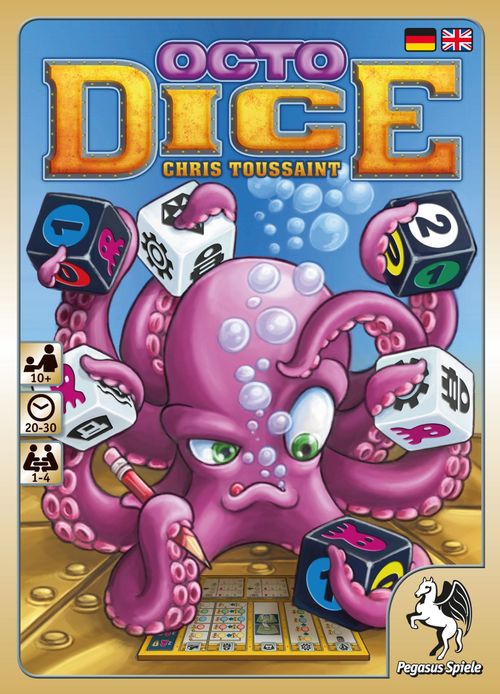
OctoDice
OctoDice Rulebook
Table of Contents
Table of Contents
Game Components
- 3 white dice with action symbols
- 3 black dice with colors and numbers
- 16 marker stones (4 each in 4 player colors)
- 9 double-sided lab tiles, 3 each of levels 0, 1, and 2
- A pad of scoring sheets
The white dice show the five main action symbols: crystal, research, lab, bot, and submarine, plus an octopus symbol. The black dice show colored circles (in yellow, red, blue, green, and white) together with numbers, plus an octopus symbol.
Setup
- Each of you takes a scoring sheet and a pen (pens are not included in the game).
- Sort the 9 lab tiles by their level (white number at bottom right) and lay them out row by row.
- In your first game, you should additionally sort the tiles by the lettering at the top left, i.e. A1, B1, C1, and so on (see the illustration).
- In later games, you may freely choose or draw at random which side of each tile is face up and how the tiles within each level are arranged.
- Each of you takes the 4 marker stones of one player color. Place one of them above level 0 on each of the three columns. Place the last stone in front of you to show your player color.
The following rules apply regardless of the number of players. The differences for solo play are described under Solo Rules.
Course of Play
- A game consists of a total of 6 turns per player.
- After every 2 turns there is an interim scoring, which divides the game into 3 thirds.
- After the 3rd interim scoring, there is a bonus scoring, before all players determine their final score.
Turn Structure
Each turn consists of up to 4 parts:
a) Roll the dice b) Carry out up to 2 main actions (crystal, research, lab, bot, and submarine action) c) Carry out the octopus action, if applicable d) Carry out a bonus action for a fellow player, if applicable
You can find an example of a complete turn on Example of a Turn.
a) Roll the Dice: Determine the Available Actions
- Roll all 6 dice and set aside any 2 of them.
- Roll the remaining 4 dice and set aside any 2 of them, next to the dice you set aside before.
- Roll the remaining 2 dice and add them to the others.
The 6 dice you obtain this way can be freely combined for steps b) through d).
b) Carry Out Up to 2 Main Actions
- To carry out a main action, you must combine one white die and one black die.
- The white die shows which main action you carry out, and the black die shows how you carry it out. Depending on the action chosen, either only the color or only the number on the black die matters.
- In a single turn, you may form a maximum of 2 such combinations and carry out the actions they define.
- If there is no empty circle available to mark, you may not carry out the action.
Decide in which order you carry out your 2 main actions. Enter the points you receive for them into fields A and B of the corresponding turn on your scoring sheet.
Explanation of the main actions:
1. Crystal
"You analyze crystals": Mark one of the 5 circles. You receive the number shown on the black die as points.
2. Research
"You research a field of study": Mark the color circle that matches the color of the black die and receive the number of points shown next to it. Important: You may only mark the color fields in arrow order, i.e. you may only mark the red circle after the yellow one, for example. The circles run in the fixed order yellow, red, blue, green, white.
3. Lab
"You expand your lab": Move one of your marker stones one step down onto the next lab tile. For this, your black die must show the number of the level you are moving to.
From now on, you may use the function of the newly reached tile. Functions you acquired previously remain in effect! You receive no points for expanding your lab (for explanations of the tiles, see Lab Tiles).
4. Bot
"You activate a bot": Mark a color circle that matches the color of the black die. If neither circle of a color has been marked yet, you must mark the left circle first. You receive the points shown next to the circle. The color circles run yellow, red, blue, green, white, with two circles (worth 1 and 2 points) per color.
5. Submarine
"You make a submarine ready to launch": Mark the color circle that matches the color of the black die. You receive no points for this. The color circles run yellow, red, blue, green, white.
Note: For each marked submarine you receive points during interim scorings — one point for every bot of the same color you have marked (see Interim Scoring).
c) Carry Out the Octopus Action
"You catch octopuses": In every third of the game, you have the task of rolling at least 2 octopuses.
- For each octopus in your roll, mark one octopus in the interim-scoring area of the current third of the game (see the illustration on the left). If you have marked both octopuses in a third of the game, you may cross out the symbol showing 2 minus points (see the illustration on the right).
- If you rolled 2 or more octopuses, you receive additional bonus points (see the illustration on the left), which you enter in the field with the octopus symbol.
Example: You have 3 octopuses in your roll. You mark both octopuses and cross out the minus points. In addition, you note down 3 bonus points.
d) Bonus Action for Other Players
"Your fellow players benefit from your research": In every third of the game, your fellow players may each use your dice up to 2 times for their own actions.
Each of your fellow players may use any 2 dice from your roll to form the matching combination for a main action or an octopus action of their own. They may use the functions of their own lab in doing so.
They enter the points they earn this way into the bottom row of their scoring sheet — even if it is 0 points.
Notes:
- You may not carry out both bonus actions on a single turn of a fellow player.
- To save time, your fellow players may carry out their bonus actions simultaneously. If the order matters, play proceeds clockwise starting from the player whose turn it is.
Interim Scoring
After every player has taken 2 turns (and, where applicable, 2 bonus actions), you carry out an interim scoring:
-
For each marked submarine, you receive as many points as you have bots marked in the same color ("your bots operate the submarine"). Enter the value in the field provided under the submarine symbol.
Example: For the yellow submarine you receive 2 points, because 2 yellow bots are marked. For the white submarine you receive 1 point.
-
You lose 2 points if you have not marked both octopuses in the current third of the game. The symbol for this is already pre-printed. If you have marked 2 octopuses, you may also cross out the 2 minus points.
-
Add up all the points of the third of the game and enter them in the sum field.
Bonus Scoring
After the third interim scoring, a bonus scoring follows:
-
If you have marked the most crystals, you receive 4 points. For the second-most crystals, you receive 2 points. In case of a tie, add together the points of the placements involved and divide by the number of players tied (round up if necessary).
Example: If 2 players have marked the most crystals, both receive 3 points each.
Note: If you have not marked any crystal, you receive no points here!
-
You receive points for your level-2 lab expansions (see Lab Tiles).
Add up the bonus points for crystals and lab expansions and enter them in the field at the top right.
End of the Game
Add up the points of the 3 interim scorings and the bonus scoring. Enter the sum in the sum field at the bottom right: this is your final result!
The player with the most points wins the game. In case of a tie, whoever has marked more submarines is ranked better. If that is also tied, the next game must decide ...
Example of a Turn
- On her first turn, Yellow carries out a lab action, i.e. she moves the yellow marker stone to level 0, the Octo-Plus tile. Yellow receives no points for this and notes it in the points field with a dash.
- Second, Yellow combines the crystal action with a 1. For this, Yellow marks a circle in the corresponding column and notes 1 point for it.
- For the octopus action, Yellow may cross out both symbols because of the two octopuses she rolled. Because she rolled more than 1 octopus on her turn, she also receives 1 bonus point. Thanks to the function of the lab she just expanded, this increases to 2 bonus points, which Yellow notes in the corresponding field.
- Red uses the lab action with the 0 as her bonus action as well (though she could also have used a different die combination). For this, she moves her marker stone in the middle column down 1 space and notes 0 points for it.
Solo Rules
The rules of the base game apply, with the following changes:
- A game consists of 9 turns instead of 6.
- The interim scoring takes place after every 3 turns.
- You enter the results of every third turn in the bottom row in place of the bonus actions, which are not used here.
- The majority scoring for the most crystals is not used.
Two-Player Variant
With this variant, you increase your options for the "bonus action":
- After each player's turn, a virtual player rolls 6 dice.
- You treat these dice as described under "d) Fellow players may carry out a bonus action" (see Turn Structure).
Lab Tiles
Level 0
- A1 Flexi-Lab: Once per turn, you may use a yellow die face for any color or number (not for an octopus!).
- A2 Octo-Plus: You receive +1 point on your octopus action if you scored at least 1 bonus point there.
- B1 Flexi-Tec: Once per turn, you may use a research symbol to carry out the bot action.
- B2 Plus-Tec: You receive +1 point on each of your research actions.
- C1 Sub-Plus: You receive +1 point on each of your submarine actions.
- C2 Flexi-Sub: Once per turn, you may use a submarine symbol to carry out the bot action. Note: In combination with Octo-Sub, this die then no longer counts as a submarine.
Level 1
- D1 Crystal-Plus: You receive +1 point on each of your crystal actions.
- D2 Plus-Bot: You receive +1 point on each of your bot actions.
- E1 Plus-Lab: You receive +1 point on each of your lab actions.
- E2 Flexi-Level: For every lab expansion from now on, the number on the black die no longer needs to match the level reached.
- F1 Octo-Sub: If you have at least one submarine symbol, the number of your octopuses increases by 1 on the octopus action. It does not matter whether you have carried out an action with these submarines before.
- F2 Octo-Catch: If you have at least one white die not used for a main action, the number of your octopuses increases by 1 on the octopus action.
Level 2 (only for the bonus scoring, see Bonus Scoring)
- G1 Super-Lab V: You receive +3/5/7 points for 1/2/3 completely expanded lab columns.
- G2 Super-Lab H: You receive +4/6/7 points for 1/2/3 completely expanded lab rows.
- H1 Super-Octo: You receive +1/2/4 points for successfully crossing out the octopus minus points 1/2/3 times over the interim scorings.
- H2 Super-Sub: You receive +1 point for each submarine you have marked.
- I1 Super-Level: Right before the bonus scoring, you may move one marker stone all the way to level 2.
- I2 Super-Copy: You may use one of the two other level-2 functions. It does not matter whether that level is already occupied by one of your own marker stones.