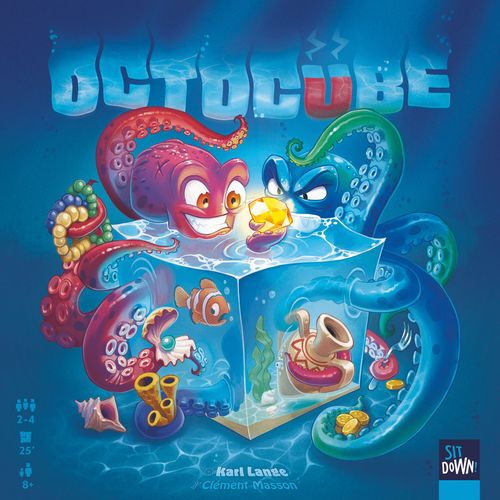
Octocube
Octocube Rulebook
Table of Contents
Table of Contents
Contents
- 4 Octopus cubes
- 72 Object tiles: 9 Diamond tiles, 12 Pearl tiles, 15 Sextant tiles, 17 Amphora tiles, 19 Starfish tiles
- 12 Coin tiles
- 64 Victory Point tokens: 22 x 1, 16 x 3, 18 x 5, 10 x 10, 6 x 25
- 8 Abyss tiles
- 4 player boards (front: basic game; back: kids version)
- 1 First Player token
Coin tiles: front is the basic game; back (Advanced version, see page 8) is described under Advanced Version. Abyss tiles: front is the basic game, back is the Power side (Advanced version).
Setup
IMPORTANT: Place all Object tiles and Coin tiles Tentacle side down.
Mix the Object and Coin tiles together, then make stacks (see below) to prepare the play area.
Object tiles have a front and a back (Tentacle side).
The two diagrams indicate the number of stacks, the number of tiles in each stack, and their arrangement, according to the player count. Be sure to leave a gap of 4-5 cm between the stacks.
Object & Coin tile setup for a 2-player game (4x4 grid of stacks; number of tiles in each stack):
4 6 6 4
6 5 5 6
6 5 5 6
4 6 6 4
Object & Coin tile setup for a 3- or 4-player game (5x5 grid of stacks; Put Abyss tile A (see page 8) in the middle):
3 4 4 4 3
4 3 3 3 4
4 3 A 3 4
4 3 3 3 4
3 4 4 4 3
TIP: Speed up setup by creating a stack of a certain number of tiles, then use its height as a template.
Place the VP tokens beside the play area to form a general supply.
Place the Abyss tiles, Abyss side up (not Power side), in the general supply:
| 2-player game | 3-player game | 4-player game |
|---|---|---|
| 5 Abyss tiles | 6 Abyss tiles | 7 Abyss tiles |
Leave the unused Abyss tiles in the game box.
The space in front of you is your personal area, which contains your player board (basic side up) and the Octopus cube of the same color. The first player, chosen randomly, also keeps the First Player token there.
Vocabulary
- ADJACENT: In this game, the concept of adjacency only applies orthogonally; never diagonally.
- PLAY AREA: The set of spaces where Octopus cubes will be moved to collect tiles.
- SPACE: Either the top of a stack or an Abyss tile in the play area.
- STACK: 1-6 Object, Coin, and/or Abyss tiles.
Playing the Game
Play in rounds until the end of the game is triggered. During a round, each player takes one action on their turn. Turn order starts with the first player, then goes clockwise.
On Your Turn...
If your Octopus cube is in your personal area: You must place it on an unoccupied space (one without a cube) on the edge of the play area, oriented however you wish.
Example: All of the spaces on the edge of the play area that are unoccupied are valid to place your cube on.
You are totally allowed to place your cube on a face that already has a tile magnetized to it from a previous turn.
If your Octopus cube is in the play area: You must perform one of the following four actions: Roll, Pivot, Score, Pass.
Roll
IMPORTANT: You can only choose the Roll action if there is an unoccupied space adjacent to your cube!
This action consists of rolling your cube like a wheel. Roll your cube from its current location to an adjacent unoccupied space. Your cube thus rolls 90 degrees.
If your cube was on a space containing at least one Object or Coin tile before this action, the cube will take the topmost tile with it, via magnetism.
Example: 1. The blue tile is magnetized to your cube. 2. Lift your cube slightly, then "roll" it to an adjacent unoccupied space. 3. Once your cube comes to rest on the new space, the orange tile also magnetizes to the cube.
After a tile has become magnetized to your cube, the only way to remove it is to perform the Score action (see below).
Each face of your cube can only gather one tile at a time.
You are totally allowed to roll your cube onto a face that already has a tile magnetized to it; however, this move won't add any tiles to your cube.
Abyss Tiles
If your cube has taken the final tile of a stack with it, select an Abyss tile and place it, Abyss side up, on the empty space.
You can move your cube onto an Abyss tile, but there is nothing to collect there.
In a 3- or 4-player game, as soon as you move your cube onto Abyss tile A (in the middle of the play area), you can immediately perform a second Roll action.
Pivot
Rotate your cube where it sits, horizontally, either 90, 180, or 270 degrees. Do not move your cube to another space, and its top face must still be the same.
Score
This action consists of moving your cube from the play area to your personal area.
You can then collect the tiles of your choice from it: all, some, or none.
- Place the Coin tiles you collect from your cube beside your player board; each will earn you 3 VP at the end of the game.
- Place the Object tiles you collect from your cube beside your player board. Then immediately score each series of Object tiles of the same type you just collected this way (regardless of their background color):
| Number of tiles in the series just retrieved from your cube | 1 | 2 | 3 | 4 | 5 | 6 |
|---|---|---|---|---|---|---|
| VP earned | 0 | 2 | 4 | 7 | 10 | 15 |
Take the earned VP tokens from the general supply and keep them face down.
Now place the tiles on the spaces of your player board that depict the same object and background color. Stack identical tiles.
Keep your cube in your personal area until your next turn.
Example: You collect 1 Coin tile that you place beside your board. You also collect 3 Starfish tiles and 1 Amphora tile, but decide to leave the Pearl tile on your cube. Score 4 VP for the 3 Starfish tiles, and 0 VP for the Amphora tile, then store these 4 Object tiles on your player board. Because you decided to collect the Pearl tile later, it remains stuck to your cube.
Pass
You choose to do nothing this turn.
End of the Game
The game ends when all of the Abyss tiles have been placed:
- 2-player game: 5 tiles
- 3-player game: 6 tiles
- 4-player game: 7 tiles
Finish the current round so that everyone has had the same number of turns.
Then perform one last Score action to collect all tiles from your cube.
Final Scoring
You score VP in four different ways...
- By adding up your VP tokens earned during the game.
- Score 3 VP per Coin tile you have; ignore these tiles for the rest of this phase.
For having collected the most in the 9 categories (5 object types and 4 background colors)...
- For each background color (row): The player with the most earns 5 VP; second place earns 2 VP.
- For each object type (column): First and second place earn VP according to the object type, as follows...
| Starfish | Amphora | Sextant | Pearl | Diamond | |
|---|---|---|---|---|---|
| FIRST PLACE | 3 | 4 | 5 | 6 | 7 |
| SECOND PLACE | 0 | 1 | 2 | 3 | 4 |
TIES: Players tied for a position all receive the VP for the contested spot. However, in the case of a tie for first place, no VP is awarded for second place.
Once final scoring is complete, the player with the most VP wins. In the event of a tie, the tied player with the most Object tiles wins. If there's still a tie, you'll just have to play again....
Kids Version (Ages 6+)
NOTE: The rules of the game are the same, with the following exceptions, which allow you to play the game with the youngsters.
Setup
Use the Kids side of the player boards. The kids version doesn't use the VP tokens.
On Your Turn
There are only two actions available: Roll and Retrieve Your Cube.
Roll
If your cube is in your personal area: You must place your cube on an unoccupied space at the edge of the play area. This ends your turn.
If your cube is in the play area: Move your cube to an adjacent unoccupied space, turning it to face any direction you wish, but make sure you place one of its empty faces (without a tile stuck to it) on the bottom.
After you perform the Roll action, if all 6 faces of your cube have a tile, you must immediately perform the Retrieve Your Cube action.
IMPORTANT: If no adjacent space is unoccupied, you cannot perform the Roll action; instead, you must perform the Retrieve Your Cube action.
Retrieve Your Cube
Retrieve your cube and remove all the tiles from it; then place them on valid spaces of your player board.
Each space of your player board can hold only one valid tile. A tile is valid if it matches the space:
- A space depicting an object on a non-multicolored background: The tile must have both the same object and background color as the space.
- A space depicting an object on a multicolored background: The tile must be the same object as the space, but its background color doesn't matter.
- A non-multicolored space with no object: The tile must have the same background color as the space, but the object on it doesn't matter.
Keep the Coin tiles beside your player board.
Tiles you collected but couldn't place on your player board (because there are no longer valid spaces for them), go in a stack, tentacle side down, in any order you like. Then:
- Replace an Abyss tile of your choice in the play area with this stack. Return the Abyss tile to the general supply.
- If there are no Abyss tiles in the play area, stack your stack atop the shortest stack in the play area (your choice if there are several).
Your empty cube remains in your personal area until your next turn.
End of the Game
The end of the game is triggered when someone places their sixteenth and final tile on their player board.
- Finish the current round so everyone gets the same number of turns.
- Unlike in the standard game, do not perform one last Score action, and there is no Final Scoring.
- The player whose player board is complete wins!
If several players completed their player board, the one of them with the most Coin tiles wins. If it's still a tie, you'll just have to play again....
Advanced Version
NOTE: The advanced version is incompatible with the kids version.
The setup and gameplay are identical to the basic game, except for the following changes:
- In a 3- or 4-player game, place a random Abyss tile from the eight available, Power side up, in the middle.
- During the game, place Abyss tiles Power side up.
There are two ways to trigger an Abyss tile's power.
- You can trigger the effect of one face-up Abyss tile adjacent to your cube. In this case, you do not perform another action on your turn.
- If you just rolled your cube onto an Abyss tile, you can trigger its power.
Abyss Tile Powers
- A. Perform the Roll action.
- B. Swap the tile from the top face of your cube with a tile from your player board. The tile going to your player board must go on its matching space. If either your cube top or your player board has no tile, you can't use this power.
- C. Take your cube without changing its orientation, and place it on an unoccupied space of your choice in the play area.
- D. Take any visible collectible tile from the play area and add it to the top face of your cube. If there is already a tile on your cube top, you can't use this power.
- E. Reorient your cube however you like, but without reorganizing its tiles, and without changing its space.
- F. Swap any visible tile adjacent to your cube with a tile on your player board. The tile going to your player board must go on its matching space. If there are no collectible tiles adjacent to your cube, or no tiles on your player board, you can't use this power.
- G. Swap the position of your cube with any opponent's cube. Each cube must remain in its initial orientation.
- H. Swap two unoccupied stacks in the play area without peeking at their contents.
- I. Swap the top tile of your cube with the top tile of an opponent's cube on the playing area. If either cube's top has no tile, you can't use this power.