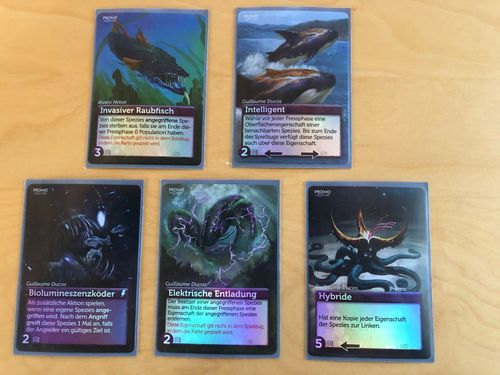
Oceans: Exclusive Promo Cards
Oceans: Exclusive Promo Cards Rulebook
Table of Contents
Table of Contents
Deep Card Reference
This section provides a card-by-card description of each Deep card, including its full card text, migrate and resolution numbers, rules explanations, and some of its potential interactions. Some common card icons and effects are already described in the reference booklet, so they won’t be covered again. Descriptions of cards which aren’t in the base game also mention which promo set they can be found in.
Bioluminescent Lure
Migrate 2 — Event — Resolution 96 — Kickstarter Promo
Play as an extra action when attacked. After the attack is resolved, if the attacker is a valid target, the attacked species attacks back once.
- Errata: Some printings of Bioluminescent Lure have a resolution number of 1 instead of 96.
- Event cards are another kind of Deep card. They have one-time effects, and are then removed from the game. Like other Deep cards, event cards have a cost equal to their migrate number. The rules section has further details about how events work.
- Unlike other events, Bioluminescent Lure isn’t played during your playing cards phase. It’s played when a species you own is attacked. There is no set time during the attack when you have to play the card, but try to play it before all the triggers from that attack have resolved. Once the other players have moved on to other things, like dealing with overpopulation, it’s too late.
- In order to play Bioluminescent Lure, the species that’s attacking must be a valid target for the targeted species. The targeted species must be able to attack, must be able to ignore any “can't be attacked” effects, must be able to take at least 1 population, and so on. If the attacked species can’t attack its attacker, then you can’t play Bioluminescent Lure.
- A species that overpopulates from its own feeding turn can't feed again during that turn, but a species that overpopulates during another species' feeding turn (from gains, for example) can still feed later in that turn. If the targeted species overpopulated earlier in the turn due to another species’ feeding, even the attack against it, it can still use Bioluminescent Lure to attack back.
- A player can’t take back their attack when Bioluminescent Lure is played. They have to carry it out to the bitter end.
- If you attack your own species, you can play Bioluminescent Lure during that attack.
- The attack from Bioluminescent Lure takes place after all the triggers from the original attack have resolved, and before overpopulation is checked. (See step 3 in the “Feeding: Order of Operations” section of the reference booklet.)
- A species with Tentacled or other traits that allow it to attack additional times can still only attack once from the effect of Bioluminescent Lure. If you use multiple copies of Bioluminescent Lure during the same attack, the attacked species can attack once for each copy of Bioluminescent Lure that was played.
- If someone plays a Bioluminescent Lure during an attack that also triggers Burrower, the order that the additional attacks occur is determined like with triggers: in turn order, then each player chooses the order of their triggers.
Electric Discharge
Migrate 2 — Resolution 98 — Kickstarter Promo
The owner of an attacked species must remove a trait from the attacked species at the end of this feeding phase. This trait doesn’t trigger the turn it is played.
- Errata: Some printings of Electric Discharge have a resolution number of 2 instead of 98.
- The effect of Electric Discharge applies during all feeding phases, not just your own. If a species with Electric Discharge manages to attack during an opponent’s feeding phase (for example, if it also has Burrower), then the attacked species must lose a trait at the end of the current feeding phase.
- The effect of Electric Discharge only applies to species attacked by the species with Electric Discharge, not to all species that are attacked by any species.
- The owner of the attacked species chooses which trait(s) to discard from it.
- A trait that can’t be removed, like Cthulhu Leech or Vestigial Limb, can’t be chosen to be removed. If that’s the only trait left on the attacked species, then no trait is removed.
- It is possible for a species to have no traits. A species with no traits that can be removed can still be attacked by a species with Electric Discharge.
- If the species with Electric Discharge attacks multiple times in a feeding phase, each species it attacked has to lose a trait.
- If the species with Electric Discharge attacks the same species multiple times during a feeding phase, that species’ owner must discard a trait from it for each time it was attacked.
- If more than one trait has to be removed at the end of the feeding phase, any consequences of losing those traits (such as losing extra population or extra traits) aren’t checked until they’re all removed. If one player’s choices might influence the other players’ choices of which traits to remove, players remove traits in turn order.
- If the attacker somehow loses Electric Discharge before the feeding phase ends, its effect still applies, and attacked species still have to lose a trait.
- If a species overpopulates after losing a trait due to Electric Discharge, that does not count as losing population “due to an attack”.
- If there are multiple effects that would take place at the end of a feeding phase (for example, if both Electric Discharge and Invasive Predator had been used), those effects resolve in the usual order: turn order of the trait owners, then each player arranges their own effects.
Hybridization
Migrate 5 — Left arrow — Resolution 103 — Kickstarter Promo
Has a copy of each trait of the species to its left.
- Errata: Some printings of Hybridization have a resolution number of 3 instead of 103.
- Hybridization has an effect that creates copies of traits. These copies don’t have to be represented by a physical card. The species just has the effects of those traits as if the physical card were next to its species board.
- Copies of traits have all the characteristics printed on the original trait card. They’re treated just like ordinary traits, with a few exceptions. They don’t count towards a species’ trait limit. They can’t be copied. They can’t be swapped or discarded from the species they’re on. They disappear if the trait that made them is lost. The rules section has further details about how copies of traits work.
- Hybridization copies both Deep and Surface traits. It can copy traits from an opponent’s species.
- The copy ability of Hybridization isn’t optional. You don’t get to pick which traits to copy. It copies all the traits on the adjacent species (except for other copies), even if having copies of those traits would be inconvenient.
- The copies created by Hybridization exist as soon as the original trait is played onto the adjacent species, and stop existing as soon as the original trait is removed.
- When Hybridization creates a copy of a trait, that trait isn’t considered to have been played on that species. It just begins to exist. Effects that trigger when a trait is played won’t trigger from the creation of the copy, although they may trigger from the playing of the original trait.
Intelligence
Migrate 2 — Left + right arrows — Resolution 104 — Kickstarter Promo
Before each feeding phase, choose a Surface trait on an adjacent species. Until the end of the turn, this species has a copy of the chosen trait.
- Errata: Some printings of Intelligence have a resolution number of 4 instead of 104.
- Intelligence has an effect that creates copies of traits. These copies don’t have to be represented by a physical card. The species just has the effects of those traits as if the physical card were next to its species board.
- Copies of traits have all the characteristics printed on the original trait card. They’re treated just like ordinary traits, with a few exceptions. They don’t count towards a species’ trait limit. They can’t be copied. They can’t be swapped or discarded from the species they’re on. They disappear if the trait that made them is lost. The rules section has further details about how copies of traits work.
- The copy ability of Intelligence isn’t optional. You have to copy an adjacent species’ Surface trait if one is available, even if all your options are inconvenient. If neither adjacent species has a Surface trait, then Intelligence doesn’t make any copies at all.
- Each Surface trait has a Deep version. Intelligence can only copy the Surface versions of those traits; it can’t copy Deep traits.
- When Intelligence creates a copy of a trait, that trait isn’t considered to have been played on that species. It just begins to exist. Effects that trigger when a trait is played won’t trigger from the creation of the copy.
- The copies created by Intelligence exist as soon as the trigger resolves, and stop existing as soon as the current turn ends. If the original trait is somehow removed from the adjacent species while Intelligence is still copying it, the copy persists until the end of the current turn.
- When the Intelligence trigger resolves on your turn, it’s still before your feeding phase. If your Intelligence copies a Parasitic on your turn, its trigger goes off as soon as the copy of Parasitic begins to exist. You can arrange that trigger along with your other unresolved “before your feeding phase” triggers. The copy of Parasitic still triggers even if the original Parasitic trait has already triggered before this feeding phase.
Invasive Predator
Migrate 3 — Resolution 105 — Kickstarter Promo
Species attacked by this species go extinct if they have 0 population at the end of this feeding phase. This trait doesn’t trigger the turn it is played.
- Errata: Some printings of Invasive Predator have a resolution number of 5 instead of 105.
- Species attacked by Invasive Predator don’t go extinct until the end of that feeding phase, and only if they have 0 population. If a species can increase its population before the feeding phase ends, it won’t go extinct.
- A species that was attacked by Invasive Predator and that has 0 population at the end of the feeding phase still goes extinct, even if the attack from Invasive Predator isn’t what caused it to have 0 population.
- If a species with Invasive Predator attacks during another player’s feeding phase (for example, with Burrower), its effect still triggers.
- If the attacker somehow loses Invasive Predator before the feeding phase ends, its effect still applies, and attacked species with 0 population still go extinct.
- If there are multiple effects that would take place at the end of a feeding phase (for example, if both Electric Discharge and Invasive Predator had been used), those effects resolve in the usual order: turn order of the trait owners, then each player arranges their own effects.
- Swapping a trait or creating a copy of a trait doesn’t count as playing it. If you swap Invasive Predator onto a species using Rapid Mutation, or copy it with an effect like Mimicry, then the effect of Invasive Predator will apply on that turn.
Migratory Exodus
Migrate 10 — Event — Resolution 106 — Kickstarter Promo
Pay the cost into another player’s score pile and take one of their species, with population.
- Errata: Some printings of Migratory Exodus have a resolution number of 6 instead of 106.
- Event cards are another kind of Deep card. They have one-time effects, and are then removed from the game. Like other Deep cards, event cards have a cost equal to their migrate number. The rules section has further details about how events work.
- The cost of Migratory Exodus doesn’t go to a Reef or Ocean zone. It goes straight from your score pile to the score pile of the player you’re taking a species from.
- When you take the species, you may put it anywhere in your species line. It keeps its population and traits.
- There is currently no way to prevent a player from taking one of your species with Migratory Exodus, except perhaps by trying to appeal to their better nature.
- If you use Migratory Exodus to take a species with Cthulhu Leech, you don’t gain control of the Cthulhu Leech’s effect. The player who originally played the Cthulhu Leech continues to score from it.
Mimicry
Migrate 2 — Resolution 107 — Kickstarter Promo
At the start of each turn, choose a trait in the Gene Pool. Until the end of the turn, this species has a copy of the chosen trait.
- Errata: Some printings of Mimicry have a resolution number of 7 instead of 107.
- Mimicry has an effect that creates copies of traits. These copies don’t have to be represented by a physical card. The species just has the effects of those traits as if the physical card were next to its species board.
- Copies of traits have all the characteristics printed on the original trait card. They’re treated just like ordinary traits, with a few exceptions. They don’t count towards a species’ trait limit. They can’t be copied. They can’t be swapped or discarded from the species they’re on. They disappear if the trait that made them is lost. The rules section has further details about how copies of traits work.
- The copy ability of Mimicry isn’t optional. You have to copy a trait from the Gene Pool, even if all your options are inconvenient.
- Mimicry can only copy Deep traits. It can’t copy Deep events. If all face-up cards in the Gene Pool are Deep events, Mimicry has nothing to copy and no copy is created.
- Mimicry can only copy the top two face-up cards in the Gene Pool. You can’t look through the two piles to find a trait you want to copy.
- The copies created by Mimicry exist as soon as the trigger resolves, and stop existing as soon as the current turn ends. If the original trait is somehow removed from the Gene Pool while Mimicry is still copying it, the copy persists until the end of the current turn.
- When Mimicry creates a copy of a trait, that trait isn’t considered to have been played on that species. It just begins to exist. Effects that trigger when a trait is played won’t trigger from the creation of the copy.
- Mimicry doesn’t trigger until the start of each turn. The turn you play Mimicry, it won’t create a copy of anything.
- If the trait copied by Mimicry is still in the Gene Pool when the current turn ends, you can choose to copy it again when the next turn begins. However, the trait still disappears in between turns. If the trait being copied allowed the species to have extra population or traits, like Dense Population, any extra population or traits above the species’ usual limit have to be discarded when the copy of that trait disappears at the end of the turn.
Overgrazing
Migrate 3 — Event — Resolution 108 — Kickstarter Promo
Instead of your normal feeding turn, each of your species without [Can't forage] may forage this turn. After your feeding phase, move all population in the Reef to an Ocean zone.
- Errata: Some printings of Overgrazing have a resolution number of 8 instead of 108.
- Event cards are another kind of Deep card. They have one-time effects, and are then removed from the game. Like other Deep cards, event cards have a cost equal to their migrate number. The rules section has further details about how events work.
- Once you’ve replaced your normal feeding turn with an effect like Overgrazing, you can’t use another event like Feeding Frenzy to replace it again. You can only play one “instead of your normal feeding turn” event per turn.
- In between each feeding, triggers resolve, overpopulation is checked, and scenarios are activated or deactivated.
- After your feeding phase, you choose which Ocean zone to move all the population in the Reef into. If there is no population in the Reef after your feeding phase, nothing happens. You don’t have to leave any population in the Reef while your species are foraging.
- Species don’t have to forage from the Reef during Overgrazing if they can forage from other places. Only the Reef loses its population to the Ocean after the feeding phase ends, even if some species foraged from other places. The Reef still loses population even if none of the species that fed foraged from it.
- Species with Tentacled or other traits that allow them to feed additional times may forage additional times during Overgrazing. They can’t use the additional feedings to attack. Species that forage multiple times during Overgrazing have to take their additional feedings consecutively.
- A species that overpopulates from its own feeding turn can't feed again during that turn, but a species that overpopulates during another species' feeding turn (from gains, for example) can still feed later in that turn. If one of your species overpopulates because one of your other species foraged during an Overgrazing, that species can still forage later in the turn.
Paralyzing Venom
Migrate 1 — Resolution 109 — Kickstarter Promo
Species attacked by this species can't attack or forage until after their next feeding phase. This trait doesn’t trigger the turn it is played.
- Errata: Some printings of Paralyzing Venom have a resolution number of 9 instead of 109.
- The effect of Paralyzing Venom prevents the attacked species from doing any kind of foraging or attacking, even attacks made outside its usual feeding phase from effects like Bioluminescent Lure.
- The phrase “their next feeding phase” refers to the next feeding phase of the attacked species’ owner, on that player’s next turn. In other words, the species affected by Paralyzing Venom can’t attack or forage on or before its owner’s next turn.
- If a species affected by Paralyzing Venom changes owners while it’s still unable to feed (for example, due to Migratory Exodus), that species’ “next feeding phase” is changed to the next feeding phase of its new owner. It can’t attack or forage on or before its new owner’s next turn.
- Effects that allow additional species to feed in one turn, like Voracious Feeder or Overgrazing, don’t create additional feeding phases. All the species feed as part of one single feeding phase. Each player’s turn has one feeding phase.
- A “can't attack” effect isn’t the same as having a [Can't attack] icon. If a species with Bubble Net is affected by the “can't attack” effect from Paralyzing Venom, it can’t ignore that effect.
- Swapping a trait or creating a copy of a trait doesn’t count as playing it. If you swap Paralyzing Venom onto a species using Rapid Mutation, or copy it with an effect like Mimicry, then the effect of Paralyzing Venom will apply on that turn.
Sparkles
Migrate 2 — Can't attack — Left + right arrows — Resolution 111 — Kickstarter Promo
When taking population, distribute it between this species and adjacent species. Sharing is caring!
- Errata: Some printings of Sparkles have a resolution number of 10 instead of 111.
- When Sparkles takes population, you may distribute it any way you like between Sparkles and the adjacent species. For example, you may choose to put all of the taken population onto one or both adjacent species and none on Sparkles. (How generous!) You may also choose to put all of the taken population on Sparkles and none on the adjacent species. (How selfish!)
- Sparkles’ effect only applies when Sparkles is doing the taking. If one of the species adjacent to Sparkles takes population, it won’t be shared.
- If one of the adjacent species belongs to another player, you can still put population on it.
- Sparkles is still considered to be taking the population even if it ends up in a different place. Sparkles can still forage or attack as long as at least 1 population would be taken, even if Sparkles itself doesn’t end up with any of that population. (Normally, Sparkles can’t attack, but Bubble Net exists.) If Sparkles also has Bubble Net and Cavitation Bullet, it can’t take more than 2 population from an attack, even if it keeps none of that population for itself.
- A species can't forage or attack if it doesn’t have at least 1 empty space on its species board. If Sparkles has a full species board, it can’t forage or attack at all, even if all of the population would end up someplace besides its species board.
- Sparkles doesn’t lose the population that’s shared with the adjacent species. It was never Sparkles’ population to begin with. It just goes straight from wherever it came from to the adjacent species boards.
- Sparkles’ effect still applies even if the action didn’t use the specific verb “take”. Any effect that would put population onto Sparkles’ species board counts as Sparkles taking population. This includes foraging, attacking, gaining, leeching, the Proliferation event, or even a second Sparkles sharing with the first.
- If Sparkles shares taken population with adjacent species, those species aren’t considered to have foraged, attacked, gained, leeched, and so on, even if that’s how Sparkles initially took the population. If Sparkles attacks with Bubble Net and shares the population with an adjacent species that has Cavitation Bullet, the species with Cavitation Bullet can take more than 2 population.
- If Sparkles takes population from one of the adjacent species (for example, by leeching or with Bubble Net), it may put it back onto that species as it takes it. Traits that care if population is lost still trigger, even though the taken population ends up back where it starts.
Scenario Card Reference
Most scenarios have simple effects, but they might interact with Deep cards and other scenarios in unexpected ways. This section provides a card-by-card description of each Scenario card, including its full card text, icons, rules explanations, and some of its potential interactions. Descriptions of cards which aren’t in the base game also mention which promo set they can be found in.
Aggressive Environment
Aggressive 3 — Kickstarter Promo
Species with 0 population may be attacked. They immediately go extinct before any traits trigger.
- This is an exception to the rule that a species can't attack unless it would take at least 1 population. The attacking species won’t take any population from the target as part of its attack. It receives only the satisfaction of knowing that it has permanently removed a competitor from the ecosystem.
- “They” in the card text refers to the species being attacked, not the attacker. The species with 0 population goes extinct after being attacked.
- A species can't attack if it doesn’t have at least 1 empty space on its species board, even if Aggressive Environment means it wouldn’t take any population anyway.
- An attacker’s [Attack] must be greater than its target’s [Defense] in order to attack it, even if Aggressive Environment means it wouldn’t take any population anyway.
- If Aggressive Environment is active, a species with Extremophile and 0 population can still be attacked, but it doesn’t go extinct.
- The attacked species goes extinct before any of its own traits trigger. For example, if the attacked species had Poisonous Spines, the attacker and other species that gained don’t lose any population.
- The attacked species goes extinct before traits on other species trigger, but the attack still triggers those traits. Traits like Surface Bottom Feeder or Burrower that care about adjacent species being attacked still trigger.
Coral Bleaching
Kickstarter Promo
After your aging phase, place 2 population from the Reef onto any Ocean zone.
- “Your aging phase” refers to the aging phase of the player whose turn it is. The trigger will only trigger once per aging phase, even if an effect like Über Inhospitable Environment causes other players’ species to also age during that phase.
- The player whose turn it is decides which Ocean zone the population from the Reef is moved to. If the Solar Radiation scenario is also active, the current player also chooses whether to move population from the Reef before or after the effect of Solar Radiation.
- The effect of Coral Bleaching doesn’t count as migration.
- The 2 population moved from the Reef have to go to the same Ocean zone.
- If the Reef has only 1 population, just move the 1 population. If the Reef has 0 population, nothing happens.
Evolutionary Arms Race
Kickstarter Promo
Species can't attack a target whose [Attack] or [Forage] is greater than their own [Attack].
- If a species has an effect that allows it to ignore “can't be attacked” effects, that doesn’t allow it to attack species with [Attack] or [Forage] greater than its own [Attack]. “Can't attack” effects on the attacker are different from “can't be attacked” effects on the target.
- [Can't attack] and [Can't forage] icons don’t change a species’ [Attack] or [Forage]. A species that can’t attack or forage still has at least [Attack 1] and [Forage 1]. It’s possible for a species that can’t attack or forage to still have an increased [Attack] or [Forage] from traits like Speed or Megamouth. These are taken into account when checking the effect of Evolutionary Arms Race.
- If the attacker has Bubble Net, it compares its own [Forage] to the target’s [Attack] or [Forage] to see if it can attack. If the attacker is attacking a species with Bubble Net, it compares its own [Attack] to the target’s [Forage] and disregards the Bubble Net species’ [Attack] entirely.
Horizontal Gene Transfer
Aggressive 2 — Complex 2 — Kickstarter Promo
Before your feeding phase, you may swap one of your traits with a trait on an adjacent species.
- You don’t have to own the species that your species swaps with. You can make a swap with an opponent’s species if you like. You can swap Surface or Deep traits.
- When determining the order for resolving effects, triggers from scenarios resolve after all the triggers from all players’ traits have resolved. All traits that trigger before your feeding turn resolve before you make the swap with Horizontal Gene Transfer.
- If your species that participates in the swap has the Nomadic trait, that species can still only swap with the two species directly next to it. Nomadic’s effect only applies to traits, not scenario effects.
- Copies of traits created by traits like Intelligence can’t be swapped. Only traits on actual cards can be swapped.
- It’s possible to use Horizontal Gene Transfer to swap a trait on an opponent’s species with a trait on one of your own species. If you do this, and the trait from the opponent’s species has a “before your feeding turn” trigger, it triggers after it’s been swapped onto your species. It’s still before your feeding turn, and that trait’s “before your feeding turn” trigger hasn’t gone off yet. (This is an exception to the usual rule that trait triggers resolve before scenario triggers.)
Hostile Conditions
Aggressive 2 — Complex 2 — Kickstarter Promo
Aging occurs for the active player and the player to their right.
- During your aging phase, all of the species of the player on your right also age. This does not count as that player’s aging phase.
Hostile Environment
Complex 4 — Kickstarter Promo
Aging +3
- There are currently no clarifications for Hostile Environment.
Lazy Creator
Event (maybe) — Complex 3 — Kickstarter Promo
Before the game, decide as a group what this card says.
- TODO: come back to this one later (Editor: We apologize for the lazy reference guide writer. Basically, your group just makes up an effect for this scenario. Any kind of effect you want. It’s up to you. If your group comes up with any good effects, you can share them on the BoardGameGeek forums.)
Mass Migration
Event — Aggressive — Kickstarter Promo
Slide the leftmost species of each player to the opponent on their left.
- The species you shift to the opponent on your left becomes their rightmost species. They can’t move it to another spot in their species line. Likewise, the species you receive from the opponent on your right becomes your rightmost species. You can’t move it to another spot in your species line.
- If a player has no species, the opponent to their left receives nothing. The player who has no species receives one from the opponent on their right.
- If Mass Migration causes you to take a species with Cthulhu Leech, you don't gain control of the Cthulhu Leech’s effect. The player who originally played the Cthulhu Leech continues to score from it.
Parallel Universe
Complex 4 — Kickstarter Promo
On your turn, numbers on traits can be treated as 1 higher or 1 lower.
- The effect of Parallel Universe only applies to numbers on traits. It can’t be used on the numbers of other scenarios, Deep events, the Cambrian Explosion reminder card, or the game rules. It can be used on the numbers on other players’ traits during your own turn, not just your own traits. It can be used on traits in your hand to make Deep traits cheaper.
- Any number on a trait can be treated as 1 higher or 1 lower. This includes numbers in icons, numbers in trait text, migrate numbers, and resolution numbers. If a number has a noun associated with it, like “may have 1 extra trait”, you can pretend that the noun also changes to singular or plural as necessary.
- If you choose to treat a number one way, you can still treat it a different way at a later point in your turn. Since gains technically resolve at different times, you can even choose different values for gains which were triggered simultaneously.
- The player whose turn it is decides how numbers are treated. If they decide to change a number on one of your traits during their turn, there’s nothing you can do about it. Of course, you are more than welcome to do the same thing to them on your turn, which may provide a useful disincentive.
- The [Forage], [Attack], [Defense] values and aging rates on individual traits can be negative. If a species’ total [Attack] or [Forage] would be less than 1, it’s increased to 1. If a species’ total [Defense] or aging rate would be negative, it’s increased to 0.
- There aren’t really many other rules for this card. This scenario is supposed to be pretty informal. Just do what makes sense. Have fun with it.
Prescient Mutations
Complex 2 — Kickstarter Promo
During the next player’s turn, you may exchange 1 Surface card in your hand for 1 card in the discard pile.
- Only Surface cards go to the discard pile, so you can exchange 1 Surface card for another Surface card. Deep cards are removed from the game after they’re discarded. Even if you put the removed Deep cards in a pile, that doesn’t count as the discard pile.
- You can make the exchange at any point during the next player’s turn. You can wait until they’ve discarded Surface cards during their draw phase to see if they’ve discarded anything you like.
Radiation Blast
Event — Kickstarter Promo
Players shuffle the traits on their species and play them randomly on their species one at a time.
- The easiest way to handle the effect of Radiation Blast is this: First, shuffle all the traits on all of your species together into a single pile, including traits like Vestigial Limb or Cthulhu Leech that otherwise can’t be removed. Copies of traits will disappear, and won’t be shuffled or redistributed. Species boards, with their population, stay in the same place and aren’t rearranged.
- Then, deal out your traits from that pile onto your species one by one. You’re not supposed to see what traits you’re playing, so deal them all out face-down. You don’t have to give a species the same number of traits it had before the Radiation Blast. You can deal more than 3 traits onto a species, and hope that one of the traits it ends up with allows it to have additional traits. You can give a species 0 traits.
- Traits remain face-down until all players have dealt out their traits. Then they’re all turned face up. If a species ends up with more traits than it’s allowed to have, immediately discard down to the allowed number of traits. If Tiny ends up on a species with more than [Attack 2] or [Forage 2], discard Tiny immediately. If a species now has more population on its board than its traits allow, it overpopulates immediately.
- The rearranged traits don’t count as having been played or evolved. Effects that care about traits being played or evolved, like Bioluminescence or Protective Growth, won’t trigger after Radiation Blast settles down.
Schadenfreude
Complex — Kickstarter Promo
When a species goes extinct, each other player’s species gain 1.
- When multiple species have to age, they’re treated as if they all aged simultaneously. Any triggers that go off during aging, such as Schadenfreude, are handled after all the species that are aging have aged. If the gains from Schadenfreude cause an ocean zone to be emptied, that zone’s scenario won’t activate until all the other species have also finished aging.
- “Each other player” is in reference to the owner of the species that went extinct. All of the species owned by every player except the player whose species went extinct will gain 1.
- If multiple species go extinct during the same round of aging, Schadenfreude can trigger multiple times. The triggers will resolve after the species have lost population to aging, so the gain 1 will happen too late to save any species from extinction.
- Overpopulation is checked and scenarios are activated after all the Schadenfreude triggers resolve, and before any additional rounds of aging (such as from Degenerative Virus) occur.
- When determining the order for resolving effects, triggers from scenarios resolve after all the triggers from all players’ traits have resolved. If any traits are triggered during aging, those effects will resolve first in the usual order (turn order, then player’s choice), then each player in turn order chooses the order their species gain 1. This may in turn trigger other traits, like Sedentary Colony.
- When Schadenfreude triggers during an aging phase, the aging phase isn’t done until all the effects from and triggered by Schadenfreude have finished resolving. Scenarios that trigger after the aging phase, such as Coral Bleaching or Solar Radiation, will trigger and resolve after everything from Schadenfreude has been resolved.
- While most extinctions take place during the aging phase, Schadenfreude triggers whenever a species goes extinct, even if it takes place outside the aging phase (for example, from the effect of an Invasive Predator).
- Even though Schadenfreude has a triggered effect, it’s not an event scenario. Its effect occurs each time a species goes extinct, and resolves before overpopulation is checked and before scenarios are activated or deactivated.
Shallow Reef
Kickstarter Promo
Species lose 2 population to the Reef after foraging.
- A species can still forage from the Reef even if all of the population it takes would be lost back to the Reef afterwards.
- When determining the order for resolving effects, triggers from scenarios resolve after all the triggers from all players’ traits have resolved. A species with Ambush takes 2 population from a forager before the forager loses population due to Shallow Reef.
- Even though Shallow Reef has a triggered effect, it’s not an event scenario. Its effect occurs each time a species forages from the Reef, and resolves before overpopulation is checked and before scenarios are activated or deactivated.
Snowball Earth
Complex — Kickstarter Promo
The [Attack] and [Forage] of every trait is reduced by 1.
- This doesn’t affect the [Attack] or [Forage] from scenarios like Biodiverse Reef or Large Predators. It only affects [Attack] and [Forage] on traits.
- The [Attack -1] effect of Snowball Earth applies before the [Attack] is doubled by Pack Hunting.
- Individual trait cards can have [Attack] or [Forage] that are 0 or even negative. For example, if a species has Swarming and 0 population while Snowball Earth is active, Swarming has [Attack -1]. However, a species’ total [Attack] or [Forage] can never be below 1. If it would be below 1, it’s increased to 1 instead.
- Deep Diver gets [Forage +2] for each Deep trait it has. Snowball Earth applies to the total [Forage] on Deep Diver, not the cumulative [Forage +2]. If Snowball Earth is active, Deep Diver on a species with 2 other Deep traits (3 Deep traits total) has [Forage 5].
Über Inhospitable Environment
Aggressive 3 — Complex 3 — Kickstarter Promo
Aging happens to every species in play.
- This means that during each player’s aging phase, all species age, not just the ones belonging to the active player.
- A player’s aging phase is the one that occurs during their own turn. Effects that care about “your aging phase” won’t trigger if your species age during someone else’s turn.
- If one of your species ages during another player’s aging phase and doesn’t have enough population to age its full amount, it still goes extinct, even though it’s not your turn.
New Rules Reference
This section describes the rules for new game mechanics that don’t appear in the base game, such as Deep Event cards and traits that copy other traits.
Event Cards
The rules for event cards were included with the special insert for Kickstarter backers. However, if you don’t have the Kickstarter insert, the rules for event cards are included here.
- Event cards are another kind of Deep card. Events have a purple textbox and a lightning-bolt- shaped event icon like the one on some Scenario cards. Instead of being played as traits, they have one-time effects.
- Like Deep traits, playing an event requires paying a cost equal to its migrate number. Before playing the event, move population equal to the migrate number from your score pile to one location: the Reef or any Ocean board. After being played, event cards are removed from the game instead of put into the discard pile.
- Most event cards are played during your play cards phase as an action, just like Deep traits. A few events, like Bioluminescent Lure, are played at other times, which will be described in their rules text.
Copying Traits
A few promo Deep traits have an effect saying that a species “has a copy” of another trait: Hybridization, Intelligence, and Mimicry. Having a copy of a trait allows a species to benefit from having a trait, but without needing an actual card for that trait.
- When an effect says a species has a copy of another trait, it’s not necessary to find an actual copy of that specific card to add it to that species. Just pretend it has a printed copy of that trait next to its species board.
- A copy of a trait is just like the original card, and has everything printed on the original card: the trait’s name, rules text, attack/forage/gain icons, text box color, adjacency arrows, migrate number, resolution number, whether it’s a Deep or Surface trait, and anything else that might be relevant.
- Copies of traits don’t count towards a species’ trait limit. Copies of traits are still counted in other situations.
- For example, a species with Gigantic Brain still counts copies of traits when determining how much population it ages.
- Copies of traits only copy what's printed on the original trait. If the original trait has been modified by other effects, those modifications won’t be copied. Modifications can still apply to the copy itself after it’s created.
- For example, consider a species with Intelligence that copies a Bottom Feeder while Abundance is active. Because of Abundance, the original Bottom Feeder’s gain is increased to gain 3. However, the copy will only have the Bottom Feeder’s printed gain 2, which will then be increased to gain 3 because of Abundance. It won’t copy the original’s increased gain 3 and then have it increased again to gain 4.
- Copies of traits can never be discarded, swapped, or otherwise removed from the species they’re on. Copies of traits can also never be copied themselves. (That is, you can’t have a copy of a copy of a trait. The original trait can still be copied by another effect.) Only traits on actual printed cards can be removed, moved, or copied.
- For example, if one of your species has Hybridization, and it copies an undesirable trait from the species to its left, you can’t choose to discard the copy of that trait while keeping the rest of the copies. The only way to get rid of the undesired copy is to either discard Hybridization itself or to remove the original trait from the species to the left.
- If a trait that can create copies of other traits is removed from a species, any copies of traits that it created also disappear at the same time. Those copies aren’t considered to have been discarded from that species. The copies just stop existing.