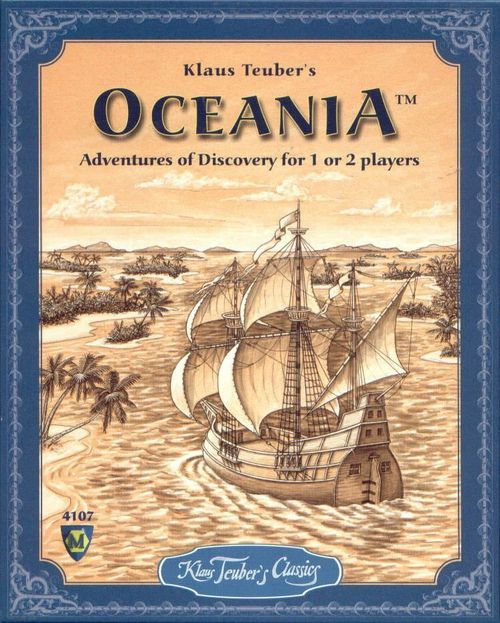
Oceania
Oceania Rulebook
Table of Contents
Table of Contents
Game Components
- 1 rulebook
- 1 game board
- 35 sea tiles
- 25 reserve tiles (sea tiles with a cloud)
- 1 explorer ship
- 16 explorer tiles (8 each in white and gray; each color has tiles showing 1, 2 and 3 explorers)
Before the first game: carefully punch the tiles and chips out of the two punchboards.
Setup
- Place the game board in the middle of the table.
- Separate the sea tiles from the reserve tiles.
- Sort the reserve tiles. This produces 6 stacks. Lay these 6 stacks face up next to one side of the game board.
- Place the sea tiles face down in the box lid. Mix them by pushing them back and forth a few times.
- Draw 3 sea tiles from the box (without turning them over) and set them aside face down outside the play area. They are not used in the current game.
- One player receives the gray explorer tiles, the other player the white ones.
- Place the ship next to the game board, ready for use.
Overview
The brownish area in the middle of the game board represents the unknown sea region "Oceania". The players' task is to discover the island world of Oceania, starting from the edge spaces of the game board.
Whoever has discovered a sea space on which part of an island is depicted may place an explorer there. When an island is completely discovered, the player with the most explorers on that island scores points, and the larger the island, the more points. The player with the most points at the end of the game wins.
Sequence of a Turn
The player who lost the last game of Oceania begins. If the game is played for the first time, the younger player begins.
A turn consists of the following steps:
- Determine a starting space
- Discover
- Place explorers, if land was discovered
Then it is the other player's turn.
1. Determine a Starting Space
The player determines a starting space from which he would like to discover a space. A starting space can be an edge space or an already discovered space (one covered with a sea tile).
Important: A starting space must always border, with at least one sea side (a side with a dashed line), an undiscovered space. Once the player has decided on a starting space, he places the explorer ship there.
Example: The edge spaces and discovered spaces marked with a white "x" can be used as starting spaces. It is not possible to choose the spaces marked with a red "x", because those spaces do not border an undiscovered space with a sea side.
2. Discover
The player takes a sea tile from the box and turns it face up. He places the tile with a sea side (a side with a dashed line) so that it fits a sea side of the starting space. "Fits" means: the tile must be oriented or rotated so that all sides of the tile that border tiles already lying there match. Land must border land and sea must border sea. If a tile fits, it must be placed.
Example: The player has determined his starting space and drawn a sea tile. He can place the tile to the left of or above the starting space.
The player has decided on the upper space and places the sea tile so that it fits (sea side to sea side).
If the player cannot place the sea tile (even by rotating it) so that it fits, his turn ends. He lays the sea tile face up in front of him. Discarded sea tiles count as minus points at the end of the game. However, they can be brought back into play with the help of explorer tiles (see "Bringing Discarded Sea Tiles into Play", page 3). If placing the tile creates a space that is surrounded on all sides by discovered spaces, it is filled in (see "Filling Defined Spaces", page 3).
3. Place Explorers
If the player was able to place the sea tile so that it fits, and land is shown on the tile, he may place one of his explorer tiles on the newly discovered sea tile. This can be a tile with 1, 2 or 3 explorers.
The player places an explorer tile with 2 explorers on the newly discovered sea tile.
On tiles with separate land parts, the player must decide on which land part he wants to place his explorer tile.
End of the Game
The game can end in two ways:
a) All spaces are discovered. b) The sea tiles in the box are used up.
Note: On the top sea edge of the game board there are no edge spaces from which discovery can be made. This can lead to situations that make it impossible to discover an island completely.
Scoring
Only completely discovered islands are scored. On each island, the players count their explorers. The player with the most explorers on an island receives one point for each sea tile that belongs to the island. If both players have the same number of explorers on an island, no player receives points. (See also page 3: scoring example.)
Every sea tile that a player has lying in front of him, that is, one which he could not place fittingly during one of his turns, counts 2 minus points. After all islands have been scored and any minus points deducted, the player with the most points has won the game.
Scoring example: In the illustration the 3 islands are scored as follows:
- Island A: Player "gray" has the majority and thus receives 3 points.
- Island B: Player "white" has 4 explorers, player "gray" only 3. Player "white" receives 8 points.
- Island C: The island was not completely discovered and is therefore not scored.
Other Rules
Filling Defined Spaces
An undiscovered space counts as "defined" if it is surrounded on all 4 sides by discovered spaces or edge spaces. Several undiscovered spaces count as defined if they are surrounded on all sides by land. If a player has placed a sea tile so that a defined space has come into being, he fills this space with a fitting reserve tile.
Example (A): The player places a sea tile. On the left a defined space comes into being, since it is surrounded on all 4 sides by discovered spaces. On the right 2 defined spaces come into being, since these are surrounded on all sides by land.
(B) The defined spaces were filled with fitting reserve tiles (red frame).
Note: Should the unlikely case occur that a space is defined but there is no fitting reserve tile left to fill it, the space nevertheless counts as discovered (as defined).
Bringing Discarded Sea Tiles into Play
Once a player has determined his starting space, he may, instead of drawing a sea tile from the box, also use one of his discarded sea tiles lying in front of him and place it at the starting space (provided it fits). To do this, however, he must give up one of his explorer tiles. He may give up any tile - sensibly it should be, if possible, a tile with only one explorer.
Tips
- A game of Oceania usually lasts no longer than 10 minutes. Agree with your opponent to play several games in a row. Then the player who has the most points in total after 3 or 5 games wins.
- When you put the game away, pack the reserve tiles into the enclosed zip bag. The next game will then be set up faster.
- It is advisable to place explorer tiles only when the first contours of larger islands appear on the game board. Only then should you deliberately place your explorers in order to obtain the majority on islands that are as large as possible.
- It can certainly make sense at the beginning of the game to provoke the "passing" of a sea tile. You choose the starting space so that as few kinds of sea tiles as possible fit. In the further course of the game, a discarded tile can then be used, by giving up an explorer tile, to finish discovering an island or to shrink a potentially large island of your opponent.
- From the top side of the game board nothing can be discovered. This can mean that islands cannot be completely discovered. You can make use of this circumstance if your opponent has the majority on an island that is not completely discovered. You can then - especially by using discarded tiles - try to discover so that the opponent's island is not completed.
Oceania - The Solo Version
The game is set up as in the 2-player version. The explorer tiles are not needed. Since one plays alone, it is not about majorities on islands, but about creating islands that are as large as possible while discovering. The sequence of play is the same as in the game for two. The player determines the starting space, draws a sea tile from the box, and places it fitting, or lays it in front of himself if it does not fit. He does this until either all spaces are discovered or no sea tiles remain.
Scoring differs from the two-player game: The player first determines, for each completely discovered island, how many tiles it consists of. The number of tiles of an island is squared. This gives the points for one island. The points of all islands are added. From this number, 20 points are deducted for each undiscovered space.
Example of scoring: In the illustrated example the islands are worth 4, 9, 100, 9, 4 and 4 points (130 in total), and 3 undiscovered spaces cost 3 x 20 = 60 points. In total the player reached 70 points.