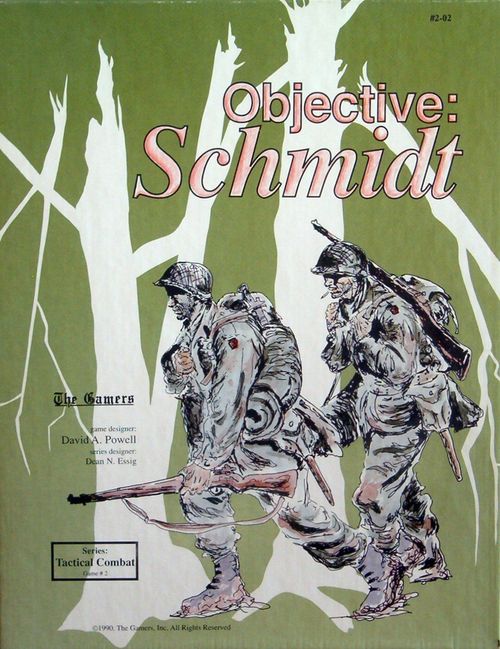
Objective: Schmidt
Objective: Schmidt Rulebook
Table of Contents
Table of Contents
- 1.0 Terrain Special Rules
- 2.0 American Special Rules
- 3.0 German Special Rules
- 4.0 Command and Control Special Rules
- 5.0 General Special Rules
- 6.0 Minor Variants
- 7.0 Scenario Notes
- 8.0 Modifications for Using the Original Objective: Schmidt Map
- Teaching Scenarios
- Historical Scenarios
- Schedules and Tables
1.0 Terrain Special Rules
1.1 The Kall Trail. The five Kall Trail hexes are marked on the map with a white number. Initially, this trail is considered impassible for all Vehicle and Carrier units. See the Kall Trail rules (section 2.1) for more explanation.
1.2 The Kall River. The Kall River is considered a stream. It is not considered Billiard terrain for Overwatch on the hexside.
1.3 Hedges. A Hedge blocks LOS unless it makes up one of the hexsides of the firer, observer or target hex. LOS to a Movement-based Overwatch Trigger may not cross a hedge hexside of the Trigger's hex unless the Trigger is adjacent to the firer or observer. Open terrain targets immediately adjacent to a hedge are considered to be in Partly Protective terrain for spotting and for Low-Trajectory fires that cross the hedge feature. Roads that cross a hedge feature are bottlenecks for units using road movement.
1.4 AT Guns and Foot Movement. During the time frame of this battle, the ground was extremely wet from the persistent rains. Due to these muddy conditions, when using Foot movement (manhandling), AT guns may only enter a hex if it is a Village hex or if using a primary road. AT guns may only set up in Village hexes or hexes containing primary roads.
1.5 Dense Forests. The forests in this area were generally quite dense. Even on steep slopes visibility was blocked by trees. Only at the edge of the forest could one see out of the forest. For non-adjacent LOS, the LOS to or from a forest hex is always considered blocked if the LOS passes through any forest depiction in the hex immediately adjacent to the firer, observer or target regardless of the elevation of the forest in that adjacent hex. In other words, the LOS will be blocked unless the hex is at the edge of the forest. For example, the LOS between 26.23 and 32.20 is blocked because the LOS passes through the forest in 31.21.
As usual, LOS is never blocked between adjacent hexes.
2.0 American Special Rules
2.1 The Kall Trail. In the initial battle plan for the 28th Division, the Kall Trail was designated the divisional main supply route, and as axis of advance for the operation. In retrospect, it can be seen that the trail was totally unsuited for the amount of traffic required, and was ultimately one of the main reasons the American attack failed. These rules will detail the efforts the American player can make in trying to render the Kall Trail passable.
At any point in the game, the Kall Trail is defined in one of three conditions: impassable, semi-passable, or passable.
2.1a The Kall Trail Status Marker. The Status marker (use any marker not in use for the current game, or a blank with "passable" and "semi" written on either side) defines the exact state of the Kall Trail at any given point in the game. This marker determines the trail to be either passable, semi-passable, or impassable. Use of the marker is as follows:
On the turn after all five hexes of the Kall Trail have been controlled by US units, and no German units are on or adjacent to any Kall Trail hex, the US player places his status marker on the Turn Record Track twelve hours (not turns) ahead of the Turn Record Marker, semi-passable side showing. This placement simulates the commencement of the US engineer effort to improve the trail. Note: these engineer troops are not placed on the map.
The Kall Trail remains impassable until the Turn Record Marker reaches the space occupied by the Kall Trail Status Marker. At this time, the Kall Trail is considered semi-passable, and the marker is flipped to its passable side and is placed ahead 30 hours on the Turn Record Track. Since the Turn Record Track is only 24 hours, players must make a note on which day the Status Marker is on. On the correct turn of the correct day, the Kall Trail is considered passable.
Special Note: Since the Turn Record has 20 minute day and hour long night turns, some confusion may arise as to where to exactly place the Status Marker. If, for example, the US player controls the Kall Trail on the 1120 turn of 2 November, the Status Marker should be placed on the 2340 turn 2 November. Since there is no 2340 turn at night, the Status Marker must be placed on the next full hour turn, that of 2400, 2 November. Note that a marker to be placed on the 2320 turn would also be placed on the 2400 turn. As a rule of thumb, always round up for night turns.
2.1b Effects of Kall Trail Status. At all times, foot-mobile units may freely move along the Kall Trail, treating it as a normal trail, subject to all other series rules.
- Impassable - No Vehicles or Carriers may enter or move through a Kall Trail hex.
- Semi-Passable - No trucks may enter or move through any Kall Trail hex. Other Vehicles and Carriers may move along the trail subject to 2.1c.
- Passable - Vehicles and Carriers of any type may move along the trail, subject to the following table:
| # of Vehicle & Carrier units this turn | Effect |
|---|---|
| 4 or less | Automatic passage at 1 MP per hex |
| 5 to 10 | Automatic passage at 3 MP's per hex |
| 11 or more | Roll one die for each Vehicle or Carrier attempting to cross. 1-4 allows passage at 3 MP's per hex. 5-6 means disabled, roll as per rule 2.1c for placement of the disabled unit. |
Any truck counts against the total number of units using the trail normally, but always rolls for passage as per the 11 or more line.
Regardless of the Kall Trail status, Vehicles and Carriers may always enter or exit hex 5 of the Kall Trail (even if blocked) if they enter or exit without actually using the Kall Trail. Vehicles and Carriers may never use the Kall Trail for a SYR.
2.1c Semi-Passable Crossing. Only one Vehicle/Carrier may move along the Kall Trail (any hex) per turn. The Vehicle/Carrier must have at least half of its MPs remaining when it attempts the Kall Trail. One die is rolled. On a roll of 1 or 2, the moving unit is automatically placed at the other end of the trail or in the last available non-blocked hex on the unit's side of the block. For example, a unit going to enter the Kall Trail at 28.14 makes a 1 on its die roll, the unit is then placed at 32.13, or vice versa. The unit so moving has completed its Action Phase and must remain in Move Mode and may not move further.
On a roll of 3-6, the unit has broken down and blocks the trail. Roll a second die to determine the exact hex of breakdown. The numbers on the map correspond to the die roll, re-roll on a six. Place the disabled unit in Fire Mode and a block marker in the above indicated hex. Reroll until a decision is reached. See 2.1d for rules about a blocked Kall Trail.
2.1d Disabled Units and the Kall Trail. If a Vehicle or Carrier fails to successfully move along the trail, it has blocked it. Any units being transported immediately disembark and may switch to Fire Mode. Once a hex is blocked, no Vehicle/Carrier may move into that hex. Such units may still move along as far as the block, but units on the Kall Trail must make another roll on a later turn when again attempting to move.
Additionally, blocks can be cleared either by trying to repair the disabled unit, or by destroying it. At the beginning of any Action Phase, the owning player may decide to destroy or repair each disabled unit on the trail. If the unit is to be destroyed, it is automatically removed from play and that block is removed. A unit destroyed in such manner does not count toward Battalion Morale but does count toward victory conditions if applicable. A repair attempt is made by rolling one die. On 1-3, the unit is repaired and may again attempt to move along the trail (in the same turn). On a 4-6, the unit remains disabled in its hex until the next turn, when another try may be made. With a successful repair attempt, any units that were being transported by the Vehicle or Carrier that are still in the hex may immediately mount back up with no movement cost.
A unit that is repaired may then attempt to renegotiate the trail. In this case, as in any when the trail is attempted again, roll again as per the appropriate rule above for semi-passable or passable trail. If such a unit fails and becomes disabled, to determine which hex the block occurs follow the rules below. Count the number of hexes left along the trail and roll one die. A roll of one places the unit in the next hex, etc. Ignore and re-roll any rolls greater than the number of hexes remaining. Re-rolls are made until an acceptable number is rolled.
Players should note that a specific unit may only move in one direction along the trail in a given turn. A Vehicle or Carrier that ends its movement on the trail, may only continue to move in the same direction as it has been moving and not return the way it came. Once the trail is passable, units may move in both directions as desired, but all count toward the total for the turn. If players cannot remember the direction in which units are moving along the trail, it is best to mark the direction by the careful facing of units so moving toward the hexside in the direction of movement.
2.1e Engineers and the Kall Trail. Two companies of US engineers, A and B Companies of the 20th Engineer Battalion, were responsible for improving the trail. Normally, these units are not physically present on the map, and the "trail improvement mission" is assumed. The US player may also elect to place these troops on the map to participate in combat operations, if need be. However, this placement will interfere with work on the Kall Trail. Additionally, the presence of German units can also interrupt work on the trail.
In any Command Phase of scenario 9, the US player may decide to deploy his engineers onto the map. This is announced to the German player, and entry occurs on the next turn's Command Phase. The engineers are placed on the map in any hex or hexes within 4 hexes of any Kall Trail hex, but at least four hexes from any German unit. If these conditions cannot be met, the engineers may appear within 4 hexes of any US unit, but again at least 4 hexes away from a German unit. The Engineers are immediately placed on their own implemented Hasty Defense Op Sheet. On the turn of their placement on the map, they may be given new unimplemented orders and accrue weighted turns normally.
To represent delays on improving the trail, the Kall Trail Status Marker must be moved along the Turn Record Track according to the following schedule: If one US engineer company has been placed on the map, advance the Status Marker one space along the Turn Record Track for every hour the Turn Record Marker is advanced. If both companies of engineers have been placed on the map, or if any German unit occupies a hex on or adjacent to a Kall Trail hex, advance the Status Marker one space along the Turn Record Track for every time the Turn Record Marker is advanced.
Later in the game the engineers may be returned to working on the Kall Trail. This is announced to the German player during any Command Phase and the units are removed from the map on the next turn's Command Phase. An engineer company must have at least 8 steps remaining and be with in 4 hexes of the Kall Trail in order to return to work on the Kall Trail.
2.1f Combat and the Kall Trail. Combat is possible for units on the trail. Disabled units on the trail may still fire normally. AT rolls against disabled units have an additional +2 modifier. Units that automatically transit the Kall Trail by successfully rolling on the semi-passable table, may still be fired on by Overwatch Fire. Move the unit along the trail as it would normally after the roll, apply any Overwatch Fires as they occur normally. Any Vehicle/Carrier unit destroyed by combat while on the trail (not just during Overwatch) forms a block. These blocks can be voluntarily destroyed as described in rule 2.1d at the beginning of the next or any future action phase.
2.2 Supplying American Units on the South Side of the Kall River. Normally, these games make no provision for unit supply, since we felt that an extensive supply routine would greatly bog down play and add little to the game. However, the morale of US units was very greatly affected due to the very tenuous supply situation on the south side of the Kall River. The following rules try to present some of these effects in a relatively abstract manner.
2.2a Supply Periods. Each day is divided into three supply periods, 0600-1140, 1200-1700, and 1800-0500. Only American units on the south side of the Kall River are affected by these supply rules. Once US units cross the Kall River they need to be supplied once per supply period, beginning with the first turn of the next complete supply period. For instance, if units cross the Kall on the 0800 turn, on the 1200 turn they will be subject to these supply conditions.
2.2b Supply Convoys. The US player has 4 Weasel counters which serve as the supply convoy units. Weasels are not subject to any Kall Trail movement conditions, and may always move along the Kall Trail paying one movement point per hex. They do not count against the number of units which may use the Kall Trail per turn. In all other cases, they are considered Carriers for movement purposes. They may never carry or tow other units. (Exception: see 2.9)
On the first turn of every new supply period, the US player receives one supply convoy, consisting of the four Weasel units, at entry area A. The main function of these units is to move across the Kall River and stack with at least one US unit anywhere on the south side of the river. Once these units cross the river and successfully reach any US unit, their mission is considered finished and they are removed from play until the beginning of the next supply period. Only one of the Weasels must successfully cross the river to resupply all US troops, and any Weasels that are eliminated due to combat reappear at the beginning of the next supply period. A supply convoy may not enter the map until all the Weasels from the previous convoy have been removed from the map.
The supply convoy does not need an implemented Op Sheet to complete its mission. Each unit of the supply convoy must remain within two hexes of another unit in the convoy at the end of its own Action Phase. The US player may assign combat units to escort the supply convoy, but such units do need an Op Sheet. Escorting units must have an implemented Op Sheet that specifies that such units will accompany the supply convoy across the Kall, and when the convoy completes its mission, all escorting units must return to Germeter. Once there, consider the escorting mission terminated.
2.2c Mechanics of Supply. The only units affected by supply are US units on the south side of the Kall River; the same side of the river as Schmidt. The status of these units is either supplied or unsupplied, depending on the successful arrival of the latest supply convoy. The very first time any US unit crosses the Kall River, all US troops are considered in supply for that and the next complete supply period. Subsequent crossings do not trigger this automatic supply state.
As each supply convoy arrives across the Kall River, it affects the next supply period. For instance, a supply convoy that enters the map on the 0600 turn of 4 November, and reaches a US unit on the 0820 turn of 4 November, insures that all US units on the south side of the Kall River will be supplied for the supply period of 1200-1700, 4 November. If the same supply convoy does not successfully complete its mission until 1220 on 4 November, all US units south of the Kall River will be unsupplied for the period of 1200-1700, 4 November. Note that they will, however, become supplied again at 1800, 4 November until that supply period ends at 0500, 5 November.
Players should note that once the first US unit crosses the Kall River to the south, the American player must begin keeping track of supply periods and convoys. Furthermore, unsupplied status is a blanket condition that affects all US troops south of the Kall River, and it does not matter to any particular unit status when that individual unit crossed. (Unless this is the first time that any US unit has crossed, as above.) In fact, a given US unit may cross back and forth across the river several times within a supply period, and its current supply status will change the instant it crosses, if the unsupplied state is currently in effect.
2.2d Effects of Supply. Units that are considered unsupplied may not reduce Battalion Morale. Once they are again supplied, they may start reducing Battalion Morale normally. If any part of a battalion is out of supply, the entire battalion is considered out of supply for Battalion Morale purposes. See also 5.4, 5.6 and 7.1b for further effects of being unsupplied.
2.3 Sgt. Spooner (The World's Greatest Tank Driver). One platoon, the five tanks of 1/A/707th Medium Tank Battalion, is blessed with the driving abilities of Sgt. Spooner, who managed to maneuver his platoon's vehicles around obstacles on the Kall Trail which completely stymied the rest of the US armored force. In deference to Sgt. Spooner, any Vehicle of the 1/A/707th which tries to use the Kall Trail may subtract two from the die roll to pass successfully. In addition, any Vehicle of this platoon may ignore one and only one disabled Vehicle/Carrier on the trail.
2.4 US Command Prep Rating. The US Command Prep Rating is 4, and remains constant throughout the game.
2.5 US Artillery Availability. Not all US artillery batteries are available at the start of the battle. Instead, battery availability is presented on the Artillery Availability Schedule. No US artillery battery may fire before it is available. The US player initially has only the artillery ammunition listed as "At Start" on the US Artillery Availability Schedule. Starting on the 0500 turn of 3 November, and on the 0500 turn of every day thereafter, the ammunition listed as "Add" is added to the total US ammunition available. However, the US player has a limit to the total ammunition he may have available at any one time. Any ammunition which exceeds this maximum limit is lost and may not be used in any way.
2.6 US Variable Reinforcements. In addition to the regular reinforcements shown on the US Reinforcement Schedule, a number of variable reinforcements are available. At the beginning of the Command Phase on every hour turn (e.g. 0900, 1000...), the US player rolls one die, and consults the Variable Reinforcement Table. If the units called for have not already arrived, and if it is at least the turn indicated on the table, the US player may bring on the indicated units at entry area A.
If at any time a German unit enters a hex that is with in 4 hexes of entry area A, the US variable reinforcements are no longer restricted by the listed time and date. They may arrive as soon as their number is rolled.
2.7 The Greene Hornets. The unit designated GH/3/112 represents a special force detached from the 3/112, and was allowed to roam the battlefield almost at will. Accordingly, this unit, and this unit only, never needs to create or be listed on Op Sheets. It can observe for artillery normally and can also observe for the M/3/112 mortar units. This unit is not a platoon and it has only two steps. If the player so desires, this unit can be part of an Op Sheet, but is not bound by the sheet's restrictions. To be Dug In this unit must be on an implemented Prepared Defense Op Sheet.
2.8 D/86 Chemical Mortar Company. This unit is in support of the 28th Division's attack. Scenarios giving historical orders generally assign this company to the support of particular units. If the historical orders are being used, only the unit being supported may observe this company's fires. Fires may be observed for this unit by any unit assigned to the same Op Sheet as D/86 Chem. Reassignment of this company to other Op Sheets, etc. is handled as with any other unit. D/86 Chem does not add to the size of the Op Sheet it is listed on. As with other Mortars, the company may always observe its own fires if the opportunity presents itself.
2.9 Weasel Convoys and AT Guns. The only 57mm AT guns to make it across the Kall were transported by Weasel convoy. Weasel convoys may transport 57mm AT Guns. Until the Kall Trail is passable, this is the only way these guns may be transported onto or beyond the Kall Trail. Only one Weasel per convoy may transport up to two 57mm AT guns. AT guns that are to be transported in the Weasel convoy must be on the map and at least 4 hexes from the nearest German unit. The AT guns must be on an implemented Op Sheet with orders to be transported by Weasel to its destination. AT guns not transported in one convoy must wait for future convoys.
Just before the Weasels enter the map, remove any AT gun(s) that is north of the Kall River and at least 4 hexes from the nearest German unit from the map and place them in Move Mode under one of the Weasels; no MPs are expended for this "loading". The AT gun must not be Suppressed or Paralyzed at the time it is loaded onto the Weasel. Once towing the AT guns, the Weasel transports and unloads them normally. The Weasel towing the AT guns must move as part of the supply convoy until it reaches a point where its ordered path diverges from that of the convoy at which point it may move freely toward the AT gun's destination. The Weasel is removed from the map immediately after unloading the AT guns. The Weasel that transports the AT guns cannot also be used to supply the units south of the Kall River; one of the other three Weasels will need to perform this function.
2.10 57mm AT Gun Integrated Carriers. All US 57mm AT guns have Integrated Carriers. These Carriers are considered to be B-1 targets with a non-truck MA of 24. These Carriers may never enter Forest or Mud hexes except when using a road or trail. These Carriers may only be used by AT guns north of the Kall River until the Kall Trail is considered passable. They may only move along the Kall Trail when it is passable and then only on turns when 10 or fewer Vehicles/Carriers use the Kall Trail. Any 57mm AT guns that were transported along or beyond the Kall Trail by Weasels may not use integrated carriers until the Kall Trail is considered passable.
3.0 German Special Rules
3.1 German Artillery Status. Not all German artillery batteries are available at the start of the battle. Instead, battery availability is presented on the Artillery Availability Schedule. No German artillery battery may fire before it is available.
The German player initially has only the artillery ammunition listed as "At Start" on the German Artillery Availability Schedule. More ammunition listed as "Add" gives the time, day and amount of ammunition added to the total German ammunition available. However, the German player has a limit to the total ammunition he may have available at any one time. Any ammunition which exceeds this maximum limit is lost and may not be used in any way.
3.2 The German Command Prep Rating. Initially, the German command prep rating is a 5. After 1800, 3 November it becomes a 4 for the rest of the game.
3.3 Observations from the Bergstein Ridge. Any hex within the limits of hexes 15.27 to 22.27, via xx.27; and 15.17 to 22.17, via xx.17, may be targeted by German artillery. These fires do not need an on-map observer, as long as a clear Line of Sight can be traced to the northeast map edge between 15.xx and 21.xx. Terrain never blocks this LOS; only smoke and limited Visibility can block this LOS. Bergstein Ridge missions always use the 10 column of the Artillery Adjustment Table without modification.
3.4 Germans and the Kall Trail. German units may move along the Kall Trail in exactly the same fashion as US units. Germans may never try to improve the status of the trail, nor may they degrade the status of the trail in any way (except laying mines). They may, however, take advantage of any status improvements made by the US player.
The Kall trail could barely be made wide enough for American tanks. Most German tanks were wider than their American counterparts. The only German Vehicles and Carriers that can use the Kall Trail are the Sdkfz 234/1, Sdkfz 234/2, Halftracks and Wagons.
3.5 German Reinforcements. For all versions of scenario 9 apply the following procedure for German reinforcements.
Five hours (not turns) or more prior to the listed entry time of a reinforcement group as listed on the Reinforcement Schedule, the German player draws up one Op Sheet for the group. This Op Sheet is immediately implemented. This Op Sheet cannot be changed and can have only one entry area. The reinforcement group may not accrue Weighted Turns on any unimplemented Op Sheet until the turn after the group enters the map.
Two hours (not turns) prior to the listed arrival time of a reinforcement group, the player receiving the reinforcements rolls two dice at the beginning of the Command Phase. A roll of 63-66 on a day/twilight turn (55-66 on a night turn) means that the reinforcements may enter on that turn at their assigned entry area. If a 62 or less (54 or less at night) is rolled, the reinforcements may not arrive that turn. The player must roll again on each subsequent Action Phase until the reinforcement group is allowed to arrive. The German 2/1055 is considered a separate reinforcement group from 1/16Pz, 228 PzJg.
This procedure does not apply to the Artillery Availability Schedule; follow the schedule as written (Exception: the German 1400, 3 November and 1500, 4 November batteries and ammunition become available on the turn of the arrival of their respective units - 3/1055 and 1/60Pg).
For all versions of scenario 9 German reinforcements may enter at any entry area listed for that reinforcement group. All units from a reinforcement group must enter at the same area. Optionally, players may stick to the historical entry areas.
4.0 Command and Control Special Rules
4.1 American Commander's Higher Intent. The US Divisional Commander, as directed by both Fifth Corps and First Army, was to take and hold Vossenack, Kommerscheidt, and Schmidt, as well as keeping the divisional main supply route (MSR) over the Kall Trail free of German interference. Once these initial objectives were secure, further attacks would be launched to the south and west.
4.2 German Commander's Higher Intent. The German forces in the area were ordered to halt the US attack, and then counterattack to isolate and destroy the American forces in both Schmidt and Vossenack.
5.0 General Special Rules
5.1 Weather. During the Command Phase of every full hour turn, the German player rolls one die and consults the Weather Table on the game map. The maximum Visibility in hexes for each weather type is listed on the Weather Track.
5.2 Air Sorties. Historically, the weather was poor. However, a few US aircraft, mostly P-47's, did appear on the field. In daylight turns, when the weather is light fog, mist or clear, the US player rolls one die for possible Sorties during the Aircraft and Artillery Phase. Consult the Air Sortie Table on the back of these rules to determine the number of P-47's available for that phase. Each P-47 sortie can attack with either an Area Fire strength of 24 or a Point Kill number of 7+.
5.3 Battalion Weapons Companies. Both sides in the game have companies which are devoted to the support of the remainder of their battalion. US companies D, H, and M are the heavy weapons companies for each battalion. For the Germans, 4, 8 and 12 serve the same function. The units of these companies may be doled out to the line companies of their battalion as desired (with appropriate notes on Op Sheet task organizations). Mortars in these companies may have their fires observed by any unit of their battalion.
5.4 Reorganized Troops and Replacements. On 5 November and 6 November at the start of the 0300 Command Phase, the U.S player rolls three dice and the German player rolls two dice. The number rolled is the number of replacement steps received. These steps are immediately added to any Infantry platoon on the map with the following restrictions:
- The unit may not be Suppressed or Paralyzed.
- The unit must be unassigned or be on an implemented Hasty or Prepared Defense Op Sheet.
- US units must be in supply if south of the Kall River.
- No platoon can be completely 'healed'. It must have at least -1 step.
- Any steps not applied at this time are lost.
5.5 Tow Only Mortar Units. German 120mm mortars and U.S. Chem mortars are tow only units. They can only move when transported by a Carrier (not Vehicle). They are considered to have 2 MPs for Mode change and transport cost purposes.
5.6 Mortar Ammunition Limits. Neither ammunition supplies nor lines of communication were assured during the fighting for Schmidt.
In any attack which involves firing Mortars, if a 11 or a 12 is rolled on the Fire Table, all Mortars involved in the attack are considered to be out of ammunition (or have lost communication). Orient or mark these Mortar counters in such a way as to denote this status. Mortars without ammunition function normally except that they may never fire in any way. At the beginning of a player's action phase roll one die for every stack of Mortars without ammunition. On a roll of 1-2 all the Mortars in that stack again have ammunition and may fire that turn. On a roll of 3-6 the Mortars still have no ammunition and must try again in subsequent Action Phases to become resupplied with ammunition. Rolling for ammunition does not count as an action in any way, so Mortars can perform other actions on a turn they roll for ammunition.
American Mortars that are unsupplied run out of ammunition on a Fire Table roll of 11, 12 or 13. In addition, once out of ammunition, they may not roll for more ammunition until they are considered supplied again.
5.7 Night Movement Restriction. Successfully navigating through the forest during the day was very difficult; the darkness of night only compounded matters. At times one could not see the hand in front of one's face. Not surprisingly, it was impossible to coordinate large unit movements through the forest at night.
During night turns units may not enter a forest hex unless moving on a road or trail or conducting an SYR. Units entering from off-map as reinforcements may ignore this restriction on their turn of entry only.
5.8 Night Attack Restriction. While there were patrols, harassing artillery fire and some troop movements at night, the usual difficulties of coordinating an attack at night combined with the unusually inclement conditions discouraged continued fighting by both sides into the night. All of the day's attacks ended by nightfall, and there were no major night attacks.
At the start of the Command Phase of a day's first night turn (1700), all implemented Attack Op Sheets with any on-map units immediately fail. All such units must either immediately implement a Hasty Defense, creating one if necessary, or execute failure instructions, at the owner's option. In addition, all unimplemented Attack Op Sheets are discarded at the start of the 1700 Command Phase. Attack Op Sheets drawn up on of after the 1700 turn may accrue weighted turns and implement normally.
Attack Op Sheets of reinforcements that have not yet entered the map are an exception to the above and do not fail at night.
6.0 Minor Variants
Minor variants exist to add different flavors to the game. They are only used with the mutual consent of both players. Some minor variants have a specific penalty defined as a number of losses incurred by the side using the variant. This number is added to that side's losses in the final victory determination.
6.1 US Minor Variants
6.1a Early Arrival of 1/112. Historically, 1/112 was to move out shortly after 2/112 set out to capture Vossenack on 2 November. Unlike the 2nd Battalion, the 1st ran into stiff German resistance in the woods south of Vossenack, and never really entered the map on the first day. Regimental HQ decided since 2/112 captured Vossenack quite easily, 1st Battalion's axis of attack would be shifted to move through the town instead.
Instead of arriving at 1200, 3 November, as called for in the US Reinforcement Schedule, 1/112 may arrive at 1200, 2 November. Its historical orders are to move along the Richels Branch to Mestrenger Mühle, cross the Kall River, and capture all hexes of Kommerscheidt. Note that only A, C, & D/1/112 appear. B/1/112 will arrive at its regular time. This adds three Infantry units to the US total losses at the end of the scenario.
6.1b Early Arrival of B/707, 1340 Eng, C/20 Eng and 146 Eng. Historically, these units were held in reserve or performing rear area duties such as road maintenance. They were eventually released to counter German pressure on Vossenack and the Kall Trail. This variant examines what might have happened if they were released earlier.
Instead of being available as variable reinforcements at 0500, 6 November, they are available as variable reinforcements at 1400, 4 November. Their historical orders were to recapture Vossenack and secure the Kall River Bridge area. This adds five Infantry units to the US total losses at the end of the scenario.
6.2 German Minor Variants
6.2a Tiger Tanks. US Intelligence officers initially reported that some Tiger tanks from the GroßDeutschland were absorbed into the 116th Panzer during the course of rebuilding the latter in the autumn of 1944. No such tanks were identified during the fighting, but this variant allows the German player to examine their impact and give free rein to US intelligence fears.
When the German 1/16 Pz Rgt arrives at 0200, 4 November, allow the six Mk VIe units of 3/1/16/116 to arrive with it. Note: Only when this option is used are these units used in the game; all references to 1/16 Pz in set up or arrival are without the Tiger units. This adds eight units to the German loss total.
6.2b 2/1056/89 & 6.2c 3/1056/89. Rationale for the arrival of these two units is the same. By the 5th of November, the US 110th Infantry had lost the impetus in its attack to the south. Indeed, one battalion of the US force had been brought into the 112th's sector to retake Schmidt. However, this loss of momentum in the south freed up German reserves, including these units of the 1056th.
6.2b 2/1056/89: This battalion enters the game on 1200, 5 November, at entry hex B or C. It has no historical orders when it arrives. This adds six units to the German loss total.
6.2c 3/1056/89: This battalion enters the game on 1700, 5 November, at entry area B or C. It has no historical orders when it arrives. This adds five units to the German loss total.
Note that these (6.2b, 6.2c) are two separate variants - to use both would add 11 units.
6.2c 228 PzJg. Part of the 228 PanzerJaeger Battalion was assigned to Bergstein Ridge. The Germans could have assigned the entire unit to the ridge. This battalion does not enter the game. This adds three Infantry units to the US total losses at the end of the scenario.
7.0 Scenario Notes
7.1 Set Up Notes
7.1a The American sets up and draws up Op Sheets first. The German player then sets up and draws up Op Sheets with no German unit setting up adjacent to any American unit.
7.1b Minefields, when listed, are set up in accordance with the TCS mine placement rules. If no minefields are listed, none may be set up at start, but minefields can be placed during the game. No side can have more than 25 minefields on the map at any one time. American units may not place minefields if they are unsupplied at the time the Prepared Defense Op Sheet implements.
7.1c Losses are specified in number of steps for the affected units and are preceded by a "-" sign. All losses must be spread as equally as possible among the units specified. In some cases, only some of an organization's units are set up, others may not be used in play. For example, "I/3/112 (2Inf, 1Mtr)" means that only two Infantry units and one Mortar unit of this company are remaining in play.
7.1d The following abbreviations are used in the scenario set ups:
- Inf = Infantry platoon
- Mtr = Mortar section
- MG = Machine Gun section
- AT = Anti-Tank gun.
7.1e Historical orders, when given, are to provide reference for the players. They need not be followed in any way, unless players wish to pursue a strictly historical game.
7.1f Use the Artillery ammunition allotments as printed; they have already been divided by 4 per TCS rules. Most scenarios do not use the Artillery Availability Schedules; they instead list all batteries and ammunition available for that scenario. Artillery Barrage markers that match the latest TCS rules can be viewed and downloaded at The Gamers Archive. Also found there is the one counter missing from the Objective: Schmidt countersheets - a U.S. "Recon/C" counter.
7.2 Victory Conditions
Victory is based primarily on territorial objectives. These victory conditions listed below apply to all versions of the "campaign game," as outlined in Scenario 9. The other scenarios list their own victory conditions. The following are organized into the "Levels of Victory" as mentioned here and later. They are in the order most-US to most-German with shades of grey between.
Control is defined as being the last player to occupy with a unit or pass through all of the contiguous hexes of the feature indicated. A player also initially controls all unoccupied hexes within its initial set up area/region of the map. A town consists of all contiguous Village and Building hexes. Mestrenger Mühle consists of the two hexes on each side of the Kall River bridge.
US Massive Victory: Control Vossenack, Kommerscheidt, Schmidt, and all hexes of the road/trail connecting Vossenack to Schmidt (17.15 to 61.15 - via 42.15, 46.11 and 54.13). No German unit may be within 2 hexes of the road/trail running from 17.15 to 61.15.
US Major Victory: Control Vossenack, 6 hexes of Kommerscheidt and all hexes of the road/trail (17.15 to 42.15). No Germans within 2 hexes of this road/trail portion.
US Minor Victory: Control Vossenack and all hexes of the road/trail to Mestrenger Mühle (17.15 to 34.13). No Germans within 2 hexes of this road/trail portion.
Draw: Any result other than these listed.
German Minor Victory: US troops may control all or part of Vossenack, Kommerscheidt, and Schmidt, but German units control at least 3 hexes of the road/trail between Vossenack and Kommerscheidt (17.15 to 42.15).
German Major Victory: German troops control all of Schmidt and the part of Vossenack east of and including xx.15. The Germans also control at least 3 hexes of the road/trail between Vossenack and Kommerscheidt (17.15 to 42.15).
German Massive Victory: German troops control Schmidt, Kommerscheidt, and Vossenack, as well as both hexes of Mestrenger Mühle.
Adjustments to Victory Levels:
- Shift one level in the US favor if at least 40 German units have been destroyed (unit=any counter). Shift two levels in the US favor if at least 70 German units have been destroyed. Any unit from the 116th Panzer counts as two, any "tank" (PzIV, PzV, StuGIII, JgPzIV and Tiger I) from the 116th counts as three.
- Shift one level in the German favor if at least 25 US Infantry units have been destroyed. Shift two levels in the German favor if at least 40 US Infantry units have been destroyed.
For example, if the Germans won a minor victory, but the US player has destroyed 65 German units, the Victory Level is shifted one in the US favor, resulting in a draw.
Note: For all versions of scenario 9, at start losses do count toward these victory level shifts.
8.0 Modifications for Using the Original Objective: Schmidt Map
The following modifications are for players who want to use these rules with the original Objective: Schmidt map.
8.1 Ignore the Sequence of Play, the Assault Combat Sub-Sequence and the Overrun Sub-Sequence listed on the original OS map.
8.2 Steep Slope Hexsides. Although their rules have generally been incorporated into the series rules, continue to use them. These hexsides are impassible to all Vehicles and Carriers. Other units may cross these hexsides at a cost of one (+1) extra movement point.
8.3 Kall trail hexes are marked with a red number (not white).
8.4 Mud. The hexes marked with a red "x" on the map are "Mud" hexes as listed on the TEC.
8.5 Switchbacks. Ignore the "switchbacks" hex listed on the TEC.
8.6 Scenario 5: US reinforcements enter at hex 36.12 (not 36.16).
8.7 Scenarios 4, 5, 9c and 9e - US set up: C/1/112 w/i 2 36.12 (not 35.15).
Teaching Scenarios
The following are not historical actions, but rather represent simple combats in order to isolate and illustrate certain aspects of the rules. Each should take a half hour to two hours to play, using a few units and a limited map area in order to facilitate learning the different aspects of the game system. Each scenario lists the rules sections it highlights. None of these scenarios require the Command rules (6.0) and it is recommended that these rules not be used at first, but that players concentrate on the game's mechanical aspects. Weather is clear for all teaching scenarios.
1. Armor Fight
- Map Area: All, south of the Kall River.
- Start: 0800
- End: 1000 (7 turns)
- Artillery: None
- Set Up: US: 1/A/707, 1/B/893 w/i 5 Kommerscheidt. German: 1/1/16, 2/1/16 w/i 5 Schmidt.
- Reinforcements: None
- Rules Highlighted: Vehicle related rules, PFA, Overwatch, Movement
- Victory: German: Exit 8 or more Vehicles via 34.13 at a cost of one MP. US: Avoid the above and lose no more than 4 Vehicles. Draw: Other than the above.
- Special Rules: Do not use the Vehicle Morale rules. Optionally, use the Vehicle Morale rules, but simply remove from the map any formation that fails its Vehicle Morale.
2. An Infantry Fight
- Map Area: All, south of the Kall River.
- Start: 0800
- End: 0940 (6 turns)
- Artillery: None
- Set Up: US: C/1/112 any hex of Kommerscheidt. German: 2/1056/89 any hex of Schmidt.
- Reinforcements: None
- Rules Highlighted: Infantry related rules, SFA, Overwatch, Morale, Movement, Assault Combat
- Victory: German: Control all hexes of Kommerscheidt. US: Control at least 3 hexes of Kommerscheidt. Draw: Other than the above.
- Special Rules: Only the US player can roll to recover Battalion Morale.
3. Armor Overrun
- Map Area: All, south of the Kall River.
- Start: 0800
- End: 0900 (4 turns)
- Artillery: None
- Set Up: US: GH/3/112 46.08. German: 2/1/1/16 w/i 3 48.05.
- Reinforcements: None
- Rules Highlighted: Assault combat, Overrun Combat, AT Rolls
- Victory: German: Destroy the US unit. US: Avoid the above and destroy at least 2 German Vehicles. Draw: Other than the above.
4. Forward Observer
- Map Area: All, north of the Kall River.
- Start: 0800
- End: 0900 (4 turns)
- Artillery: German: Two 105mm batteries (1/I/89 and 2/I/89) with HE:5, Smoke:2. US: None.
- Set Up: US: F/2/112 w/i 2 19.23. German: None, an FO (forward observer) is located on the Bergstein Ridge. See the Bergstein Ridge rule (3.3) for limits of target area.
- Reinforcements: None
- Rules Highlighted: Artillery
- Victory: German: Destroy 3 or more US steps. US: Avoid the above.
- Note: The Smoke ammunition is not used in this scenario. It is listed for the following scenario if the artillery option is used.
5. Minefield Assault
- Map Area: All, south of the Kall River.
- Start: 0800
- End: 0940 (6 turns)
- Artillery: None (As an option, use the German artillery given in scenario 4 above.)
- Set Up: US: C/1/112 w/i 3 46.11; 5 minefields in line from 48.09 to 48.13. German: 2/1055/89 w/i 3 53.13.
- Reinforcements: None
- Rules Highlighted: Minefields, Assault Combat
- Victory: German: Create at least one minefield breach and declare Assault combat against at least 2 US units. US: Control at least 3 hexes of Kommerscheidt. Draw: Both sides achieve their victory conditions.
- Special Rules: Only the US player can roll to recover Battalion Morale.
6. JABOS ! !
- Map Area: All, south of the Kall River.
- Start: 0800
- End: 0900 (4 turns)
- Artillery: None
- Set Up: US: None. US gets 2x P-47's each turn. German: 1/16 Pz (no Tigers) w/i 2 50.05.
- Reinforcements: None
- Rules Highlighted: Aircraft
- Victory: German: Avoid US conditions. US: Destroy 3 or more of the German Vehicles.
Historical Scenarios
1. The First US Attack
At 0900, 2 November, the lead elements left their positions in the town of Germeter, and advanced over open ground toward the handful of German troops defending Vossenack. The initial US plan called for the 2/112 Infantry to seize Vossenack, and for the 1/112 to move by Vossenack to the south to capture the bridge over the Kall River. 2/112 took Vossenack with little loss, but the lead company of 1/112 was held up by strong resistance after jumping off at noon. The day ended with Vossenack firmly in US hands, but with 1/112 stuck close to its jump off position.
- Start: 0900, 2 November
- End: 1600, 2 November (22 turns)
US Information:
- Set Up: 2/112 (-AT guns), C/707, D/86 Chem on or northwest of route 399.
- Artillery: As per US Artillery Availability Schedule, 2 November.
- Reinforcements: None, but players may wish to use the US Minor Variant allowing arrival of 1/112 at 1200. Such use shifts the final victory one level in favor of the Germans.
- Historical Orders: 2/112, C/707 Attack and capture Vossenack; D/86 Chem Support this attack.
- Kall Trail Status: Impassible.
- US Supply Status: Not applicable.
German Information:
- Set Up: 1/983/275 any hex or hexes of Vossenack; 2/983/275 with 5 minefields forest hexes w/i 4 22.04 and/or 16.03; Fus/275 any hex or hexes of Schmidt.
- Artillery: As per German Artillery Availability Schedule, 2 November.
- Reinforcements: None
- Historical Orders: 1/983/275 Hasty Defense of Vossenack; 2/983/275 Prepared Defense in place; Fus/275 No orders.
Victory Conditions:
- US Massive: Control all hexes of Vossenack, Kommerscheidt, and Schmidt and all hexes of the Kall Trail between Kommerscheidt and Vossenack.
- US Major: Control all hexes of Vossenack, Kommerscheidt and the Kall Trail between them.
- US Minor: Control all hexes of Vossenack and Mestrenger Mühle.
- Draw: US controls all hexes of Vossenack.
- GE Minor: Neither side has complete control of Vossenack.
- GE Major: As GE Minor, except more than 20 step losses inflicted on US.
- GE Massive: As GE Major, except German player controls all hexes of Vossenack.
2. The Attack on Schmidt, 3 November
While the successful capture of Vossenack the previous day earned praise from the 28th Division commander, Major General Cota, the failure of 1/112 to cross the Kall, or even advance much past Germeter, was disappointing. The next day, 3/112 was chosen to lead the next attempt. The new plan called for a movement through Vossenack, bypassing the defended woods, to cross the Kall at Mestrenger Mühle and then move on Schmidt. 1/112, less B Company, would follow the 3rd Battalion, and A/707 Tank Battalion was to support the entire operation. This time, the attack was startlingly successful, with the German defenders in Schmidt caught by surprise and driven out handily.
- Start: 0800, 3 November
- End: 1640, 3 November (27 turns)
US Information:
- Set Up: 2/112 (-AT guns, -5 steps of Infantry) w/i 3 19.23 and/or 18.20; 3/112 (-AT guns), A/707 w/i 3 of any Vossenack hex between 18.18 and 15.13 inclusive; D/86 Chem in any hex of Germeter; C/707 on or northwest of Route 399.
- Artillery: Batteries available: Cannon/112, A/108, B/108, B/229, B/997. 105mm: HE:13, Smoke:3, Illum:5. 155mm: HE:13, Smoke:2, Illum:5. 8 inch: HE:6, Smoke:1, Illum:2.
- Reinforcements: A, C, & D/1/112 1200, 3 November, Entry Area A.
- Historical Orders: 2/112 Hasty Defense of east end of Vossenack; 3/112 Move along the Kall Trail through Kommerscheidt to capture Schmidt; 1/112 Follow route of 3/112 to capture Kommerscheidt; A/707 Support attacks of 3/112 and 1/112; D/86 Chem, C/707 No orders.
- Kall Trail Status: Impassible.
- US Supply Status: Not Applicable.
German Information:
- Set Up: 2/983/275 with 5 minefields forest hexes w/i 4 22.04 and/or 16.03; Fus/275 any hex or hexes of Schmidt.
- Artillery: Batteries available: 1/275 105mm: HE:3, Smoke:1, Illum:1. See German Artillery Availability Schedule for additional batteries and ammunition available at 1400.
- Reinforcements: 3/1055/89 1400, 3 November, Entry Area D.
- Historical Orders: 2/983/275 Prepared Defense in place; Fus/275 No orders; 3/1055/89 Move to Harscheidt and set up a Hasty Defense.
Victory Conditions:
- US Major: Control all hexes of Kommerscheidt, and Schmidt and all hexes of the Kall Trail between Kommerscheidt and Vossenack.
- US Minor: Control all hexes of Kommerscheidt and the Kall Trail between Vossenack and Kommerscheidt, as well as have troops in Schmidt (even if German units are also in Schmidt.)
- Draw: As US Minor, except Germans alone control Schmidt.
- GE Minor: No US troops in Schmidt; both sides control part of Kommerscheidt.
- GE Major: No US troops south of the Kall River.
Shift victory level one in favor of the Germans if Harscheidt is German controlled at the end of the game.
Note: The listed US and German Illumination ammunition is only used if starting scenario 9b.
3. Counterattack at Schmidt
At dawn on 4 November, the German forces launched a powerful counterattack designed to recapture Schmidt. Three battalions of German infantry supported by 17 Panther tanks, assaulted the American positions from several directions, overwhelming the lone US battalion defender. By 1100, the remnants of 3/112 were regrouping in Kommerscheidt and the German 1055th consolidated in Schmidt.
- Start: 0700, 4 November
- End: 1100, 4 November (13 turns)
US Information:
- Set Up: 3/112 (-AT guns) with 3 minefields w/i 4 55.14.
- Artillery: Batteries available: A/108, A/229, B/229. 105mm: HE:8, Smoke:1. 155mm: HE:4, Smoke:1.
- Reinforcements: None
- Historical Orders: 3/112 Hasty Defense of Schmidt.
- Kall Trail Status: Not Applicable.
- US Supply Status: All units are unsupplied.
German Information:
- Set Up: 1/1055/89, 3/1055, 1/16/116 (-Tiger tanks) anywhere south of 50.xx and east of xx.20; 2/1055/89 w/i 4 52.01.
- Artillery: Batteries available: 1/I/89, 2/I/89, 1/II/89. 105mm: HE:9, Smoke:4.
- Reinforcements: None
- Historical Orders: All German units are ordered to Attack and capture Schmidt.
Special Rules:
- Hex Boundaries - Only hexes south of 48.xx (inclusive) are in play.
- US Unit Exit - US units may exit via the 48.xx hexrow. Such units do not count for German victory and may not reenter the game later.
Victory Conditions:
- GE Minor: Control Schmidt.
- GE Major: Control Schmidt and eliminate 25 or more US steps.
The above levels (including the other levels as listed in earlier scenarios, except a draw which is not allowed and ignored) are shifted in the US favor according to the following:
- Shift one level for 15 to 29 German steps eliminated.
- Shift two levels for 30 or more German steps eliminated.
Note: Each German Vehicle counts as three steps for this purpose.
The US player automatically wins a massive victory if he controls 8 or more hexes of Schmidt at the end of the game.
4. The First Counterattack at Kommerscheidt
After their success at Schmidt, the German 1055th Infantry prepared to push on to take Kommerscheidt. By 1300, 4 November, the US defenders (1/112) reported German armor and infantry approaching their positions. Three Shermans, commanded by the ever-alert Lt. Flieg, and the remnants of 3/112 aided the defense of Kommerscheidt. The Germans were repulsed with some loss. As dusk fell, US troops across the Kall prepared for further German attacks which were expected at dawn.
- Start: 1300, 4 November
- End: 1620, 4 November (11 turns)
US Information:
- Set Up: A & D/1/112, I/3/112 (2Inf, 1Mtr), K/3/112 (1Inf), L/3/112 (1Inf), M/3/112 (1MG, 1Mtr (-1 step)), 1/A/707 (3xM4) in or adjacent to any hex of Kommerscheidt; C/1/112 w/i 2 35.15.
- Artillery: See scenario 3.
- Reinforcements: None
- Historical Orders: A & D/1/112, 1/A/707 Prepared Defense of Kommerscheidt; 3/112 Hasty Defense of Kommerscheidt; C/1/112 Prepared Defense in place.
- Kall Trail Status: Not Applicable.
- US Supply Status: Supplied.
German Information:
- Set Up: 1/1055/89 (-6 steps Infantry), 3/1055/89 (-5 steps Infantry), 1/1/16/116 in any hex of Schmidt.
- Artillery: See scenario 3.
- Reinforcements: None
- Historical Orders: All troops are ordered to capture Kommerscheidt.
Special Rules:
- Play is confined to the boundaries: xx.05, xx.20, 36.xx, and 54.xx, with corners of 36.05, 36.20, 54.20, and 54.05 (inclusive).
Victory Conditions:
The side which alone has units in any hex or hexes of Kommerscheidt wins a minor victory. If Kommerscheidt is unoccupied or occupied by both players, a draw results.
5. The Second Attack on Kommerscheidt
After being repulsed at Kommerscheidt on the afternoon of the 4th, the 1055th Infantry made a second attempt to capture the town. Again supported by 116th Panzer tanks, the Germans stepped off from Schmidt for another try.
- Start: 0700, 5 November
- End: 1200, 5 November (16 turns)
US Information:
- Set Up: I/3/112 (1Inf, 1Mtr), K/3/112 (1Inf), M/3/112 (1MG, 1Mtr (-1 step)), A/1/112 (-3 steps), D/1/112 (-2 steps of MG), 1/A/707 (3xM4) in or adjacent to any hex of Kommerscheidt; C/1/112 w/i 2 35.15.
- Artillery: Batteries available: Cannon/112, A/229, B/229, B/108. 105mm: HE:19, Smoke:1. 155mm: HE:8, Smoke:1.
- Reinforcements: All enter at hex 36.16: 0920: 1/C/893; 1000: 3/C/893 (-1 M10); 1100: 5xM4 from any available platoon of A/707.
- Historical Orders: All (except C/1/112) Prepared Defense of Kommerscheidt; C/1/112 Prepared Defense in place.
- Kall Trail Status: Not Applicable.
- US Supply Status: Supplied.
German Information:
- Set Up: 1/1055/89 (-10 steps), 3/1055/89 (-12 steps), 1/16/116 (-5 PzV, no Tigers) any hex of Schmidt; 2/1055/89 (-2 steps) w/i 5 54.05; 2/16/116 any hex of Harscheidt.
- Artillery: Batteries available: 1/I/89, 2/I/89, 1/II/89, 1/IV/89. 105mm: HE:10, Smoke:3. 150mm: HE:5, Smoke:1.
- Reinforcements: None
- Historical Orders: 2/1055/89 Attack and capture Kommerscheidt; Other units have no orders.
Special Rules:
- Play is confined to the boundaries: 36.xx, 62.xx, xx.01, and xx.25, with corners of 36.01, 36.25, 62.25, 62.01 (inclusive).
Victory Conditions:
- US Minor: Avoid the German conditions.
- GE Minor: Control all hexes of Kommerscheidt.
6. German Attack on Vossenack
While the fighting raged on the other side of the Kall, the 2/112 held Vossenack. By the 6th of November, continuous pounding by artillery had worn down the endurance of the men of the 2/112, and they seemed prone to panic. That morning, German artillery fired a particularly heavy barrage in preparation for an assault. This shelling proved to be too much for the Americans to bear, and they routed back through the town. The 60th Panzergrenadiers soon followed seizing half of Vossenack before a scratch US force of tanks and infantry put a halt to further advances.
- Start: 0700, 6 November
- End: 1200, 6 November (16 turns)
US Information:
- Set Up: 2/112 (-10 steps, -AT guns) w/i 3 19.23 or 18.20; AT guns/2/112, AT guns/1/112 w/i 2 17.15; 1/B/707 (4xM4) w/i 2 16.15; 1/C/707 (4xM4) w/i 2 19.15; 1/B/893 (4xM10) w/i 2 14.11.
- Battalion Morale: 2/112 starts with a Battalion Morale of 6. This applies despite TCS rule 17.1f.
- Artillery: Batteries available: Cannon/112, B/108, B/997. 105mm: HE:6, Smoke:1. 155mm: HE:5, Smoke:1. 8 inch: HE:4.
- Reinforcements: None
- Historical Orders: All US units in a Prepared Defense of Vossenack.
- Kall Trail and Supply Status: Not Applicable.
German Information:
- Set Up: 60PG anywhere east of xx.30, and north of 27.xx.
- Artillery: Batteries available: 1/I/146, 2/I/146, 3/I/146. 2/III/146, and 3/III/146. 105mm: HE:25, Smoke:5. 150mm: HE:14, Smoke:3.
- Reinforcements: None
- Historical Orders: All units are to attack and capture Vossenack.
Special Rules:
- Play is contained by the hex boundaries linking the corners: 10.10, 10.23, 18.32, 28.32, and 28.10 (inclusive).
Victory Conditions:
- US Major: Control all hexes of Vossenack.
- US Minor: Control all hexes of Vossenack west of xx.15 inclusive.
- GE Minor: Control all hexes of Vossenack east of xx.15 inclusive.
- GE Major: Control all hexes of Vossenack.
7. Return to Vossenack
With the rout of 2/112, German troops were poised to completely isolate the rest of the 112th Regiment on the other side of the Kall. In desperation, the 28th Division HQ committed all remaining reserves to a counterattack aimed at retaking Vossenack. Unfortunately, only two companies of US engineers, A and C, 146 Eng Bn, were at hand. The counterattack was duly ordered for the engineers and the various armored elements which were still available. The American forces failed to recapture the town, but the engineers did manage to contain the Germans east of the Church, preserving the precarious supply line over the Kall.
- Start: 1300, 6 November
- End: 1640, 6 November (12 turns)
US Information:
- Set Up: A & C/146 Eng w/i 3 11.08; D/86 Chem in or northwest of Germeter; B/707 w/i 3 14.10; C/707 (-5 M4) w/i 3 13.10; 1/B/893 (-1 M10) w/i 3 15.11.
- Artillery: Batteries available: Cannon/112, A/229, B/229, B/108, B/997. 105mm: HE:20, Smoke:3. 155mm: HE:8, Smoke:1. 8 inch: HE:5, Smoke:1.
- Reinforcements: None
- Historical Orders: All are ordered to Attack and capture Vossenack.
- Kall Trail and Supply Status: Not Applicable.
German Information:
- Set Up: 1/60PG/116 (-4 steps) in or adjacent to any Village hex of Vossenack east of xx.15 inclusive.
- Artillery: Batteries available: 1/I/146, 2/I/146, 3/I/146. 105mm: HE:10, Smoke:1. 150mm: HE:5, Smoke:1.
- Reinforcements: None
- Historical Orders: All in a Hasty Defense of Vossenack.
Special Rules:
- Play is contained in the boundaries: East of xx.05 inclusive and north of 22.xx inclusive.
- The US player has 8x P-47 Sorties to use in this scenario. No more than two may be used in any given turn. These Sorties can be used regardless of the current weather conditions.
Victory Conditions:
Whichever player holds all of Vossenack wins a major victory. Any other result is a draw.
8. Task Force Ripple
Task Force Ripple, named for LTC Richard Ripple the battalion commander of the 707th, was created by General Cota to retake Schmidt. The 3/110 was moved to Kommerscheidt where it would launch its effort to retake the objective. Support was to be provided by two companies of the 707th, as well as elements of the 893rd TD. The attack was scheduled to begin at 1200, 6 November. Unfortunately, various events interfered with Ripple's attack. Due to the fighting in Vossenack, no more tanks crossed the Kall, and instead of almost four armored companies, only eight M4's and seven M10's were available. Furthermore, the 3/110 had less than 300 men and was in no condition to attack. At the last minute, the operation was cancelled by the decision of LTC Ripple, and 3/110 joined the defense of Kommerscheidt. This scenario deals with what might have happened had the assault gone forward as planned.
- Start: 1200, 6 November
- End: 1640, 6 November (15 turns)
US Information:
- Set Up: 3/110 (-3 steps per Infantry platoon), A/707 (-8 M4), C/893 (-3 M10) anywhere north of 44.xx and west of xx.18.
- Artillery: Batteries available: A/229, B/229, A/108. 105mm: HE:13, Smoke:1. 155mm: HE:6, Smoke:1.
- Reinforcements: None
- Historical Orders: All are to attack and capture Schmidt.
- Kall Trail Status: Not Applicable.
- Supply: Supplied.
German Information:
- Set Up: 1/1055 (-12 steps of Infantry) south of 50.xx and west of xx.13 inclusive; 3/1055 (-14 steps of Infantry) south of 50.xx and east of xx.14 inclusive; 1/16/116 (-10 PzV, no Tigers) south of 50.xx, inclusive.
- Artillery: Batteries available: 1/I/89, 2/I/89. 105mm: HE:9, Smoke:1.
- Reinforcements: None
- Historical Orders: All are in a Hasty Defense in place.
Special Rules:
- Play is contained by the boundaries created by the hexrows connecting the hexes 36.01, 36.20, 62.20, 62.01 (inclusive).
Victory Conditions:
- US Major: Control all hexes of Schmidt.
- US Minor: Control at least five hexes of Schmidt.
- Draw: Other than the above or below.
- GE Minor: Control all of Schmidt.
- GE Major: Control all of Schmidt, and destroy at least 9 units of 3/110 and at least 7 Vehicles.
9. Objective: Schmidt, The Full Battle - 2 to 6, November, 1944.
This scenario allows players to examine the entire action from 0900, 2 November until dark on 6 November. Players undertaking this project should be forewarned that it will be quite lengthy and will take many hours to complete. For those interested in abbreviated versions of the campaign game, additional set up information is provided for the other scenarios in order to use them as jump off points for the longer scenario. The 112th Infantry's attack was the centerpiece of the 28th Division's operation. In the end, the 112th failed and so did the rest of the division. The 28th lost over 5600 men in November, with the 112th alone suffering 2093 casualties. The Hürtgen Forest fighting was considered some of the worst faced by American troops in WWII.
9a. Scenario 1 as start of Campaign Game. Starting the campaign on 2 November allows for a flexible and aggressive U.S. player to cross the Kall River a day earlier than was done so historically.
- Start: 0900, 2 November
- End: 1700, 6 November (201 turns)
- Set Up: As per Scenario 1.
- Kall Trail and Supply Status: Kall Trail impassible, supply not yet triggered.
- Artillery: See "at start" on the Artillery Availability Schedules for each side. Further batteries and ammunition are added as given.
- Reinforcements: As per each side's Reinforcement Schedule.
9b. Scenario 2 as start of Campaign Game. Starting the campaign on 3 November will result in a more historical time frame for the U.S. crossing of the Kall River.
- Start: 0800, 3 November
- End: 1700, 6 November (160 turns)
- Set Up: As per scenario 2.
- Reinforcements: As per Reinforcement Schedules.
- Artillery: Starts as per scenario 2, then follow Artillery Availability Schedules.
- Kall Trail and Supply Status: Kall Trail impassible, supply not yet triggered.
9c. Scenario 3 as start of Campaign Game.
- Start: 0700, 4 November
- End: 1700, 6 November (119 turns)
- Set Up: As per scenario 3, plus the following:
- US: A, D/1/112 in or adjacent to any hex of Kommerscheidt; C/1/112 w/i 2 35.15; 2/112 (-5 steps of Infantry and -AT guns) w/i 3 19.23 or 18.20; D/86 Chem w/i 2 9.13; A,C/707 any hex of Vossenack.
- German: 2/983/275 w/i 4 28.01; 228PzJg/116 any hex of Froitscheidt.
- US Historical Orders: A,D/1/112 Prep Defense of Kommerscheidt; C/1/112 Prep Defense in place; 2/112, C/707 Prep Defense of Vossenack with D/86 Chem in support.
- German Historical Orders: 2/983/89 Hasty Defense in place; 228PzJg/116 No orders.
- Reinforcements: As per Reinforcement Schedules.
- Artillery: Use the following instead of that given in scenario 3:
- US: All batteries available. 105mm: HE:21, Smoke:4, Illum:5. 155mm: HE:14, Smoke:3, Illum:5. 8 inch: HE:6, Smoke:1, Illum:2.
- German: Batteries available as per the Artillery Availability Schedule. 105mm: HE:19, Smoke:4, Illum:7. 155mm: HE:10, Smoke:3, Illum:3.
- Additions to batteries and ammunition as per the respective Artillery Availability Schedules.
- Kall Trail and Supply Status: Kall Trail impassible, semi-passable marker placed at 1000, 4 November. Supply status is unsupplied, Weasels enter on first turn.
9d. Scenario 5 as start of Campaign Game.
- Start: 0700, 5 November
- End: 1700, 6 November (75 turns)
- Set Up: As per scenario 5, plus the following:
- US: C/893, B/630 any hex of Vossenack; B/893, 2/A/707 (-3 M4), 3/A/707 (-2 M4) w/i 8 14.12; 2/112 (-5 steps of Infantry and -AT guns) w/i 3 19.23 and/or 18.20.
- German: 228PzJg/116 any hex of Froitscheidt; 2/983/275 (-3 steps of Infantry) w/i 4 28.01; 1/1056/89 w/i 4 32.01; 1/60PG/116 w/i 5 23.33.
- US Historical Orders: C/893, 2,3/A/707 Move via the Kall Trail to Kommerscheidt; B/630, 2/112 Prep Defense of Vossenack; B/893 No orders.
- German Historical Orders: 2/983/275 Hasty Defense in place; 228PzJg/116, 1/60PG/116 No orders; 1/1056/89 Attack to capture the Kall River Bridge.
- Reinforcements: As per Reinforcement Schedules on and after 0700, 5 November, ignore those listed in scenario 5.
- Artillery: Use the following instead of that given in scenario 5:
- US: All batteries available. 105mm: HE:25, Smoke:5, Illum:10. 155mm: HE:10, Smoke:2, Illum:3. 8 inch: HE:5, Smoke:1, Illum:5.
- German: All batteries available. 105mm: HE:21, Smoke:5, Illum:5. 155mm: HE:11, Smoke:2, Illum:3.
- Additions to ammunition as per the respective Artillery Availability Schedules.
- Kall Trail and Supply Status: Kall Trail semi-passable, passable marker placed at 1500, 5 November. Supply status is supplied.
9e. Scenario 6 as start of Campaign Game.
- Start: 0600, 6 November
- End: 1700, 6 November (32 turns)
- Set Up: As per scenario 6, plus the following:
- US: D/86 Chem any hex of Germeter; B/1/112, A/1/112 (-5 steps), D/1/112 (-3 steps MG), A/707 (-8 M4's), C/893 (-3 M10) in or adjacent to any hex of Kommerscheidt; C/1/112, AT guns/3/112 (-1 AT gun) w/i 2 35.15; 3/110 (-2 steps per Infantry platoon) w/i 5 28.12; 2,3/C/707 (-4 M4), 2,3/B/707 w/i 5 any hex of Germeter; B/893 (-1/B/893) w/i 5 3.05; 3/112 (except AT guns) withdrawn, not set up.
- German: 1/1055/89 (-9 steps) w/i 5 54.20; 2/1055/89 (-10 steps) w/i 5 54.05; 3/1055/89 (-11 steps) w/i 5 55.15; 1/1056/89 (-1 step) w/i 6 32.05; 116R/116 w/i 3 28.25; 1/16/116 (-7 steps), 2/16/116 any hex of Schmidt; 228PzJg/116 any hex of Froitscheidt.
- US Historical Orders: D/86 Chem Support 2/112; 1/112, AT guns 3/112 Prep Defense in place; 3/110, A/707, C/893 Cross the Kall and Attack Schmidt via Kommerscheidt; B,C/707, B/893 No orders.
- German Historical Orders: 1/1056/89, 116R/116 Attack and capture Mestrenger Mühle. All other German Units No orders.
- Reinforcements: US player may roll for variable reinforcements as called for, no other reinforcements are available to either side.
- Artillery: Use the following instead of that given in scenaio 5 (as printed):
- US: All batteries available. 105mm: HE:18, Smoke:2. 155mm: HE:14, Smoke:1. 8 inch: HE:8, Smoke:1.
- German: All batteries available. 105mm: HE:25, Smoke:5. 155mm: HE:14, Smoke:3.
- Kall Trail and Supply Status: Kall Trail semi-passable, passable marker placed at 1200, 6 November. Supply status is supplied.
9f. Scenario 1 as start. This scenario starts on 2 November with victory determined on 4 November.
- Start: 0900, 2 November
- End: 1440, 4 November (106 turns)
- Set Up: As per Scenario 1.
- Kall Trail and Supply Status: Kall Trail impassible, supply not yet triggered.
- Artillery: See "at start" on the Artillery Availability Schedules for each side. Further batteries and ammunition are added as given.
- Reinforcements: As per each side's Reinforcement Schedule.
- Victory Conditions: As per the campaign except double the value of each unit destroyed. For example, a destroyed 'tank' from 116th Panzer would count as 6 units destroyed. Shift the final victory level one level in favor of the Germans. For example, a draw would become a German minor victory.
- Special Rules: 1/60Pg does not enter during this scenario.
Schedules and Tables
German Reinforcement Schedule
| Time | Units | Entry Areas |
|---|---|---|
| 1400, 3 November | 3/1055 | D or E or F |
| 1800 | 1/1055 | D or E or F |
| 0200, 4 November | 2/1055 | B or C |
| 0200, 4 November | 1/16Pz, 228 PzJg | D or E |
| 1200 | 2/16Pz | D or E |
| 1500 | 1/60Pg | D or E or F |
| 0500, 5 November | 1/1056 | B or C |
| 1300 | 116Recon Bn | D or E |
| 0400, 6 November |
Historically used entry areas in bold type in the original (not reproduced here).
Optional Troops:
- 0200, 4 November: 3/1/16Pz (Tigers) ** - D or E
- 1200, 5 November: 2/1056 - B or C
- 1700: 3/1056 - B or C
** Arrives with the rest of 1/16Pz.
German Artillery Availability Schedule
- Available at start: 1/275 (105mm)
- Add at 1400, 3 November*: 1/I/89 (105mm), 2/I/89 (105mm), 1/II/89 (105mm), 2/II/89 (105mm), 1/IV/89 (150mm)
- Add at 0600, 4 November: 1/I/146 (105mm), 2/I/146 (105mm), 3/I/146 (150mm)
- Add at 1500, 4 November**: 2/III/146 (150mm), 3/III/146 (150mm)
* Available on the turn of arrival of 3/1055. ** Available on the turn of arrival of 1/60Pg.
Ammunition:
- German Maximum Limit: 105mm: HE:25, Smoke:5, Illum:10. 150mm: HE:14, Smoke:3, Illum:5.
- At Start: 105mm: HE:4, Smoke:1, Illum:2.
- Add at 1400, 3 November*: 105mm: HE:19, Smoke:3, Illum:5. 150mm: HE:4, Smoke:1, Illum:2.
- Add at 0500, 4 November: 105mm: HE:11, Smoke:2, Illum:3. 150mm: HE:5, Smoke:1, Illum:1.
- Add at 1500, 4 November**: 150mm: HE:5, Smoke:1, Illum:2.
- Add at 0500, 5 November and again at 0500, 6 November: 105mm: HE:15, Smoke:2, Illum:4. 150mm: HE:10, Smoke:1, Illum:2.
American Reinforcement Schedule
| Time | Units | Entry Area |
|---|---|---|
| 0700, 3 November | 3/112 (-AT guns), A/707 | A |
| 1200 | A, C, & D/1/112 | A |
| 1700, 4 November | B/893 TD, B/630 TD | A |
| 1200, 5 November | AT guns of 2/112 | A |
| 1300 | B/1/112, AT guns of 1/112 | A |
| 0300, 6 November | 3/110 (-18 Inf Steps) | A |
Variable Reinforcement Table
All enter at area A.
| Die Roll | Units |
|---|---|
| 1 | AT guns of 112th Regiment |
| 2 | AT guns of 3/112 (on or after 0700, 3 November) |
| 3 | One platoon of C/893 TD (on or after 1200, 4 November)* |
| 4 | B/707 (on or after 0500, 6 November) |
| 5 | B, C/1340 Eng & C/20 Eng (on or after 0500, 6 November) |
| 6 | A, C/146 Eng (on or after 0500, 6 November) |
* Company units (2xInf, 2xHalftrack) enter with 1/C/893.
American Artillery Availability Schedule
- Available at start: Cannon/112 (105mm), A/108 FA (155mm), B/229 FA (105mm)
- Add at 0100, 3 November: A/229 FA (105mm), B/108 FA (155mm), A/187 FA (155mm), B/997 FA (8 inch)
Ammunition:
- American Maximum Limit: 105mm: HE:25, Smoke:5, Illum:10. 155mm: HE:19, Smoke:3, Illum:5. 8 inch: HE:8, Smoke:3, Illum:5.
- At Start: 105mm: HE:16, Smoke:3, Illum:5. 155mm: HE:4, Smoke:1, Illum:2.
- Add at 0500, 3 November and each 0500 thereafter: 105mm: HE:13, Smoke:3, Illum:5. 155mm: HE:13, Smoke:3, Illum:5. 8 inch: HE:4, Smoke:1, Illum:2.
Air Sortie Table
| Die Roll | Lt Fog | Mist | Clear |
|---|---|---|---|
| 1 | - | - | - |
| 2 | - | - | P-47 |
| 3 | - | P-47 | P-47 |
| 4 | - | P-47 | P-47 x2 |
| 5 | P-47 | P-47 | P-47 x2 |
| 6 | P-47 | P-47 x2 | P-47 x2 |
German Order of Battle
275th Infantry Division
- Fusilier Bn (Fus): 1/Fus (2xInf); 2/Fus (2xInf); 3/Fus (2xInf); 4/Fus (2x81 Mtr)
- 983rd Infantry Regiment
- 1/983: 1 Co (2xInf); 2 Co (1xInf); 3 Co (2xInf); 4 Co (1xMtr)
- 2/983: 5 Co (2xInf); 6 Co (2xInf); 7 Co (3xInf); 8 Co (2xMtr)
89th Infantry Division
- 1055th Infantry Regiment
- 1/1055: 1 Co (3xInf); 2 Co (3xInf); 3 Co (3xInf); 4 Co (3xMtr, 1xWagon)
- 2/1055: 5 Co (3xInf); 6 Co (3xInf); 7 Co (3xInf); 8 Co (2xMtr)
- 3/1055: 9 Co (3xInf); 10 Co (3xInf); 11 Co (3xInf); 12 Co (3xMtr, 1xWagon)
- 1056th Infantry Regiment
- 1/1056: 1 Co (3xInf); 2 Co (3xInf); 3 Co (3xInf); 4 Co (2xMtr)
- 2/1056 (optional): 5 Co (3xInf); 6 Co (3xInf); 7 Co (3xInf); 8 Co (2xMtr, 1xWagon)
- 3/1056 (optional): 9 Co (3xInf); 10 Co (3xInf); 11 Co (3xInf); 12 Co (2xMtr)
116th Panzer Division
- Recon Bn (116 Recon): Bn Troops (2xSdkfz 234/2, 14xHalftrack); 1 Co (7x Sdkfz 234/1); 2 Co (3xInf, 1xMtr); 3 Co (3xInf, 1xMtr); 4 Co (2xMtr, 3xAT, 2xMG, 1xEng)
- 228 PanzerJaeger Bn (228 JgPz): (2xStuGIII, 8xJgPzIV)
- 16th Panzer Regiment: 1/16 (17x PzMkV, optional: 6x Tiger I); 2/16 (14x PzMkIV)
- 60th Panzergrenadier Regiment: 1/60PG (9xInf, 2xMtr); 2/60PG (9xInf, 2xMtr)
American Order of Battle
28th Infantry Division
- Divisional Troops (4xWeasel)
- 112th Infantry Regiment (9xAT)
- 1/112 Bn Troops (3xAT): A Co (3xInf, 1xMtr); B Co (3xInf, 1xMtr); C Co (3xInf, 1xMtr); D Co (2xMtr, 4xMG)
- 2/112 Bn Troops (3xAT): E Co (3xInf, 1xMtr); F Co (3xInf, 1xMtr); G Co (3xInf, 1xMtr); H Co (2xMtr, 4xMG)
- 3/112 Bn Troops (3xAT, 1xInf Sec): I Co (2xInf, 1xMtr); K Co (3xInf, 1xMtr); L Co (3xInf, 1xMtr); M Co (2xMtr, 4xMG)
- 110th Infantry Regiment
- 3/110 Bn: I Co (3xInf, 1xMtr); K Co (3xInf, 1xMtr); L Co (3xInf, 1xMtr); M Co (2xMtr, 4xMG)
- 707 Tank Battalion: A Co (16xM4); B Co (15xM4); C Co (14xM4)
- 86 Chem Battalion: D Co (4xMtr, 4xTruck)
- 630 Tank Destroyer Battalion (Towed): B Co (2xInf, 8xAT, 6xHalftrack)
- 893 Tank Destroyer Battalion (SP): B Co (2xInf, 2xHalftrack, 12xM10); C Co (2xInf, 2xHalftrack, 10xM10)
- 20 Engineer Battalion: A Co (3xInf); B Co (3xInf); C Co (3xInf)
- 146 Engineer Battalion: A Co (3xInf); C Co (3xInf)
- 1340 Engineer Battalion: B Co (3xInf); C Co (3xInf)
Designer's Notes, Battle Notes and the bibliography ("Note on Sources") that follow the scenarios in the booklet are historical background and commentary, not rules, and are not transcribed here.