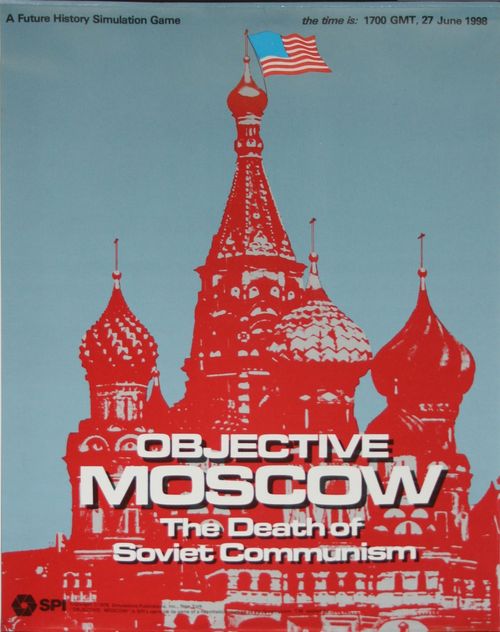
Objective Moscow: The Death of Soviet Communism
Objective Moscow: The Death of Soviet Communism Rulebook
Table of Contents
Table of Contents
- 1.0 Introduction
- 2.0 General Course of Play
- 3.0 Game Equipment
- 4.0 Sequence of Play
- 5.0 Land Movement
- 6.0 Supply
- 7.0 Zones of Control
- 8.0 Stacking of Units
- 9.0 Strategic Movement
- 10.0 Headquarters
- 11.0 Combat
- 12.0 Nuclear Combat (Optional Rule)
- 13.0 Special Unit Types
- 14.0 Camouflage
- 15.0 Replacements, Reinforcements, Mobilization
- 16.0 National Restrictions
- 17.0 Weather
- 18.0 How to Set Up and Play the Scenarios
- 19.0 The Contemporary Scenarios
- 20.0 The Contemporary Campaign Game
- 21.0 Korea Minigame (North and South Korea, SE Map)
- 22.0 1998 Campaign Game
- 23.0 Play-By-Mail Module
- Historical Rationale: 1998
- Charts and Tables
- 11.52 Combat Results Table
- 12.4 Nuclear Combat Results Table
- 12.5 Nuclear Capabilities Chart
- 17.22 Weather Table (as printed on page 22)
- 16.21 National Policy Chart
- 17.33 Weather Chart
- 5.4 Terrain Effects Chart / Terrain Key
- 9.6 Strategic Movement Grid
- 10.5 Reaction Rating Table
- 10.4 Headquarters Organization Charts
1.0 Introduction
Objective: Moscow is a divisional level simulation of invasions of the Soviet Union within the next twenty years. Several contemporary scenarios are postulated, including a NATO counteroffensive after a Soviet invasion of Western Europe, a Chinese invasion of Siberia, and an Iranian campaign of expansion in the Mideast. Scenarios taking place in the year 1998 postulate an alliance of the USA, a United Europe, Iran, China, and other countries joining for the conquest of the Soviet Union.
2.0 General Course of Play
Objective: Moscow can be played as either a two-Player or three-Player game. In either version, each Player moves his units and executes attacks on Enemy units in turn, attempting to fulfill the Victory Conditions. Each unit expends a portion of its Movement Allowance to move from one hex to another. Combat is resolved by comparing the Combat Strengths of opposing ground and air units. The total Combat Strengths are expressed as a comparison and simplified as a ratio. Each battle is resolved individually by cross-indexing a die roll with the appropriate ratio column on the Combat Results Table.
3.0 Game Equipment
3.1 The Game Map
The 70" x 42" four-piece mapsheet portrays the Soviet Union and adjacent areas of Europe and Asia. A hexagonal grid is superimposed on the map to regularize combat and movement of the playing pieces. Terrain, communications lines, and other features pertinent to the game are depicted on the mapsheet.
How to Assemble the Map: The Northwest map section overlaps the Southwest section so that the bottom hexrow of the Northwest section is superimposed on the top hexrow of the Southwest section. The Northeast section overlaps the Southeast section in the same way. The entire East section should now be placed to overlap the West section. Note: It is not necessary to assemble all four map sections to play all the scenarios. Players may wish to use masking tape (not cellophane tape!) to secure the map edges and cover the map with a sheet of plexiglass for protection.
3.2 Game Charts and Tables
Various visual aids are provided to illustrate and simplify certain game functions. These charts and tables are explained in their appropriate rules sections. These are the Combat Results Table, Terrain Effects Chart, Turn Record Track, Headquarters Organization Charts, Nuclear Combat Results Table, Nuclear Capability Chart, Strategic Movement Grid, Weather Chart (by area), Weather Table, Replacement Points Track, and Terrain Key.
3.3 The Playing Pieces
The differently colored playing pieces represent the units of the various armed forces in the game. Depending on the scenario being played, each country's units will be Neutral or be controlled by either the Soviet, Chinese, or US Player. Many units are printed on both sides. One side of the Soviet-allied and Chinese-allied units faces up when the unit has not been "tried" in combat; the other side is used, revealing the unit's Strength, when the unit has attacked or defended. One side of US-allied units is the full-Strength side while the reverse side shows the reduced-Strength. Air units, some headquarters units, naval units, and most Neutral units are printed on only one side.
3.31 Unit Types
There are three general types of units: land, air, and naval. Each of these types is further subdivided into several categories. The uses and limitations of each are explained in the rules Sections dealing with unit types.
3.32 Sample Units
Important Note: In some instances, such as in the case of the US 84th Infantry Division, the printing on the back of the counter represents the same unit at a reduced strength. The backs of such counters are easily identified by their similarity to the counter front and their reduced combat and personnel values. Other counters are backprinted with the full strength of the unit. On the PRC S and SU 37G samples, the front represents an untried state which preserves the anonymity of the unit until it has become involved in combat. Many air units represent contemporary aircraft on the front and "future" aircraft — used only in the 1998 scenario — on the back. Finally, some counters are backprinted with a totally different type of unit, sometimes of a different nationality.
The sample counters show the following items:
- Combat unit (with step-reduction): unit designation, nationality, unit type, organization category, Personnel Value, and the Attack Strength - Defense Strength - Movement Allowance (for example 8-8-5 on the front, with a reduced-strength back).
- Combat unit (with untried state): the untried front shows only nationality, unit type and Movement Allowance (e.g. "U-5"); the tried back shows the Personnel Value and Attack - Defense - Movement.
- Combat unit (with readiness class): Soviet units show a Readiness Class (I to IV) on the untried front; the back shows Attack - Defense - Movement and Personnel Value.
- Cruise missile brigade: front shows unit designation, nationality, Personnel Value, and Attack/Defense Strength and Movement Allowance; the back is blank.
- Naval unit: shows Attack/Defense Strength (equal to the Column Shift on the CRT) and Movement Allowance.
- Air unit: front (contemporary) and back (1998) each show nationality, unit designation (aircraft name), aircraft class (F, B or FB), Air-to-Air Strength, Ground Attack Strength and Range, in the order Ground Attack Strength - Air-to-Air Strength - Range.
- Other sample units: Mountain Infantry, Contemporary Fighter-Bomber (limited weather, with parenthesized range), Contemporary Bomber, Space Marines, Marines, Airborne, Airmobile, Hovercraft, Cavalry, Infantry and Artillery (untried and tried), US Army / Corps Headquarters (0-0-5 and similar).
3.33 Summary of Unit Types
Combat unit types shown: Army Headquarters, Corps Headquarters, Armor, Mechanized Infantry, Motorized Infantry, Marine, Airborne, Airmobile, Mountain Infantry, Hovercraft, Cruise Missile Brigade, Naval Unit, Contemporary Fighter, Fighter-Bomber and Bomber, 1998 aircraft, Cavalry, Infantry, and Artillery.
Game markers: Reaction Rating markers; Game-Turn marker; Mechanized Replacement Points (Mech Repl) marker; Infantry Replacement Points (Inf Repl) marker; Weather Area marker.
3.34 Definition of Terms
Aircraft Class: The category of an air unit for combat purposes. F = Fighter; B = Bomber; FB = Fighter-Bomber.
Air-to-Air Strength: The Combat Strength used by air units for both attack and defense against other air units.
Attack Strength: The strength of the unit, quantified in Combat Strength Points, when attacking.
Defense Strength: The strength of the unit, quantified in Combat Strength Points, when defending.
Friendly: Units belonging to a common alliance (Soviet, Chinese, or US) are considered Friendly to one another. Also, geographic locations controlled by an alliance are considered Friendly in that alliance. In some scenarios, US-allied and Chinese-allied units are considered Friendly to one another.
Ground Attack Strength: The Combat Strength used by air units attacking ground units.
Limited Weather Aircraft: Aircraft marked with a parenthesized range are restricted in some instances by adverse weather (see Case 17.11).
Movement Allowance: The basic movement ability of the unit quantified in Movement Points. In most cases, a unit expends one Movement Point of its Movement Allowance for each hex entered.
Organization Category: A unit's size. xxxx = Army (Front to the Soviets); xxx = Corps (Army to the Soviets and Chinese); x = Brigade. Most units are divisions (unmarked). Air units are air divisions (Soviet or Chinese) or two air wings — about 100 planes.
Personnel Value: A comparative representation of the manpower and "staying power" of a unit quantified in Personnel Points.
Range: The number of hexes from its airbase that an air unit may fly to attack an Enemy unit. Range is calculated from the airbase hex (exclusive) to the Enemy unit's hex (inclusive). Note: During the Strategic Movement Phase, all air units have unlimited range for ferrying.
Readiness Class (Soviet only): A unit's preparedness for war. Class I units are full strength; Class II are 70% strength; Class III are cadres; Class IV are mid-war reinforcements.
Unit Designation: The name of a unit — usually a number of the unit. Some designations are not historical but are necessary for Play-by-Mail and are thus included for ID purposes.
3.4 Game Equipment Inventory
A complete game of Objective: Moscow includes the following parts:
- One Map (four 22" x 34" sections)
- One Rules Booklet
- Three Sheets of 400 Die-Cut Counters (1200 total)
- One Sheet HQ Displays / Strategic Movement Grid
- One Plastic Die
- Two Game Boxes with Coversheet
3.5 Game Scale
Each Game-Turn represents two weeks. Each hexagon represents an area 60 kilometers from side to side. Each ground unit represents a division of 8,000-20,000 men, a brigade of 3,000 men, or a headquarters controlling 10,000 or more men. Each air unit represents 100+ aircraft. Each naval unit represents one aircraft carrier plus its defensive escorts.
4.0 Sequence of Play
4.1 The Game-Turn
Objective: Moscow is played in Game-Turns. Each Game-Turn is composed of two Player-Turns in the two-Player Scenarios (US or Chinese followed by Soviet) or three Player-Turns in the three-Player Scenarios (Chinese followed by US followed by Soviet).
Each Player-Turn is composed of a number of discrete Phases which must be executed in sequence. The Player whose Player-Turn is in progress is termed the Phasing Player.
4.2 Sequence Outline (Two-Player Scenario)
A. NON-SOVIET PLAYER TURN (US or Chinese)
-
Strategic Movement Phase. The Phasing Player may move land units by Rail Movement, Sea Transport, and Air Transport. Air units may ferry. Naval units may move. No other movement or combat is allowed.
-
Land Movement Phase. The Phasing Player determines which units are in supply and which are out of supply. He then moves his land units. Land units out of supply move at half their printed Movement Allowances. Units may receive Bonus Movement. Finally, the Phasing Player moves any of his air units that neither ferried during the Strategic Movement Phase nor began the current Land Movement Phase out of supply to hexes within range containing Enemy units to be attacked.
-
Interception Phase. The non-Phasing Player moves any of his fighter and fighter-bomber units to hexes within range that contain air units placed upon non-Phasing units by the Phasing Player during last Phase. He then executes attacks on the Phasing air units. Both Players return their air units to their airbases as each Interception is resolved. The only air units not on their airbases at the end of the Phase are Phasing bomber and fighter-bomber units which survived Interception.
-
Combat Phase. The Phasing Player's land units attack adjacent Enemy units and his air units attack Enemy units they are stacked with. The Phasing Player may abort any of his air units, presumably because they would have to attack at poor odds. These air units are returned to their Airbases. As each combat is resolved, remaining air units are returned to Airbase.
-
Reaction Phase. The non-Phasing Player checks the Reaction Rating of army headquarters within five hexes of an Enemy unit. A number of mechanized units equal to the Reaction Rating (and within the Army Headquarters' Reaction Radius) may move up to half their Movement Allowance.
-
Mechanized Movement Phase. The Phasing Player determines which units are in supply and which are out of supply. He may move all his mechanized units (those units with a printed Movement Allowance of 5) up to half their Movement Allowance. Unsupplied units move up to one quarter of their Movement Allowance. Naval units may move.
B. SOVIET PLAYER TURN
- Strategic Movement Phase.
- Land Movement Phase.
- Interception Phase.
- Combat Phase.
- Reaction Phase.
- Mechanized Movement Phase.
- Replacement, Reinforcement, and Mobilization Phase. In addition to taking any replacements and reinforcements, the Soviet Player replaces Class II and Class III Peacetime units with Class II and III Wartime units if they have completed mobilization.
C. GAME-TURN INDICATION
The Game-Turn marker is advanced one space on the Turn Record Track to signal the start of a new Game-Turn.
4.3 Sequence Outline (Three-Player Scenario)
A. CHINESE PLAYER-TURN. B. US PLAYER-TURN. C. SOVIET PLAYER-TURN. D. GAME-TURN INDICATION.
Each Player-Turn is identical to those in the Two-Player Scenarios. During the Chinese Player-Turn, only Soviet-allied units may Intercept and React. During the Soviet Player-Turn both US-allied and Chinese-allied units may Intercept and React. No unit can Intercept or React more than once per Game-Turn. Soviet units can React during the Chinese Player-Turn only if they are within five hexes of Chinese-allied units; during the US Player-Turn Soviet units can React only if they are within five hexes of a US-allied unit. (In other words, units may only Intercept and React in the appropriate Player-Turn.)
4.4 Game Length
Repeat the steps for each Game-Turn until the final Game-Turn as stated in the scenario. The Players' performances are then evaluated by the Victory Conditions.
5.0 Land Movement
GENERAL RULE: During the Land Movement Phase of a Player-Turn, the Phasing Player may move as few or as many of his land units as he wishes. Units may be moved in any direction or combination of directions. During the Mechanized Movement Phase, only mechanized units (those with a Movement Allowance of 5 or more) may move. During the Reaction Phase only some mechanized units can move.
PROCEDURE: Units are moved one at a time, tracing a path of contiguous hexes through the hex grid. As a unit enters a hex, it expends one or more Movement Points of its Movement Allowance.
5.1 Movement Limitations
5.11 Movement may never take place out of sequence.
5.12 A land unit may never enter a hex containing an Enemy unit. Exception: an airborne unit being airdropped (see Case 13.2).
5.13 A unit may expend some, all, or none of its Movement Points in a movement phase, but unused Movement Points may not be accumulated until another movement phase or transferred to another unit. A unit may not expend more Movement Points than its Movement Allowance in one movement phase. Exceptions: during the Land Movement Phase (not the Mechanized or Reaction Phases) a unit may always move one hex, even if it lacks sufficient Movement Points. In addition, infantry units being carried by headquarters (see Case 10.21) may expend more Movement Points than their printed Movement Allowance.
5.2 Bonus Movement
If a supplied unit begins the Land Movement Phase outside Enemy Zones of Control and does not enter an Enemy Zone of Control, it receives three Bonus Movement Points. If the moving unit is out of supply, it receives only one and a half Bonus Movement Points. All land units may be eligible for Bonus Movement, but only during the Land Movement Phase. Bonus Movement Points are identical in all respects to normal Movement Points.
5.3 Effects of Terrain and Zones of Control
5.31 Units must expend more than one Movement Point to enter certain types of terrain or cross certain hexsides (see the Terrain Effects Chart). To leave an Enemy-controlled hex, a unit must expend one extra Movement Point. These Movement Point costs are cumulative.
5.32 Units may not leave the map (except via Strategic Movement) or enter or cross prohibited terrain. If forced to do so as a result of combat, the unit is eliminated.
5.4 Terrain Effects Chart (Map A)
(Printed on the map.)
6.0 Supply
GENERAL RULE: All land and air units are either in supply or out of supply. Supply for movement purposes is judged at the beginning of each Movement Phase. Supply for combat is judged at the instant of combat. Land units are in supply if they can trace through one hex unblocked by Enemy units (not Zones of Control) to a supply source or to a headquarters which is itself in supply. Headquarters units are in supply if they can trace a line of three hexes unblocked by Enemy units to a supply source (or to another headquarters in supply, etc). Count hexes from the unit (exclusive) to the supply source (inclusive).
6.1 Communication Zones
The European and Japanese Communication Zones represent regions densely filled with roads and railroads. Every hex in a Communications Zone contains roads and Secondary railroads connecting each adjacent hex within the Zone. (They are not printed on the map simply to reduce clutter.) Example: A supply line could be traced from hex NW0314 to hex SW3717 via NW0214 and NW0115. The Communications Zone also applies for Movement purposes. Blocked Hexsides within Communications Zones are exceptions.
6.2 Supply Sources
The US uses two types of supply source: those that can supply an unlimited number of US-allied units and those that can supply only a limited number.
6.21 An unlimited supply source hex is any road hex from which the US Player can trace a line of continuous road hexes unoccupied by Enemy units to a Friendly map-edge. Friendly map-edges are NW3505 to NW0101, SW3801 to SW2601, SW0107 to SW0115. (In other words, the edge of any Friendly country.)
6.22 A limited source is a Friendly port or a road hex from which a supply line can be traced to a Friendly port. A Friendly port is one that is currently occupied or last passed through by Friendly land units. A port in a Friendly country is assumed to be Friendly initially, just as a port in an Enemy country is Enemy until it is captured. Major ports can supply five US-allied units. Minor ports can supply two US-allied units (see Terrain Key).
6.23 Soviet-allied units trace to different sources for combat and movement. Both types of source can supply an unlimited number of units. Movement supply sources include any Primary or Secondary railroad hex from which an unblocked supply line can be traced to a railroad hex within five hexes of a Friendly refinery. The five hex path from the railroad hex to the refinery can traverse any terrain passable to land units, but it must not be blocked by Enemy units. Units may also trace the five-hex line directly to the refinery.
6.24 Combat supply source hexes include any Primary or Secondary railroad hexes from which an unblocked line of rail hexes can be traced to a Friendly Urban hex in the USSR. The Urban hex must be directly on the railroad.
6.25 Chinese-allied infantry units (those with a Movement Allowance of 2) are always in supply for Movement. The movement supply source for other Chinese units and the combat supply source for all Chinese units is identical: any Chinese rail hex from which an unblocked line of rail hexes can be traced to a Friendly urban hex in China.
6.26 The Soviet Player can trace supply through railroads in the USSR, Poland, East Germany, Czechoslovakia, Hungary, and Rumania. If Finland is Soviet-allied, its railroads can also be used. The Chinese Player uses Chinese railroad hexes and (if Chinese-allied) North Korean railroads.
6.27 A supply line is not blocked by an Enemy Zone of Control — only by an Enemy land unit.
6.3 Supply Effects
6.31 Land units that are out of supply have their Attack, Defense, and Movement capabilities halved. Fractions are retained for Attack and Defense Strengths and dropped for Movement Allowances. However, units may always move one hex during the Land Movement Phase except through prohibited terrain. This condition does not apply during the Reaction and Mechanized Movement Phases.
6.32 Air units that are out of supply may not Intercept or fly ground attack missions. They may ferry to another airbase.
6.33 Naval units are always in supply, as are the air units flying from them.
6.4 Airbases
6.41 Except when an air unit is making a ground attack (flying in the Land Movement Phase) or Intercepting, it is on the ground at an airbase. An airbase traces supply just like land units of that nationality. Air units in a supplied airbase are themselves supplied.
6.42 A Major airbase can hold five air units, a Minor airbase two.
6.43 If an air unit is not airbased at the end of any Combat Phase, it is eliminated. If the airbase it is on is out of supply, the air unit is not eliminated, but is prohibited from all activity except ferrying (see Case 9.4).
6.44 An air unit may voluntarily switch airbases only during the Strategic Movement Phase, by ferrying. An Intercepting air unit or an air unit conducting a Ground Attack must return to the airbase it flew from.
7.0 Zones of Control
GENERAL RULE: The six hexes surrounding a land unit constitute that unit's Zone of Control. Headquarters, hovercraft, cruise missile, air, and naval units do not exert a Zone of Control. Hexes upon which a unit exerts a Zone of Control are controlled hexes.
7.1 Effectiveness of Zones of Control
7.11 Land units pay one additional Movement Point to leave an Enemy-controlled hex, in addition to the normal terrain cost of the hex being entered. There is no cost to enter an Enemy-controlled hex.
7.12 Friendly Zones of Control never affect Friendly units, only Enemy. Zones of Control do not affect air or naval units, either Friendly or Enemy.
7.13 Zones of Control extend into all six hexes surrounding a unit except across blocked hexsides or Major river hexsides.
7.14 There is no additional effect of having more than one unit exert a Zone of Control into a hex.
7.2 Zones of Control and Retreats
Units may not retreat as a result of combat into or through an Enemy-controlled hex, even if the hex is occupied by a Friendly unit or a Friendly Zone of Control is being cast into the hex. Supply lines may be traced through Enemy Zones of Control.
8.0 Stacking of Units
GENERAL RULE: A maximum of three Friendly land units may be stacked in one hex at the end of any Friendly Movement Phase. A maximum of five Friendly air units may be stacked in a Major airbase, two air units in a Minor airbase. An unlimited number of naval units may stack in a hex. Excess units in a stack at the end of a Friendly Movement Phase are eliminated. The owning Player selects the units to be eliminated.
8.1 Exceptions to Stacking Restrictions
8.11 Up to four land units may stack with a corps or army headquarters. Only one headquarters may stack in any hex.
8.12 Any number of air units may be placed in a hex for Interception and Ground Attack. Air unit stacking limitations apply only when air units are at their airbases.
8.13 If Friendly land units are stacked in a hex with Friendly air units in an airbase, the combined total of Friendly units of both types in the hex must not exceed five.
8.2 Stacking and How Combat Affects It
8.21 All land units in a single hex must be attacked as a single combined defense strength (see Case 11.21).
8.22 In the case of Interception, the non-Phasing (intercepting) Player may attack stacked Enemy air units individually, although all Enemy fighter and fighter-bomber units in the stack must be attacked at at least 1 to 1 odds before any bombers can be attacked (see Section 11.0 for more detailed explanation).
8.23 Stacked naval units being attacked by Enemy air units can be attacked individually, with the Enemy Player attacking only those he wishes to. He may choose to attack them all as one combined Defense Strength if he wishes.
9.0 Strategic Movement
GENERAL RULE: Units that use Strategic Movement may not move or attack the remainder of the Player-Turn. They may move during the Interception or Reaction Phase of the Enemy Player-Turn.
9.1 Rail Movement
9.11 Twenty-five Soviet-allied land units per Game-Turn may move on Primary railroads within the USSR, Poland, East Germany, Czechoslovakia, Hungary, Rumania, and (if Soviet-allied) Finland. A unit must begin the Strategic Movement Phase on a Primary rail hex. It may then move up to 50 hexes along Primary railroads. Only supplied units may use Rail Movement. A unit may not move off the Primary railroad during Rail Movement.
9.12 Ten Chinese-allied land units per Game-Turn may move on any railroad within China. Infantry units may move up to 70 hexes. Mechanized units (including headquarters) may move up to 50 hexes.
9.13 Neither US-allied nor Neutral units may use Rail Movement.
9.14 A unit that is moving by rail must immediately stop upon entering an Enemy Zone of Control. A unit may not end its Rail Movement in a hex exceeding stacking limits.
9.15 Because of the low capacity of the Trans-Siberian Railway, only two Soviet-allied units per Game-Turn may move by Rail on the SE map section in each direction (east and west). A total of four units could therefore move onto, off, or across the SE section by rail.
9.2 Sea Transport
The US Player may move US-allied units by sea from one Strategic Movement Grid (SMG) box to another, from a box to a port on the map, from a port to a box, or between ports.
9.21 Direct movement between ports is allowed only if both ports are included under the same SMG box heading. Example: Antwerp and Riga are both included under the "Europe Ports" heading, so Sea Transport between them is allowed.
9.22 A given land unit may make only one SMG move per Game-Turn. A maximum of 10 land units may use Sea Transport each Game-Turn, up to five in the Western SMG area and five in the Eastern.
9.23 A unit in a port can move to the port's heading box and then to another port as one move. Example: A unit in Antwerp can move to the "Europe Ports" box and then to the Eastern USA box (or vice versa) in one move.
9.24 There are no stacking limits in SMG boxes. Units in SMG boxes are always in supply and cannot be attacked.
9.3 Overland Strategic Movement
Some route lines between boxes are designated as Overland. Units may move between these boxes without counting against the Sea Transport limit. Units in the Italy and Turkey boxes move onto the map via regular movement. Units move into and out of the Turkey box between SW3904 and SW2601. Units move into and out of the Italy box between NW3905 and NW3001.
9.4 Air Ferry
During the Strategic Movement Phase, any number of air units may fly from any Friendly airbase to any other Friendly airbase on the map or to or from the Strategic Movement Grid. Ferrying units may not move or attack for the rest of the Player-Turn, but they may Intercept in the Enemy Player-Turn. Range is unlimited during ferrying. Ferrying is the only task that unsupplied air units can perform. The Strategic Movement Phase is the only Phase in which air units may voluntarily change airbase, although an air unit is sometimes forced to ferry (see Cases 11.31 and 11.71).
9.5 Air Transport
The US and Soviet Players may each Air Transport four Personnel Points per Game-Turn. Tank divisions may never be Air Transported.
9.51 To Air Transport, a unit must begin the Strategic Movement Phase in supply at an airbase, stacked with at least one Friendly fighter or fighter-bomber unit. The land unit may then be moved to any other Friendly, supplied airbase on the map or on the Strategic Movement Grid. If the destination airbase is on the map, it must also be occupied by a Friendly fighter-bomber or fighter.
9.52 Units with Zero Personnel Points equal one PP for Air Transport Purposes.
9.6 Strategic Movement Grid
(See separate sheet.)
10.0 Headquarters
GENERAL RULE: Headquarters (HQ) units represent the staff, reserve equipment, and logistic capacity of corps and army rear areas. They are treated as regular combat units for attack, defense, and exchange purposes except as noted below. In addition, they have special functions.
10.1 HQ's and Combat
10.11 HQ's exert no Zone of Control.
10.12 A Soviet unit must be adjacent to or stacked with a corps or army headquarters to make a nuclear attack (see Section 12.0).
10.2 HQ's and Movement
10.21 US and West German corps HQ's are heavily endowed with motor transport. Each may carry Friendly infantry divisions at the mechanized Allowance of five Movement Points. A US HQ may carry two infantry divisions and a German HQ may carry one. In any Friendly Movement Phase that the HQ begins stacked with the infantry, the infantry may move with the HQ at the HQ's rate. The infantry may "drop off" before the HQ finishes moving, but it may not enter a hex that the HQ does not enter. Carrying is voluntary. Note that infantry being carried is considered mechanized for the purposes of Reaction.
10.22 Each army HQ within five hexes of an Enemy unit at the start of the Reaction Phase may move a certain number of Friendly mechanized units. Units moved during the Reaction Phase move at half the printed Movement Allowance, halved again if unsupplied.
10.23 US-allied army HQ's may move Friendly units within [number missing in the printed text] hexes. Soviet-allied and Chinese-allied army HQ's can move units adjacent or stacked with the HQ.
10.24 The number of units that can be moved is equal to the HQ's Reaction Rating. The first Reaction Phase an HQ starts within five hexes of an Enemy unit, the owning Player rolls a die on the Reaction Rating Table. That result is marked on the HQ Organization Chart with a number chit. The number (from 0 to 3) is the number of mechanized units the HQ can move. An HQ can include itself as a unit being moved (unless the Rating is 0).
10.25 Normally the Reaction Rating does not change and is used by the HQ for every Reaction Phase. However, in any Friendly Replacement Phase the owning Player may transfer chits between two Army HQ's on the Organization Chart. This represents a transfer of commanders. There is no limit to the number of times this may be done, but chits may not be placed in the empty Chart boxes of HQ's yet to be Rated. Chits may only be transferred between HQ's with established Reaction Ratings.
10.3 HQ's and Stacking
Each HQ may stack with up to four other land units. Two HQ's may not stack in the same hex. To reduce inconveniently high stacks, units stacked with an HQ may be placed in the HQ's box on the HQ Organization Chart. Although the counters are removed from the map, the units are considered to be on the map. The counters may be returned to the map at any time. Players may freely examine all units just as if they were on the map (Exception: see Section 14.0).
10.4 HQ Organization Charts
(See separate sheets.)
10.5 Reaction Rating Table
(See HQ Organization Charts.)
11.0 Combat
GENERAL RULE: Combat occurs between adjacent opposing land units and/or between bomber, fighter-bomber, and airborne units stacked on an Enemy hex. The Phasing Player is referred to as the attacking Player and the non-Phasing Player is the defending Player, regardless of the overall strategic situation.
PROCEDURE: All attacking units are committed to an attack, and once committed cannot be withdrawn or reallocated to another attack. The defending units are always the total of ground units in the hex under attack. The "tried" strength of all units attacking and defending is then revealed. Total the modified Attack Strengths of the attacking units in a specific attack and compare it to the total modified Defense Strengths of the units in the hex under attack. State the comparison as a ratio of attacker's Strength to defender's Strength. Round off the ratio in favor of the defender to conform to the simplified odds found on the Combat Results Table (26 to 9 becomes 2 to 1), roll the die and apply the result read on the appropriate column. The result is applied before any other combat is resolved. Friendly units may not attack each other.
11.1 Which Units May Attack
11.11 Land and air units attack during the Friendly Combat Phase. Land units attack land units adjacent to them. Air units attack land units stacked with them.
11.12 Attacking is completely voluntary; units are never compelled to attack, nor is every land unit adjacent or air unit stacked on an Enemy unit required to attack it even if other units are attacking it. A unit not participating in an attack is never affected by the result.
11.13 An Enemy unit can be attacked by as many land units as can be stacked in the six adjacent hexes (up to 30, including six Headquarters) and an unlimited number of air units.
11.14 No unit may attack more than once per Combat Phase. No unit may be attacked more than once per Combat Phase.
11.15 Fighter units (those air units with no Ground Attack Strength) cannot attack land units, and will never be stacked with an Enemy unit during the Combat Phase (see Case 4.2). Air units do not attack Enemy air units during the Combat Phase; they attack them during the Interception Phase. Phasing air units do not attack non-Phasing air units.
11.2 Multi-Unit and Multi-Hex Combat
11.21 All land units in a hex must be attacked as a single combined Defense Strength. The defender may not "withhold" a unit under attack.
11.22 Other units in a hex containing an attacking unit need not participate in the attack. They could attack another hex or not attack at all.
11.23 Only one hex may be attacked in a single attack! Different units in a single hex could attack more than one hex in more than one attack.
11.24 A unit's Attack or Defense Strength is always unitary and may not be divided among different combats for attack or defense.
11.3 Air Combat
11.31 Land units may not attack air units. Any time a land unit enters a hex adjacent to an Enemy air unit in an airbase, the air unit immediately ferries to another airbase. It may not Intercept that Player-Turn. This is true even if Friendly land units are with the air unit.
11.32 Air-to-air combat occurs during the Interception Phase. Phasing air units are attacked by non-Phasing air units (see Case 4.2). A stack of air units does not automatically defend with one Combat Strength as a stack of land units does. The topmost unit of the stack must be attacked first, followed by the second, etc., in sequence. A unit in the stack cannot be attacked unless all the units atop it have been attacked at a Combat Ratio of at least 1 to 1. (Presumably, the Player will place his fighters atop his bombers.) Not all units need be attacked.
Example: the Phasing Player stacks (from the top down) a 0-8-10 fighter, a 10-8-20 fighter-bomber, and a 25-5-40 bomber. The defender Intercepts with four 0-8-15 fighters. One 0-8-15 attacks the 0-8-10 at 1 to 1 allowing another 0-8-15 to attack the 10-8-20 at 1 to 1 allowing the two remaining 0-8-15's to attack the 25-5-40 at 3 to 1. Alternately the four 0-8-15's could have attacked the whole stack at 1 to 1.
11.33 Air units attacking land units without Friendly land units aiding in the attack have their Ground Attack Strength halved, keeping fractions. Example: A 99-4-23 attacks a 4-5-5 in rough terrain. The odds are (99 / 2 = 49) to (5 x 2 = 10), or 4 to 1.
11.34 A land unit with a Defense Strength of zero defends a pure-air unit attack with a Defense Strength of 1.
11.35 Note that air units may fly over and stack with (while attacking) Enemy land units!
11.4 Effects of Terrain
11.41 A unit defending in certain terrain has its Defense Strength multiplied. This applies only to land units (see Terrain Effects Chart).
11.42 A unit attacking across a Minor or Major river hexside has its Attack Strength halved, keeping fractions. Air units never attack across a hexside so they are unaffected by rivers.
11.5 Combat Resolution
11.51 Combat odds are rounded off in favor of the defender. For example, 26 to 9 becomes 2 to 1. The 2 to 1 column on the Combat Results Table is used to resolve the attack.
11.52 Explanation of Combat Results
D1 (D2, D3) = Defender retreats 1 (2, 3) hexes. The owning Player retreats his own units according to the retreat rules. Units may not retreat across blocked hexsides. Air units do not retreat a given number of hexes. Instead, they fly back to their airbase.
A1 (A2, A3) = Attacker retreats 1 (2, 3) hexes.
De = Defender Eliminated. All defending units are eliminated. Attacker may advance into the hex.
Ae = Attacker Eliminated. All attacking units are eliminated. Defending units may advance into hex.
Ex = Exchange. The Player with the fewer Personnel Points involved in the combat eliminates all his units. The other Player eliminates an equal number of his Personnel Points. It is at this point that US-allied units may flip to their partial-strength side to "make change" for the Exchange.
Example: A US unit of four Personnel Points attacks a Soviet unit with two Personnel Points, rolling an Ex. The Soviet unit is eliminated. The US unit flips over to its reverse side, which shows two Personnel Points.
Example: Chinese units totaling three Personnel Points attack a stack of two Soviet units each of two Personnel Points, rolling an Ex. The Chinese units are eliminated. The Soviet must remove at least three Points. Since Soviet units have no partial-strength side, both Soviet units are removed.
Example: A US unit of four Points attacks a Soviet Headquarters with zero Points, rolling an Ex. The HQ is eliminated. The US must remove an equal number of Points (zero) and is unaffected.
If only units with zero Points are involved in an Exchange, the Player with the fewer units removes all his units, with the other Player removing an equal number of units.
Air units exchange equal numbers of air to air Points. In an Ex between air units and land units, one air unit is exchanged for each land unit Personnel Point, on a one to one basis regardless of the air unit's strength. A naval unit exchanges with two air units (as if the naval unit had two Personnel Points).
11.53 Combat Results Table (see page 22)
11.6 How to Retreat
When the Combat Results Table requires units to be retreated, the owning Player immediately moves the units the required number of hexes away from their combat position. Air units return to their Friendly airbase. This retreat movement is not normal Movement and is subject to the following restrictions. If a unit is unable to retreat within these restrictions it is eliminated.
11.61 In retreating, a unit may initially exit an Enemy-controlled hex. Thereafter, it may not enter an Enemy-controlled hex even if the hex is occupied by a Friendly unit.
11.62 Although Terrain Movement Costs are ignored, a retreating unit may not cross a blocked hexside or enter a prohibited hex.
11.63 If possible, a retreating unit must retreat into and through vacant hexes. If no other route is available, the retreating unit may move through Friendly-occupied hexes, displacing every Friendly unit whose hex it moves through. Retreating units may not stack with other units (except units they were stacked with when the retreat began).
11.64 In all cases, the retreating land unit must terminate its retreat the indicated number of hexes away from its former combat position. If it cannot, and it can retreat only a portion of the number of hexes away, it is eliminated instead, in the last hex it was able to retreat to. The same elimination occurs if the last hex already contains a Friendly unit that cannot be displaced.
11.65 If an air unit cannot retreat to an airbase within range without overstacking the airbase's capacity, the air unit is eliminated.
11.7 Displacement
11.71 If Friendly units occupy hexes in the only possible retreat route available to a retreating unit, those Friendly units are displaced (moved out of their hexes) by the retreating unit. A displaced land unit is moved one hex by the owning Player as if it were itself retreating. A displaced air unit flies to a Friendly airbase within range as if it were retreating. The retreating unit then enters the vacated hex. As many units as necessary may be displaced to allow a unit to retreat.
11.72 If the displacement would cause any of the displaced units to be eliminated, the retreating unit is eliminated instead, and there is no displacement. Displaced units can themselves displace units in a chain reaction, if that is the only path open to them. A unit may be displaced more than once per Combat Phase if necessary. Units may not displace other Friendly units if they have other paths open to them.
11.73 Remember that retreating units may not stack with other Friendly units, unless stacked with them when starting the retreat; Friendly units are otherwise always displaced.
11.8 Advance After Combat
11.81 Whenever an Enemy land unit is forced to retreat or is eliminated as a result of combat, it will leave a path of vacant hexes behind it called the path of retreat. This includes any hexes left vacant due to displacement. Friendly victorious land units which participated in the combat and were adjacent to the retreated unit are allowed to advance along the path of retreat.
11.82 Advancing is optional. Advancing units may stop in any hex along the path of retreat. Advancing units ignore Enemy Zones of Control.
11.83 Infantry units may advance only one hex. Mechanized units may advance the length of the path of retreat or may advance one hex if the Enemy unit(s) was totally eliminated.
11.84 Advancing units may not stray from the path of retreat.
11.85 The option to advance must be exercised immediately, before any other combat resolution. After advancing, units may neither attack nor be attacked the remainder of the Combat Phase, even if their advance places them next to Enemy units whose combat has yet to be resolved.
11.86 Units may stack and unstack freely as a result of advance after combat, as long as there are no more than three units (or four with an HQ) in a hex at the end of the Combat Phase.
11.9 Untried and Zero Strength Units
11.91 An Untried Soviet-allied or Chinese-allied combat unit has its Strength revealed for the first time the first time it attacks or defends. If it is revealed to have both an Attack Strength and Defense Strength of zero, it is immediately eliminated. If such a unit is defending alone in a hex the attacker can advance into the hex. If such a unit is attacking with other units, the attack goes on without it. If it is the only land unit in the attack, Friendly attacking air units have their Ground Attack Strength halved (see 11.33).
11.92 A combat unit with an Attack Strength of zero and a Defense Strength of one or more cannot attack. It can defend normally.
11.93 An Artillery unit with an Attack Strength but no Defense Strength is eliminated if attacked alone in a hex by land units or if an Enemy Zone of Control is extended into a hex occupied by the artillery unit alone.
11.94 A Headquarters unit with a Defense Strength of zero is eliminated if attacked alone in a hex by land units or if an Enemy Zone of Control is extended into a hex occupied by the HQ alone. HQ units with Attack Strength and Defense Strength of zero are not eliminated automatically.
11.95 Units with Defense Strengths of zero defending in a hex with other Friendly units suffer the same result, even though they add nothing to the defense.
12.0 Nuclear Combat (Optional Rule)
GENERAL RULE: Tactical Nuclear Combat is similar to conventional combat in that units attack from the same positions: land units adjacent to land units, air units stacked with land units. Nuclear Combat occurs only during the Combat Phase, never during the Interception Phase (i.e., air units may not make Nuclear attacks on air units). A stack may be attacked conventionally or by Nuclear attack in a single Combat Phase, never both.
PROCEDURE: A Player making a Nuclear attack ignores the Attack and Defense Strengths of the units involved. Instead, he uses the Nuclear Capability Chart to determine how many Nuclear Points each attacking unit has; this varies by nationality. The die is rolled on the appropriate column of the Nuclear Combat Results Table (NCRT), and the result is applied.
12.1 Restrictions
12.11 A Soviet unit may make a Nuclear attack only if it is adjacent to a Soviet (not Soviet-allied) Army or Corps Headquarters.
12.12 If a unit is defending against a Nuclear attack in certain terrain, the NCRT column used is shifted to the left (see Terrain Effects Chart). Example: A unit defending in Rough receives a Shift 2 benefit. If 12 Nuclear Points are attacking the hex, the 10 column on the NCRT is used.
12.13 A unit must be in supply to make a Nuclear attack. In the case of Soviet units, both the unit and the Army HQ must be in supply.
12.14 If a Nuclear attack eliminates all the units in the defending hex, the attacking land units may advance into the hex, but no farther.
12.2 Results
12.21 Nuclear attacks inflict losses only on defending units. Attacking units are never harmed by Nuclear combat.
12.22 If defending air units are airbased in a hex under Nuclear attack, they ferry to another airbase; they are not harmed by the Nuclear attack.
12.23 A Nuclear Combat Results Table result of 1/2e means the defending Player removes units of his choice totaling half the Personnel Points in the hex, rounding up for an odd number of Points (1/2e on three Personnel Points means two Points are removed). If the total number of Points in the hex is zero, the defender removes half the units. A US-allied unit suffering a 1/2e may flip to its diminished strength.
12.3 Armageddon
Each time a Nuclear attack is made there is a chance the use of tactical weapons will escalate to strategic nuclear war — citybusting, mass death, radiation poisoning of agricultural areas, depletion of the ozone layer (leading to increased skin cancer), and the immediate end of the war.
12.31 Each time a Nuclear attack is made, a separate die roll is made. On a roll of 1 the world reverts to Early Industrial Revolution and the Player who made the attack loses. (In reality, everybody loses, but this rule prevents a losing Player from purposely beginning a nuclear holocaust to salvage a draw. While this might happen in real life, in the game you are spared this hysteria.) In three-player games the other two Players share the "victory."
12.32 Nuclear attacks may not be made in 1998 scenarios!
12.4 Nuclear Combat Results Table (see page 22)
12.5 Nuclear Capabilities Chart (see page 22)
13.0 Special Unit Types
13.1 Naval Units
13.11 Naval units represent task forces based upon US Seventh Fleet aircraft carriers and their escorts. They may only move on the NE and SE maps, in all-sea hexes only. Their Movement Allowance is unlimited and they can move in both the Strategic Movement and Mechanized Movement Phases.
13.12 Each naval unit has an accompanying air unit marked with the same designation. Each naval unit serves as an airbase for one air unit. The naval-air units can use regular airbases or other naval units as airbases, and a naval unit can serve as an airbase for one of the other naval-air units, but not for regular air units.
13.13 Naval units are attacked by Enemy air units in the same manner as land units. The attacking air units can attack stacked naval units as a group or attack just one, leaving the others unharmed. If a naval unit is eliminated, an air unit on it is also eliminated. Retreat results have no effect on naval units.
13.2 Airborne Units
13.21 Airborne divisions are normal land units except when being airdropped. To be airdropped an airborne unit must begin the Land Movement Phase in supply in an airbase. The airborne division "flies" to a hex like an air unit. The airborne division has an air to air Defense Strength of 1 while in the air; it may be escorted and Intercepted just like a bomber. The division is attacked by Enemy air units as though it were a bomber.
13.22 If the airborne division survives Interception, it can attack a land unit in the hex (not adjacent) in concert with or without land and air units. If the attack fails to remove the Enemy unit from the hex, the airborne unit is eliminated. (This is the only time Friendly and Enemy land units may stack together.) Airborne units do not have to land on Enemy-occupied hexes, but if they don't, they cannot attack during this Combat Phase.
13.23 An airborne unit is automatically supplied for the Combat Phase in which it drops but loses its Zone of Control for that Combat Phase. After that Combat Phase, an airdropping airborne unit is treated normally. Airborne units may Airdrop an unlimited number of times (see Case 13.21).
13.24 US airborne units have a range of 97 hexes. West German airborne have a range of 75 hexes. Soviet-allied airborne have a range of 57 hexes. Chinese airborne units have a range of 40 hexes.
13.25 Any number of US-allied airborne units may airdrop per Game-Turn, but a maximum of only one Chinese and three Soviet-allied may drop per Game-Turn. Soviet-allied airborne units may not airdrop on a Game-Turn that Soviet-allied units use Air Transport.
13.26 US airborne units in the Eastern USA box of the Strategic Movement Grid may airdrop directly onto the NW or SW map. US airborne units in the Western USA box may airdrop directly onto the NE or SE map.
13.3 Airmobile Units
Airmobile divisions are normal mechanized divisions in all ways but one — they do not pay extra Movement Points to leave Enemy ZOC's.
13.4 Japanese Samurai Units (1998)
Japanese mechanized divisions (3-3-5) can convert to Samurai divisions at any time, on an individual basis, simply by flipping over to reveal the 9-1-5 strengths. A Samurai division operates like a normal mechanized division, but if it attacks and does not achieve a De result, the Samurai is automatically eliminated. Even if the defender is eliminated by a Retreat result (due to lack of Retreat space) the Samurai is eliminated unless the result is De.
13.5 Hovercraft (1998)
Hovercraft are normal, fast, mechanized divisions in every way but the following.
13.51 Hovercraft have no Zones of Control.
13.52 Hovercraft pay one Movement Point per hex entered regardless of terrain, but they pay no extra Movement Point to cross a Major river hexside. Hovercraft may not enter (not even on roads) broken, rough, or urban hexes.
13.53 Hovercraft and their supply paths are not affected by blocked hexsides. Hovercraft may pass through all-sea hexes and hexsides but may never end a Movement Phase on an all-sea hex. Hovercraft cannot retreat into or through all-sea hexes or hexsides and cannot attack through all-sea hexsides.
13.54 US, Canadian, and Japanese Hovercraft on coastal hexes of the NE and SE maps are always in supply.
13.6 Cruise Missile Brigades (1998)
These units represent special control and communications centers for tactical cruise missiles. An area supported by a CM Brigade is receiving special attention in the commitment of these very flexible and powerful weapons.
13.61 A CM Brigade is a zero-strength unit. It is automatically destroyed if attacked alone in a hex, or if it is alone in a hex and an Enemy Zone of Control is exerted into it.
13.62 The CM Brigade has no Zone of Control and does not count against stacking.
13.63 A CM Brigade has no Attack Strength. However, a CM Brigade may attack once per Combat Phase like any other unit, shifting the Combat Results Table column to the right. Example: US units totaling 12 Attack Strength Points attack Soviet units totaling 4 Defense Strength Points. A CM Brigade must be stacked with at least one of the units making an attack in order to support the attack. A CM Brigade must attack in concert with a land unit to have an effect; a CM Brigade has no effect on an attack made solely by air units. (The example is printed without its conclusion.)
13.7 Space Marines (1998)
The US Player may choose to deploy the United Space Marine Corps in the 1998 Campaign Game. Space Marines freefall from orbital shuttlecraft in an erratic fashion to avoid the laser ABM defenses. The cost to deploy this force is high, as the aerospace industry is diverted from production of combat aircraft.
13.71 The US Player decides before Game-Turn One whether or not he will use the Space Marines and informs the other Players of his decision. If yes, two 1-9-1 Space Marine brigades are placed in the Eastern USA box of the Strategic Movement Grid and no US-allied air unit replacements arrive between Game-Turns Two and Six. The Space Marines may not be used until after Game-Turn Thirteen.
13.72 During any US Movement Phase, the US Player may place one or both brigades on any hex or hexes on the map. They may land on separate hexes or Game-Turns at the US Player's option. They may not be Intercepted.
13.73 Space Marines are in supply for one full Game-Turn after which they must trace a normal supply path. They have Zones of Control and are treated as normal infantry units.
13.8 Marines
13.81 US (United States — not Space) Marines may make amphibious landings. To do this, a Marine unit begins the Land Movement Phase in a Friendly supplied port. The Marine unit is moved from the port and placed on any coastal hex (except broken, rough, or urban) not occupied by an Enemy land unit. The Marine unit may move no farther that phase. It may attack units in adjacent hexes.
13.82 US Marine units on coastal hexes of any terrain are always in supply. A US Marine unit on a coastal hex in the Land Movement Phase may move from the coastal hex to a Friendly port in supply.
13.83 These rules apply only to US Marine units and Friendly ports on the NE and SE map section.
13.9 Mountain Infantry
Mountain infantry units are tripled defending in rough or broken hexes rather than doubled. All Chinese infantry divisions are mountain infantry, as are Soviet, Spanish, and West German units marked with the Mountain symbol.
14.0 Camouflage
GENERAL RULE: Units in forest, heavy forest, rough and urban hexes are less exposed to spy satellite reconnaissance. An attacking Player can usually examine a stack of Enemy units to calculate its Defense Strength before allocating attacking units. However, when a defending stack is in the above-mentioned terrain, the attacking Player can examine only the topmost unit in the stack. The owning Player can always examine his own units (unless they are Untried). Note that the attacking Player will know the number of units in the stack, but not their type or Strength.
15.0 Replacements, Reinforcements, Mobilization
GENERAL RULE: Units are introduced into the game in three ways. Reinforcements are units that arrive on the mapsheet via Strategic Movement or being placed on a hex on the map as directed. Replacements are previously eliminated units returned to play. Mobilization is a process whereby Soviet units at weak Peacetime strength are replaced by stronger Wartime strength units.
PROCEDURE: All replacement, reinforcement, and newly mobilized units are brought into play during the owning Player's Replacement and Reinforcement Phase, as instructed by the Scenario. Once these units arrive they function normally just like other units.
15.1 Replacements
The number of Replacement Points due a Player is listed per Game-Turn on the Game-Turn Record Track. This number is equal to the number of eliminated Attack Strength Points that can be brought into play. Example: If four Replacement Points of mechanized and three of infantry were due a Player, he could bring back any combination of mechanized units with four Attack Strength Points and infantry with three: e.g., a 4-5-5, a 1-1-4, and a 2-2-4.
15.11 Replacement Points may be accumulated from Game-Turn to Game-Turn. They may be saved indefinitely. The US Player keeps track of Replacement Points on his Headquarters Organization Chart.
15.12 There are two types of Replacement Points: mechanized and infantry. Separate tallies are kept and one type of Replacement Point may not be used to replace units of the other type.
15.13 Replacement units are brought back in any Friendly urban hex of the map half (East or West) the unit was eliminated in as long as the unit is in supply when placed. The placement hex may be in an Enemy Zone of Control.
15.14 The US Player may replace units at their diminished Strength if desired. Diminished units may also be brought up to full strength by spending a full Game-Turn in supply in a Friendly urban hex, and expending the necessary Replacement Points. Example: A 4-5-5 (1 Personnel Point) enters a Friendly urban hex during the Mechanized Movement Phase of Game-Turn Six. During the Replacement Phase of Game-Turn Seven, five Mechanized Replacement Points are expended for the unit and it is flipped over to its 9-11-5 side.
15.2 Reinforcements
Reinforcements are assigned in the Scenario instructions. They may not, of course, move or attack during the Reinforcement Phase. They may enter on an Enemy-controlled hex. Reinforcements may be withheld as long as the owning Player desires. Note: In the Campaign Game US Reinforcements arrive in the USA and must be moved via Strategic Movement to the map.
15.3 Mobilization
Only Soviet Class II and Class III Peacetime units may mobilize. At the start of the Soviet Land Movement Phase of Game-Turn One, the Soviet Player declares which Peacetime units will mobilize and which will go into action at Peacetime strength. The latter are treated as normal units. The former are rotated 180 degrees from the other Soviet units so they can be easily identified as mobilizing.
15.31 All, some, or none of the Peacetime units may be mobilized, but the decision must always be made on Game-Turn One.
15.32 A unit undergoing mobilization may not move or attack. If attacked, it defends with its Peacetime strength, but if a retreat is called for, the unit is eliminated. Note that even when its tried strength is revealed it is considered undergoing mobilization; keep it rotated 180 degrees.
15.33 During the Replacement Phase on Game-Turn Two, mobilizing Class II units are considered fully mobilized. Replace the Peacetime counter with an appropriate Wartime counter (see Class and unit type). The unit is now normal in every way.
15.34 Class III Peacetime units are mobilized randomly between Game-Turns Five and Seven. Roll a die individually for each mobilizing Class III unit during the Replacement Phase; on a one or two the unit is replaced with a Wartime counter and is completely normal. All units are automatically mobilized on Game-Turn Seven.
15.35 Note that units committed on Game-Turn One never become Wartime units. At the end of the Soviet Replacement Phase of Game-Turn Seven, all mobilizing units have either been upgraded to Wartime status or eliminated.
16.0 National Restrictions
16.1 Neutrals
16.11 Finland, Sweden, Austria, Afghanistan, and North Korea are Neutral nations. No Player controls their units at the start of the game. Their units remain stationary. Neutral units trace supply lines one hex to a road connected to an urban hex within the country or off the mapedge within the country. Neutral Zones of Control do not extend across borders.
16.12 When a Player's units cross a border into a Neutral (including air units flying over the country) or attack the Neutral's units, the Neutral is violated. A Neutral violated by the US or Chinese Player immediately becomes Soviet-allied. A Neutral violated by the Soviet Player becomes US-allied (except North Korea, which becomes Chinese-allied). When a Neutral is violated, it can trace supply either to sources given in Case 16.11 or to the sources of the Alliance it has joined.
16.2 National Policy
16.21 In the Campaign Game, the Players (especially the US Player) can move units around the world. But it is unreasonable to assume that nations would move their units to fronts of little importance to the nation (Iran would hardly send divisions to Korea). The National Policy Chart (16.22) details which countries may be entered by each country's units.
16.22 National Policy Chart (see page 23)
16.3 Warsaw Pact Collapse
If the capital city of a Warsaw Pact country is occupied by an Enemy land unit, the Warsaw Pact country's units are immediately removed from the map and never return. The Warsaw Pact consists of Poland, East Germany, Czechoslovakia, Rumania, Hungary. Their respective capitals are Warsaw, East Berlin, Prague, Bucharest, and Budapest. Note: See Case 16.43.
16.4 Warsaw Pact Reliability (Optional Rule)
The standard Contemporary scenarios assume the Warsaw Pact countries will ally themselves with the Soviet Union. This is by no means a sure thing. This rule allows a closer touch with political reality.
16.41 Before the start of the first Soviet Player-Turn, the Soviet Player rolls a die for each Warsaw Pact country individually and consults the Reliability Table.
16.42 Reliability Table
| Die | Result |
|---|---|
| 1-3 | Alliance: The country's units follow normal rules. |
| 4, 5 | Self-Defense: The country's units are considered Soviet-allied but will not leave their own country. Land units may attack across the border. If an Enemy unit attacks or crosses the border the country's units may leave the home country at will. |
| 6 | Neutrality: The country's units cannot move or attack. If a unit of any alliance attacks or crosses the border, the country's units become allied to the other side. Soviet units within the country have one Player-Turn to leave or are considered in violation of the neutrality. |
| 7 | Rebellion: The country's units immediately go over to the US Player. Air units stacked with Enemy land units are eliminated. If land units of both sides are stacked treat it as an Ex result with the smaller side being eliminated and the larger taking equal losses. |
Subtract 1 from the roll for East Germany and Poland.
Add 1 to the roll for Czechoslovakia and Rumania.
Do not change the roll for Hungary.
16.43 When using this rule, Case 16.3 (Warsaw Pact Collapse) is altered slightly: a country in Rebellion ignores the effect of its capital being captured. A country in Neutrality or Self-Defense follows the normal rule and loses its units. A country in Alliance has a second die rolled on the Reliability Table with appropriate additions or subtractions. A result of anything but Alliance results in the removal of the units. A result of Alliance means the units remain. There is never a third roll for Reliability, not even if the capital is lost and retaken.
16.5 Non-Russian Soviet Revolt (Optional Rule)
Only 50% of the Soviet Union is Russian. The other 128,000,000 people are Ukrainian, Latvian, Lithuanian, Estonian, Byelorussian, Mongolian, Armenian, Jewish — the list continues. Many of these groups have centuries-old animosities toward the Russians who control the USSR. Those most likely to actually rebel are probably the Caucasians and the Muslim Turkic ethnic groups of Central Asia — Tartar, Uzbek, Kazahk. As most Soviet units are manned largely by local troops, the rebels might have an intact army. This revolt is somewhat unlikely and greatly affects play balance. Use it only in the Contemporary Campaign game if at all.
16.51 At the start of any Game-Turn the US Player can announce a Revolt. He rolls a die and consults the Revolt Table.
16.52 Revolt Table
| Die | Result |
|---|---|
| 1-3 | No Effect: Revolt fails to spread. |
| 4 | Discontent: All Class II and III divisions on the SW map attack at half strength for one Game-Turn. |
| 5 | Severe Discontent: No Class II or III division on the SW map can attack unless surrounded by Enemy units and Zones of Control, in which case the attacks are further halved. Movement Allowances for Class II and III units on the SW map are halved. These effects last one Game-Turn. |
| 6 | Severe Discontent: for two Game-Turns. |
| 7-8 | Rebellion: All Class II and III divisions on the SW map are now US-allied. Half of the Soviet air units on the SW map (rounded down, Soviet Player's choice) are eliminated. The rebel land units are permanently out of supply. If Class I units or HQ's are stacked with rebels, casualties are inflicted as if an Exchange were occurring. |
Add 1 to the roll if four or more Soviet urban hexes have been captured by the US and/or Chinese alliances.
Add 2 if eight or more US-allied divisions (not including Iranians) are in supply in the USSR on the SW map.
The US Player can roll for revolt only once per Game.
17.0 Weather
GENERAL RULE: The effects of weather apply only during the Campaign games, not the individual-map scenarios. They apply only to the map, not to boxes on the Strategic Movement Grid.
PROCEDURE: At the very beginning of each Game-Turn the Soviet Player rolls two dice, modifying each die roll according to the Weather Table (17.22). The two modified numbers are cross-indexed on the Weather Chart. Results are specified for each of the ten Weather Areas on the mapsheet. If no weather is specified for an area it is clear (no effect). A record of each area's weather is kept on the Weather Track.
17.1 Restrictions
17.11 The effects called for an Area last one complete Game-Turn, equally affecting all Player's units.
17.12 Movement effects for a unit crossing an Area boundary are calculated on the weather being entered, not exited. A unit moving from a hex in a clear area to a rain area pays the rain cost.
17.2 Weather Determination
17.21 Explanation of Weather Table Results
C = Clouds: Limited weather aircraft (those with a parenthesized range) may not move except to ferry, may not attack or Intercept.
R = Rain: Limited weather aircraft may not move except to ferry, may not attack or Intercept. All Movement costs except Roads are doubled. Advance after combat is limited to two hexes. Rail movement rate unaffected.
S = Snow: Limited weather aircraft may not move except to ferry, may not attack or Intercept. All Movement costs are doubled. Roads are ignored for Movement purposes (but not Supply purposes). Rail movement rate is halved. Major river hexsides are frozen and ignored for movement purposes. Zones of Control extend across Major river hexsides. Combat effect of Major rivers unaffected.
F = Freeze: If the area currently has snow, freeze becomes snow. If not, freeze causes Major rivers to freeze but limited weather aircraft can fly normally and other movement effects are normal.
CHART EXAMPLE: A modified roll of 10 is cross-indexed with a modified roll of 2. The result is C90/F1-7. Areas 9 and 0 are in CLOUDS, Areas 1, 2, 3, 4, 5, 6, 7, in FREEZE, and 8 is in CLEAR.
17.22 Weather Table
First Roll Modifications:
| Game-Turn | Add | Game-Turn | Add |
|---|---|---|---|
| 8 | 1 | 18 | 9 |
| 9 | 2 | 19 | 8 |
| 10 | 3 | 20 | 7 |
| 11 | 4 | 21 | 6 |
| 12 | 5 | 22 | 5 |
| 13 | 6 | 23 | 4 |
| 14 | 7 | 24 |
Second Roll Modifications:
| Game-Turn | Add |
|---|---|
| 2-7 | 3 |
| 8-19 | 0 |
| 20-26 | 3 |
17.3 Weather Chart
(See page 23.)
18.0 How to Set Up and Play the Scenarios
GENERAL RULE: Each of the three Contemporary scenarios is played on one map and lasts 10 Game-Turns. Each scenario is a game in itself. The makeup of each Alliance varies with the scenario, as does the number of units available to each side. Each scenario contains an Order of Battle listing for both players, instructions relating to initial deployment of units, replacements and reinforcements, special rules pertaining to the scenario, and the Victory Conditions.
18.1 Setting Up
The Players decide which Player will control which Alliance, and which scenario to play. They select their initial forces from the countermix according to the Order of Battle and deploy them according to instructions. After setting up, the Players begin the first Game-Turn.
18.2 Deployment
Each Player's initial forces are deployed on the map. The instructions either specify that a given unit be placed in a given hex or allow the Player certain freedom in setup — deploying units within a given area. Untried units are always deployed with their Untried sides up. Units are listed by their numerical strengths, or type for Untried units. Example: III-T-P means Class III Tank, Peacetime Strength. Deploy the Peacetime counter, Untried side up.
18.3 Eliminated Units
Eliminated units are placed in a pool (a compartment of the box is best) with all units of the same type previously eliminated. These units may be available as Replacements (see Case 15.1 and each scenario's rules). Eliminated units with an Untried side are placed with the Untried side down. When replaced, they are placed on the map with both Players aware of their Strengths.
18.4 Victory Conditions
Each scenario has its own Victory Conditions based upon the number of Victory Points (VP's) achieved by each Player. The following standard schedule applies to all scenarios. A hex is considered Captured if, at the end of the scenario, (a) it is occupied by a Friendly land unit, (b) a Friendly Zone of Control is exerted into it without an Enemy unit or Zone of Control in the hex, or (c) a Friendly land unit was last to pass through the hex. Air and naval units cannot capture or dispute capture of a hex.
| VP's | Condition |
|---|---|
| 7 | Each Enemy Urban hex captured |
| 5 | Each Enemy Aircraft Factory captured |
| 3 | Each Enemy Refinery hex captured |
| 2 | Each Enemy Industrial hex captured |
| 1 | Each Enemy Major Airbase captured |
| 1 | Each Enemy Major Port captured |
| 1 | Each 3 Enemy Minor Airbases captured* |
| 1 | Each 2 Enemy Minor Ports captured* |
*Fractions ignored
Certain hexes contain more than one type of objective. The Player receives Victory Points for all the objectives in the hex. An Urban hex containing a Major Airport and a Major Port is worth 9 VP.
Moscow Bonus: If the US Player captures all three hexes of Moscow (NW 1220, NW 1221, NW 1121) he receives a 40 VP bonus.
Note: Points are awarded only for hexes controlled at the end of the Scenario.
19.0 The Contemporary Scenarios
Note: It is suggested that Players familiarize themselves with the game system by playing one of the less complex scenarios (19.2 or 19.3) before undertaking the NATO Front scenario, 19.1.
19.1 NATO Front (NW Map Section)
19.11 Initial Order of Battle (Soviet Alliance)
Units of the appropriate Class are drawn Untried side up and placed in the appropriate hexes. The designation x 2 means two of the units are placed in the specified hex.
Soviet
Class I-Tank (T): 0411, 0711, 1907, 1913, 2203, 2302, 2315, 2316, 2513, 2607, 2705, 2804, 2806, 2905, 2907, 2909, 2910, 3005, 3006, 3007, 3009, 3108, 3109.
Class II-T-P: 0809, 0810, 0908, 0909, 1116 (x 2), 1309, 1509, 1615, 1715, 1816.
Class III-T-P: 1023, 1111, 1120, 1409, 1514, 2023.
Class I-Motorized (M): 1105, 1307, 1606, 1707, 1708, 1910, 2010, 2102, 2201, 2213, 2404, 2414, 2513, 2706, 2734, 2805, 2906, 2907, 3006, 3007, 3106, 3107, 3108, 3109 (x 2), 3206.
Class II-M-P: 1005, 1006 (x 2), 1116, 1508, 1509, 1831, 2014, 2124, 2223, 2224, 2420, 2532.
Class III-M-P: 0427, 0507, 0517, 0619, 1109, 1111, 1124, 1326, 1411, 1421, 1513, 2123.
Airborne: 1019, 1206, 1717, 1818, 2214.
Artillery: 0511, 1614, 1809, 2022, 2513, 2908.
Corps HQ: 1313, 1415, 1509, 1606, 1608, 1915, 2026, 2113, 2506, 2513, 2805, 2806, 2906, 2907, 2908, 3108.
Army HQ: [6-6-5]: 2607. [4-4-5]: 2002. [0-0-5]: 0212, 0910, 1221, 1311, 1807, 1814, 2022, 2316, 2706, 2808.
Fighter: [0-9-20]: 2108, 3110. [0-6-20]: 1904, 2108. [0-8-24]: 2734. [0-4-14]: 2317. [0-3-14]: 2317. [0-5-24]: 1807.
Bomber: [63-5-26]: 1904, 2106, 2108. [76-4-26]: 3110. [77-3-61]: 2734. [20-8-20]: 0907.
Fighter-Bomber: [4-4(9)]: 3006 (x 2), 3109. [3-3(9)]: 2907 (x 2). [5-5(9)]: 0907. [4-8(4)]: 0212, 1210. [3-6(4)]: 1210. [5-10(4)]: 0212. [8-4-6]: 1807. [10-6-6]: 1206 (x 2), 2010. [12-7-6]: 2010.
East German
Tank: 3010, 3106. Motorized: 2806, 3007, 3107, 3209. Corps HQ: 3007, 3106. Fighter-Bomber: [10-10(4)]: 3006.
Polish
Tank: 2310, 2708 (x 2), 2710 (x 2). Motorized: 2310 (x 3), 2607 (x 2), 2708 (x 2), 2710 (x 2). Airborne: 2207. Corps HQ: 2310, 2708, 2710. Fighter-Bomber: [6-8(2)]: 2608. [8-8(9)]: 2609. [6-10(4)]: 2610. Bomber: [6-1(27)]: 2611.
Czechoslovakian
Tank: 2205, 2704 (x 2), 2805 (x 2). Motorized: 2205, 2704 (x 2), 2805 (x 2). Corps HQ: 2704, 2805. Fighter-Bomber: [2-2(2)]: 2705. [3-3(9)]: 2705. [7-14(4)]: 2705.
Hungarian
Tank: 2303 (x 2). Motorized: 2202 (x 4). Corps HQ: 2202, 2303. Fighter-Bomber: [2-2(2)]: 2103. [2-4(4)]: 2103.
Rumanian
Tank: 1302, 1704. Motorized: 1203 (x 2), 1302 (x 3), 1704 (x 3). Corps HQ: 1302, 1704. Fighter-Bomber: [2-3(2)]: 1202. [6-6(9)]: 1202.
19.12 Initial Order of Battle (U.S. Alliance)
Units are listed by their counter Strengths. The historical designation of each unit is provided in brackets [ ], separated from the counter Strengths by a slash (/). Historical designations are optional for set-up.
U.S.
Armor: [1, 3/12-15-5] 3104, 3304 Mechanized: [3, 8/10-13-5] 3104, 3303 Corps HQ: [5/1-1-5] 3304; [7/2-2-5] 3203 Army HQ: [7/0-0-5] 3202 Fighter-Bomber: [17/9-6-15] 3602; [13b/12-2-11] 3505
U.K.
Armor: [1, 4/5-6-5] 3406, 3306; [2/4-5-5] 3406 Corps HQ: [1/0-0-5] 3405 Army HQ: [Rhine/4-4-5] 3405 Fighter-Bomber: [RAFG/8-4-10] 3001
West German
Armor: [3, 5/13-16-5] 3308, 3404; [10, 12/10-13-5] 3102, 3104 Mechanized: [1, 6, 11/11-14-5] 3307, 3309, 3407; [7/8-10-5] 3506 Infantry: [4/6-7-4] 3404 Mountain: [1j/4-5-4] 3001 Airborne: [1/2-2-2] 3405 Corps HQ: [1, 2, 3/1-1-5] 3102, 3404, 3507 Fighter-Bomber: [2, 4/2-1-18] 3004, 3505; [3/4-3-18] 3505; [1/6-5-11] 3304
Belgian
Mechanized: [16/7-9-5] 3506; [1/5-6-5] 3404 Corps HQ: [1/1-1-5] 3506 Fighter-Bomber: [KTL/14-10-10] 3804
Dutch
Mechanized: [1/10-13-5] 3706; [4/6-7-5] 3706; [5/5-6-5] 3706 Corps HQ: [1/2-2-5] 3706 Fighter-Bomber: [L/2-2-18] 3806; [KTL/5-7-10] 3806
Danish
Mechanized: [J/4-5-5] 3511 Fighter-Bomber: [KTL/5-7-10] 3212
French
Mechanized: [1, 3/6-7-5] 3503, 3501; [4, 7, 8/5-6-5] 3601, 3401, 3502 Corps HQ: [1, 2/0-0-5] 3502, 3302 Army HQ: [1/2-2-5] 3401 Fighter-Bomber: [3/5-6-4] 3202; [7/4-2-10] 3202; [11/8-2-14] 3901; [13/4-3-4] 3202; [33/5-3-4] 3202
NATO
Infantry: [Berlin/1-2-4] 3008 Army HQ: [AFNORTH, AFCENT/0-0-5] 3518, 3705
19.13 Initial Order of Battle (Neutral)
Austrian
Infantry: [1, 3/3-3-4] 2503, 2801; [2/2-2-4] 2501 Fighter-Bomber: [A/2-1(4)] 2503
Swedish
Infantry: [S,E/3-3-2] 2918, 3121; [W,UN/1-1-2] 3115, 3128 Fighter: [S/0-5(2)] 2918 Fighter-Bomber: [S/2-2-2] 2918; [S/1-1(4)] 2918
Finnish
Infantry: [F/1-1-2] 2521 Fighter-Bomber: [F/1-1(4)] 2521
19.14 Reinforcements and Replacements (Soviet Alliance)
None.
19.15 Reinforcements and Replacements (U.S. Alliance)
Norwegian units and Italian, Spanish, and AFSOUTH land units appear in the stated hex. U.S. air units arrive in any Friendly airbase. U.S. land units appear in any Friendly port. Other NATO land units appear in any Friendly urban hex in Western Europe, air units in any Friendly airbase in Western Europe. Only Norwegian and U.S. units may arrive in Norway. Replacement units appear in any Friendly urban hex.
GAME-TURN 1
U.S. — Fighter-Bomber: [3/99-4-23], [134/8-5-11] U.K. — Bomber: [1/41-3-13]. Fighter-Bomber: [11/5-5-10], [38/10-8-10] French — Mechanized: [VI/2-2-5]. Infantry: [II, III, IV/2-2-4], [1/1-1-2]. Bomber: [91, 93, 94/5-1-20]. Fighter-Bomber: [2, 4/3-2-4] Norwegian — Infantry: [1, 3, 5, 6/2-2-2] 3518, 3713, 3722, 3530. Fighter-Bomber: [8/14-4-18] 3518; [2/5-2-18] 3518
GAME-TURN 2
U.S. — Armor: [1 Cav./13-16-5], [2/11-14-5]. Mechanized: [1/12-15-5], [4/9-11-5]. Corps HQ: [3/0-0-5]. Bomber: [40, 42/82-2-80], [45a/55-1-80]. Fighter-Bomber: [12b/99-4-23], [45b/83-3-23], [9a/58-4-14], [9b/41-6-11], [9c/21-13-11], [9d/12-8-15]
NATO — Army HQ: [AFSOUTH/0-0-5] either 3001, 3101, 3201, 3301
Italian (either hex 3001, 3101, 3201 or 3301, unless otherwise indicated) — Armor: [70/4-5-5], [71/3-5-5]. Infantry: [48/3-3-4], [44, 47/2-2-4], [43, 46/1-1-4]. Corps HQ: [2/0-0-5], [4, 5/3-3-5]. Fighter-Bomber: [IL/9-9-18] Any friendly Airbase.
Spanish (either hex 3901, 3902, or 3903) — Armor: [B/4-5-5]. Mechanized: [GB/3-3-5], [M/2-2-5]. Mountain: [4, 5/2-2-2]. Fighter-Bomber: [SL-/5-3-11], [SL-/6-3-4]
Replacement Points: 12 Mechanized, 3 Infantry
GAME-TURN 3
U.S. — Airborne: [82/5-6-2]. Airmobile: [101/4-5-5]. Marine: [2/3-3-4], [4/2-2-4]. Corps HQ: [17/3-3-5]. Replacement Points: 9 Mechanized, 14 Infantry
GAME-TURN 4
U.S. — Infantry: [9/5-6-4]
GAME-TURN 7
U.S. — Infantry: [26, 28, 42/3-3-4]. Army HQ: [1/0-0-5]. Replacement Points: 10 Mechanized, 3 Infantry
GAME-TURN 8
U.S. — Armor: [50/9-11-5]. Mechanized: [40/7-9-5]. Army HQ: [5/0-0-5]. Replacement Points: 5 Mechanized, 2 Infantry
GAME-TURN 9
U.S. — Armor: [49/9-11-5]. Infantry: [38/3-3-4]. Army HQ: [6/0-0-5]. Replacement Points: 7 Mechanized, 2 Infantry
19.16 Special Rules
-
The US Player is the first Player.
-
The only US-allied units which can cross Enemy or Neutral borders or attack on Game-Turn One are Iranian units.
-
Any and all Soviet and Soviet-allied land units which begin their Land Movement Phase within two Movement Points of, or adjacent to, U.S.-allied units must attack some US-allied unit in the Combat Phase, even if the odds are poor. This rule applies on Game-Turns One and Two only! Starting on Game-Turn Three the restriction is lifted.
-
The Soviets may Air Transport only one Personnel Point per Game-Turn.
-
The Scenario lasts 10 Game-Turns. Total the Victory Points of the US and Soviet Players. If the US Player has 216 more Points than the Soviet, the US Player wins. Otherwise the Soviet Player wins.
19.2 China Front (SE Map Section)
19.21 Initial Order of Battle (Soviet Alliance)
Units of the appropriate Class are drawn Untried side up and placed in the appropriate hexes. "x 2" means two of the units are placed in the hex.
Soviet
Class I-Tank (T): 1524, 2042 Class III-T-P: 1716, 2122 Class I-Motorized (M): 1342, 1441, 1442, 1641, 1742, 1825, 1842, 1943, 2142, 2235, 2239, 2340, 2533 Class II-M-P: 0820, 1123, 1542, 1924, 1925, 2023, 2224, 2335, 2342, 2434, 2534 Class III-M-P: 1317, 1741, 1917, 2014, 2509, 2604, 2642, 2648, 2846 Airborne: 2630 Artillery: 1442, 1742, 2142, 2630 Army HQ: [0-0-5] 1317, 2122, 2342, 2604 Fighter: [0-4-12] 1442, 2122, 2340, 2527; [0-9-18] 2142; [0-6-18] 2534 Bomber: [25-1-36] 1442; [19-1-36] 2014 Fighter-Bomber: [3-5(4)] 1716, 2122; [5-4(2)] 1728, 2628
Mongolian
Infantry: 1318 (x 2)
19.22 Initial Order of Battle (Chinese Alliance)
All Chinese land units are placed untried side up in the listed hexes. They are then moved a stated number of Movement Points by the Chinese Player before the game begins. Units may not leave China during this special pre-game movement.
The units initially set up in the following hexes move ten Movement Points pre-game.
Infantry: 0127 (x 3), 0130 (x 4), 0331 (x 2), 0334, 0431, 0601, 0936 (x 3), 1036 (x 2), 1135, 1137, 1235 (x 2), 1239 (x 3), 1632, 1937, 1840 (x 3), 2130 Corps HQ: 0127, 0130, 0228, 0334, 0936, 1036, 1239, 1840, 1937, 2130
The units initially set up in the following hexes move five Movement Points pre-game.
Infantry: 0125 and/or 0129 (x 9) Corps HQ: 0125 and/or 0129 (x 3)
The units initially set up in the following hexes move sixteen Mechanized Movement Points pre-game.
Armor: 1536 (x 2) Airborne: 1536 Army HQ: 1536
The following units are placed on hexes 0125, 0126, 0127, 0128, 0129, and 0130 within stacking limits. No pre-game movement.
Armor: (x 2) Infantry: (x 10) Cavalry: (x 1) Corps HQ: (x 2) Army HQ: (x 1)
The following units are placed directly on the given hexes, and have no pre-game movement.
Bomber: [49-2-26] 1536 Fighter-Bomber: [3-5(4)] 1536; [5-5(9)] (x 5) 0130
19.23 Initial Order of Battle (Neutral)
North Korean
The Soviet and Chinese Players alternate placing one North Korean unit each on any hex in North Korea until all of the units are placed. The Soviet Player places the first unit.
Armor: [4-4-5]; [3-3-5] Infantry: [1-1-4] (x 14); [2-2-4] (x 8) Fighter-Bomber: [5-8(4)]; [5-5(9)]; [4-4(9)]; [3-3(9)]; [2-3(4)]
19.24 Replacements and Reinforcements (Soviet Alliance)
None.
19.25 Replacements and Reinforcements (Chinese Alliance)
Chinese land unit Reinforcements arrive between hexes 0125 and 0130 unless otherwise noted. Up to ten units may arrive by rail per Game-Turn. Air units arrive at any Friendly Airbase.
GAME-TURN 1 — Armor: (x 2). Infantry: (x 9). Airborne: (x 1). Corps HQ: (x 4). Army HQ: [1-1-5]. Fighter-Bomber: [4-4(9)] (x 2); [4-6(4)] (x 2); [3-5(4)]
GAME-TURN 2 — Infantry: (x 11). Infantry: (x 1) 0110. Corps HQ: (x 2)
GAME-TURN 3 — Infantry: (x 13). Corps HQ: (x 2)
GAME-TURN 4 — Armor: (x 4). Infantry: (x 22). Airborne: (x 2). Corps HQ: (x 7). Army HQ: (x 2). Fighter-Bomber: [4-4(9)] (x 2); [4-6(4)] (x 2); [3-5(4)]
GAME-TURN 5 — Infantry: (x 1). Cavalry: (x 1). Corps HQ: (x 1)
There are no Chinese Replacements.
19.26 Special Rules
-
The Chinese Player-Turn is first.
-
While hex 1442 (Vladivostok) is occupied by a Chinese-allied land unit, all Chinese attacks are shifted one column right on the CRT. If the Soviets retake the city, the Chinese immediately lose this advantage.
-
The Soviet Player may Air Transfer only one Personnel Point per Game-Turn.
-
Neither Player's units may enter South Korea.
-
The Scenario lasts 10 Game-Turns. Total the Victory Points of the Chinese and Soviet Players. If the Chinese Player has 24 points more than the Soviet, the Chinese Player wins. Otherwise the Soviet Player wins.
19.27 Additional Forces (Optional)
If both Players agree, the following U.S. forces arrive as Chinese reinforcements. U.S. air units can airbase only in Japan or South Korea. The Soviet Player receives reinforcements to balance.
GAME-TURN 4 (US) — Bomber: [55-1-80]; [5-3-11]; [8-5-11]
GAME-TURN 6 (Soviet) — Class I-Tank (T): west map edge (x 2)
GAME-TURN 8 (Soviet) — Class I-Motorized (M): west map edge (x 2)
19.3 Mideast Front (SW Map Section)
19.31 Initial Order of Battle (Soviet Alliance)
Units of the appropriate class are drawn untried side up and placed in the appropriate hexes. The designation "x 2" means two of the units are placed in the hex.
Soviet
Class II-T-P: 1545 Class III-T-P: 1318, 3436 Class I-Motorized (M): 0734, 1119, 2512, 2609, 2710, 2808, 2909, 3009, 3208 Class II-M-P: 0626, 0729, 0928, 1037, 1038, 1130, 1138, 1140, 2210, 2313, 3011, 3012 Class III-M-P: 1021, 1418, 1717, 1946, 2349, 2649, 2842, 3434, 3526, 3538, 3635, 3710, 3717, 3810, 3825 Airborne: 0931, 2411 Artillery: 1219, 1946, 2813, 3209 Corps HQ: 2709, 2813, 3208 Army HQ: [0-0-5] 1039, 1131, 2910, 3735, 3825 Fighter-Bomber: [3-3(9)] 3735, 3825; [3-5(4)] 1039; [7-6(2)] 1021; [5-4(2)] 0626; [8-7-6] 2910; [12-12-6] 2709
Iraqi
Mechanized: 2302, 2503 Infantry: 1401, 2001, 2304 (x 2) Tank: 1401, 2302, 2304, 2503 Fighter-Bomber: [7-5(2)] 2001; [3-7(4)] 2001
19.32 Initial Order of Battle (U.S.-Allied)
Units are listed by their counter Strengths. Designations, optional for setup, are given before the slash.
Turkish
Infantry: [1-9/2-2-4] 2601 (x 4), 2708, 2807, 2908, 3008, 3108 Corps HQ: [2, 3/1-1-5] 2601, 3007
Iranian
Armor: [1, 2, 3/6-7-5] 1017, 1302, 1609 Mechanized: [1, 2, 3, 4/3-3-5] 1017 (x 2), 1302, 1609 Army HQ: [Iran/1-1-5] 1609 Fighter-Bomber: [IL-/28-18-11] 1609; [IL-/20-5-18] 1302
19.33 Initial Order of Battle (Neutral)
Afghan: The Soviet and U.S. Players alternate placing one unit each on any hex of their choice until all the units are placed. The Soviet Player begins the sequence. Afghan land units are untried.
Armor: (x 3) Infantry: (x 10) Fighter-Bomber: [5-3(4)]; [2-1(15)]
19.34 Reinforcements and Replacements (Soviet Alliance)
Replacements are taken in any Friendly Urban hex.
Game-Turn 1 — Iraqi only. Replacement Points: 1 Mechanized, 1 Infantry.
19.35 Reinforcements and Replacements (U.S. Alliance)
Replacements are taken in any Friendly Urban hex. Turkish land unit Reinforcements arrive on hexes 3701, 3702, 3702, and/or 3704. U.S. land units arrive on hexes 0105 and/or 1302. Air and airborne units arrive on any Friendly airbase.
Game-Turn 1
Turkish — Fighter-Bomber: [E/9-3-10]; [D/4-2-10] Replacement Points: 2 Mechanized, 4 Infantry
Game-Turn 2
U.S. — Airborne: [82/5-6-2]. Airmobile: [101/4-5-5]. Marine: [2/3-3-4]; [4/2-2-4]. Corps HQ: [17/3-3-5]. Fighter-Bomber: [1M/8-5-11]; [2Mb/13-5-11]; [2Ma/50-2-9]
Turkish — Armor: [1/4-5-5]. Mechanized: [1, 2/3-3-5]. Infantry: [10, 11, 12/2-2-4]. Corps HQ: [1/1-1-5]. Army HQ: [Turkey/0-0-5]. Fighter-Bomber: [E-/4-2-10]
Game-Turn 3
Infantry (Turkish): [13, 14/2-2-4]
19.36 Special Rules
-
The U.S. Player-Turn is first. Turkish units may not move out of Turkey on Game-Turn 1, nor may they attack. Iranian units are under no such restrictions.
-
Iraqi units trace supply via roads to a Friendly Urban hex in Iraq. Iraqi units may not use Soviet supply sources and Soviet units may not use Iraqi supply sources.
-
Each Player may move one Personnel Point by Air Transport.
-
The Scenario Length is 10 Game-Turns. To win, the U.S. Player must have at least 28 more Victory Points than the Soviet Player. Any other result is a Soviet Victory.
20.0 The Contemporary Campaign Game
20.1 Setup (All Four Maps)
-
Set up all Initial Forces as described in Scenarios 19.1, 19.2, and 19.3. No Initial Forces begin on the NE mapsheet. In fact, it is a rare game that will see any unit enter the NE mapsheet.
-
Thirteen additional Chinese Infantry divisions are placed in any hex of China on the SW map section.
-
The following South Korean units of the U.S. Alliance are set up anywhere in South Korea:
Armor: [1-1-5] (x 2) Infantry: [3-3-4] (x 3), [2-2-4] (x 4), [1-1-4] (x 11) Corps HQ: [4-4-5] Fighter: [0-2-7] Fighter-Bomber: [5-2-18], [9-6-11]
South Korean units trace supply by road to Seoul or Pusan.
- All Turkish reinforcement units (see Case 19.35) are placed in the Turkey box of the Strategic Movement Grid. All Italian, Spanish, AFSOUTH, and one U.S. Fighter-Bomber [16-/8-5-11] are placed in the Italy box.
Europe Ports box:
U.S. — Bomber: [3-/99-4-23], [3-/8-5-11] U.K. — Bomber: [1/41-3-13], [11/5-5-10], [38/10-8-10]
Eastern U.S.A. box (all U.S. units):
Armor: [1 Cav/13-16-5], [2/11-14-5] Mechanized: [1/12-15-5], [4/9-11-5] Infantry: [9/5-6-4] Airborne: [82/5-6-2] Airmobile: [101/4-5-5] Marine: [2/3-3-4], [4/2-2-4] Corps HQ: [3/0-0-5], [17/3-3-5] Bombers: [40, 42/82-2-80], [45a/55-1-80], [45b/83-3-23] Fighter-Bomber: [9d/12-8-15], [9c/21-13-11], [9a/58-4-14], [9b/41-6-11], [12b/99-4-23], [12a/15-9-11], [2Ma/50-2-9], [2Mb/13-5-11]
Western U.S.A. box (all U.S. units):
Mechanized: [7/9-11-5] Infantry: [25/4-5-4], [24/5-6-4] Marine: [3/4-5-4] Bomber: [12, 57/55-1-80] Fighter-Bomber: [314/8-5-11]
Japan Ports box (all U.S. units):
Infantry: [2/7-9-4] Marine: [1/4-5-4] Corps HQ: [1/0-0-5] Army HQ: [8/2-2-5] Bomber: [4/27-1-80] Fighter-Bomber: [3M/28-3-9]
Ignore the US Player Reinforcement Schedules in the Scenarios. Units now enter the map via Strategic Movement or regular land movement. NATO units not listed above continue to enter according to 19.15.
20.2 Special Rules
-
The Strategic Movement, Weather, and Air Transport rules are in full effect. The Campaign Game lasts for 26 Game-Turns (or until somebody surrenders).
-
The Campaign Game is basically Three-Player (Soviet, US, Chinese). It can be played with two Players. In this case one takes the part of both the Chinese and US Players, moving their units during the two separate Player-Turns and keeping separate track of Victory Points scored by the US and Chinese alliances. Important: While the US and Chinese alliances are independent forces, one may not attack the other, exert a Zone of Control to the detriment of the other, or block the movement of the other. They are allies.
-
All Chinese attacks are shifted one odds column to the right while hex SE 1442 is Chinese- or US-controlled. US-allied attacks are not shifted.
-
The only US-allied units that may cross an Enemy border and attack on Game-Turn 1 are the Iranians.
-
On Game-Turns 1 through 3 all Soviet-allied units on the NW map that begin a movement phase in an Enemy Zone of Control may not move during that phase. Soviet-allied units within the Zone of Control of an Enemy unit on the NW map must attack some US-allied unit. These effects are lifted on Game-Turn 4.
-
Rule 16.3 Warsaw Pact Collapse is in effect. Rules 16.4 Warsaw Pact Reliability and 16.5 Non-Russian Soviet Revolt are optional.
-
If a Warsaw Pact HQ surrenders (see 16.3) and four Soviet-allied divisions are left in a hex the Soviet Player chooses one to eliminate.
-
Replacement Points arrive according to the Scenarios.
20.3 Additional Reinforcements and Replacements
20.31 Soviet
Game-Turn 11 through 26 (each)
Count the number of Soviet Urban hexes Friendly to the Soviet Player (i.e., not captured). For every six hexes, one Untried division is placed on a Friendly Urban hex of the USSR. One division may be Class III-Tank-Wartime, two Class III-Motorized-Wartime, the rest Class IV Infantry. These units are either Replacements (taken at random from previously eliminated units) or Reinforcements drawn from the countermix. If insufficient counters are available the units may not come on, nor may they be stockpiled for a later time when counters are available. They are lost. Units are drawn at random.
Game-Turns 11, 14, 17, 20, 23
One 0-4-12 on any Friendly Airbase in the USSR.
20.32 Chinese
Game-Turns 11 through 26 (each)
Up to ten infantry divisions drawn from the pool of previously eliminated units. Units enter between 0125 and 0130, Untried side up. Units are drawn at random.
Game-Turns 11 through 23 (each)
Two air units from the countermix (Reinforcements). No air replacements.
20.33 U.S.-Allied
Norwegian and French units are available according to [19.15]. Replacement Factors arrive as specified in [19.15] and [19.35]. The following U.S. units are placed in the Eastern U.S.A. box on Game-Turn 5:
Armor: [49, 50/9-11-5] Infantry: [26, 28, 38, 42, 47/3-3-4] Army HQ: [1, 5, 6/0-0-5]
Western U.S.A. box on Game-Turn 5: Mechanized: [40/7-9-5]
Eastern U.S.A. box on Game-Turn 9: Infantry: [70, 76, 78, 80, 84, 86, 95, 98, 108/3-3-4]
Western U.S.A. box on Game-Turn 9: Infantry: [91, 104/3-3-4]
Game-Turns 11 through 26 (each): Replacement Points: 3 Mechanized, 1 Infantry for any U.S. Allied units.
Game-Turns 11, 14, 17, 20, 23: 1 Fighter [0-6-14] at any Friendly Airbase.
Game-Turns 16 and 25 (each): 1 Fighter [0-8-14] at any Friendly Airbase.
Game-Turns 12, 15, 18, 21, 24 (each): 1 Fighter-Bomber [7-2-7] at any Friendly Airbase.
NAVAL UNIT REINFORCEMENTS on east edge of NE map.
Game-Turn 2 — -5- (CV41) with CV41 35-5-11.
Game-Turn 3 — -5-, -5- (CV63, CV64), -8-, -8-, -8- (CVN43, CVN61, CVN65), -6- (CVFDR) with CV63 35-5-11, CV64 27-2-14, CVN43 35-5-11, CVN61 35-5-11, CVN65 27-2-14, CV42 9-6-15.
20.4 Victory Conditions
The Soviet Player keeps a separate tally of the Victory Points scored against the US and Chinese Players according to the Standard Victory Point Schedule (18.4). The Moscow Bonus is in effect. At the end of Game-Turns 5, 10, 15, 20, and 26 Players check their VP levels. The Soviet VP's scored against each Player are subtracted from their VP levels independently. Example: If the US Player had 30 VP's, the Chinese Player 26 VP's, and the Soviet Player had scored 12 and 27 against the US and China respectively the results would be +18 US and -1 Chinese. If the US or Chinese Player achieves his Victory Level (below) at the end of a "check" Game-Turn that Player wins. If the US or Chinese VP level is at or below the Sue level at the end of a "check" Game-Turn that Player sues for peace.
When a Player sues for peace he immediately loses the game. His units cannot move but retain their Zones of Control. They cannot attack; they can only stay where they are. Soviet land units cannot move over them. The other anti-Soviet Player loses 100 VP's (the demoralization effect of losing an ally) which may well cause him to sue for peace, too.
The Soviet Player wins the game if both Players sue for peace or if, at the end of Game-Turn 26, neither has achieved his Victory Level. The US or Chinese Player wins by achieving his Victory Level at the end of any "check" Game-Turn. If both achieve their Victory Levels on the same "check" Game-Turn both win. (Important: if one Player is taking the part of both US and Chinese, both must reach Victory Level independently (not necessarily on the same Game-Turn) for that Player to win.)
| GT | US Victory Level | US Sue | Chinese Victory Level | Chinese Sue |
|---|---|---|---|---|
| 5 | +216 | 0 | +24 | 0 |
| 10 | +287 | +79 | +96 | +6 |
| 15 | +366 | +158 | +168 | +78 |
| 20 | +455 | +237 | +221 | +150 |
| 26 | +522 | +293 |
If neither achieved, Soviet Victory.
21.0 Korea Minigame (North and South Korea, SE Map)
21.1 Initial Order of Battle (North Korean)
The North Korean Player places nine infantry divisions on the border and other units anywhere in North Korea.
Armor: [4-5-5], [3-3-5] Infantry: [1-1-4] (x 14), [2-2-4] (x 8) Fighter-Bomber: [5-8(4)], [5-5(9)], [4-4(9)], [3-3(9)], [2-3(4)]
21.2 Initial Order of Battle (South Korean)
The South Korean Player places nine infantry divisions on the border and other units anywhere in South Korea.
Armor: [1-1-5] (x 2) Infantry: [3-3-4] (x 3), [2-2-4] (x 4), [1-1-4] (x 11) Corps HQ: [4-4-5] Fighter: [0-2-7] Fighter-Bomber: [5-2-18], [9-6-11]
21.3 Replacements and Reinforcements
The North Koreans receive no replacements or reinforcements. The South Koreans receive the following US reinforcements only if the North Korean Player starts the war (see Special Rules). Land units arrive in South Korean ports, air units fly from Japan.
Game-Turn 1 — Marine: [1/4-5-4]. Corps HQ: [1/0-0-5]. Army HQ: [8/2-2-5]. Bomber: [12/55-1-80]. Fighter-Bomber: [314/8-5-11]
Game-Turn 2 — Infantry: [2/7-9-4]. Fighter-Bomber: [3 Mar/28-3-9]
Game-Turn 4 — Infantry: [25/4-5-4]
21.4 Special Rules
-
The North Korean Player-Turn is first. If the North Korean Player doesn't wish to attack, he doesn't have to.
-
South Korean units trace supply to Seoul or Pusan via road. North Korean units trace to Pyongyang or Wonsan via road. US units trace to Pusan or Inchon via road. If South Korea launches the first attack, all South Korean units are automatically out of supply on Game-Turn 4 until the end of the game.
-
The Minigame lasts 10 Game-Turns. If a Player holds the Enemy capital (Seoul or Pyongyang) at the end of the Minigame, he wins.
-
All units defending in urban hexes of their home country are tripled in defense, not doubled. This also applies to US units in South Korea. North Korean infantry are considered mountain infantry, tripled defending rough hexes.
22.0 1998 Campaign Game
22.1 Set-Up (All Four Maps)
Set-up hexes are not provided for units. Instead, the units which may set up in a country are listed and the Player places them freely. Soviet units are listed by map section and may set up in that map section only (in the USSR and Mongolia only). All Soviet units set up at Wartime status.
22.2 Initial Setup (Soviet-Allied)
Soviet:
NW Map: Class I-Tank (x 12); Class I-Motorized (x 21); Class II-T-W (x 2); Class II-M-W (x 4); Class III-M-W (x 11); Cruise Missile (x 2); Fighter [0-8-15] (x 11); Bomber [25-3-25] (x 8); Fighter-Bomber [8-5-15] (x 5)
SW Map: Class I-T (x 5); Class I-M (x 9); Class II-T-W (x 2); Class II-M-W (x 9); Class III-T-W (x 4); Class III-M-W (x 11); Infantry (Class IV) (x 7); Hovercraft (x 3); Cruise Missile (x 1); Fighter [0-8-15] (x 6); Bomber [25-3-25] (x 3); Fighter-Bomber [8-5-15] (x 5)
NE Map: Class II-M-W (x 5); Infantry (Class IV) (x 10); Hovercraft (x 8); Fighter [0-8-15] (x 4); Fighter-Bomber [8-5-15] (x 2)
SE Map: Class I-T (x 4); Class I-M (x 10); Class II-T-W (x 3); Class II-M-W (x 8); Class III-M-W (x 8); Infantry (Class IV) (x 15); Hovercraft (x 2); Cruise Missile (x 5); Fighter [0-8-15] (x 6); Bomber [25-3-25] (x 6); Fighter-Bomber [8-5-15] (x 6)
Mongolian: SE Map: Infantry (x 2)
22.3 Initial Set-Up (US-Allied)
U.S.:
Europe: Armor [8-6-5] (x 8); Mechanized [7-7-5] (x 8); Infantry [3-3-4] (x 8); Airmobile [6-6-5] (x 3); Cruise Missile (x 2); Bomber [25-5-40] (x 2); Fighter-Bomber [10-8-20] (x 10)
Norway: Marine [4-5-4] (x 1)
Iran: Armor [8-6-5] (x 2); Mechanized [7-7-5] (x 1); Infantry [3-3-4] (x 1); Cruise Missile (x 1); Bomber [25-5-40] (x 2); Fighter-Bomber [10-8-20] (x 5)
Japan: Infantry [3-3-4] (x 2); Marine [4-5-4] (x 3); Cruise Missile (x 1); Bomber [25-5-40] (x 1); Fighter-Bomber [10-8-20] (x 3); Naval [-8-] (x 2), [10-8-20] (x 2)
Alaska: Hovercraft [3-3-7] (x 9); Bomber [25-5-40] (x 2); Fighter-Bomber [10-8-20] (x 1)
Canadian:
Europe: Infantry [5-5-4] (x 1)
Alaska: Infantry [5-5-4] (x 5); Hovercraft [3-3-7] (x 9); Bomber [25-5-40] (x 1); Fighter-Bomber [10-8-20] (x 2)
Europa:
Europe: Armor [7-7-5] (x 15); Mechanized [5-5-5] (x 5); Infantry [3-3-4] (x 15); Cruise Missile (x 2); Bomber [25-8-40] (x 2); Fighter-Bomber [10-8-20] (x 5)
Pan-Scandinavian:
Norway & Finland: Mechanized [4-5-5] (x 2); Infantry [2-3-4] (x 16); Fighter [0-8-10] (x 4)
Iranian:
Iran & Iraq: Armor [6-7-5] (x 3); Mechanized [3-3-5] (x 7); Hovercraft [3-3-7] (x 3); Fighter-Bomber [10-8-20] (x 2)
Israeli:
Iran & Iraq: Armor (10-10-5) (x 2); Mechanized (9-9-5) (x 1); Infantry (2-2-4) (x 2); Cruise Missile (x 1); Fighter-Bomber (10-8-20) (x 3)
Turkish:
Turkey: Armor [3-3-5] (x 5); Infantry [2-2-4] (x 12); Fighter [0-8-10] (x 3)
Japanese:
Japan: Armor [5-3-5] (x 3); Mechanized [3-3-5] (x 12); Hovercraft [3-3-7] (x 6); Fighter-Bomber [10-8-20] (x 6)
22.4 Initial Set-Up (Chinese-Allied)
Chinese:
China: Armor (x 6); Mechanized (x 12); Infantry (x 93); Cruise Missile (x 3); Fighter [0-6-10] (x 8); Bomber [20-3-30] (x 3)
Korea: Infantry (x 7)
Vietnamese:
China: Mechanized [4-6-5] (x 3)
22.5 Replacements
During the Replacement Phase, each Player receives a set number of Replacement units. This number does not change throughout the game; the same number and type of units are always received. A Player may never deploy more units than he has at the start of the game. The Replacements come from previously eliminated units. Soviet and Chinese Untried units are returned to their Untried side when eliminated and Replacements re-enter the game in the Untried state. Replacements are placed in any Friendly Urban hex. Replacements cannot be accumulated or delayed entry.
Soviet Replacements (per Game-Turn): 3 Tank units (any Class), 6 motorized units (any class), 4 infantry units (Class IV), 5 air units (any type).
US-Allied Replacements (per Game-Turn): 1 Armor, 2 Mech, 3 Infantry, 6 air units (any type). Any US-allied country/countries.
Chinese Replacements (per Game-Turn): 2 Tank or Mech, 6 Infantry, 2 air units (either type).
Note that some units, once destroyed, can never be replaced (Cruise Missiles, Hovercraft, Marines, Vietnamese).
Soviet Emergency Replacements: Once per Game, the Soviet may declare Emergency Replacements. His maximum Replacement rate for the Game-Turn is tripled, but no Soviet Replacements arrive in the next three Game-Turns.
22.6 Special Rules
-
The Chinese Player-Turn is first, followed by the US, followed by the Soviet. The game lasts 26 Game-Turns. See Rules 20.2/2 and 20.2/9 for Chinese/US cooperation and non-cooperation requirements.
-
There are no Headquarters units in 1998. Stacking limit is now four units per hex. Cruise Missiles do not count against stacking. Airbase stacking is unchanged.
-
All units trace supply as in the Standard (Contemporary) rules, but land units may now trace four hexes back to their road or railroad. Vietnamese units trace supply like Chinese.
-
The Soviet is not limited to two units of Rail Movement on the SE map. Th[e] US Player may use Strategic Movement to move units (presumably between fronts, e.g. Europe to Japan via USA).
-
US-allied units do not have Reduced Strengths; thus they may not "make change" for Exchanges.
-
No Nuclear attacks may be made in 1998!
-
"Europa" consists of Western Europe, Austria, East Germany, Czechoslovakia, Poland, Hungary, and Rumania. Pan-Scnadinavia [sic] consists of Norway, Finland, and Sweden. Iraq is considered an integral part of Iran. Korea is considered an integral part of China.
-
Seven Chinese land units must stay in Korea at all times. This rule is cancelled the first time a Soviet unit enters Korea.
-
No unit may ever enter Afghanistan.
-
Any US-allied Fighter or Fighter-Bomber may use a Naval unit as an Airbase (one at a time).
-
The Weather rules are in effect. Note that there are no Limited Weather Aircraft. The Non-Russian Soviet Revolt rules cannot be used.
22.7 Victory
At the end of Game-Turn 26, the US Player wins if he has conquered the Soviet Union. This is defined as: capturing and holding at least 40 Urban hexes, reducing the number of Soviet land units on the NW and SW maps to 40 or less, and capturing and holding all three hexes of Moscow. If these three conditions are not met the US Player loses.
At the end of Game-Turn 26, the Chinese Player wins if he has retaken Siberia. This is defined as: capturing and holding every Soviet Urban hex on the SE map and reducing the number of Soviet land units on the SE map to 6 or less.
If the US Player reduces the number of Soviet land units on the NE map to 6 or less and captures and holds at least two Ports and five Airbases on the NE map, it counts as a bonus of 5 Urban hexes toward his requirement of 40.
If at the end of Game-Turn 26 the Soviet Player has prevented both US and Chinese Players from winning it is a decisive Soviet Victory. If only one Player has won it is a Marginal (Phyrric) Soviet Victory — the Soviet Player places between the Enemy Player who won and the Enemy Player who lost. If both US and Chinese Players win it is considered a tie between them. If one Player takes both US and Chinese, both must win for the Player to win; otherwise it is a Soviet Victory.
23.0 Play-By-Mail Module
COMMENTARY: Play-By-Mail differs from a face-to-face encounter in that the same game is played simultaneously in two different locations. PBM takes longer, requires bookkeeping, but has the advantage of a longer study time before each move. The Players can study the situation and make numerous changes in their move before mailing it to their opponent. Only the three Contemporary Scenarios and the Korea Minigame can be played by mail.
23.1 PBM Rules Modifications
23.11 All units start the game or arrive tried side up. The camouflage rule is ignored.
23.12 The Retreat rules are unchanged. However, instead of the defender retreating his own units, the attacker chooses retreat paths for both sides' units. This information is included in the letter with the Phasing Player's move. If the Phasing Player doesn't specify a retreat path or makes an illegal retreat order, then the defender chooses a retreat path for his unit.
23.13 The Phasing Player must list the order of his attacks for the Combat Phase before they are resolved. He also lists his advance after combat orders. He does not wait for the outcome of an attack before planning the rest.
23.2 PBM Procedure
After determining which Scenario is being played and who will take which side, the Players choose local newspapers to use in resolving the opponent's attacks. Instead of a die roll, players consult the sales-in-hundreds of the New York Stock Exchange report found in the financial section of their newspaper. This number is divided by six and the remainder becomes the die roll. If there is no remainder, the die roll is six.
Example: sales-in-hundred is 112. The die roll result is 4, since 112 / 6 = 18 remainder 4.
Example: sales-in-hundred is 120. The die roll result is 6, since 120 / 6 = 20 remainder 0 (becomes a die roll of 6).
All other parts of the Game-Turn can be solved by simple bookkeeping: recording which hex a unit ends its turn in, which units will attack which units, where units will advance, where units will retreat, etc.
23.21 The Phasing Player makes all Strategic movement, land movement, and movement of air units into hexes containing Enemy units within range they wish to attack. The Phasing Player lists the designation and hex for each of his units on the map and sends this list to his opponent.
23.22 The non-Phasing Player makes his Interception movement. He records the designation and hex of all air units making an Interception. He then lists his Interception attacks in order and which units he will lose in event of an exchange. Finally he lists a future date when the stock market is opened (it must be after the postmark on his letter) and mails his list to his opponent.
23.23 The Phasing Player resolves all Interception battles by consulting the financial section of his local newspaper that gives the closing quotations for the day specified by the non-Phasing Player. He looks at the stocks reading in alphabetical order, until he comes to a stock with a three digit sales-in-hundreds. The first such stock listed is used to resolve the first interception combat, the next three digit sales-in-hundreds stock in alphabetical order is used for the second Interception combat, etc. He next lists which units are attacking Enemy units, which units will advance where, where Enemy units must retreat, and which units will be lost in an exchange. In effect, the Phasing Player must cover every possible result for each attack. Finally, he chooses a future date that the stock market is open and mails his list to the non-Phasing Player.
23.24 Using the sales-in-hundreds results from the financial section of his newspaper for the closing transaction date listed by the Phasing Player, the non-Phasing Player resolves each battle one at a time in the same way the Phasing Player resolved Interceptions. He then lists which of his units advanced and where and in which attack. Finally he makes his Reaction move and lists the designations and hexes of all his units on the map. In the event that he would have to roll to determine an army HQ's Reaction Rating, he uses the next three digit sales-in-hundreds stock for the die roll. If there are more than one army HQ that need a Reaction Rating, the one on the lowest numbered hex gets the Reaction Rating first, the next lowest numbered hex second, etc. Finally, he mails the new positions of his units to the Phasing Player.
23.25 The Phasing Player makes his mechanized movement and introduces Reinforcement and Replacement units on the map. He records the designation and hex number of each unit and sends it to his opponent. If he attempts to mobilize units via die roll he lists the units in order with a future opening date for the stock exchange. His opponent resolves die rolls in the same way as Interception and Combat. This letter ends the Player-Turn.
23.3 PBM Restrictions
23.31 Each Player must send his copy of the financial page for proof of the "die roll" result.
23.32 Players should return for correction letters containing erroneous moves.
23.33 A time-limit per move is recommended.
23.34 We strongly recommend that only the Mideast, China, and Korea scenarios be played by mail; the other games are too large and complex. Note that the Korea minigame allows free setup, so Players should apprise each other of their setup before the game begins.
23.4 Soviet Set-Up — PBM
NATO Scenario
Corps HQ
- 3-3-5: 3S (3108).
- 6-6-5: B (2805).
- 2-2-5: 1Ga (2806), 5Ga (1415), 7Ga (1915), 8Ga (1509).
- 1-1-5: 2G (2907), 8G (2906), 20G (2908), 11G (2513), 1G (1313).
- 0-0-5: 0 (2506), 6 (2026), 28 (2113), 13 (1608), 38 (1606).
Tank Divisions, Class I
- 8-10-5: 47G (3108), 20G (3005).
- 7-9-5: 9 (3009), 12G (3109), 6G (3007), 7G (3006), 9G (2907), 1G (2806), 10G (2905), 24G (2316), 28G (2315), 4 (0411), Uzhgorod (1907), Dnjepropetrowsk (0711).
- 5-6-5: 25 (2909), 51 (2804), 10 (2705), 2 (2203), 5 (2302), 20 (2910), 38 (2607), 1 (2513), 8 (1913).
Tank Divisions, Class II Peacetime
- 5-6-5: 18G (0909).
- 4-5-5: 27G (1816), 3G (1116), 8G (1615), 29 (1715), 13 (1509), Krivoy Tog (0809).
- 3-3-5: 34 (0908), 23 (1309), Borisov (1116), Novomoskovsk (0810).
Tank Divisions, Class III Peacetime
- 2-2-5: 2G (2023).
- 1-1-5: 4G (1120), 15G (1023), 75G (1111), Bobrujsk (1514).
- 0-0-5: C (1409).
Motorized Divisions, Class I
- 5-6-5: 94G (3206), 32G (3109), 207G (3108), 14G (3007), 6G (2907), 27G (3107), 39G (3106), 20G (2906), 15G (2706), 55G (2805), 66G (2404), 102G (2201), 1G (2513), 23G (2414), 30G (2134), 50G (2010), 318G (1906).
- 4-5-5: 19 (3109), 35G (2102), 26G (2213), 45 (2734), 118G (1105), 33G (1307), 128G (1708), 70G (1707), C (1910), Cernobycy (1606).
Mechanized Divisions, Class II Peacetime
-
3-3-5: 16 (2014), 34 (2532), 107G (2224), 45G (2223), 59G (1006), 15G (1508), 17G (1509), Borisov (1116), Belgorod (1005).
-
2-2-5: 56G (2420), 64G (2124), 28 (1006), Isakogorka (1831).
-
1-1-5: (Class III Peacetime) 37G (2123), 32G (1421), 69 (1326), 26G (1124), 126 (0507), 72G (1109), 25G (1111), Kursk (0916), Tambov (0619), Chernikov (1513), Oster Vypol).
-
0-0-5: 128 (0407), Konotop (1211), Kazan (0427), Uryupinsk (0517).
Airborne Divisions
- 1-1-5: 31G (2214), 76 (1818), 103G (1717), 106G (1019), 102G (1206).
Artillery Divisions
- 2-1-5: 34 (2908), 3G (1614), 2G (0511).
- 1-0-5: 129 (2513), Kamanka-Bugskaja (1809), Krivoy Rog (0710).
Air and Army HQ units placed as in Face-to-Face set-up.
East German Tank Divisions
- 5-6-5: 7 (3106).
- 4-5-5: 9 (3010).
East German Motorized Divisions
- 4-5-5: 4 (2806), 8 (3107), 11 (3209).
- 3-3-5: 1 (3007).
East German Corps Headquarters
- 1-1-5: 3 (3106).
- 0-0-5: 5 (3007).
Air units placed as in Face-to-Face set-up.
Polish Tank Divisions
- 5-6-5: 1 (2710), 2 (2708).
- 4-5-5: 3 (2710), 4 (2708).
- 1-5-5: 5 (2310).
Polish Motorized Divisions
- 3-3-5: 1 (2710), 2 (2708).
- 2-2-5: 3 (2710), 4 (2708), 5 (2617), 6 (2617), 7 (2310).
- 1-1-5: 8 (2310).
Polish Corps Headquarters
- 1-1-5: 2 (2710), 3 (2708).
- 0-0-5: 1 (2310).
Polish Airborne Division
- 1-1-5: 6 (2207).
Air units placed as in Face-to-Face set-up.
Czechoslovak Tank Divisions
- 5-6-5: 1 (2805).
- 4-5-5: 2 (2704).
- 3-3-5: 3 (2704).
- 1-1-5: 4 (2805).
Czechoslovak Motorized Divisions
- 4-5-5: 1 (2805).
- 3-3-5: 2 (2704).
- 2-2-5: 3 (2704).
- 1-1-5: 4 (2805).
Czechoslovak Corps Headquarters
- 1-1-5: Pr (2705).
- 0-0-5: Pi (2704).
Air units placed as in Face-to-Face set-up.
Hungarian Tank Division
- 3-3-5: 1 (2303).
Hungarian Motorized Divisions
- 3-3-5: 1 (2202), 2 (2202), 3 (2202).
Hungarian Corps Headquarters
- 1-1-5: 1 (2303).
Air units placed as in Face-to-Face set-up.
Rumanian Tank Divisions
- 4-5-5: 1 (1302).
- 3-3-5: 2 (1704).
Rumanian Motorized Divisions
- 3-3-5: 1 (1302), 2 (1302), 3 (1704), 4 (1704).
- 2-2-5: 5 (1302), 6 (1704), 7 (1203), 8 (1203).
Rumanian Corps Headquarters
- 1-1-5: B (1302).
- 0-0-5: C (1704).
Air units as in Face-to-Face set-up.
Mideast Scenario
Army Headquarters
- 0-0-5: Volga (3825), Ural (3733), Transcaucasus (2910), Turkestan (1131), Middle Asia (1039).
Corps HQ
- 1-1-5: 76G (2709).
- 0-0-5: 4 (2813), 45 (3208).
Tank Division, Class II Peacetime
- 3-3-5: Ayaguz (1545).
Tank Divisions, Class III Peacetime
- 1-1-5: Aschchabad (1318).
- 0-0-5: Kamyslov (3426).
Motorized Divisions, Class I
- 5-6-5: 414 (3208), 10 (3009), 11 (2909), 26 (2808), 261 (2709), 75 (2609), Bikrava (1119).
- 4-5-5: Jerevan (2710), Kirovabad (2512), Os (0734).
Motorized Divisions, Class II Peacetime
- 3-3-5: Frunze (1037), Alma Ata (1038), Termez (0626), 6 (2110), 19 (3011), 24G (3012).
- 2-2-5: Samarkand (0928), Circii (0729), 216 (2313), Saryozek (1140), Krudaj (1138).
Motorized Divisions, Class III Peacetime
- 1-1-5: 9 (3710), 73 (3810), Kizyl Arvat (1717), 266 (3717), Novosibirsk (2649), Biysk (2349), Simipalatinsk (1426).
- 0-0-5: Kujbysev (3825), Sverdlovsk (3635), Totskoje (3526), Tumen (3538), Chebarque (3434), Omsk (2842), Aschchabad (1418), Mary (1021).
Airborne Division
- 1-1-5: 104G (2411).
Artillery Divisions
- 1-0-5: 4 (2813), Kutaisi (3209).
Air units placed as in Face-to-Face set-up.
Iraqi Armored Divisions
- 4-5-5: 1 (2503).
- 3-3-5: 2 (2304), 3 (1401).
- 2-2-5: 4 (2302).
Iraqi Motorized Divisions
- 3-3-5: 1 (2503).
- 1-1-5: 2 (2302).
Iraqi Infantry Divisions
- 2-2-2: 1 (1401).
- 1-1-2: 2 (2304), 3 (2304).
Air units placed as in Face-to-Face set-up.
China Scenario
Army HQ
- 0-0-5: Transbaikal (2122), Siberia (2604), Mongolia (1317), Far East (2342).
Tank Divisions, Class I
- 5-6-5: Choibalsan (1524), Iman (2042).
Tank Divisions, Class III Peacetime
- 2-2-5: Mirnja (2122)
- 1-1-5: Nauski (1716)
Motorized Divisions, Class I
- 5-6-5: Smol'aniovo (1442).
- 4-5-5: Birobidzan (2340), Babstovo (2239), Blagovescensk (2235), Svobodnyj (2533), T (1825), Kraskino (1342), Slavyanka (1441), Prograncnyj (1641), Kamen-Rybolob (1742), Lesozavodsk (1842), Sebuchar (1943), Lermontouka (2142).
Motorized Divisions, Class II Peacetime
- 3-3-5: Belogorsk (2534), Borza (1925), Daurija (1924), Ussurijsk (1542), Chabarovsk (2342).
- 2-2-5: Zavitinsk (2335), Vozzajevsk (2434), Bezrechnaja (2023), Sretensk (2224), Sayn-Shand (0820), Barun-Urt (1123).
Motorized Divisions, Class III Peacetime
- 1-1-5: Abakan (2604), Ulan Ude (1917), Irkutsk (2014), Komsomul'skna Amure (2741), Dzeingy (2642), Ulan-Bator (1317), Juzno-Sachalinsk (2648).
- 0-0-5: Nizneudinsk (2509), Leonidovo (2846).
Artillery Divisions
- 1-0-5: Tsugol (2124), Slayanka (1442), Pokrova (1742).
Air units placed as in Face-to-Face set-up.
Mongol Infantry Division
- 1-1-5: 1 (1318).
23.5 Chinese Set-Up — PBM
Corps HQ
- 1-1-2: 207 (1840), 1 (1239), 2 (2130), 7 (1036), 4 (0936), 196 (1937), 205 (0334), 206 (0228).
Infantry Divisions
- 2-2-2: 136 (1840), 137 (1840), 138 (1840), 67 (1239), 68 (1239), 69 (1239), 118 (2130), 46 (1235), 47 (1235), 119 (1135), 113 (1137), 116 (1036), 117 (1036), 114 (0936), 148 (0936), 150 (0936), 112 (1937), 197 (0431), 190 (0334), 115 (0331), 198 (0331).
- 1-1-2: 61 (0127), 62 (0127), 63 (0127), 196 (0139), 205 (0130), 206 (0130), 207 (0130).
- 0-1-2: Ms (1630).
Within 16 Mechanized MP of 1536 within China.
- 1-1-5: (5 XXXX).
- 1-1-2: (162 inf).
- 5-6-5 (x 2): (Ma, P armored).
Within 5 MP of 0125 and/or 0129.
- 0-0-2 Corps HQ (x 3): 24, 67, 68.
- 1-1-2 Inf (x 9): 33, 70, 71, 72, 199, 200, 202, 203, 204.
On 0125, 0126, 0127, 0128, 0129, 0130.
- 1-1-5: (1 XXXX).
- 0-0-2 (x 2): (26, 63 XXX).
- 4-5-5 (x 2): (S, L armored).
- 1-1-2 Inf (x 9): 11, 28, 76, 77, 179, 187, 188, 189, 191.
- 0-1-2 Inf (x 1): H.
Air units placed as in Face-to-Face set-up.
23.6 Chinese Reinforcements — PBM (all between 0125-0130)
Game-Turn 1:
- 1-1-5: (3 XXXX).
- 0-0-2 (x 4): (15, 16, 20, 27 XXX).
- 4-5-5 (x 2): (K, Ca armored).
- 1-1-2 (x 8): (44, 45, 58, 59, 60, 79, 80, 81 Inf).
- 0-1-2: (9a Inf).
Game-Turn 2:
- 0-0-2 (x 2): (22, 28 XXX).
- 1-1-2 (x 11): (64, 65, 66, 75, 82, 83, 84, 88, 91, 92, 93 Inf).
- SPECIAL: 1-1-2: (55 Inf) on 0110.
Game-Turn 3:
- 0-0-2 (x 2): (47, 69 XXX).
- 1-1-2 (x 11): (36, 49, 53, 139, 140, 141, 160, 161, 162, 178, 192 Inf).
- 0-1-2 (x 2): (Ki, Kw Inf).
Game-Turn 4:
- 1-1-5 (x 2): (2, 4 XXXX).
- 0-0-2 (x 7): (2ap, 4ap, 5ap, 6ap, 7ap, 8ap, 10ap)
- 3-3-5 (x 2): (Ch, W armored).
- 1-1-2 (x 19): (31, 34, 35, 37, 38, 39, 41, 42, 43, 48, 121, 122, 123, 124, 125, 126, 127, 128, 132 Inf).
Historical Rationale: 1998
In the 1970s, the USA achieved something of a comeback in its relations with the Third World. Skillful diplomacy and liberal foreign aid (much going to the pockets of African and South American dictators) made many countries that had been scared off by the USA's Vietnam involvement eager to deal. In part, this was because these nations were "on the rebound" after leaving the Soviet sphere. The USSR had overextended itself somewhat. This was well illustrated in 1977 when the embarrassed Soviets found themselves supplying both sides of a war between Somalia and Ethiopia. Somalia, Sudan, Egypt, and Zimbabwe were among the new de facto US allies in 1980. Even Vietnam had reconciled with the USA, needing investment capital and being a little frightened of traditional enemy China. As the new decade began, the USA was at its strongest abroad. The USSR was not a little bit unhappy.
Besides the routine confrontation with China and the setback to its attempt to form a truly global, truly Socialist community, the USSR had trouble at home. The Eastern European satellites were asserting themselves a bit more, and the USSR's demographic patterns were showing a trend not at all to the liking of the Politburo. The birthrate among non-Russian Soviets, who were definitely second-class citizens, was much higher than the Russian. By 2000, only 44% of the Soviets would be Russian.
In 1990 a revolt broke out in East Germany, widely rumored to be instigated by West German and US agents and money. In any case, it spread until the Soviets were faced with fighting a full-scale war for possession of their East Europe buffer. They might very well have done so, but the Chinese were stirring up trouble on the Ussuri River and the Americans threatened to intervene. The withdrawal from East Europe indicated a weakening of Soviet national will and triggered a series of dramatic events.
NATO and the Common Market had already melded Europe, but it was made official with the formation of Europa from those countries and the old Warsaw Pact. The Scandinavian nations formed the "defensive" Pan-Scandinavian Union. China gobbled up Korea and Taiwan while the USA stood by and watched — in return, the two nations formed a de facto alliance against the Soviets. Israel and Iran carved up the Mideast and shipped the oil to the USA. A new generation of Japanese leaders, free of WWII guilt, brought the nation back to its pre-war stature. The Bushido code of the Samurai made the new Japanese army surprising strong surprisingly quickly.
The Soviets, to put it mildly, were unhappy. Unfortunately several consecutive disastrous harvests, grumblings from the proletariat about the low standard of living, and a near-revolt (this time certainly US-planned) in the Caucasus paralyzed Soviet foreign intervention efforts. There was one benefit, at least...by 1995 the people of the USSR were fully aware of the threat from without, and the Red Army was brought up to its strongest possible level.
The deployment of laser anti-ballistic missile systems in 1984 had made a nuclear holocaust unlikely. Low-altitude Cruise missiles could still deliver nuclear warheads. Yet in 1995 there seemed little reason to consider nuclear or biological warfare. Everyone knew it would do little to save the USSR from invasion, and the allies had no intention of contaminating what the whole world knew was their objective.
In 1998, the first blood was spilled, not surprisingly on the Sino-Soviet border. Perhaps it was a Soviet pre-emptive attack. In any case, the next day troops from Norway to Alaska invaded the USSR. Vowing to "rid the world of Soviet imperialism," the allies pushed inexorably forward. Objective: Moscow.
Charts and Tables
11.52 Combat Results Table
Ratio of Attacker Strength to Defender Strength (the 7-1, 8-1 and 9-1 ratios share one column).
| Die | 1-4 | 1-3 | 1-2 | 1-1 | 2-1 | 3-1 | 4-1 | 5-1 | 6-1 | 7-1, 8-1, 9-1 | 10-1+ |
|---|---|---|---|---|---|---|---|---|---|---|---|
| 1 | A2 | Ex | D1 | D1 | De | De | De | De | De | De | De |
| 2 | A3 | A1 | Ex | Ex | Ex | Ex | De |
Explanation: D1, 2, or 3 = Defender retreats that number of hexes. The owning Player retreats his own units according to the retreat rules. Units may not retreat across blocked hexsides. Air units do not retreat a given number of hexes. They return to their airbase. A1, 2, or 3 = Attacker retreats the indicated number of hexes. De = Defender Eliminated. All defending units are eliminated. Attacker may advance into hex. Ae = Attacker Eliminated. All attacking units are eliminated. Defender may advance into hex. Ex = Exchange. The Player with fewer Personnel Points eliminates all his units. The other Player eliminates a matching number of Personnel Points. At this point US-allied units may flip to their partial-strength side to "make change" for the Exchange.
Note: Attacks at less than 1-4 are automatic Ae results.
12.4 Nuclear Combat Results Table
Number of Nuclear Points Expended on Target Hex
| Die | 1 | 2 | 3 | 4 | 5 | 6 | 7 | 8 | 9 | 10 | 11 | 12 |
|---|---|---|---|---|---|---|---|---|---|---|---|---|
| 1 | 1/2e | 1/2e | 1/2e | 1/2e | e | e | e | e | e | e | e | e |
| 2 | - | 1/2e | 1/2e | 1/2e | 1/2e |
Explanation: - : No Effect. 1/2e: Defender removes units equal to 1/2 Personnel Points in hex. e: All units in hex eliminated. Attacker may advance into hex (but no farther).
12.5 Nuclear Capabilities Chart
Nuclear Points per attacking unit.
Soviet Units (not Soviet-allied units)
| Unit | Nuclear Points |
|---|---|
| Class I Peacetime Divisions | 2 |
| Class II Wartime Divisions | 2 |
| Class II Peacetime Divisions | 1 |
| Class III Wartime Divisions | 1 |
| Bomber Divisions | 1 |
| Army Headquarters | 2 |
NATO Units
| Unit | Nuclear Points |
|---|---|
| US Divisions | 3 |
| 82 Strength US Bombers (B52) | 3 |
| 55 Strength US Bombers (B52) | 2 |
| 27 Strength US Bombers (B52) | 1 |
| US Headquarters | 2 |
| British Corps Headquarters | 1 |
| British Bombers | 1 |
| French Headquarters | 1 |
| French Bombers | 1 |
| 21+ Strength Fighter-Bombers | 1 |
Chinese Units
| Unit | Nuclear Points |
|---|---|
| Bombers | 1 |
Note: The Soviet Player is limited to a maximum of 303 Nuclear Points for the entire game; the NATO Player is limited to 472; the Chinese Player is limited to 10. (# = Nuclear Points.)
17.22 Weather Table (as printed on page 22)
Source note: the Weather Table printed on page 22 differs from the one printed in the text of Case 17.22 (page 11) in several rows. Both are transcribed as printed; the page 11 version appears above.
First Roll Modifications:
| Game-Turn | Add | Game-Turn | Add |
|---|---|---|---|
| 8 | 1 | 18 | 9 |
| 9 | 2 | 19 | 8 |
| 10 | 3 | 20 | 7 |
| 11 | 3 | 20 | 7 |
| 12 | 4 | 21 | 6 |
| 13 | 5 | 22 | 5 |
| 14 | 6 | 23 |
Second Roll Modifications:
| Game-Turn | Add |
|---|---|
| 2-7 | 3 |
| 8-10 | 0 |
| 20-26 | 3 |
Explanation: Numbers listed next to Game-Turns are applied to the specified die roll on the Weather Chart (17.33).
16.21 National Policy Chart
| Country | May Enter... |
|---|---|
| Afghanistan | May not leave Afghanistan |
| Austria | Europe |
| Canada | Europe, USSR, Mongolia, China |
| China | Any Country |
| Europa (1998) | Europe, USSR, Iran |
| Finland | Norway, Sweden, USSR |
| Iran | USSR, Iraq, Afghanistan |
| Iraq | Iran, Turkey |
| Israel (1998) | USSR, Iran |
| Japan (1998) | USSR, Mongolia |
| Mongolia | USSR, China |
| NATO (other than USA and Canada) |
Only US, Canadian, and UK units may enter the USA via the Strategic Movement Grid.
*See Case 16.4, Warsaw Pact Reliability.
17.33 Weather Chart
Rows are the modified First Die; columns are the modified Second Die. Each cell lists the weather by Weather Area number (C = Clouds, R = Rain, S = Snow, F = Freeze; a cell with several entries lists them separated by semicolons). Areas not listed are Clear.
| First Die | 1 | 2 | 3 | 4 | 5 | 6 | 7 | 8 | 9 |
|---|---|---|---|---|---|---|---|---|---|
| 1-3 | - | C9,0 | R9,0 | R9 | C2,3,4,7; R1,9 | C5; R1-4,6,7,9 | R3-7,9 | C3,4; R5,7 | R7 |
| 4,5 | F1 | C9,0; F1 | R9,0; F1 | R9; F1 | C2,3,4,7; R9; S1 | C5; R3,4,6,7,9; S1 | R3-7,9; F1 | C3,4; R5,7; F1 | R7; F1 |
| 6,7 |
Explanation:
C = Clouds: Limited Weather aircraft (those with parenthesized range) may not move except to ferry; they may not attack or intercept.
R = Rain: Limited Weather aircraft may not move except to ferry; they may not attack or intercept. All Movement costs except on Roads are doubled. Advance after combat is limited to two hexes. Rail Movement rate is unaffected.
S = Snow: Limited Weather aircraft may not move except to ferry; they may not attack or intercept. All Movement costs are doubled; Roads are ignored for purposes of Movement, but not for Supply. Rail Movement rate is halved. Major river hexsides are frozen and ignored for Movement purposes. Zones of Control extend across Major river hexsides. Combat effect of Major rivers is unaffected.
F = Freeze: If the area currently has Snow, Freeze becomes Snow. If the area does not have Snow, Freeze causes Major rivers to freeze, but Limited Weather aircraft can fly normally and other Movement effects are normal.
Example: A modified die roll of 10 is cross-indexed with a modified die roll of 2. The result is C9,0/F1-7. Areas 9 and 0 are in Clouds; Areas 1-6 are in Freeze; and Area 7 — which already was in Snow [printed "Sonw"] — is in Snow. Area 8 is Clear.
Notes: A Weather Area is Clear unless specifically stated otherwise. An Area can have both Clouds and Freeze (these are the only Weather states that can coexist in an Area).
5.4 Terrain Effects Chart / Terrain Key
| Terrain Type | Movement Cost: Mechanized | Movement Cost: Infantry | Combat Effect: Regular | Combat Effect: Camouflage | Combat Effect: Nuclear |
|---|---|---|---|---|---|
| Clear | 1 | 1 | - | - | - |
| Forest | 2 | 1 | - | C | Shift one col. left |
| Heavy Forest | 3 | 2 | - | C | Shift two cols. left |
| Swamp | 2 | 2 | - | - | - |
Map symbols shown in the key: Major Airbase, Minor Airbase, Major Port, Minor Port, Weather Area Boundary, Communication Zone Boundary, Weather Zone (numbered), Oil Refinery, Aircraft Factory, Industrial Hex, National Border, Blocked Hexside, Primary Rail, Secondary Rail.
Explanation: - = No effect. P = Land units (except hovercraft) cannot enter or cross; land units cannot attack across. Cmflg = Camouflage; terrain indicated with a C under Combat Effects afford camouflage to units in such terrain; see Section 14.0.
9.6 Strategic Movement Grid
Land units may move one box per Strategic Movement Phase by Sea Transport. Air units may Ferry any Distance. Land units may move any distance by Air Transport. Naval units may operate only on the NE and SE map sections. A move between ports in one box-area (e.g., from Antwerp to Riga) counts as a full move. See Section 9.0. Note that Europe Ports includes ports in Western Europe, Poland, and the USSR (Baltic and Black Sea).
The grid is divided into a Western and an Eastern half. Its boxes are:
- Western half (Eastern map sections): Alaska; USSR NE Ports; Japan Ports; Korea Ports; China Ports; Western USA.
- Eastern half (Western map sections): Eastern USA; Norway Ports; Europe Ports; Italy (off map, enter between NW 3001 and NW 3903); Turkey (off map, enter between SW 3904 and SW 2601); Iran Ports.
- Boxes marked with a road symbol (Alaska, Western USA, Eastern USA, Italy, Turkey) are connected by "overland" routes: Alaska to the other eastern boxes and to Western USA via the overland link; Western USA to Eastern USA overland; Europe Ports to Italy, and Italy to Turkey, overland.
Source note: Case 9.3 gives the Italy box entry as between NW 3905 and NW 3001, while the grid sheet prints NW 3001 and NW 3903. Both are transcribed as printed.
10.5 Reaction Rating Table
| Die | Reaction Rating |
|---|---|
| 1 | 0 |
| 2 | 1 |
| 3-5 | 2 |
| 6 | 3 |
10.4 Headquarters Organization Charts
Each chart has a box for every headquarters (Army HQs have a "Reaction Rating Chit" space), in which units stacked with the HQ may be placed (Case 10.3). The US chart also has a Replacement Point Track (boxes 1 to 16).
10.41 US Allied Headquarters Organization Chart
- Army HQs: US 1, US 5, US 6, US 7, US 8, UK Rhine, FR 1, AFN, AFC, AFS, TK, IR.
- Corps HQs: US 1, US 3, US 5, US 7, US 17, UK 1, WG 1, WG 2, WG 3, BG 1, NL 1, FR 1, FR 2, IT 2, IT 4, IT 5, TK 1, TK 2, TK 3, SK 1.
10.42 Soviet Allied Headquarters Organization Chart
- Soviet Army HQs: Pl (Poland), Hy (Hungary), EG (East Germany), Cz (Czechoslovakia), Le (Leningrad), B (Baltic), By (Byelorussia), Ca (Carpathian), Ki (Kiev), Mo (Moscow), Od (Odessa), NC (North Caucasus), FE (Far East), Mn (Mongolia), Tr (Transbaikal), Si (Siberia), Vo (Volga), Ur (Ural), Tc (Transcaucasus), Tu (Turkestan), MA (Middle Asia).
- Soviet Corps HQs: B, 3S, 5GA, 7GA, 8GA, 1GA, 1G, 2G, 8G, 11G, 20G, 76G, 0, 4, 6, 13, 28, 38, 45.
- Warsaw Pact Corps HQs: EG 3, EG 5, PL 1, PL 2, PL 3, CZ Pr, CZ Pi, HY 1, HY 2, RM B, RM C.
10.43 Chinese Headquarters Organization Chart
- Army HQs: 1, 2, 3, 4, 5.
- Corps HQs: 12, 13, 14, 15, 16, 18, 21, 22, 23, 24, 26, 27, 28, 38, 39, 40, 42, 43, 46, 47, 50, 55, 57, 64, 65, 20, 41, 63, 67, 68, 69.