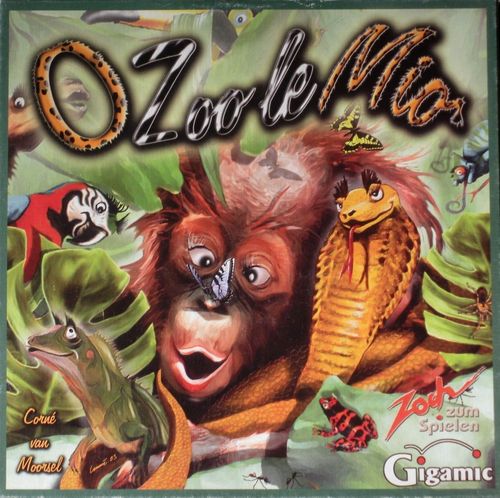
O Zoo le Mio
O Zoo le Mio Rulebook
Table of Contents
Table of Contents
Contents
- 35 zoo coins
- 15 park benches
- 4 starting tiles
- 4 zoo entrances: Porky Park, Aqua Shark, Villa Gorilla, Crocodome
- 15 visitors (3 each in five colors)
- 1 flagpole
- 4 flags
- 3 trees
- 1 scoring block
- 1 rule booklet
- 25 zoo tiles
The zoo tiles
The zoo tiles show the following:
- paths
- bushes (not on every tile)
- 2 animal enclosures (each tile) with stars, that represent the value of the enclosure
In all, there are 5 animal types:
- Apes (orange)
- Mammals (yellow)
- Birds (red)
- Reptiles (gray)
- Sea creatures (blue)
Each zoo tile, like a domino, is divided into two halves. On each half, an enclosure for a different animal type is shown.
Preparation
- Each player takes a zoo entrance, which he places in his play area (in front of himself). Then he places a starting tile next to his zoo entrance.
- Each player takes 8 zoo coins, which he keeps hidden behind his zoo entrance. Place the remaining coins, the visitors, the trees, and the park benches in the middle of the table.
- Place the flagpole to one side. Shuffle the flags of the zoos being used in the game face down and place them face up in random order on the flagpole.
- Shuffle the 25 zoo tiles face down and place them in a stack on the table.
Playing the Game
In just five years, create a marvelous zoo...
Each zoo director has five years to create his zoo and attract visitors. In each year, there are 5 auctions. At the beginning of each year, the players turn over the top-most 5 zoo tiles from the stack and place them in order in a row on the table. Each of these tiles is auctioned, separately, one at a time in the order drawn.
The auction of a zoo tile
Simultaneously, all players put any number of their coins in their closed fists as their bids for the next zoo tile being offered.
When all players are ready, they simultaneously show their bids. The player with the highest bid (most coins) places the coins he bid in the supply and takes the offered zoo tile. The other players put their bid coins back behind their zoo entrances.
If there is a tie for the highest bid, the winner of the auction is the player whose flag is highest on the flagpole among those tied with the highest bid. After a tie, the winning player places his flag under all other flags on the pole, moving other flags up.
Placing a zoo tile in a player's zoo
When a player acquires a zoo tile at the auction, he must immediately add it to his zoo. He places the tile so that it extends at least one path in his zoo. A path may not be interrupted by grass.
How do visitors come to the zoos?
After each new zoo tile is placed, the players check to see which zoo has the most attractive enclosures. Adjacent enclosures of the same animal type (same color) combine together to make a combined enclosure. The attractiveness of a combined enclosure is the sum of the stars in all the separate enclosures that make up the combined enclosure. Adjacent means that the like-colored (stars) enclosures lay together half to half (like dominos). Zoo tiles that touch only diagonally are not adjacent. If a player has separate enclosures of the same animal type, only the one with the most stars counts for him. It is though any other enclosures of this animal type do not exist for him. The way a path runs has no impact on the attractiveness of an enclosure.
Example: 3 tiles create a blue enclosure worth 6 stars, since all three tiles are adjacent half to half. If two blue enclosures are only diagonally touching, they are not a combined enclosure.
The visitors will spend their time at the most attractive enclosures. To show this, place two visitors of the color of the animal type in the enclosure that is most attractive. Also, place one visitor of the color of the animal type in the enclosure that is second-most attractive.
Exception: as long as there is only one player with an enclosure of an animal type in his zoo (no other players have that animal type enclosure), he gets just one visitor in this enclosure. When placing visitors in enclosures, please be sure to leave all stars visible.
Example: Alan's blue enclosure is worth 5 stars and is more attractive than either of Klaus' two blue enclosures worth 3 stars each. Therefore, Alan attracts 2 blue visitors and Klaus attracts 1 blue visitor. As Klaus has the only orange enclosure, he attracts just 1 orange visitor.
The visitors move throughout the game to the most attractive enclosures. Thus, there are only 3 visitors of each color: 2 for the most attractive enclosure of that color and 1 for the second-most attractive enclosure of that color.
If several players tie with the most attractive enclosure, the visitors will go toward the newer of them. Thus, the player, who just placed the tile that created the tie, will get the visitor(s).
Example: Reiner has just placed a new zoo tile (X). As a result of this placement, his gray enclosure is now tied with Wolfgang's gray enclosure with 5 stars. Thus, he attracts a visitor from Wolfgang's gray enclosure as his is the newest of the tied gray enclosures.
How do trees come to the zoos?
Some of the zoo tiles have bushes. These green zones add to the attractiveness of the zoos. Accordingly, the zoo with the most bushes gets two trees. The zoo with the second-most bushes gets one tree.
It is best to place the trees in the zoo tile with the most trees, but be careful not to cover any of the pictures of the bushes.
How do park benches come to the zoos?
When a player places a zoo tile that creates a closed path, he places a park bench on the grass in the area surrounded by the path. Park benches, once placed, remain for the entire game and are scored at the end of each year (see below).
A closed path can enclose empty space (without zoo tiles).
The end of an auction round
After a zoo tile has been auctioned and placed, the visitors, trees, and park benches are placed according to the rules above. Then this auction round ends and the next zoo tile for this year is auctioned.
Points at the End of Each Year
At the end of each year, players score points for their zoos and record them on the scoring block. At the end of the first year, each player scores one point for each visitor, tree, and park bench in his zoo. At the end of the second year, each visitor, tree, and park bench scores two points, at the end of the third year, each scores three points, at the end of the fourth year, each scores four points, and at the end of the fifth year, each scores five points.
Example: a player at the end of the third year with three visitors, two trees, and one park bench scores (3+2+1)=6 x 3 = 18 points. At the end of the fourth year, a player with the same number of visitors, trees, and park benches would score 6 x 4 = 24 points.
Coins are worth no points.
Income at the End of the Year
At the end of each year (after each fifth zoo tile auction), each player takes one coin from the supply for each zoo tile in his zoo.
Example: Wolfgang's zoo has 2 zoo tiles. He takes 2 coins from the supply. Klaus has 3 zoo tiles in his zoo and takes 3 coins.
Game End and the Winner
The player with the most points after five years is the best zoo director and the winner!
Example
After 13 auctions, Alan's bird enclosure has an attractiveness of 4 (2 + 2 stars) as both his bird enclosures are adjacent. With this, Alan has the most attractive bird enclosure and gets 2 visitors in his bird enclosure. Klaus has one visitor for his second-most attractive bird enclosure with 3 stars. Reiner also has a bird enclosure with 3 stars, but Klaus built his later.
Wolfgang's zoo has two reptile enclosures, but they touch each other diagonally, so they are not adjacent and do not combine for a combined enclosure. The attractiveness of his best reptile enclosure is 3 – the attractiveness of his second reptile enclosure with 2 stars has no value to him. Klaus has a reptile enclosure with an attractiveness of 6 (two adjacent reptile enclosures, each with 3 stars).
Klaus has 2 closed paths, each with a park bench. All other players each have one closed path and, thus one park bench.
At the beginning of the 14th auction, the players bid for the fourth zoo tile of the third year. The zoo tile for auction shows a sea creature enclosure, a bird enclosure, and one bush. Klaus and Reiner each bid 3 coins, Alan 2 coins, and Wolfgang 1 coin. Because Reiner's flag is higher on the flagpole than Klaus' flag, he wins the auction, pays 3 coins, and takes the zoo tile. Then Reiner moves his flag to the bottom of the flagpole.
After the 14th auction, Reiner places the zoo tile in his zoo. He is unable to use the tile to create a closed path and so gets no new park bench. Reiner now has 3 bushes. As this is as many as Klaus has and Reiner placed his 3rd bush later, he takes a tree from Klaus and puts it in his zoo for having the second-highest number of trees. The sea creature enclosure on the new tile does not help Reiner as he did not place it next to his existing sea creature enclosure with 5 stars. He places the new zoo tile with the other half (bird enclosure with 1 star) next to his other bird enclosure with 3 stars giving him a combined bird enclosure with an attractiveness of 4. As Reiner has the newest most attractive bird enclosure, he gets 2 red visitors: one from Alan, whose bird enclosure is tied with Reiner's at 4 and 1 from Klaus, whose bird enclosure is now third-most attractive and will attract no visitors.
Let's score this situation as though it were the end of the 3rd year (which it is not as the last zoo tile in the 3rd year must still be auctioned). The players would score the following points:
- Alan: 3 visitors + 1 park bench = 4 x 3 = 12 points
- Klaus: 2 visitors + 2 park benches = 4 x 3 = 12 points
- Reiner: 5 visitors + 1 tree + 1 park bench = 7 x 3 = 21 points
- Wolfgang: 4 visitors + 2 trees + 1 park bench = 7 x 3 = 21 points
These points are added to the points earned in the first two years and will later be added to the points earned in years 4 and 5.
Variants for Professional Zoo Directors
In each year, draw and auction zoo tiles until 3 zoo tiles have at least 1 bush on them. For the fifth year you place all remaining zoo tiles. (This means that some years may have fewer and other years more than 5 tiles for auction.)
Author: Corné van Moorsel. Illustration & Layout: Czarné.