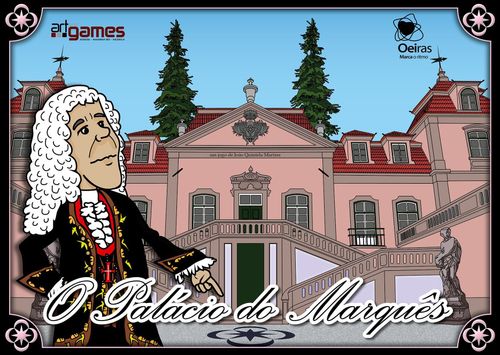
O Palácio do Marquês
O Palácio do Marquês Rulebook
Table of Contents
Table of Contents
- Summary of Rules
- 1. Icons
- 2. Board
- 3. Game Set Up
- 4. Starting Player, Hire Workers and Turn Sequence
- 5. Increase the Value of the Die
- 6. Exploration Places - Resolve Actions
- 7. Production Locations - Resolve Actions
- 8. Reception Venues for Visits - Resolve Actions
- 9. Point of Sale - Products and Resources - Resolve Actions
- 10. Character Cards and Their Special Actions
- 11. End of the Game and Final Points
- 12. Rules for 2 and 3 Players
- The Palace
- The Palace From Hand to Hand
- Is the Palace Naked?
Summary of Rules
(Printed as a summary at the end of the booklet.)
At each turn, players have 3 decisions to make:
- Decide how many workers to hire.
- Choose the place where they want to take action and place the workers in the coats of arms.
- Roll the die (one roll for each worker) and decide if they want to pay coins to increase the value.
In case they conquer some character card they still have special actions to make.
- Hire workers from the Staff House. Move currency marker by paying its cost. Put the workers in front of you on the table. This action can be performed simultaneously by all players.
- Place the workers in the coat of arms where they want to take action. One player at a time, starting with the 1st player, places a worker and passes his turn to the player left of him who also places one. When all workers are placed, the first player resolves all his actions in the order he chooses. After the action is resolved, each worker is placed back in Staff House and passes the turn to the next player who will resolve all of his actions and so on until all players complete their turn.
- Action at Reception venues for visits (Character cards): Resolve the action by rolling the die, if the number is not enough then the player can pay coins to increase the value of the die. Maximum 6 coins. In case of a successful action place your cube in the next square and score the points obtained. At the last level (rectangle), in addition to the points it receives, it offers the products or coins to the visitor and receives the card. The points indicated on the card are only scored at the end of the game. At Fishing House you just roll the die, get a 4 or more and pay 10 coins to receive the Marquis of Pombal card. Card actions can be used in the same turn.
- Action in the Exploration sites (Olive trees, Vineyards and Mulberries): Resolve the action by rolling the die, if the value is not enough then the player can pay coins to increase the value of the die. Maximum 6 coins. In case of successful action you receive the resources you can gather.
- Actions at the production sites (Wine making, Olive oil mill and House of the silkworms): Move the worker to the 2nd coat of arms of the site, pays 2 coins and places the resources at the location. At this place the action is resolved in 2 turns, the worker does not return to the Staff House at the end of the 1st turn. In the second turn, returns the resources to the respective pile, receives the product, score the points and puts the worker back in the Staff House.
- Action at the location to sell products and resources (Laje Creek): Exchanging coins for the products and resources you want.
- Special character card actions can be performed when the player wishes (during his turn) as long as they respect the number of times indicated in the card. (See 10. Character Cards and your special actions).
(The booklet's own summary closes with a pointer to the publisher's website, www.artandgames.pt/opalaciodomarques, and the publisher copyright line; these are omitted here.)
1. Icons
- Coins (10 coins shown): the currency used to hire workers, to raise die values, to pay for production and to win some cards.
- Grapes: harvested in the Vineyards.
- Carcavelos wine barrel: a product, made in the Wine mill.
- Tile Victory Points: the victory point tile (10 shown).
- Marquis Coat of Arms - Starting Player (marked "1º jogador"): place a worker here to receive the starting player tile and be the first to play the next turn.
- Marquis Coat of Arms: place a worker here to do an action.
- Olives: harvested in the Olive tree plantation.
- Olive oil pot: a product, made in the Olive oil mill.
- Die value required: the minimum die value needed for the action.
- Mulberry leaves: harvested in the Mulberry plantation.
- Silk cocoon: a product, made in the Silkworms House.
- Arrow: indicates that the job is done in 2 turns. The worker passes from the 1st to the 2nd Marquis Coat of arms and completes the service on his next turn.
2. Board
The board contains:
- Coins Track
- Staff House (workers rest)
- Cascade of Poets (Architect card)
- Olive oil mill (production of olive oil)
- Wine mill (production of Carcavelos wine)
- Final Points (resources, products and coins)
- Olive tree plantation (harvest of olives)
- Starting Player Fishing House (Marquis card)
- Noble Hall (King card)
- Gardens (Marquise card)
- Mulberry plantation (harvest of mulberry leaves)
- Vineyards (harvest of grapes)
- Chapel (Cardinal card)
- Concordia Hall (Secretary of State for the Navy card)
- Laje Creek (sale of resources and products)
- Silkworms House (production of silk cocoons)
- Victory Points Track
3. Game Set Up
- Each player chooses their colour.
- A disc of each player's colour is placed on the victory point track in the 0/100.
- A disc of each player's colour is placed on the 25 coin marker.
- Each player receives 5 cubes of his colour and places them in front of him next to the board.
- 4 workers of each player are placed in the Staff House.
- The Marquis card is placed in the Fishing House with the front facing upwards.
- Place the resource pieces and products on separate piles next to the board.
- The character cards are properly shuffled and placed next to the board and with their backs facing upwards.
- Each player receives 2 products of his choice (Olive Oil Pot, Carcavelos Wine Barrel or Silk Cocoon). If the player prefers he can chose 2 of the same product.
4. Starting Player, Hire Workers and Turn Sequence
The player who has visited the Palace of the Marquis for more recently starts the game. Optionally starting order can be drawn by rolling the die. Whoever gets the highest die value starts the game.
The player who starts the game is called the "starting player" and has the starting player tile in their possession. The rest of the players play clockwise.
Hiring workers. Each player withdraws from the Staff House to his hand, the number of workers he wants to put to work in this turn paying its cost, 1 coin per worker (move your disk in the coin marker depending on the number of coins spent). This procedure is done in the beginning of each turn and all players can do this simultaneously. If at the beginning of the turn, a player has no coins (0 on the coins track) he can use a single worker of his colour at no cost. If he has at least 1 coin, he will have to pay for the worker.
Placing workers. The starting player then places one of his workers on the coat of arms of any of the places indicated on the board. Then the player on the left also places a worker on a coat of arms available from a location. All the players will repeat this procedure until all the workers are placed on the available coats. When a player has no workers in hand he passes his turn to the next player.
The white coat of arms on a purple background next to the Fishing House means that the player who placed a worker there does not take any action, but has the privilege of being the first player on the next turn receiving the starting player tile.
After the workers of all players are placed to their place of work, each player will have to resolve the actions of each individual worker. The order in which they are resolved is decided by the player, one at a time. After action is taken, the worker returns to the Staff House until hired in the next turn.
If for example the order of the players is: yellow, green, red and blue, only when the yellow player withdraws all his workers from their places and puts them in the Staff House can the green player initiate his workers actions. Then the red player and then the blue player. When the turn is over, the starting player starts a new one repeating all these actions until the end of the game.
Worker placement example (as printed). The yellow player places a worker in the Cascade of Poets (with the objective of providing his service in the preparation for the architect's reception). The green player then puts a worker in the Noble Hall (with the aim of aiding in the preparation of the location to receive the King). Then the red player places a worker at Wine mill (with the aim of producing Carcavelos Wine), finally the blue player places a worker in Olive trees plantation (with the goal of harvesting olives). After all players have placed their first worker, the procedure is repeated again. The yellow player places a worker in the Vineyards (with the aim of harvesting grapes), then the green player places a worker on the Olive Tree plantation (with the goal of harvesting olives) next to the blue who was already there. Red places a worker in the Fishing House (with the aim of winning the Marquis's card). Blue places a worker in the coat of arms (white on purple background) 1st Player (with the goal of being the first player to start the next turn).
- The "Starting player" can never place his 1st worker on the white with purple background coat of arms. In this way the other players can gain the primacy of being the "Starting player" in the next turn. He can place his 2nd worker if the coat of arms is still available.
Location actions will only begin to be resolved once all workers have been placed. The yellow player then resolves all his actions, one at a time. The order of resolution is chosen by the player. Then switches to the next player.
After all the actions have been resolved, a character card arrives to the palace and should be placed on the respective spot, thus ending the turn.
5. Increase the Value of the Die
This game, besides being a worker placement game, also has the mechanics of dice rolling. Whenever a player is not satisfied with the value reached in the rolling of the die, he can add 1 value in exchange for 1 coin. 6 is the maximum value you can add to the die. It means that the value 1 of the die, with a further 6 coins becomes the value 7. The maximum you can reach is a value of 12.
(The booklet illustrates this with a die showing "+ 1 = [die]" and "+ 6 = maximum".)
6. Exploration Places - Resolve Actions
There are 3 places to explore the resources of the farm: Olive Tree plantation (Oliveiras), Vineyards (Vinhas) and Mulberry plantation (Amoreiras). Each has three coats of arms; the second and third are marked 3 and 4 on the board (see section 12).
In these places the player only has to place his worker in the respective place and when it's his turn, roll the die (the die will be for each worker in his respective place) and reap what they sowed. The values of the die are not cumulative for a second worker. A roll of die for each worker. The amounts in surplus are simply wasted. Each player may have more than one worker in the same location as long as there are available coats of arms. They shall be solved one at a time.
- Olives: you need to get 3 on the die. It means that a 6 results in 2 olives, but if you get 5 then you only get 1 olive, thus losing the 2 values which resulted in excess for 1 olive, but which are not sufficient for 2 olives.
- Grapes: you need to get 4 on the die. It means that a 4 results in 1 grape but if get 6 then you get only 1 grape, thus losing the 2 values that resulted in excess for 1 grape but not enough for 2 grapes.
- Mulberry leaves: you need to get 2 on the die. It means that a 4 results in two sheets but if you get a 5 you also get 2 leaves.
The booklet's example diagrams for these three resources show the die value with coins added (for example grapes with "+ 1" and "+ 5", mulberry leaves with "+ 1" and "+ 6"), with the resulting yield pictured.
The player then has the possibility, in another turn, to turn these resources into products or simply sell them to increase the number of coins.
7. Production Locations - Resolve Actions
There are 3 production sites:
- Olive oil mill (Lagar de Azeite), where the player transforms olives into olive oil.
- Wine mill (Lagar de Vinho), where the player turns grapes into wine of Carcavelos.
- Silkworm House (Casa dos Bichos-da-seda), where the player transforms mulberry leaves into silk cocoons. (Symbolizing the feeding of silkworms.)
These sites all work in the same way.
In the first round, the player places a worker on the respective location. When taking action the player passes the worker to location 2 indicated by the arrow, he will have to pay 2 coins for the work and put the out the required resources demanded by that location.
For cocoons - 6 mulberry leaves; For olive oil - 3 olives; For wine - 3 grapes.
In these places the workers do not return to the Staff House after their action. They are production sites with 2 turns. As the player has to pay 2 coins as the action is being performed he will not pay the usual initial currency you usually pay when the worker is still in the Staff House.
In the next turn the player receives the product that he transformed giving the resources that he just to transformed back to the pile, marking his victory points and putting his worker back in the Staff House.
The booklet's summary of the two turns:
- 1st turn (resolve the action in 2 turns): a) Move worker to the second coat of arms; b) Put resources in place; c) Pay 2 coins.
- 2nd turn: d) Receive the product and return resources to the pile; e) Score victory points; f) Place Worker at the Staff House.
The victory points awarded for the three products are: olive oil 6, Carcavelos wine 8, silk cocoon 10. (The booklet's illustrations label these as "put the necessary resources", "product to receive" and "Victory points to receive".)
If the player does not have money to pay the worker during his or her job (2nd turn) then the worker returns to the Staff House without having produced anything, thus losing the resources that were put at that location.
If the player does not have the resources required for production, he returns to the Staff House without having produced anything wasting the action of his worker. Only one product can be produced at a time.
If a worker is already placed on the second coat of arms, it is not allowed to occupy the first coat of arms of that location.
8. Reception Venues for Visits - Resolve Actions
There are 5 places where the player will have to work to properly prepare the reception of their visitors: Noble Hall (A) to receive the King, Chapel (B) to receive the Patriarch of Lisbon, Concordia Hall (C) to receive the Secretary of State of the Navy, Cascade of Poets (D) to receive the architect and Gardens (E) to receive the marquise.
In these places there is only one coat of arms available for worker placement. The player who first places his worker will be the only one working at this location on the turn in question.
At the moment of resolving your action you will have to roll the die and if you can reach the indicated value, then, you place a cube of your colour in the square indicated on the board. There are 4 columns of squares, which means that 4 players can work at this location, but only 1 at a time per turn.
The goal is to reach the rectangle at the top of the columns and manage to conquer the character card. To do so it is always necessary to reach a value on the die equal to or greater than that indicated on the board. To reach the last level, it is necessary, in addition to the value obtained on the die, to offer the character the product or value that is required for that rectangle. Following, the player receives the card and can enjoy the special action of the character.
Whenever the player goes up one level in his column he adds in the victory points marker the ones indicated. Regardless of the value of the die, only one level can be obtained per turn then the player puts his worker back in the Staff House.
If the player preparing to reach the last level (rectangle) does not respect the character's requirements (product or amount to be offered) or if the card is not already in place, then the player can not go up to that level, and leaves his cube in the same place. Even if the card has already been won by another player, all players can continue to work at this location and climb to the last level of the column as long as it is a square. This way, the player can earn points even if he has not been able to win the card but only one player can ever rise up to the rectangle at one time.
The booklet's column diagram for the Chapel (B) shows: the products or amount to offer to the character, the card to be received when the cube reaches the rectangular space, the die value needed to place your cube (2, 4, 6, 10 from bottom to top) and the victory points to receive at each level (2, 4, 6, 10).
Example (as printed). The yellow player rolled the die and got 3. He then places his cube and gets 2 victory points. If he had rolled 1 on the die, then he cannot place his cube. In the next turn the green player rolled the die and got 5. He then places his cube and gets 2 victory points. In a later turn the player blue rolled the die and got 4. His cube is raised to the last level, having to pay 1 barrel of carcavelos wine (in this case), he then receives the character card and 10 victory points.
9. Point of Sale - Products and Resources - Resolve Actions
Laje Creek is the place where products and resources can be sold in order to increase the number of coins. It symbolizes the exports that were made at the time, in which the products followed by the Laje creek by boat, to the warehouse at Paço de Arcos, then to the Tagus River to Lisbon, and finally to its destination.
In this place each player can only place a worker. Resolving the action consists of exchanging resources or products for coins. You can change any quantities you want, return the chips to the stack, and move your disk to the marker of coins according to the amount you received with the sale.
On the board are indicated the commercial values of the resources and products:
| Resource / product | Value |
|---|---|
| Grapes | 3 |
| Olives | 2 |
| Mulberry leaves | 1 |
| Carcavelos wine barrel | 12 |
| Olive oil pot | 8 |
| Silk cocoon | 12 |
10. Character Cards and Their Special Actions
The character cards, which are properly shuffled and placed in a stack with their backs facing up next to the board, come into play one at a time at the end of each of the first five turns. The card from the top of the stack at its respective location (match the letter of the card with that of the location) as reported in 8. Reception venues for visits.
Each character card has indicated on it the number of points that are won at the end of the game and has also a special action that can be used by the player who has won it. The actions on the cards can be executed immediately.
King. To conquer this card and be graced with its favours (special action), the player will first have to reach the last stage of the Noble Hall (rectangle) and offer the King 1 barrel of Carcavelos Wine, 1 Pot of Olive Oil and 1 Silk Cocoon (Return pieces to the pile of products). Points awarded at the end of the game: 20 points. Special Action: The player receives an additional worker that he can use in the following turns without having to pay one coin per turn. He is a King's worker and will be at your service until the end of the game for free.
Marquise. To win this card and be graced with its favours (special action), the player will first have to reach the last stage of the Gardens (rectangle) and offer the Marquise 1 Silk Cocoon. Points awarded at the end of the game: 5 points. Special Action: The player can exchange 1 product for 5 points. Change a maximum of 2 products per turn. Ex: If he returns to the pile of products 1 barrel of wine and 1 pot of olive oil he receives 10 points (maximum number of points awarded per turn).
Architect. To conquer this card and be graced with your favours (special action), the player will first have to reach the last stage of the Cascade of Poets (rectangle) and offer the Architect 1 barrel of Carcavelos Wine. Points awarded at the end of the game: 5 points. Special Action: The player adds 1 to the value he rolled on the die.
Secretary of State of the Navy (and also Governor of Grão-Pará and the State of Maranhão). To win this card and be graced with its favours (special action), the player will first have to reach the last level of the Concordia Hall (rectangle) and offer the Secretary of State of the navy 5 coins. Points awarded at the end of the game: 5 points. Special Action: The player can exchange 2 coins for 2 points or 2 points for 2 coins. You can only change a maximum of 3 times. Ex: exchange 4 coins for 4 points or 4 points for 4 coins at most you can exchange 6 coins for 6 points or 6 points for 6 coins.
Patriarch of Lisbon (Cardinal, Canon of the Patriarchal Member of the General Council of the Holy Office). To win this card and be graced with its favours (special action), the player will first have to reach the last level of the Chapel (rectangle) and offer the Patriarch of Lisbon 1 pot of Olive Oil. Points awarded at the end of the game: 5 points. Special action: The player can add 2 to the value of the die he rolled in exchange for 1 coin. Normally in the game the player would pay 1 coin for 1 value on the die, in this case, this action allows the player to spend half for the same effect. However, the maximum value that rolling the die can add is always 6, the cost is that it is only 3 coins.
Marquis of Pombal. To win this card and be graced with its favours (special action) the player will have to, in the Fishing House, roll a die and get a value equal to or greater than 4 and offer the Marquis 10 coins. Points awarded at the end of the game: 10 points. Special action: Whoever discards it (put back in the Fishing House) chooses a venue for the visitors and all the opponents cubes descend one level, they also lose the points indicated at the respective level at which they were previously. The opponent who has already reached the rectangle and completed the service from that location and received its card are not affected.
Example of the action performed by the Marquis of Pombal card (as printed). The red player discarded the Marquis of Pombal card and chose to affect the work of his opponents in the Cascade of the Poets. Consequently the Yellow and the green players go down one level and lose the points indicated on the line (yellow loses 6 points and green loses 4 points). The blue player is immune because he has already reached the last level (rectangle) and already has the Architect card (in this case) in his possession.
11. End of the Game and Final Points
The game ends when the 5 character cards are acquired by the players. Optionally, the game may end without the King's card being conquered, it being only necessary to conquer the other 4 visitor cards. This version of the game is shorter. At the beginning of the game players choose the way they prefer to play.
The Marques is not considered a visitor and might not even be won by the players.
When a player wins the last card, the other players still have the opportunity to have one last turn. The game ends only when the player to the right of the 1st player (who has the 1st player chip at that time) finishes his turn.
The final scores are then attributed as follows:
- Character card points
- Each product that was not offered or sold is worth 3 points
- Each resource that has not been processed or sold is worth 1 point
- Each group of 5 coins is worth 1 point
The player who achieves the most points is considered the winner.
12. Rules for 2 and 3 Players
In a 2 or 3 player game all rules are identical to the 4 player game. The only exception is at the moment of placing the workers on the coats of arms.
Whenever a place has more than one coat of arms, all of them are available in a 4-player game, but in a 3-player game, coats of arms with the number 4 next to it can not be used.
In a 2-player game, coats of arms with numbers 3 or 4 can not be used.
The Palace
From which history is this Palace made of?
What we know today as the former recreational Estate of the Marquis of Pombal in Oeiras, was originated in small properties acquired in 1676 by the grandfather of the Marquis of Pombal, near the Laje streamlet and on the place occupied by the Palace. In the early eighteenth century (around 1715/20) was built in these properties a small manor of rural features, built by the Marquis uncle on his father side, Paulo de Carvalho and Athayde, whose Majorat, created in 1737 was to be inherited by our Sebastião José de Carvalho e Melo, while family firstborn.
From 1750 onwards, being the future Count of Oeiras and Marquis of Pombal already back to Portuguese lands, he was appointed Secretary of the Kingdom of King Joseph I, being precisely in this decade, particularly in the years following the 1755 earthquake, which would design and ensure all means to achieve the construction of a large summer house in the capital's suburbs - a space that would enhance the power and space that lay emphasis on the new sociability, so characteristic of the Pombal family.
To the small manor will be added a small chapel, which links the two bodies of the house an older one of baroque-Johannine origin and another, rocaille-Pombaline. The renovation and expansion are attributed to the Hungarian architect Carlos Mardel, also responsible for the recovery plans for Lisbon after the earthquake.
The Palace From Hand to Hand
But the echoes that resonate through the halls of this palace are not only from the Pombal family. In fact it was his own family in the late 30s of the twentieth century, who sold the property to a tycoon of his close relations, named Artur Brandão, and auctioned off all his assets. On these parts there is an inventory, but little is known about the current location of most of them.
To Artur Brandão and his family, inhabitants of this manor for about twenty years, is due the construction of the first bathrooms and even acquisition of the magnificent Fireplace, which now adorns the entrance of the Palace. They were able to keep the dignity of the space and enjoyed it without causing any damages, ensuring that the Gulbenkian Foundation acquired it in perfect condition in order to receive its famous collection.
It was therefore the Gulbenkian Foundation the third owner of the Palace of the Marquis of Pombal, in Oeiras, here placed the art works collection, which holds however. In 1967, this whole area was devastated by a huge flood which destroyed lives, but also some of these pieces. The fate was thereby traced with mud and blood.
Gulbenkian opened doors on Avenue de Berna in Lisbon in 1969, building, yet its Science Center, right in front of the Noble Hall of the palace and this, that was still its property, made it available for about 30 years to the National Institute of Administration (INA). Many are those who still recognize in their rooms, spaces where they received training, but today the Palace of the Marquis of Pombal is owned by the Municipality of Oeiras and is open to the public since 2015 with remodelled rooms and a visiting circuit aimed at disclosing this, which is the Carvalho's family house, up today, in better conditions, even after about 300 years.
Is the Palace Naked?
No, on the contrary The Palace of the Marquis of Pombal offers us an huge wealth of stories to tell. Spare it a little of your time and you will be asked to figure out the differences between the Johannine and the Pombaline architecture, how did Pombal brought to us the innovations of the modern manor and which are the stories behind the extraordinary collection of decorative arts, that make up the stucco ceilings and the wails tile panels.
All the great artisans and masters of the time were invited to participate in the construction of this great manor, from Machado de Castro to Giovanni Grossi passing by André Gonçaives and Joana do Salitre and this leaflet, supported by audio guides and interpretative signs, which are at your disposal will be the perfect support to enjoy in the best way all the magic of this palace of our.