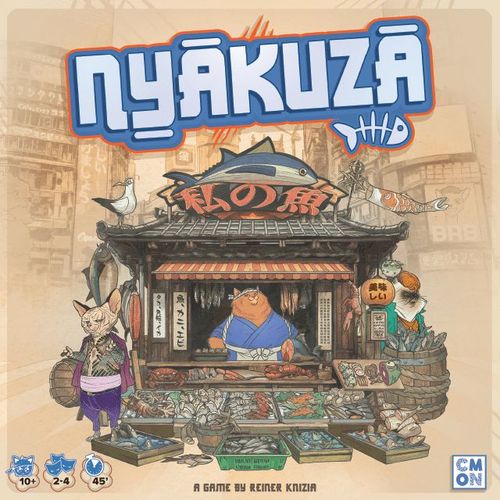
Nyakuza
Nyakuza Rulebook
Table of Contents
Table of Contents
Game Idea
Erect your monumental statues, or Moai, as quickly as possible on one of the numerous coastal spaces of Easter Island and on its ceremonial site, Orongo! With the right resources and careful bidding, you can acquire the best spaces.
Be the first player to build the 'Ceremonial Moai', and you will be the winner!
An exciting bid and build game for 2 to 4 players, ages 10 and up.
By: Reiner Knizia Illustrations: Franz Vohwinkel Editor: Stefan Brück Instructions design: Franz Vohwinkel
Game Components
- 1 game board
- 4 screens (1 per player)
- 60 numbered resource tiles
- 48 shells
- 1 amulet
- 21 Moai
- 160 transparent tokens (4 colors, 40 per color)
Game Set Up
Remove all parts form the punchboard before the first game.
Place the game board in the middle of the table. It shows Easter Island, divided into 50 palm spaces and 60 numbered resource spaces.
Shuffle the 60 numbered resource tiles and place them face down beside the board. Each resource tile has a corresponding resource space on the island, with a matching number.
Each player receives:
- 1 screen, placed nearby on the table;
- 40 tokens of the same color (a "personal supply") placed beside the screen;
- 24 (2 players), 16 (3 players), or 12 shells (4 players), placed behind the screen;
- 10 (2 players), 6 (3 players), or 5 Moai (4 players), placed in front of the screen.
Place one Moai, the Ceremonial Moai, on the corresponding space at the top right of the game board. (With 3 players, return the 2 remaining Moai to the game box.)
The oldest player takes the amulet, and places it in front of their screen.
Game Play
The game is played over several rounds. Each round proceeds in following order:
- Place new numbered resource tiles on the board.
- Use your shells to bid for spaces.
- Place tokens on the board, and erect Moai.
1.) Place New Resource Tiles
One player draws resource tiles from the supply pile and places them onto the corresponding spaces on the board. The number of resource tiles placed each round varies according to the number of players in the game, and the round of play:
| 2 and 3 players | 4 players | |
|---|---|---|
| First round: | 6 tiles | 8 tiles |
| All consecutive rounds: | 3 tiles | 4 tiles |
2.) Bid for Spaces
To bid, each player takes any number of shells (even zero is allowed) into a closed fist and holds the fist over the game board. Simultaneously, all players open their fist, and compare bids:
- The player who bid the most shells places them all on the reef (bottom right of the game board) and then takes three tokens from their personal supply and places them in front of their screen.
- The player who bid the second most shells returns the shells back behind their screen, and places two tokens in front of it.
- Each of the other players who bid at least one shell returns their shell(s) back behind their screen and places one token in front.
- Any player who bids zero shells takes all shells from the reef and places them behind their screen, but does not place a token in front of it. If more than one player bid zero, these players split the shells from the reef equally. Any remaining shells remain on the reef.
Tie bids: When more than one player ties for a bid, they break the tie in turn order, i.e. the winner is the first tied player in clockwise rotation to the player holding the amulet.
Example: Anne and Cara both bid 5 shells, Ben and Dan both bid 3. Since Ben is holding the amulet from the round before, Cara (as his left neighbor) wins the bid and places her 5 shells on the reef, and then places 3 tokens in front of her screen. Anne is the second-place bidder. She returns her shells behind her screen and places 2 tokens in front of it. Ben and Dan return their shells behind their screens, and each places 1 token in front.
3.) Place Tokens and Erect Moai
The player who won the bid receives the amulet and places their 3 tokens on the game board. Then, the second-place player places their 2 tokens on the game board. Finally, any player who earned one token follows, in clockwise rotation from the player who currently holds the amulet.
The turn order for placing tokens this round, according to the example above, would be Cara (3), Anne (2), Dan (1), Ben (1).
When placing tokens the following rules must be followed: A token may be placed on any not-yet-occupied numbered resource tile on the board; or on any not-yet-occupied palm space that is directly adjacent to at least one of that player's tokens. A token may not be placed on any other space.
Example: Dan could place tokens on any of the spaces in the western part of the island marked with a blue star; Anne on any space marked with a red star.
Erecting Moai:
A player must immediately erect a Moai if by placing a token the player has an adjacent group of tokens that meet the following conditions:
A) One or two of the tokens in the group are on the following resource tiles
- one quarry, or
- one temple and one god, or
- one birdman and one nest, or
- two food
B) An additional token in the group is on a coastal palm space (and this token does not already contain a Moai). Note: Moai can never be erected on inland palm spaces; those spaces are only used to connect tokens.
If conditions A and B are met, the player immediately erects a Moai on the token on the coastal palm space. The player must also place a shell on the 1 or 2 used resource token(s) (i.e. the quarry, or temple + god, or birdman + nest, or food + food) to show that this tile/these tiles have been "spent". "Spent" tiles and palm spaces already occupied by a Moai cannot be re-used to meet the conditions for placing Moai in future rounds, but may still be used to connect one's own tokens.
Attention: If a player does not have enough shells to place on the 1 or 2 resource tiles in the group of tokens after erecting the Moai then this player is not allowed to place the token that would satisfy the criteria to initiate the building of the Moai. In other words, a player who wants to build a Moai must be sure to have enough shells before placing a token that satisfies the conditions of building, otherwise that last token (that would meet the final criteria) must be placed somewhere else!
Example: Dan places the first of his tokens on a coastal palm space, in a group of tokens including his 2 food tokens (on 4 & 8). He immediately erects a Moai onto the coastal palm space, and covers the two food resource tiles by putting one shell on each. He then places his remaining two tokens. Since he now has connected tokens including a nest tile (on 1), a birdman tile (on 2), and another coastal palm token, he erects a Moai on the coastal palm space and covers the two resource tokens with shells.
Game End
Once a player has placed all their Moai, they may erect the Ceremonial Moai, waiting at the top of the game board (in accordance to the placement rules). The first player to erect the Ceremonial Moai immediately wins the game (players do not finish the round)!
The game may also end in the round in which no numbered tiles can be placed. The last round takes place, without placing new tiles. If no player has erected the Ceremonial Moai during this round, the winner is the player with the fewest Moai left. If there is more than one player tied with the fewest Moai, the winner is, among these, the player with the most shells. If there is still a tie, there is more than one winner.
Variation (for 3 and 4 players)
At the beginning of the game all players receive one random resource tile, which they place behind their screen without showing it to their opponents. (Note: If this tile shows a quarry, it must be replaced with a new tile, and the quarry tile is reshuffled into the supply pile.)
A player may place this extra tile, together with an additional token, during any move. Thus, even a player who has just bid zero shells may place the extra tile, together with an additional token, in a turn after all other players who had bid have played.