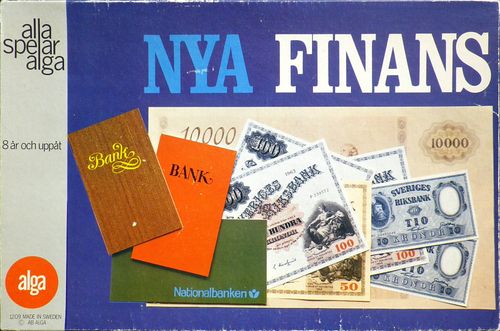
Nya Finans
Nya Finans Rulebook
Table of Contents
Table of Contents
Contents
- 1 game board
- 1 card display
- 2 dice
- 6 playing pieces
- 126 cards (shares, title deeds, bonds, Financial News cards, Market Tip cards, Registration Certificates and bank loans)
- 8 industrial buildings
- 15 smaller buildings
- Bills in various denominations
- These rules
Setting Up the Game
Players: 2 to 6, from age 10.
- Sort the cards into their separate piles and place them in the card display. Shuffle the Financial News cards and the Market Tip cards separately and place them on the game board with their backs face up.
- Choose one player to be the banker. The banker looks after the bank. The banker may, but need not, take part in the game. The banker sorts the bills and gives each player 75,000 in suitable denominations. Place the remaining bills in the display.
- Each player chooses a playing piece and places it on the Bank Exit space. Every player rolls both dice. The highest roller starts, and play then passes clockwise.
Getting Started
Moving Around the Board
Move the playing pieces clockwise around the board. A player without a car rolls 1 die; a player with a car rolls 2 dice. Exception: inside the bank (from Bank Entrance to Bank Exit) you always roll 1 die, even if you own a car. Movement is by as many spaces as the die or dice show. Exception: always stop on Bank Entrance and Bank Exit, even if the dice show more steps.
Buying a Car
When it is your turn you may begin by buying a car for 50,000, before you roll the die. As proof of the car purchase you receive a Registration Certificate from the bank. A car owner rolls 2 dice when moving (but not inside the bank). You may own only one car at a time. Car deals between players are not allowed. At any time during your turn, before or after you roll, you may sell the car back to the bank for 25,000.
Plots and Shares
You may only buy plots and shares when you are on the Bank Branch space (12) or inside the bank (the spaces between Bank Entrance and Bank Exit). Purchases may only be made during your turn and before you roll the dice. You may buy only 1 plot and/or 1 share per turn.
Building on Plots
You may build on your plots when you are on the Building Project Ltd space (17) or on the space where the Bank Arranges Building Deals (40), or if you hold the Market Tip that lets you build whenever you like. Building may only be done during your turn and before you roll the dice. You decide which of your plots you want to build on (you do not need to own all the plots in a group). You may build on as many plots as you like in the same turn.
The prices of industrial buildings and other buildings are shown on the title deeds. When you have paid the bank you receive either an industrial building (large) or another building (small) to place on the space as proof of the construction. You may only build industrial buildings on the spaces Sustainable Energy, Pharmaceutical Industry, Biotechnology, Sawmill, Paper Mill and Steelworks. Other plots are built on with the smaller buildings. Once a plot has been built on, you cannot later remove the building and get the money back from the bank.
Rent
If your piece lands on a plot that you yourself own, or that is unsold in the bank, nothing happens. If you land on a plot (built or unbuilt) owned by another player, you must pay rent to that player. The rent amount is shown on the title deed. If the owner of a plot fails to ask for the rent before the next player in turn rolls the dice, the owner loses that rent.
Company Groups
There are 7 company groups on the board: Hantverkskoncernen AB, Servicekompaniet, Affärscentrum AB, Finanstrusten, AB Teknikföretagen, Kemibolaget AB and Industrikoncernen. Each company group consists of 2 or 3 plots of the same colour, plus as many shares as there are plots.
Complete Company Group
A complete company group consists of all the plots of the same colour, plus the shares belonging to the company group. It makes no difference whether the plots are built on or not. If you own a complete company group you may double the rents. In addition, all the shares and plots that form part of the company group are protected against, for example, forced transfer.
The simplest way to acquire a complete company group is to buy all of its plots and shares from the bank. Often, however, the plots and shares are spread among several owners, and to buy in the whole company group you need both to hold at least one plot or share in the group yourself and to call a shareholders' meeting. Read more about the shareholders' meeting on page 7.
Mortgaging Plots
At any time during your turn, before or after you roll, you may mortgage one or more of your plots. You receive the money from the bank and mark the mortgage by turning the title deed face down. No rent is charged on a mortgaged plot.
A mortgaged plot may be redeemed (the loan repaid) when it is your turn, before you roll the dice. The repayment amount is the mortgage value plus 10%. Mortgaging plots between players is not allowed.
Buying Back Plots and Shares
At any time during your turn, before or after you roll, you may have the bank buy back one or more plots and/or shares. The buy-back value is shown on the title deed or on the share respectively. A mortgaged plot cannot be bought back; it must first be redeemed (the loan must first be repaid).
Bank Loans
At any time during your turn, before or after you roll, but not on the space Repay One of Your Loans, you may take out one or more loans from the bank. Each loan is 50,000. You may hold at most 3 loans at the same time. The bank cannot give out more than 6 loans in total. If you have loans you must pay interest (5,000 per loan) each time you pass Bank Exit.
Voluntary repayment of a loan may be made at any time during your turn, before or after you roll. If you land on the space Repay One of Your Loans you must repay one loan (if you have any) and must then also pay interest of 5,000 to the bank on the loan you repay. Note that you may not take any new loan while standing on the space Repay One of Your Loans.
Bonds
Buying Bonds
Each bond costs 500. If you land on either the Small Bond Drawing space or the Bond Purchase / Share Dividend space, you may buy 1 bond of your choice from those still left in the bank. If the Financial News card "Good Times" is face up and you land on the Bond Purchase / Share Dividend space, the space applies to all players, in turn clockwise, starting with yourself.
If you draw a Financial News card for the Large Bond Drawing, first you yourself and then the other players in turn clockwise each buy one bond before the drawing takes place.
Trading bonds between players is not allowed.
Bond Drawing
The Large Bond Drawing takes place when a player draws a Financial News card with the same text. The Small Bond Drawing takes place each time a player lands on the Small Bond Drawing space.
After bonds have been bought, the banker carries out the drawing by rolling both dice:
- The highest prize goes to the bond whose number equals the total of the two dice.
- The second-highest prize goes to the bond whose number equals the number of the die showing the higher value.
- The lowest prize goes to the bond whose number equals the number of the die showing the lower value. If the dice show the same number, the lowest prize goes to the bond whose number is lower than the value of one of the dice.
Example: If the banker has rolled two 4s, the bonds 8, 4 and 3 win, in that order. If two 1s are rolled, bond number 12 receives the lowest prize.
The prizes in the Large Bond Drawing are 100,000, 50,000 and 25,000. The prizes in the Small Bond Drawing are 50,000, 25,000 and 15,000. A bond that wins a prize is returned to the bank.
Market Tips
When you land on the Market Tip space you take the top card of the Market Tip pile. Follow the instructions on the card immediately, unless the card says otherwise. Then put the card back at the bottom of the pile.
Financial News
When you land on the Financial News space, or receive a Market Tip that tells you to take a Financial News card, you take the top card of the Financial News pile. The text on the card applies to all players unless the card says otherwise. Read the text aloud.
If the card says that it applies "until further notice", it stays face up until the next Financial News card is drawn. When the card is not to apply until further notice, it is placed at the bottom of the pile face down as soon as all players have followed its instructions.
The Bank Spaces
Bank Entrance = Bonus
Always stop on this space, even when the dice show more steps. When you have landed here you must immediately roll both dice (this applies also to players without a car) to find out the size of the bonus. The bank pays out 5,000 per eye on the dice.
When the Financial News card "Good Times" is face up, the bonus is doubled. When the Financial News card "Bad Times" is face up, only the die showing the lower number applies.
Bank Exit = Market Tip
Always stop on this space, even when the dice show more steps. When you have landed here you must immediately take a Market Tip and follow its instructions.
Share Dividends
Dividends from the Bank
When you land on a space that says you receive a share dividend, or you receive a Market Tip or Financial News card that says you receive a share dividend, the bank pays a dividend on the shares you hold. The amount is shown on each share.
If the Financial News card "Good Times" is face up and you land on the Bond Purchase / Share Dividend space, the space applies to all players.
Dividends Between Players
When you land on the space "Give your opponents a 20% dividend", or draw a Market Tip that says you are to give dividends to opponents, you must give them a dividend of 20% on their shares in those company groups in which you have one or more plots.
Example: Player A owns one plot in Hantverkskoncernen AB, one plot in Finanstrusten and two plots in AB Teknikföretagen. Player A lands on the space "Give your opponents a dividend..." and must give a 20% dividend on the opponents' share capital in the above company groups. Player B holds two 50,000 shares in Hantverkskoncernen AB and the 100,000 share in Teknikföretagen. (Player B also has other shares in company groups where Player A has no plots, but Player B receives no dividend on these.) In the company groups where Player A owns plots, Player B has a combined share capital of 200,000. Player A must give Player B 20% of this, which is 40,000. Player C holds both 75,000 shares in Finanstrusten and one 75,000 share in AB Teknikföretagen. Player C is therefore to have 20% of 225,000, which is 45,000. Note that this dividend applies only to those company groups in which Player A has one or more plots and the receiving players have one or more shares.
Prison
When you land on the Prison space you must roll one die. If it shows 1 or 2 you miss one round. If it shows 3 or 4 you miss two rounds. If it shows 5 or 6 you miss three rounds.
When you land on the space Go Directly to Prison you must immediately roll one die. If it shows 3 or higher nothing happens. If it shows 1 or 2 you must immediately move your piece to the Prison space and, just as above, roll one die to find out how many rounds you must miss.
Exception: If you come directly from prison (without having first passed Bank Exit), the space Go Directly to Prison does not apply. It does apply once you have left prison and passed Bank Exit.
Even while in prison you may collect rents and take part in bond drawings and share dividends.
Shareholders' Meeting
You may call a shareholders' meeting during your turn when you are inside the bank (between Bank Entrance and Bank Exit, spaces 35 to 46) and on the Bank Branch space (12), before you roll the dice. Inform the other players that you are calling a shareholders' meeting and name the company group concerned.
- Put down an amount (x) of your own money on the table that equals the combined value (purchase value) of the opponents' shares and plots in the company group, including any buildings on them.
- Put down a further amount of your own money on the table that is evenly divisible by 10,000 (at least 30,000, at most 120,000). This amount is called the brokerage fee below.
- Roll both dice.
- If you roll higher than the brokerage fee divided by 10,000, the takeover fails. The opponents keep their plots and shares. You keep the amount (x), but the whole brokerage fee goes to the bank.
- If you roll equal to or lower than the brokerage fee divided by 10,000, you have won the shareholders' meeting and take over the opponents' shares and plots in the group, against paying the purchase value for them.
- Of the brokerage fee, 30,000 goes to the bank and the remainder is divided equally (rounded to the nearest 500) between the players who have just lost plots and shares. From now on you own the whole company group and receive double rents.
Example: Player A has the 75,000 share plus Furniture & Interiors and Fruit & Vegetables in Affärscentrum AB. Player B has Sports & Leisure (a built plot) and one of the 50,000 shares. Player C has the other 50,000 share in Affärscentrum AB. Player A calls a shareholders' meeting, adds up the combined value of Player B's and Player C's assets in Affärscentrum AB, which is 20,000 + 20,000 + 50,000 + 50,000 = 140,000, and then puts up the brokerage fee. (Let us say Player A puts up 80,000.) If Player A rolls 9 or higher, the takeover fails. Players B and C keep their plots and shares. Player A keeps the 140,000, but the whole brokerage fee of 80,000 is lost to the bank. If Player A rolls 8 or lower, the takeover succeeds. Player A then takes over Player B's plot, building and share in Affärscentrum AB and pays 90,000 to Player B. In addition, Player A takes over Player C's share and pays 50,000 to Player C. Of the brokerage fee, 30,000 goes to the bank and the remaining 50,000 is divided equally between Players B and C. Note that Players B and C could also have called a shareholders' meeting.
If you have plenty of money and can put up 120,000 as a brokerage fee, you do not need to roll the dice, since they cannot show more than 12 in total. The takeover of the company group is then guaranteed to succeed. Before calling the shareholders' meeting, you may in the same turn mortgage plots, have the bank buy back plots and shares, and take out one or more loans from the bank, all in order to raise enough cash for the shareholders' meeting.
Bankruptcy
If, despite bank loans, mortgages and buy-backs, you cannot pay your debts, you go bankrupt and are out of the game. All your plots, shares and so on return to the bank, and any buildings you have on them are removed.
Who Wins?
The first player who can show at least one million (1,000,000) in cash AND at least two complete company groups wins the game. It is permitted to sell or mortgage in order to make up the million. If the other players go bankrupt, the player who remains in the game last wins.
Playing a Shorter or Longer Game
Shorten or lengthen the playing time by lowering or raising the cash requirement for winning. Decide before the game starts what applies.