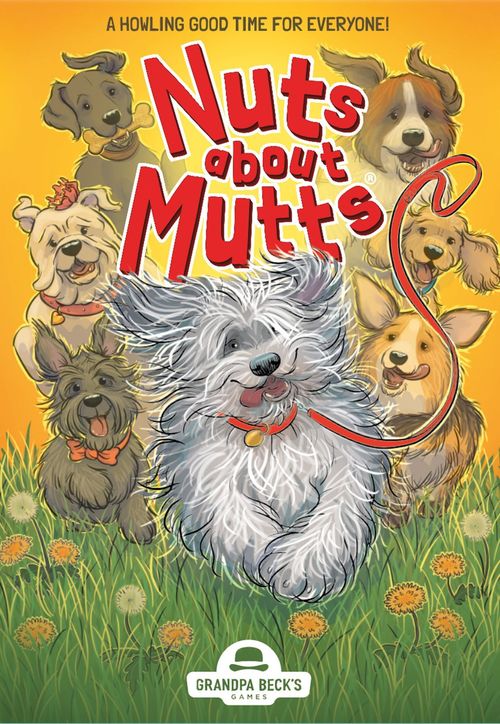
Nuts about Mutts
Nuts about Mutts Rulebook
Table of Contents
Table of Contents
Overview
Nuts About Mutts can be played in three formats:
- Speed Game, age 8-adult
- Easy Play (no speed elements), age 4-adult
- Play with optional action cards
Any format may be played over any number of rounds; but for scoring, it's best to decide ahead of time how many rounds will constitute a game. For each round, take turns playing cards until someone goes out by playing their last card.
Cards may be played to the 'home pile,' in the center of the table, in turns, if they match one of the three features of the previous card: either the color, the number, or the dog breed. Cards without numbers are wild cards and may be played on any turn.
After the determined number of rounds, the player with the fewest number of points wins and is chosen as the most Paw-some Dog Walker!
Contents
Speed & Easy Play Games:
- Number cards (84)
- Mutt cards (14)
- Dog Bones (7)
Optional Action Cards:
- Fleas (4)
- Dog House (2)
- Fire Hydrant (4)
- Pedigree (2)
Speed Game Setup
Remove all of the cards without numbers (except the Mutt cards) and set them aside. Shuffle cards and deal according to the list below.
- 3-5 players: 10 cards each
- 6-8 players: 8 cards each
Place the remaining cards next to the dealer as the draw pile. Keep the center of the table open for play.
Grab a bone from the box for each dog walker minus one (example: for a 5 player game, use 4 bones). Place them evenly around the home pile, in reach of all players. For added paw-thenticity, you can use real dog biscuits!
Draw one card from the draw pile and put it faceup in the center of the table to begin the home pile.
The youngest player plays first.
On Your Turn
You must play at least one card each turn. If you can't play a card, you must draw one card. If that card is playable, it may be played. Play rotates clockwise.
Numbered cards must match the card currently on top of the home pile by matching either the color, the number, or the dog breed.
Mutt Card
The Mutt card is wild and may be played instead of a numbered card and on top of any card. When a Mutt card is played, each player must slap a hand on top of one of the dog bones. Whoever does not act fast enough and is left without a bone must draw one card from the draw pile.
After the Mutt card is played, that player gets to choose the color to be played next.
Matches and Runs
A MATCH is a numbered card that is identical to the previously played card in color, number, and breed.
A RUN is a numbered card of the same color that is one number higher or lower than the previously played card. (Numbers 1 and 14 do NOT connect.)
Matches and Runs may be played at any time, even when it's not your turn. You may play as many as you have in your hand, calling out "Match!" or "Run!" as you do. They must be played one at a time, in order to give other players a chance to play Runs or Matches of their own. If two players attempt to play a Run or a Match at the same time, only the first card down counts.
If you start your turn with a Match or a Run, you may also play an additional card, as it was your turn. In this case call out "Play!" so it is clear what you are doing. If you do not have an additional card to play, the Match or Run may count as your turn.
Only numbered cards may be matched. When a match or run is played out of turn (often skipping other players), play continues clockwise from that player.
Play Example #1
Apryl, Jessica, Blake, and Lydia are sitting clockwise around a table. Apryl plays a dog card. Blake plays out of turn with a match. Play continues to his left. It is now Lydia's turn. At the start of her turn, she plays a run, allowing her to play a second card.
Play Example #2
A Red 3 is on top of the pile and it is Blake's turn. He quickly plays a Red 4 (Run), then another Red 4 (Match), and then a Red 5 (Run). Since it was his turn, he also plays a Yellow 5 and says "Play!", ending his turn.
Note: Play each card separately, but quickly and call out each action (Match, Run, or Play). Playing quickly prevents another player making a Match or Run before you play your next card.
Ending the Round
When one player plays their last card, the round ends. Any actions that might follow the play of a card are not done, as the round has ended.
Scoring
At the end of each round, look at the cards left in your hand and score based on the following:
- 1 point for dog cards
- 2 points for action cards
The player with the highest score plays first in the next round. In case of a tie at the end of the round, the youngest player plays first. After three rounds, (or any number agreed to) the player with the least total points wins the game. If there is a tie, the first player to bark after the scores are announced is the winner.
To add other action cards to the Speed Game, refer to Play With Optional Action Cards.
Easy Play Option
For those who want more relaxed play, the game may be played without the option for 'out of turn' play. Use of the Mutt card action is also optional. All play happens on your turn.
For the youngest players, start with just the numbered cards (without the Mutt cards or optional action cards). You may have young pups lay their cards in front of them on the table so they can see all their cards at once. Played this way the game is enjoyed by even the youngest pups who can match colors, numbers, or dogs.
As players get comfortable with game play, Mutt cards or the Match and Run feature could be added.
To consider adding in other action cards to the Easy Play game, please refer to the Play With Optional Action Cards section.
Play with Optional Action Cards
These action cards will slow down other walkers to help you get home first!
IMPORTANT: After an action card is resolved, the active player names a color for the player to their left to follow. The exception is the Pedigree card (explained below).
Action cards may be included in either the Speed Game or the Easy Play option to add more variety to the game. You may add some or all of these cards as desired.
- Dog House: Force the player with the fewest cards to draw 2 cards. In the case of a tie, each tied player, excluding yourself, must draw 1 card.
- Fleas: Force the player directly on your left and right to draw a card or play a Fleas card of their own. For each player that is able to play a Fleas card, you must draw 1 card instead. You may not play a second fleas card to counter their response.
- Pedigree: Choose a breed of dog from your hand (or a breed of your choice if you don't have any dog cards). Starting with the player to your left and ending with you, everyone may play all cards of that breed from their hand. Play continues as normal based on the last dog card played. If no dogs are played, you will choose the color for the next player to follow.
- Fire Hydrant: You have the option to force any other player to swap hands with you but are not required to do so.
Play Example
Apryl, Jessica, Blake, and Lydia are sitting clockwise around a table. Apryl plays a dog. Jessica plays a Fire Hydrant. Jessica and Lydia switch hands. Jessica chooses green to continue play. It is now Blake's turn. He plays a green card.