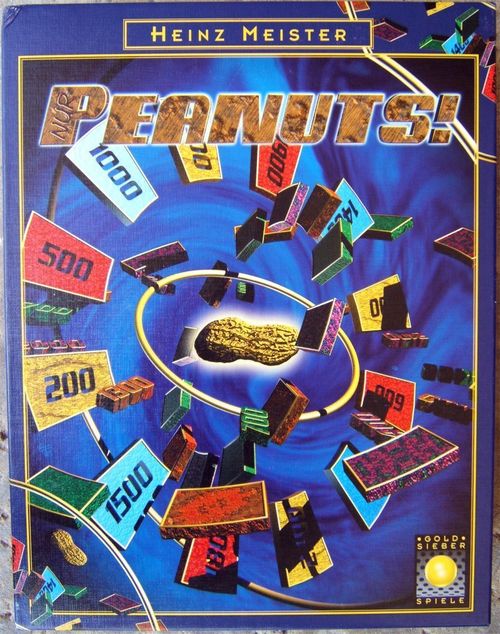
Nur Peanuts!
Nur Peanuts! Rulebook
Table of Contents
Table of Contents
Contents
- Game board
- 12 pawns, two each in the colors of the players
- 4 black wood cylinders (1 start-player stone, 3 neutral game stones)
- 2 white dice, with the numbers 0-1-2-3-4-5
- 1 black die, with the numbers 1-1-2-2-3-3
- 24 property chips
- Play money
Preparation
Place the board and the 3 special dice in the middle of the table. All spaces on the board consist of 3 sections. The inner circle is the parking places. The middle circle is the movement track, and the outer circle is the starting places.
The 24 property chips are distributed on the board. They are printed with values of 100 to 2400 Peanuts. Each chip is put on the starting-place space with the same amount.
Give each player: 17 x 100 Peanuts, 8 x 500 Peanuts, and 4 x 1000 Peanuts. If bills remain, they form the bank, next to the board.
The player with the most money in his wallet becomes the start player of the preliminary round. He takes a black stone, which will serve as the start-player stone, and places it in front of himself.
The other black stones are used according to the number of players: With 2 players 2 stones, with 3 players 3 stones, with 4 players 2 stones, and with 5 players 1 stone. Surplus stones are put back into the box.
Each player takes two pawns of one color and puts them in front of him. Surplus pawns are not required and go back into the box.
Game Summary
The game begins with a preliminary round, in which each player can buy two properties. At the same time, the start spaces are determined.
The regular game begins after that. Now, the players try to reach spaces with their pawns with the highest possible amounts. The player on the space with the highest value gets money from the other players and can buy a new property. The winner is the player who possesses six properties or the most cash.
Preliminary Round
The start player can buy a property of his choice first and pays the amount printed on the space to the bank.
Then he takes the property chip for that space and sets it in front of him, in full view of the others.
Afterwards, all other players follow clockwise. They are now allowed to buy any unsold properties.
When all players have bought a property, the second purchase round begins with the right neighbor of the start player. He buys a second property and puts his pawn on the start space of the corresponding field. He leaves the other pawn in front of him to designate his color.
Then, in counterclockwise order, all other players can buy a second property and put a pawn on the respective start space.
Games with less than six players will have neutral black game stones left over. They are put on the start spaces of the still-unsold properties with the lowest values.
Regular-Game Round
The player whose pawn stands on the space with the highest value becomes the new start player. He takes the start-player stone and executes his turn. The other players follow clockwise.
First, all pawns of the players are moved. Then the neutral game stones are moved. The round ends if all pawns and game stones stand on parking places.
A Player's Turn
To begin his turn, the player moves his pawn from the start space to the movement-track space of the same property.
Then he must roll and must move his pawn accordingly, clockwise.
Dice
Before any roll, the player has the choice of the following die combinations:
- He throws the black die alone.
- He throws a white die.
- He throws both white dice.
He must move the number rolled. If the player has rolled the two white dice together, he moves his pawn the sum of both dice.
He then has the choice of whether to park his pawn or move it further.
Parking a Pawn
If the player wants to stop moving, he puts his pawn on the parking place of that property.
Note: The player's turn ends only if he parks his pawn!
Bumping a Parked Pawn
Only one pawn can stand on each parking place. If the parking place is already occupied by another pawn, this pawn must leave the parking place. It is put on the start space of the property.
Now, the player taking his turn puts his own pawn on the parking place.
The bumped player must move again on his next turn.
By bumping pawns, a player can make several moves in the same round.
Further Pawn Moves
The player can also roll again instead of parking his pawn. He can now choose between all three die-combinations again, independently from the combination used in his last roll.
If the player had used one or both white dice in the preceding throw and had rolled 0 on at least one, he can roll again free of charge.
If the player did not roll a 0 in the preceding throw, he can roll again if he pays the value of the space his pawn rests on.
If he is on the property of another player, he pays that player. If the property is unowned, the player pays the bank. If he owns the property himself, he pays nothing.
After the player has rolled, he must move the number rolled even if he is unsatisfied with the result.
He has the choice again of whether to park his pawn or roll once more. The player can keep moving as long as he either rolls a 0 or pays the value of the respective property.
Moving Neutral Game Stones
Once all pawns stand on parking places, the moves of the neutral game stones are executed. This task falls to the start player.
He first moves the neutral game stone that stands on the start space with the highest value. When this stone's move is finished, the start player moves the neutral stone that stands on the next-highest space. This continues until all neutral stones stand on parking places.
Dice for Neutral Stones
For neutral stones, always roll both white dice. If a 0 appears on at least one die, the neutral stone is moved and the dice are rolled again.
Parking a Neutral Game Stone
If neither die shows a 0, the stone is moved and put on the parking place of the corresponding property. If another stone or pawn is already there, it is bumped to the start space.
If a player's pawn is bumped, that player gets another turn when all neutral game stones stand on parking places. If the pawns of several players were bumped, the first player to roll is the start player in this round or the player sitting closest to him, going clockwise.
Through bumping, there can be several alternating player moves and neutral game stone moves.
Ending a Round
A round finishes when all pawns and neutral game stones stand on parking places. Then, the winner of the round is determined.
Winner of the Round
First, determine which pawn stands on the most valuable space. The owner of that pawn is the winner of the round.
If a neutral stone stands on the most valuable space, the bank is the winner of the round.
Paying the Winner
Now, the other players pay the winner of the round.
The players pay the difference between values of the space where the winner stands and the space where their own pawn stands.
Players who stand on properties they own pay nothing.
The bank never pays anyone.
If the winner stands on a property that he owns, the other players pay him double the difference.
If the bank is the winner, the players always pay only the simple difference in values to the bank, even if they own the corresponding property.
Buying Property
Now, the winner can buy any unsold property. He pays the corresponding amount to the bank and takes the property chip. He can also forfeit the purchase.
If the bank is the winner, check to see whether the most valuable space with a neutral game stone on it is unsold. If so, that property chip is taken off the board and put in the bank. The property can no longer be bought. If the property is already sold, nothing happens.
Note: Players cannot buy, sell or trade properties between them. Properties cannot be sold to the bank.
Moving Pawns and Neutral Game Stones
Now all pawns and neutral game stones are put on the start spaces of their respective fields, and a new round begins.
Ending the Game
The game immediately finishes if one of the three following conditions is filled:
A. One player owns 6 properties. This player wins. The cash that players hold has no value.
B. 6 property chips are in the bank. The player with the most cash wins. The properties purchased by the players have no value.
C. One player goes bankrupt and cannot pay the winner of the round the full difference owed. The player with the most cash wins. The properties purchased by the players have no value. The winner of the round gets only the money that the bankrupt player still holds. He must forfeit the remaining amount owed.
Note: The game does not end if a player can pay the winner of the round completely, but has no more money after that.
Special Rules for 5 and 6 Players
In the preliminary round, each player buys only one property and puts his pawn on the start space of this field.
The game ends if a player or the bank owns 5 properties.
The game also ends if all properties are sold. Then, the player with the most cash wins.