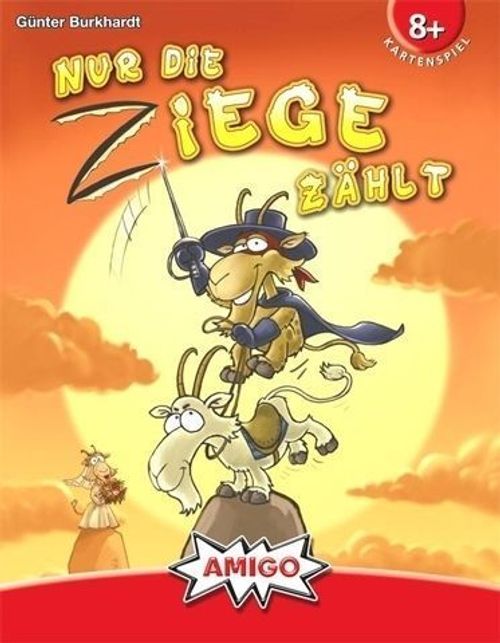
Nur die Ziege zählt
Nur die Ziege zählt Rulebook
Table of Contents
Table of Contents
Contents
- 50 Goat cards with 1, 2, 3 and 5 goat heads
- 1 Number Board
- 6 Wooden Goats
- 6 Guessing Tiles
- 6 Player Chips in yellow, red, blue, green, black and white
Game Ideas & Goals
The players receive goats, which are to be seen on the cards as black goat heads in eight "sticks" (for clarification, they are down in left and right side of a card). At the start of each game, the players must forecast, how many goat heads they can collect at the end of the game! More courageous forecast would give more points, less courageous fewer points. Whoever fulfills their forecasts best, wins.
Preparation
The Goat cards are shuffled. Deal 8 cards to each player. The rest cards are put aside. The Number Board is placed on the table.
The Guessing Tiles and Player Chips are punched carefully. Each player selects a color and receives the Wooden Goat, the Guessing Tile and the Player Chip of this color. Each player places his/her goat on the "0" field of the number board and puts his/her Player Chip and the guessing tile before them.
The Player Chip shows the color of each player. The players use their guessing tile to predict how many goat heads they will collect at the end of the game.
Game Play
The youngest player begins. The game consists of multiple rounds. Each round has two phases: prediction and the trick-taking.
1. Prediction
First, all players must predict how many goat heads they can collect at the end of the game in their received tricks. The starting player places his/her Guessing Tile on any place laterally at the Number board. The side of the Guessing Tile resting against the Number board shows, how many points he/she can get at the end of the game. He/she receives these points only if the number of collected goat heads lie within the range of his/her Guessing Tile! There are the four possibilities:
- 2 points (hearts): This side of the Guessing Tile covers a range of 4 lines on the Number board. The player occupies a large range, within which he can land with the collected goat heads. However, he/she gets fewest points (only 2) in case of success.
- 3 points: Occupies 3 lines, worth 3 points.
- 4 points: Occupies 2 lines, worth 4 points.
- 5 points: With the longest side of the Guessing Tile, the player can guess either collecting no goat heads (with this side on "0") or collecting more than 60 goat heads by putting the Guessing Tile with this side to the top edge of the Number Board (above the line "61+"). With either guess, it is worth 5 points in case of success.
Example:
- Blue player chooses 4-side of his tile and place it on the range of 41-60. It is worth 2 points, if he guessed correctly.
- Black player chooses 3-side of his tile and place it on the range of 36-50. It is worth 3 points, if he guessed correctly.
- Red and Yellow player take more risks and choose 2-side of their tile. It is worth 4 points, if he guessed correctly.
- White player takes the most risk and places his tile over the top line (collecting more than 60 goat heads). It is worth 5 points, if he guessed correctly.
After the starting player made his guess, all other players in the clockwise order place separately their Guessing Tile to the Number board. No Guessing Tile may lay one on the other. However, Guessing Tile may be put on both sides of the Number board. So each line of the Number board (e.g. the numbers "26 – 30") can be guessed twice, one with tile on the right side and the other on the left. Nonetheless, the lowest line "0" and the highest line "61+" may only guess once.
2. Trick-Taking
Beginning with the starting player, in the clockwise order, each player plays a card face-up on the table. The played cards, one from each player, constitute a "trick". The player with the highest card receives the trick and counts the goat heads on all cards of the trick (only the heads on the right of or left on the card. See example below.). Additionally, the player adds the number of the lowest card of the trick to the sum of the goat heads and moves his/her Goat forwards that many fields on the Number board. Several goats can occupy the same field on the Number board. Then, he/she puts the won cards face-down before him/her. The winner of the trick leads the next trick.
Example for one trick: In the trick: card 40 (5 goats), card 5 (3 goats), card 47 (1 goat) and card 18 (1 goat). The sum of the goat heads is: 5 + 3 + 1 + 1 = 10. The number of the lowest card is 5. The winner, who played card 47, moves his goats 15 fields forwards on the Number Board.
5 + 3 + 1 + 1 = 10 goats, plus card value 5 = 15
Game End
The round ends after the eighth trick. Each player checks whether their goat on the Number board lies within the range of their Guessing Tile. If it lies within the range, the player receives the appropriate points. If it lands outside the range, the player receives no points. Write down the points of each player. Play as many rounds as the number of players. Who has most points after that many rounds is the winner.