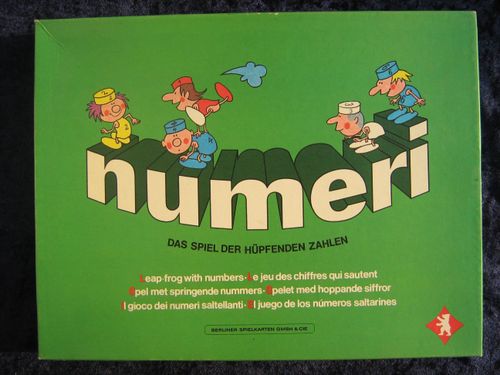
Numeri
Numeri Rulebook
Table of Contents
Table of Contents
Materials for the game
- 1 game board
- 20 tokens (5 each in four colours)
- 1 die (1, 2, 3, 4, 5, asterisk)
Object of the game
By moving them skilfully each player endeavours to place his tokens on squares with the highest numbers possible. At the end of the game the scores of the tokens are multiplied by the numbers of the squares on which the tokens are standing. The player with the highest total score wins the game.
Preparing for the game
Each player chooses 5 tokens of the same colour and places them in front of him. If fewer than four people are playing, the remaining tokens are returned to the box.
How to play
The youngest player takes the die and begins. He throws the die and places the token with the number on the die onto the dark red start square. When the turn is finished the game continues in a clockwise direction. The person whose turn it is throws the die and moves one of his tokens. It is the number thrown on the dice that determines which token is to be moved. The token is always placed on the next free square because only one token can be placed on each square.
In this way it is possible to jump over several occupied squares (this can be, for example, 1 square or 15 squares).
If the player throws an asterisk (star), he may move any one of his own tokens to the next free square.
Example: Yellow begins and throws a 2. The player then places his 2 onto the START square (A). The blue player throws a 4 and places his / her 4 onto the next free square (B). Then the green player throws a 1 and places his 1 onto the next free square (C). Thereafter yellow again throws a 2 and places it (D). Blue throws a 3. He has to place the token onto the Start square (A) because it is now the next free square for this token.
About the barrier
There are three barriers on the game board. The number of players determines which barrier is to be used. If there are 2 players the [barrier symbol] barrier is active. As soon as the first token has been moved over the active barrier all of the players are immediately permitted to divide up 3, 4 or 5 between two different tokens:
- With a 5 tokens 1 + 4 or 2 + 3 may be moved forwards.
- With a 4 tokens 1 + 3 may be moved forwards.
- With a 3 tokens 1 + 2 may be moved.
- If a 1, 2 or asterisk is thrown, the number cannot be divided up.
The die scores may only be divided up if the player is also able to move both tokens; the tokens can be moved in any order. It is not possible to miss out on a number. For example a 5 may be moved as 1 + 4 or as 4 + 1.
Transcriber's note: the barrier is shown only as an icon, which is not legible as text, and the English text names only the 2-player barrier. The sheet gives no separate barrier rule for 3 or 4 players; transcribed as printed.
Extra turn
Example: It is yellow's turn and a 4 is thrown (refer to situation at the beginning). If yellow divides up the throw into 3 and 1 and first moves the 3 (A) and then the 1 the three yellow tokens again form a row of three (B) and yellow may throw the die again.
Yellow could have moved the 4 one space along (C) or he could have divided it and first moved the 1 and then the 3 (D). In both cases a row of three would not have formed and it would have been the next player's turn.
Three tokens of the same colour in a row: an extra turn
If at the end of his turn a player has formed a chain consisting of three or more tokens of his own, he receives an extra turn and can throw the die again immediately. Here the tokens must be positioned directly one behind the other without any free spaces between. A chain that already existed before the die was thrown and was not changed does not prompt an extra turn. The chain must therefore have just emerged or been newly formed. If a player succeeds in building another chain with his extra turn, another extra turn can be taken. This can occur several times over.
Shortly before the game ends a player may be unable to move (e.g. if the 1 is standing on the last square and the player throws a 1); in this case the player cannot move a token and it is the next player's turn.
End of game
As soon as the last three squares (yellow ones) are occupied the game is over immediately. The scores for each player are then worked out.
How to calculate scores
Each player receives points for each of his tokens. The points are calculated by multiplying the number of the field on which the token has been placed. Tokens on the red minus squares result in minus points. If the players still have tokens in front of them, they are multiplied by -5. Tokens on squares with no points score zero points.
The results for all of the tokens are added up. The player with the highest total score is the winner.
Example: The green player has the 2 on square 25 (50 points), the 3 on the 9 (27 points) and the 5 on the -1 square (-5 points). He has not yet brought the 4 into play (4 x -5 = -20 points), and the 1 is standing on a square without points (0 points).
Therefore green has a total score of 50 + 27 – 5 – 20 + 0 = 52 points.