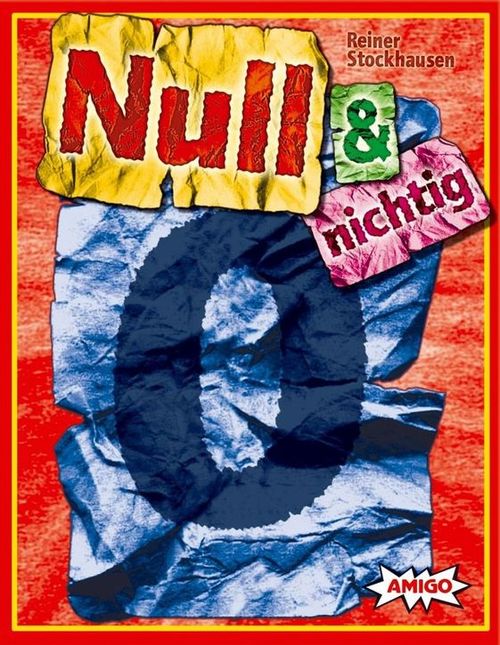
Null & Nichtig
Null & Nichtig Rulebook
Table of Contents
Table of Contents
Contents
- 65 Cards: numbers 0-11 in 5 colors (blue, green, purple, red, yellow) with a duplicate 0 valued card for each color
- Scoring Sheets (not supplied)
Game Summary
Players attempt to win tricks and collect cards (which will be arranged in a specific order). These cards are divided into piles by color during the course of the game. Only the point value of the topmost card counts at the end of the round. The goal is to score as many points as possible.
Game Set-up
Shuffle the cards and deal each player 13 cards. Each player chooses three cards from their hand, placing them face-up on the table separated by color. If choosing 2 or 3 cards of the same color, stack one card slightly offset on top of the other(s) in any order preferred. In this initial setup you must allow other players to see which cards you have placed before you.
Game Play
- Each player, in clock-wise order, takes a card from their hand and places it face-up on the table before them. Any card can be played regardless of its color or number.
- The player with the highest numbered card wins the trick, taking all of the played cards. If players tie for the highest number, the card that's played first wins the trick.
- The winning player then separates these cards by color, stacking them in the sequence that they were played - starting with their card (face-up on the table before them).
- If a player takes any cards of a color already face-up before them, they place these cards on the matching colored stack(s).
- The player winning a trick plays first for the next trick.
- In this manner, each player builds face-up piles of cards before them during the course of the game. At the end of the round, only the point value of the topmost card in each pile will count, so these point values can increase or decrease.
Playing a Trick Example (see example in German rules): Since Hannah dealt, Jan begins the round by playing a yellow 9. Laura plays a purple 2, Lukas a yellow 0 and Hannah a red 6. Jan wins the trick with the highest number and places the yellow 9 as a new pile. She does the same with the Purple 2 card. She then places the yellow 0 over the yellow pile and finally the red 6 on the red pile. After this round, she has five face-up collection piles lying before her on the table.
Round End and Game End
Once all ten tricks have been played, each player adds the numbers on the topmost card of each pile and tallies this on a scoring sheet. The player who had the fewest points in this round begins the next round. Play as many rounds as there are players in the game. The winner is the one that scores the most points after all the rounds have been played. Alternatively, you can play until a player reaches a certain point total, such as 100 points.
Game Variants
6 Player Game: When playing with 6, each player is dealt 10 cards (place the remaining cards face-down in the box) and they place only two cards face-up as scoring pile before the round begins. Instead of six rounds, it's recommended to play eight.
Team Variant: With 4 or 6 players you can divide into teams of two or three players. Players on the same team must sit opposite of one another, but the game play is identical to the game with 3-5 players. Each player wins tricks individually, still counting up the points as normal. At the end of the game, the points of all the players on the same team are added together to determine which team wins.
"No Trick Taking" Variant: With 3 or 4 players, the strategy of initially placing 3 high cards and attempting to not take any tricks can be very successful yet make gameplay predictable. Instituting a penalty of -10 points to players that don't take at least one trick tends to eliminate that action.
Strategic Tips
- Leading a trick leaves you at the mercy of the other players and it's very risky in this game. Leading with a very low or high number early allows others to dump low numbers, leaving you with a "winning" trick that tanks your score. Lead with a card that other players might want to take.
- The last player's position offers knowledge of what the trick's final value will be, use this to your advantage to take the trick or poison it.
- With a 3 player game, 40% of the cards are out of the game, so guessing what colors and values are viable is difficult. Starting with 3 high cards in your tableau with a "take no tricks" strategy can be effective.
- With a 4 player game, 20% of the cards are out of play, keen awareness of cards in other's piles is still advisable but card-counting is not as much of an advantage as the 5 player game.
- With a 5 player game, all the cards are dealt so keen awareness of other's piles and/or card-counting (if possible) is recommended.
- Player collusion and king making can exist, so don't show too much glee when poisoning other player's tricks...this can develop into a back-stabbing game.