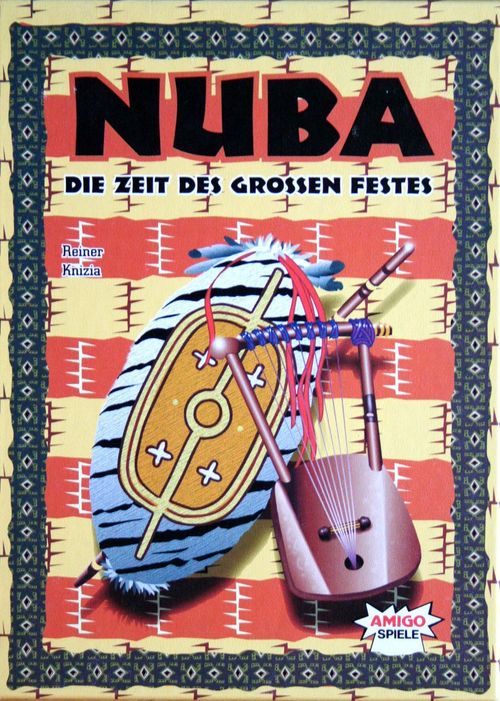
Nuba
Nuba Rulebook
Table of Contents
Table of Contents
Introduction
In the Sudanese highlands live the Nuba, one of the last primitive races on Earth. After the annual harvest, all the villagers celebrate with SANDA-Fest. The highpoint of the festival is a wrestling match followed by a music competition. In this game, a player wins by making the best use of the wrestling and musical talents of their team.
Players: 2 Ages: 12 and older Length: 20 minutes
Components
- 1 Board
- 20 Playing pieces (10 disks in green and 10 disks in red)
Aim of the Game
The aim of the game is to be the player to get the best musician possible to their opponent's base. In order to achieve this, a player must move their stronger, less musical, team members so that the better musicians have a clear route to their objective.
Outline
One player is red and the other is green. Each player has a team of nine disks of values 1 to 9, and one disk consisting of a Champion (marked with an X). The lower the number, the better the wrestling ability; the higher the number, the better the musical skill. The champion is musically perfect and a fearless wrestler.
In the wrestling competition, a piece with a low value beats a piece with a higher value. The Champion beats any of the opponent's pieces but can also be beaten by any of the opponent's pieces.
Game Play
Placing pieces on the board
Starting with the green player and in alternating order, each player places one piece at a time on the 10 squares (2 rows of 5) nearest to them. This continues until all the pieces are on the board.
(Figure 1: Example setup. The printed rulebook shows a diagram of the board with the green and red pieces placed on the two rows nearest each player.)
Moving pieces
Once all the pieces are on the board, they can then be moved.
In turn order, starting with green, players must move one of their pieces. A piece can move one square directly or diagonally forwards. A piece cannot move backwards or sideways. A piece can move into an empty square or one occupied by an opponent's piece of the same or higher value (lower strength). In this event, the opponent's piece is beaten and removed from the board. In the case of Champions, they can beat any other piece and any other piece can beat them.
A square occupied by an opponent's piece of lower value (higher strength) cannot be entered. A player must move one of their pieces if they can. They may only pass if none of their pieces can make a legal move.
(Figure 2: Example movement. The printed rulebook shows a diagram of a board with several pieces illustrating legal moves.)
Musicians
If a player gets one of their pieces to their opponent's base (the row of 5 squares nearest to their opponent) then the piece is placed in the special section to the side of the board. This piece represents a performing musician.
If subsequently a piece of higher value (i.e. a better musician) reaches their opponent's base, this piece becomes the musician, replacing the one currently occupying the music square. If a piece with a lower, or the same value arrives at the base then it has no influence as a musician and is removed from the board.
There can only be one musician performing at any time.
(Figure 3: Number 3 disk becoming a performing musician. The printed rulebook shows a diagram of the board with a number 3 disk moving onto the opponent's base and entering the music square.)
Game End
The game ends when one of the players is no longer able to become the musician. The player who owns the current performing musician is therefore the winner.
The game also ends when a player gets their Champion to their opponent's base first. They then immediately win the game.
Variant
Each player attempts to collect together a band of musicians. In this case all the pieces that reach the base are placed in the music square. The game ends once all the pieces have been removed from the board either by being eliminated or by joining the group of musicians. Each player totals up the value of all pieces that have become musicians. The player with the higher score wins.
As with the regular game, if a player succeeds in getting their Champion to their opponent's base first, they win immediately.