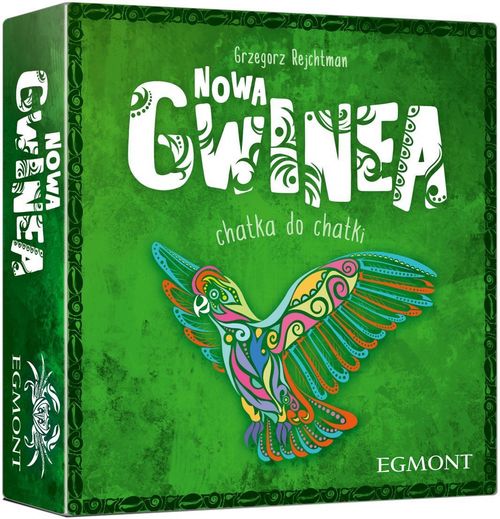
Nowa Gwinea
Nowa Gwinea Rulebook
Table of Contents
Table of Contents
Components
32 double-sided task boards (192 standard, 192 hard tasks)
- Side A: standard tasks. Side B: hard tasks.
- Each board shows starting totems, water sources (water holes) and fruit trees (fruit bushes).
48 hut tiles (12 per player)
1 score track
4 pawns (one in each of four colours)
1 die
4 points tokens
- Front: +50. Back: +100.
Setup
- Take the 32 task boards. Decide whether you will use the easier side or the harder side. Shuffle the boards and place them in a stack, unused side facing up.
- Tip: To balance the game, parents may use the harder side and children the easier side.
- Each player takes a set of 12 hut tiles and one pawn in a colour of their choice. If there are fewer than 4 players, return the unused tiles and pawns to the box.
- Place the score track in the middle of the table. Each player places their pawn on the space marked "0".
- Get the die ready.
Object of the Game
The players take on the roles of tribes building a new village in the distant New Guinea. They place hut tiles on their own task board, starting from the rolled starting totem, so that the tiles cover the water sources and as many fruit bushes as possible. Huts may touch only at their corners. The player who manages to cover all the water sources ends the turn. After 9 turns, the player with the most points wins.
Gameplay
The game consists of 9 rounds. Each round proceeds as follows:
- Each player takes 1 task board from the stack and places it in front of themselves (with the chosen difficulty side facing down).
- One of the players rolls the die. The animal symbol that comes up indicates the starting space: the stone with that animal symbol. All players simultaneously turn their boards over and begin building their villages against the clock.
Each player's first tile must be placed on the board so that it covers the totem animal indicated by the die. The other animals MUST NOT be covered (they must remain visible at the end of the round).
All players play at the same time and try to cover ALL the water holes on their board as quickly as possible. It is also worth covering the fruit bushes.
Note: a single tile may cover more than one symbol. A single tile may be placed so that it simultaneously covers the stone with the symbol indicated by the die, a water hole and a fruit bush.
- The players have the whole set of tiles available, but they do not have to use all of them (some unused tiles will always remain at the end of the round).
- Tiles may be freely rotated and flipped.
- No part of a placed tile may lie on another tile. No part of a tile may stick out over the frame or beyond the board.
- All placed tiles may touch each other only at their corners.
- Each tile must touch at least one other tile.
- Tiles may not touch each other along their edges.
Diagrams in the manual show a WRONG placement (tiles touching along edges, or a tile sticking out over the board) and a RIGHT placement (tiles touching only at corners).
- When any player covers 5 water holes, they call out "Gwinea!". The round then ends.
Translator's notes: "oczka wodne" (rules text) and "źródła wody" (component labels) are both rendered as water holes/water sources as in the manual. The manual does not further define "the first player" in the scoring bonus, so it is translated literally. Hut tiles are "kafelki chat" in the original.
End of Round and Scoring
The players count their points (see below). They then take back the tiles they used, so that they again have a full set, and discard the task boards they used in this round.
- Each player receives 1 point for each water source covered.
- In addition, the first player receives a bonus depending on the number of fruit trees they covered:
- 1 fruit tree covered: 1 point
- 2 fruit trees covered: 3 points
- 3 fruit trees covered: 6 points
- 4 fruit trees covered: 10 points
- 5 fruit trees covered: 15 points
- The other players do not receive bonus points for fruit trees.
- A player who broke any tile placement rule does not receive any points in that round.
- If a player's pawn on the score track passes 50, move it back to the start of the track. The player takes a points token and places it in front of them with the +50 side up. When it passes 50 again, the player turns the token over to +100.
New Round
The players take a new task board. One of the players rolls the die. The next round begins.
End of Game
The game ends after 9 rounds. The player who has scored the most points is the winner!
Variants
Variant: different number of water holes to cover
If you want a simpler game, you may try this variant.
- Agree in advance how many water holes must be covered to win the round. For example, you may agree that exactly 4 water holes must be covered.
- Players then receive 1 point for each water hole covered.
- All other rules remain unchanged.
Variant: reward for every fruit tree
- Players who did not cover all the water sources also receive points for fruit trees: 2 points for each fruit tree covered by them.