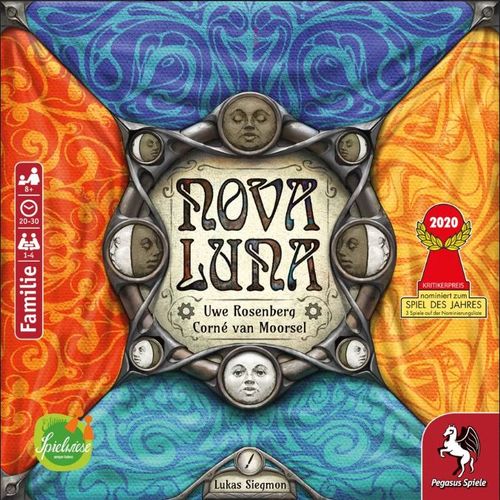
Nova Luna
Nova Luna Rulebook
Table of Contents
Table of Contents
The Game Material
- 1 Moon Wheel
- 1 Meeple
- 68 tiles in 4 colors (17 tiles each)
- 84 tokens (21 tokens each in the 4 player colors)
- 1 Rulebook
First, we describe the rules of the game for 2–4 players. The solo rules can be found in the section "The Solo Game."
The Aim of the Game
Your goal is to be the first to place all of your tokens. Each time you complete a task on one of your tiles, you may place a token on it.
The Game Structure (Setup)
-
Place the Moon Wheel in the middle of the table so that everyone can reach it easily.
-
Place the Meeple on the space above the golden field of the outer selection track (above the new moon).
-
Shuffle all tiles face down and place 1 randomly drawn tile face up on each of the remaining 11 spaces.
-
Form any number of draw piles from the remaining tiles and place them face down around the Moon Wheel.
-
Select your player color. Take the 21 tokens of your color.
Important: If this is your first game of Nova Luna, we recommend reducing the number of tokens. With 3 players, take 18 instead of 21 tokens, and with 4 players, take 16 instead of 21 tokens.
-
Now determine the preliminary game order. To do this, each player places 1 token from their personal supply in the middle of the table; the person who slept the latest draws the tokens blindly until they are all drawn. Form a pile out of them in the order in which they were drawn: the first token drawn is placed at the bottom, the next token is placed on it, and so on. Set this pile on the new moon of the moon track.
The Order of Play
Important: You do not play in clockwise order!
The tokens on the moon track will show you the order of play at all times. It is always the turn of the player whose token is furthest back on the moon track. If several tokens share the rearmost position, it is the player's turn whose token is at the top.
The Tiles
The tiles all have the same structure. They are available in 4 different colors: red, blue, turquoise, and yellow.
At the top left of the tile is a number (from 1–7) indicating the "time" it costs you to take a tile and place it.
In the other corners, there are tasks (0–3 tasks depending on the tile), which you can complete by placing additional tiles. To complete a task, the color of the adjacent tiles must match the colors of the task.
Important: It is permissible to place tiles whose frame color does not match any task of the adjacent tile. This is usually not recommended, but cannot always be prevented.
The Course of the Game
As the game progresses, you take tiles from the Moon Wheel and place them in your display, trying to complete your tasks.
How do you take the tiles?
You take the tiles from the selection track of the Moon Wheel. You always have access to the next three tiles in a clockwise order, as seen from the Meeple. Spaces where there is no tile left are ignored; they are not counted. Then place the Meeple on the space from which you took the tile.
Important:
- Any tiles you take must be placed immediately. It is not permissible to take a tile in order to put it in the display later (or not at all).
- Every time it's your turn, you have to take a tile. It is not permissible to skip selecting a tile.
Filling the selection track
If at the beginning of your turn there are only one or two tiles left on the selection track, you may fill all empty spaces with one randomly drawn tile each. Take the tiles from the draw piles and place them face up on the selection track. Always fill the space closest to the Meeple in a clockwise order first; fill the spaces further clockwise from here.
If there is no tile left on the selection track at the beginning of your turn, you must fill all the empty spaces. In this case, too, start with the space closest to the Meeple in a clockwise order and continue to fill the spaces clockwise from here.
If the tiles in the stock are not sufficient, fill up the selection track as much as possible.
How are the tokens advanced on the moon track?
Whenever you take a tile, you must move your token on the moon track forward as many spaces as the number on the tile indicates. Always move your token in a clockwise order. If you reach an occupied space, place your token on top of the other player token(s).
Don't forget: It is always the turn of the player whose token is furthest back. If several players share the backmost space, it is the turn of the player whose token is at the top.
When can you place tokens on your tiles?
Whenever you complete a task as described above, you may cover it with a token from your personal supply. Since the tiles have up to three tasks, you can place as many tokens on them as it has tasks.
Important:
- Each tile can be used for any task, as long as the neighborhood rules are followed (see examples 4 and 8). Therefore, it doesn't matter if the tasks are no longer recognisable once you have covered them.
How do you place the tiles?
Place the first tile you take in this game in front of you. As you progress through the game, always place exactly 1 tile horizontally or vertically adjacent to a tile you have already placed. Tiles are always placed with their task side face up.
Important:
- Everyone builds their own display. So make sure that each of you has enough room.
- It doesn't matter how and if you turn your tiles. It is best to always place them in such a way that the number is at the top left.
The number
Whenever you take a tile, the number at the top left of the tile indicates by how many spaces you need to advance your token on the moon track (smaller values potentially allow you more actions). If the space on which you must place your token is occupied, place it on top of the existing token(s).
The tasks
Tiles can contain zero to three tasks. The tasks are located in the three remaining spaces of the tile and must be considered separately from each other. Each task includes 1 to 4 colors.
A task is fulfilled if the colors shown correspond to the four horizontally or vertically adjacent tiles' colors—in the frequency in which they are represented in the task. There is one special feature: A neighboring color counts double if this tile has a neighboring tile of the same color. This can be continued as desired: Count all horizontally or vertically adjacent tiles of the same color together. All these tiles will help you complete a task if at least one of them is adjacent to the task's tile. But be careful: The color of the tile on which the task is written never counts!
Important: The arrangement of the colors within the task is irrelevant. Matching the right colors in the right amount is the only objective in order to complete a task.
The End
The game ends when the first player manages to place all their tokens on their tiles. This player wins.
The game also ends when a player cannot take any more tiles, as all the tiles have been laid out. In this case, the player with the fewest remaining tokens wins. The remaining places will depend on the number of tokens you still have in your personal stock. The fewer tokens, the better.
In case of a tie, the player with the fewest tokens remaining that would have taken the next turn wins the game.
Examples
Some examples of how to complete tasks:
- Examples 1 & 2: The yellow tile has the task "2 Blue" among others. This task can be accomplished with 2 blue tiles, both adjacent to the yellow starting tile (example 1), but also with 2 adjacent blue tiles, only one of which is adjacent to the yellow starting tile (example 2). Example 2 also shows that there is no diagonal neighborhood in this game. The task "3 Red" has therefore not yet been completed.
- Example 3: Shows how two tasks can be completed at the same time on one tile: Each completed task is covered with a token from the personal stock. The higher the numerical value of a tile, the easier it is to complete the tasks on the tile.
- Example 4: Shows a 7-tile whose three tasks can be completed with only 3 tiles.
- Examples 5 & 6: In the ideal case, the tiles help each other to perform the tasks. Example 5 shows how two tiles do not need any more tiles at all to complete a task on each of them. In example 6, two more tiles help to also fulfill the task "2 Yellow" on both tiles.
- Example 7: Remember that the color of the origin tile itself never counts. In order to fulfill the task on the red 2-tile in example 7, at least 4 additional red tiles are required. It is ideal if you manage to place two 2-tiles in such a display, as in example 7, because they support each other.
- Example 8: The tasks are independent of each other (see also example 4)! Therefore, the four red tiles in example 8 fulfill both the task "2 Reds" and the task "4 Reds" of the blue 4-tile.
The Solo Game
A solo game lasts about 15 minutes. All rules of the multiplayer game apply with the following exceptions:
Take the tokens of one color and form two stacks. One stack consists of 8 tokens, the other of 13 tokens. There is no token on the moon track—it is not used in the solo game.
Place the Meeple above the golden marked field of the selection track (above the new moon).
As usual, fill the 11 free spaces of the selection track with 1 randomly drawn tile each. Just like in the multi-player game, you may take 1 of the 3 next tiles after the Meeple (in clockwise order). Take one tile after the other—but without advancing the numerical value of the tile on the moon track. Your goal is to quickly place the 8 tokens of the small pile on the tiles of your choice. As soon as you succeed, add up all the numerical values on tiles in your display and note the value. Fill up the free tiles of the selection track again afterwards; tiles that you did not take remain where they are.
In the second phase of the game, try to place your remaining tokens on your tiles by taking additional tiles.
Important:
- In the first phase of the game, it is permissible to take and place more tiles even if you have already placed your 8 tokens. In the short term, this has the disadvantage that you increase your score. In the end, however, you increase your chance of really being able to place all your tokens, because you fill the selection track for the second phase with more tiles.
Also after the second phase, once you have placed all your tokens, add up the numerical values on the tiles in your display and note this value. The sum of the two numbers you wrote down is your overall result: the lower it is, the better. The game also ends if you have taken all the tiles from the selection track.
Comments:
- Try to stay below 100 points. It is quite challenging to place all tokens. The reason for this is that you have to deal with the tiles that have been uncovered by chance.
- You cannot exchange tiles from the selection track! This is particularly tricky if a color is very rare or missing at all. Consider this a special challenge.
Important:
- In the first phase, if you have taken and laid out all 11 tiles that were initially placed, but have not been able to place all 8 tokens on them, note an additional 10 points for each token that is missing. Then fill up the game board and play phase 2 of the game.
- In the second phase, if you took all the tiles and laid them out, but could not place all 21 tokens, add 10 points for each token missing. After that, the game ends.
On our webpage, you can find and download a score sheet for your results: http://edition-spielwiese.berlin
Author's Note
The inspiration for this game was provided by Habitats from the Dutch publisher Cwali (published 2016). Unlike "NOVA LUNA", the tiles in Corné van Moorsel's game have a maximum of one task, and the number of points for completion varies depending on the difficulty level. Nova Luna contrasts the difficulties the tasks have with different "acquisition costs". I express my gratitude for this inspiration by naming Corné van Moorsel as co-author and granting him the rights as such. My sincere thanks also go to Lukas Siegmon for the wonderful illustrations. Lars Frauenrath was responsible for the realisation. As a test player we would like to thank in particular Timon Rosenberg, Marei Zylka, Malte Frieg, and a lot of wonderful visitors at the Berlin Con 2019.