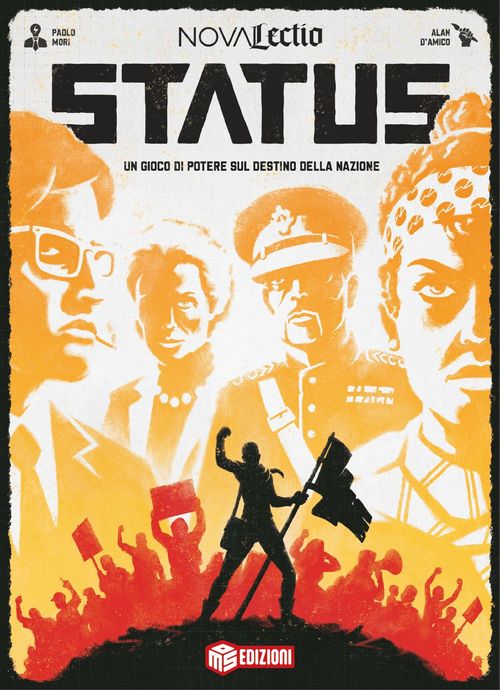
Nova Lectio: Status
Nova Lectio: Status Rulebook
Table of Contents
Table of Contents
General Components
- 1 Board
- 40 Event cards
- 36 Economy tokens
- 36 Politics tokens
- 36 Consensus tokens
- 1 Priority token
- 1 Clock token
- 1 Coin token
- 2 Wild (Jolly) Income tokens
- 6 Economy Income tokens
- 6 Politics Income tokens
- 6 Consensus Income tokens
Personal Components
- 4 Faction screens (1 per Faction)
- 4 wooden Military indicators (1 per Faction)
- 4 Status indicators (1 per Faction)
- 16 wooden Official pawns (4 per Faction, numbered 1 to 4 on the front and with a ? on the back)
- 1 Military Income token (only for the Nuova Milizia)
Key Concepts
Assets
The Economy, Politics and Consensus tokens are called Assets. During the game your Assets will always remain hidden behind your screen.
Income Tokens
For each of your Income tokens they produce Assets or Military Power (see Phase IV, p. 10), as follows:
- The Economy / Politics / Consensus Income tokens produce, respectively, an Economy / Politics / Consensus Asset, taken from the supply.
- The Wild (Jolly) Income token produces one Asset of your choice among Economy / Politics / Consensus, taken from the supply.
- The Military Income token advances the Military indicator of the Nuova Milizia by 1 space (see below).
Note: Income tokens are not considered Assets.
Military Power
During the game you keep track of your Military Power by moving your indicator forward and backward on the Military track. Each space of the track can hold at most one Military indicator.
What is Military Power for?
- Some Event cards have a Military cost. To send an Official to these cards you must first move back on the Military track.
- In all cases of a tie between two or more factions (except in Phase VI, see p. 10), the Faction furthest ahead on the Military track wins, and must then move back one space on the track.
Note: Military Power is not considered an Asset.
When you move forward and the destination space is already occupied by an indicator, push it to the left by one space (pushing the other indicators too, if there are any). Likewise, when you move backward and the destination space is already occupied by an indicator, push it to the right by one space.
Examples - Moving on the Military track
Example 1 (A, B): Spaces 4, 5, 6, 7 are occupied, in order, by the Mano, Ragione, Pugno and Milizia indicators. The Ragione (on 5) must advance 2 spaces, but space 7 is already occupied by the Milizia (A). The Ragione pushes the Milizia back by 1 space, which in turn pushes the Pugno back (B).
Example 2 (C, D): The Ragione must move back 1 space (C), but that space is already occupied by the Pugno: the two Military indicators swap positions (D).
Example 3 (E, F): The Milizia must move back 4 spaces, but space 4 is already occupied by the Mano (E). The Milizia pushes all the other indicators forward by 1 space (F).
Event Cards
Event cards represent international situations (global crises, summits and negotiations, power transitions, conflicts, technological and cultural revolutions, climatic and environmental changes...) on which the Factions can send their Officials to obtain Assets, Military Power, Income tokens, Status points and other advantages.
- Title.
- The symbol (a small arrowhead) next to the title marks the cards recommended for the first game.
- Reward (see Phase III, p. 8).
- Illustration.
- Official space (see Phase II, p. 6).
- The VS symbol is present only on some cards (see example, p. 9).
- Effect (see pp. 6 and 8).
- Above the Official space there may be a Cost (in Assets, Military Power or Status points).
- Below the Official space there may be a Gain (in Assets, Military Power or Status points).
- Continents: America, Europe, Africa, Asia (see End of the Game, p. 11).
- Thematic text.
- Card number.
Setup
Example of setup with 3 Factions (Mano Invisibile, Nuova Milizia and Pugno del Popolo).
General Setup
- Place the board in the centre of the table.
- Form the Event deck with a number of cards depending on the group size (12 with 2 players, 16 with 3 players, 20 with 4 players). Put the remaining Event cards back in the box. Note: if this is your first game, we recommend using only the cards with the arrowhead symbol next to the title.
- Draw a number of Event cards depending on the group size (3 cards with 2 players, 4 with 3 players, 5 with 4 players) and place them on the Monitor spaces (from left to right) until you cover the symbol corresponding to the number of people at the table (3a).
- Form a supply with the Assets, the Income tokens and the Coin.
- Place the Clock at the top left, above the board. Note: during the game you can keep track of the current phase by moving the Clock to the right.
Faction Setup
- Each person at the table takes a Faction, placing the corresponding screen in front of themselves. Put the components of the unused Factions back in the box.
- Randomly assign the Priority token to a Faction: this Faction places its Military indicator on space 5 of the Military track. Going clockwise, each other Faction places its Military indicator on the free space of immediately higher value.
- Each Faction shuffles its 4 Official pawns face down, so as not to know which value corresponds to which pawn. Then it stacks them in front of itself, outside the screen.
- Each Faction takes the Official on top of its stack, moves it behind its screen and turns it face up so as to see its value.
- Each Faction takes one Economy, one Politics and one Consensus Asset and the Income token indicated on its screen. Place the Assets behind the screen and the Income token outside the screen.
- Each Faction immediately collects its income.
- Each Faction places its Status indicator on space 1 of the Status track.
Example of setup of the Mano Invisibile: the Faction takes one Economy, one Politics and one Consensus Asset behind its screen, plus its Official (here a 3); its Income token (Economy) is placed outside the screen and the income is collected immediately.
Object of the Game
Be the Faction that at the end of the game has the most Status points!
How Status Points Are Gained
As the Reward of some Event cards (1), when you activate an effect on the cards (2) or on the board (3), and in Phase V (4). When you gain Status points, advance on the Status track; when you lose them, move back (see also End of the Game, p. 11).
How to Play
Each game is divided into rounds, each made up of 6 phases, to be played in the following order:
PHASE I - New Events
Draw cards from the Event deck depending on the number of Factions at the table and place them from left to right on the Monitor spaces of the board:
| Factions | 2 | 3 | 4 |
|---|---|---|---|
| Cards | 3 | 4 | 5 |
Note: in the first round skip this phase, since it was already done during setup.
PHASE II - Sending the Officials
Clockwise, starting from whoever holds the Priority token, each Faction sends the Official that it has behind its screen, placing it on any free Official space (that is, one where there is not already another Official) on the Newspaper spaces above the Monitor or on the Event cards on the Monitor.
After sending your Official, if the Event card (or Newspaper space) shows the effect symbol (lightning bolt), you must activate immediately the effect indicated in the text.
Finally, the Faction that has just taken its turn takes the Official on top of its stack, moves it behind its screen and turns it face up so as to see its value.
Its turn is over and the Faction to its left will take the next turn. When all Factions have sent all four of their Officials, move on to the next phase, "Resolving the Events".
Note: during the game it is always possible to discuss and negotiate, but no agreement is binding!
Below are the requirements that indicate how and which Officials to send:
- Official space with "?": Send your Official face down, with its value hidden.
- Official space with a number (for example 3): Send your Official face up, with a value equal to the one shown (in this case, you can only send an Official of value 3).
- Official space with a number and "+" (for example 2+): Send your Official face up, with a value equal or greater than the one shown (in this case, you can send an Official of value 2, 3 or 4 but not 1).
- Official space with the "less than or equal" sign: Send your Official face up, with a value greater than or equal to that of the Official directly to its left on the same card. You can send an Official to this space only if the previous space is already occupied.
- Costs (a red cross over an icon, shown above the Official space): To send your Official you must first pay the cost, if present, shown above the Official space. If you cannot pay it, you cannot send the Official. (In the first case, to send your Official you must first discard a Politics Asset; in the second case you must first move back one space on the Military track; and in the third you must first lose one Status point.)
- Gains (shown below the Official space): After sending your Official you immediately obtain the gain, if present, shown below the Official space. (In the first case, take a Consensus Asset from the supply; in the second case, take one of your choice among Consensus, Politics or Economy; and in the third advance one space on the Military track.)
Examples - Sending the Officials
- The Mano, after sending its Official, advances 1 space on the Military track.
- The Pugno, to send its 3, must discard 2 Economy Assets. If it does not have them, it cannot send the Official.
- The Ragione, to send its 3, must lose 1 Status point. After doing so, it takes 3 Assets of its choice from the supply, even different from one another.
- The Milizia, to send its 2, must move back 2 spaces on the Military track. After doing so, it takes 4 Politics Assets from the supply.
Examples - Activating the Effects
- The Mano, after sending its Official, immediately activates the effect "obtain immediately the income from all your Income tokens": in front of its screen it already has an Economy Income token and a Politics Income token, so it takes one Economy and one Politics from the supply.
- The Milizia, after sending its Official, immediately activates the effect (the card offers a choice of Assets, then "each other Faction in play obtains one of the same type"): it chooses to take 2 Politics from the supply, then all the other Factions in play take 1 Politics from the supply.
- The Ragione, after sending its Official, immediately activates the effect (flip the Coin; if the indicated side comes up, obtain 4 Economy): the Ragione flips the Coin and gets that side, so it takes 4 Economy from the supply.
PHASE III - Resolving the Events
Turn all Officials face up, revealing their value. Then, wherever there is at least one Official, activate the effects with the resolution symbol (circular arrows).
Note: start from the Newspaper spaces on the board, from left to right, and proceed in the same way with the Event cards on the Monitor.
Then, for each Event card on the Monitor with at least one Official, starting from the leftmost one and proceeding to the right:
- Add up the values of the Officials of each Faction.
- The Faction with the highest sum obtains the Reward shown at the top right, if present (Status points or Income tokens).
- The Faction with the highest sum takes the card and places it face down near its screen (see End of the Game, p. 11). You may always look at your cards.
Note: resolve any ties as usual (the Faction with more Military Power wins the tie, then moves back 1 space on the Military track).
If an Event card does not have at least one Official on it, put it back in the box.
Finally, each Faction takes back all of its Officials, shuffles them face down and stacks them outside its screen, then takes the one on top of its stack and moves it behind its screen.
Examples - Resolving the Events
The first effect to activate is always the one on the Newspaper space at the top left. The Milizia and the Ragione had already obtained many Assets during the "Sending the Officials" phase, but now they must repay part of their debt to the bank. The Milizia must discard 2 Assets of its choice (because it sent 2 Officials) and the Ragione 1. (The Newspaper space effect reads: "each Faction present discards one Asset (or loses one Status point) for each of its Officials.") If they did not have enough Assets to discard, they would lose one Status point for each of their Officials.
Card 1 - "Russian Invasion of Ukraine" (Reward: 1 Status point; it has two sides, left and right, with a VS symbol; effect: "Flip the Coin. Add 3 to the side obtained. Then the factions on the side with the greater total obtain a Status point. In case of a tie, the side obtained wins."): After revealing the Officials, the values of the two sides are 5 VS 4 (4+1 on the left VS 2+2 on the right). Now the effect must be activated: any Faction flips the Coin and obtains a side. The right side gets +3, which brings its total value to 7: both the Ragione and the Mano obtain a Status point. Finally the Milizia, which is the Faction with the highest sum (its only Official has value 4), advances one space on the Status track (it obtained the Reward at the top right), then takes the card and places it face down near its screen.
Card 2 - "Humanitarian Aid" (Reward: a Wild Income token; effect: "each other Faction in play must give you an Asset of its choice (or show that it has none)."): The Pugno and the Ragione have Officials with the same value. To decide who takes the card this tie must be resolved. The Ragione is further ahead on the Military track, wins the tie and must move its Military indicator back 1 space. However, space 6 is already occupied by the Mano's indicator: the two Military indicators swap positions. Finally the Ragione takes both the Wild Income token (the Reward at the top right) and the card, placing it face down near its screen.
PHASE IV - Collecting Income
Each Faction collects income from all its Income tokens, that is, it takes Asset tokens from the supply or advances on the Military track (see Income Tokens, p. 2).
Examples - Collecting Income
- The Pugno takes one Consensus, one Economy and one Asset of its choice (here, Politics, from the Wild Income) from the supply, then places them behind its screen.
- The Milizia takes 2 Politics from the supply and places them behind its screen, then moves its Military indicator 1 space to the right on the Military track.
PHASE V - Increasing Status
Starting from whoever holds the Priority token, and proceeding clockwise, each Faction may obtain Status points by discarding:
- 1 Economy + 1 Politics + 1 Consensus to obtain 1 Status point, or
- 2 Economy + 2 Politics + 2 Consensus to obtain 2 Status points.
Each time you obtain a Status point, move your Status indicator one space to the right on the Status track.
Note: in this phase you can obtain at most 2 Status points, even if you have more Assets to discard.
Example - Increasing Status
The Milizia has 3 Consensus, 3 Economy and 3 Politics behind its screen: it discards 2 Assets of each type to obtain 2 Status points and advances 2 spaces on the Status track, thus reaching the Ragione. Even though it has another Asset of each type, it cannot discard them to obtain another Status point; it will have to wait for the next "Increasing Status" phase or activate the effect (lightning bolt) of the Newspaper space in the next "Sending the Officials" phase.
PHASE VI - Establishing Priority
The Faction with fewer Status points takes the Priority token. In case of a tie, the Priority token goes to the Faction furthest back on the Military track.
Note: this is the only case in which, if a tie occurs, you must not move the Military indicators on the Military track (see Military Power, p. 2).
Example - Establishing Priority
The Milizia and the Ragione have the same number of Status points (A). In case of a tie, you must check which of the tied Factions is furthest back on the Military track (B). The Priority token therefore passes to the Ragione, which will be the first to play in the next round (C).
End of the Game
The game ends at the end of the fourth round, when there are no more cards in the Event deck. Now calculate the final score, as follows:
- The Faction with the most Asset tokens behind its screen obtains 1 Status point.
- Reveal the Event cards that you took during the game, then: a. For each Continent, the Faction with the majority of symbols obtains 1 Status point. Count the majorities in this order: America (AM), Europe (EU), Africa (AF), Asia (AS). b. Obtain 1 Status point for each complete set of 4 Continents (AM, EU, AF, AS).
Note: resolve any ties as usual (the Faction with more Military Power wins the tie, then moves back 1 space on the Military track).
The Faction with the most Status points wins the game! In case of a tie, the Faction with the highest Military Power wins the game.
Example - Counting the Continents in a game with 2 Factions
- The Ragione has 3 America, 1 Europe, 1 Africa, 1 Asia symbols. It obtains 2 Status points: 1 for the set of 4 Continents and 1 because it has more America symbols than the Milizia.
- The Milizia has 2 America, 2 Europe, 3 Africa, 2 Asia symbols. It obtains 5 Status points: 2 for the two sets of 4 Continents and 3 because it has more Europe, Africa and Asia symbols than the Ragione.
The Factions
Mano Invisibile
"Chi controlla i mercati controlla il mondo." ("Whoever controls the markets controls the world.")
Worships the God of Money. Believes that everything has a price: political influence, weapons, even people. Always sides with whoever pays the most, feigning neutrality. But even the coldest machinations have a weak point... market fluctuations.
Ragione di Stato
"Il potere si costruisce con le alleanze." ("Power is built with alliances.")
Believes in diplomacy as the supreme weapon. Deals with everyone, even those it should not, in order to maintain the balance. Every move is calculated so as not to displease anyone, but the risk is always the same: displeasing everyone.
Nuova Milizia
"Ogni confine si riscrive con l'acciaio." ("Every border is rewritten with steel.")
Speaks only one language: violence. Prefers tanks, bombs, toxic gases and ballistic missiles. Believes that diplomacy is a waste of time. Whoever disagrees gets torpedoed. But the question is another: what will be left to govern once the war is won? And with what resources?
Pugno del Popolo
"Contro il sistema, per la nazione." ("Against the system, for the nation.")
Wants to give power back to the people. To bring down the elites. Promises listening, justice, redemption for those without a voice. Presents itself as the only truth in a world of deceit. But behind every slogan shouted loudly hides the same temptation as ever: that of power.
What Does the Board Represent?
The inside of a newsroom that constantly monitors the factions, reporting every update to the international community, which watches with growing unease the unfolding of a crisis that could exceed the borders of the nation.