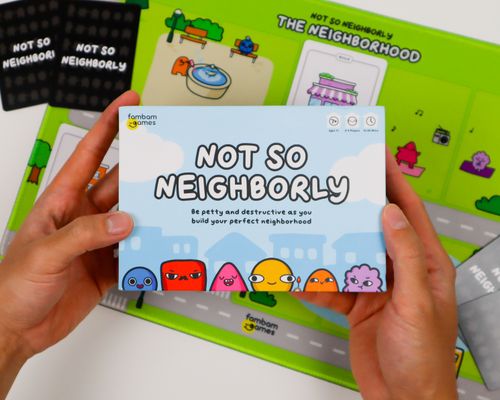
Not So Neighborly
Not So Neighborly Rulebook
Table of Contents
Table of Contents
Meet the Characters
- Dennis (Derpy, Destructive, Dangerous): Dennis is a pyromaniac and troublemaker who loves to destroy things whenever he can. He's always lurking around somewhere.
- Barry (Kind, Anxious, Nervous): Barry is always worrying about something or someone, especially Dennis. He's never had a relaxing day in his life.
- Grumf (Grumpy, Reserved, Strong): Grumf spends most of his time working out or building something. He may seem unapproachable but he's a softie on the inside.
- Kiki (Mischievous, Drama, Playful): Kiki is always up to no good. She loves pranking others and stirring up chaos. Kiki especially loves to pull pranks on Mabel.
- Mabel (Stubborn, Petty, Nosy): Mabel loves to be in other people's business. If someone wrongs her, she never forgets and plots her revenge. Don't get on her bad side.
- Libby (Silly, Light-hearted, Jolly): Libby is the life of the party. She loves to have fun wherever she goes. Libby is often seen skipping and humming around the neighborhood.
Contents
There are 64 cards and one rulebook.
How to Win
The objective of the game is to be the first to have your neighborhood reach a value of 10 points.
Setup
- Set aside the "It's Getting Serious" card.
- Shuffle the rest of the cards and deal five cards to each player.
(2-4 players, ages 7+, 15-20 minutes. The draw pile and discard pile are placed in the middle of the table.)
How to Play
- The person who suggested playing Not So Neighborly gets to go first.
- Each player can perform two actions from the following list during their turn. (Note: The two actions they choose to perform can be the same action.)
- Draw a card
- Each player can only hold up to 7 cards.
- If the draw pile runs out of cards, shuffle all of the discarded cards piles to form a new draw pile.
- Play a card
- More information about the cards can be found in the "Types of Cards" section.
- Draw a card
End of Game
- The game immediately ends when a player's neighborhood reaches 10 points in value.
- Check out the "Special Combos" section for more information about the various combinations that can get you more points.
Special Combos
- Community Bonus: if a neighborhood has a set of 1 park, 1 house, and 1 apartment, a set of these buildings will be worth 5 points together (instead of the normal 3). (Park, House and Apartment are each worth 1 point.)
- Safe Neighborhood Bonus: if a neighborhood has a set of 1 Fire Station and 1 Neighborhood Watch, a set of these cards will be worth 3 points together.
Types of Cards
Build (10 Types, 26 cards)
These cards are used to accrue points in order to win the game. These cards are vulnerable to attacks.
Attack (4 Types)
- Crime (3 cards): Place this card on top of a building in another player's neighborhood. This can include the 'Fire Station.' This building no longer has any abilities and does not count towards a neighborhood's value.
- Fire (3): Place this card on top of a building in another player's neighborhood. This can include the 'Neighborhood Watch.' This building no longer has any abilities and does not count towards a neighborhood's value.
- Demolish (2): Destroy and discard any one building. This cannot be stopped or undone.
- Petty Neighbor (2): Play this card when a player attacks you. You can destroy and discard any card in this player's neighborhood in revenge. If this player does not have any cards in their neighborhood, steal a card at random from their hand.
Protect (2 Types)
- Neighborhood Watch (3): This card protects the player's neighborhood from all 'Crime' cards. The neighborhood may still be attacked by 'Fire' and 'Demolish' cards.
- Fire Station (3): This card protects the player's neighborhood from all 'Fire' cards. The neighborhood may still be attacked by 'Crime' and 'Demolish' cards.
Action (6 Types)
- Discard (2): Choose any one player to discard two cards of their choice from their hand.
- Nosy Neighbor (3): Pick a card at random from another player's hand and add it to your own.
- Skip (2): Skip the next player's turn.
- Steal (2): Take a building from another player's neighborhood and add it to your own.
- Trade (2): Trade one building in our neighborhood with any building from another player's neighborhood.
Repair (1 Type)
- Fixer-Upper (2): Repair one of your attacked buildings by undoing a 'Crime' or a 'Fire' card. Once you repair a building, you gain back the points written on the card.