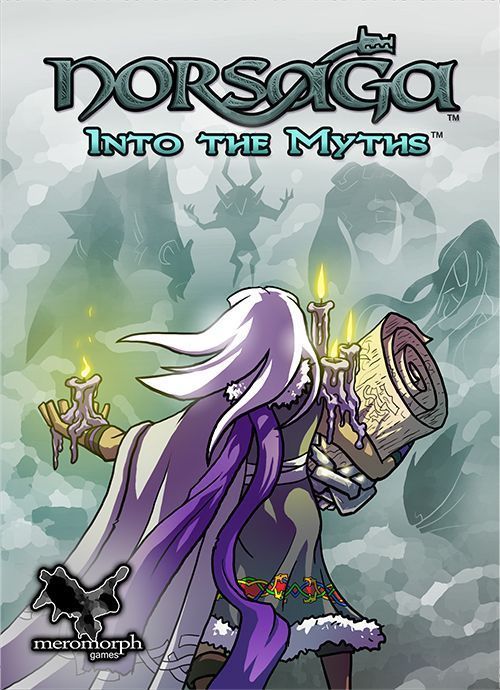
Norsaga: Into the Myths
Official rulebook: Meromorph Games · PDF
Norsaga: Into the Myths Rulebook
Table of Contents
Table of Contents
The Game
Norsaga: Into the Myths is an expansion for the card game Norsaga, which adds unique new heroes to the mix. Shuffle these new cards into the base game in various combinations for a fun new play experience that takes the strategy and storytelling of Norsaga to the next level!
The Components
- 16 basic hero cards
- 30 advanced cards
- 4 expansion summary cards
- 1 rule sheet
New Cards in Detail
Ghost Skalds & Fae Skalds: Otherworldly poets whose stories span life and death.
- The ghost skald obeys all rules for both ghosts and skalds, and is both black and purple.
- The fae skald obeys all rules for both fae and skalds, and is both teal and purple.
- When the fae skald lands on your tree, perform its fae swap ability first (if possible), then grant its skald embellishment.
Legends: Time-tested warriors who've seen it all, but quickly become set in their ways.
- Legends have recessive traits and a white Myth dominant trait.
- When a legend is played onto your family tree by any means, immediately place one inheritance marker into the white dominant trait. You cannot remove the marker until the legend leaves your family tree.
- Legends are always considered white. While not in play, they are also red, green, blue, and yellow. While in play with a marker on their dominant trait, they're white and that marker's color.
- If a legend becomes paired with another legend, remove a marker from one of their dominants and that legend becomes white exclusively until it leaves your family tree.
Apprentices: Students and heroes-in-training. Careful; they learn fast.
- When an apprentice is played onto your family tree by any means, you may immediately play a card from your hand.
- Apprentices have recessive traits, a grey Youth dominant trait, and a colored dominant trait fragment (fragments cannot receive inheritance markers).
- Apprentices have two colors: grey, and a basic color. There are no grey embellishments, but apprentices count towards embellishments of their second color.
Wanderers: Transient travelers who fit in anywhere, but won't stay for long.
- At the end of your turn, discard all wanderer cards from your hand.
- Wanderers have recessive Wander traits and a colored dominant trait fragment (fragments cannot receive inheritance markers).
- A wanderer paired with any red, green, blue, or yellow recessive trait will form a match. Wanderers cannot form matched recessives with other wanderers.
Fae: Magical creatures lurking beyond the world, who corrupt and mingle with mortal ancestors.
- Like ghosts, fae can be played onto any position of any player's family tree.
- Fae grant access to teal Lost embellishments. They have no recessive traits and their dominant trait cannot receive inheritance markers.
- When a fae is played onto your family tree by any means, immediately swap the position of that fae with another hero on your family tree from a different generation, if possible.
Additional Basic Heroes: Familiar classes, new faces.
- One new hero from each of the 16 basic classes is included in this expansion. These heroes function identical to their counterparts in the base game.
- These heroes are used to expand the game for more players, or adjust the ratio of advanced hero cards in the deck.
Expanding the Game
You can add some or all of the new cards into your Norsaga game. It is recommended that you try to balance the number of colored cards against the number of attack cards (fae and ghosts). A good rule of thumb is that 1/6th of the cards in the deck should be attack cards.
- Want something simple? Swap the base game's ghosts out for fae.
- For a light variation, add legends or apprentices to the base game.
- For a complex challenge, add legends, apprentices, wanderers, and fae to the base game.
- For a full 2-6 player game, combine all of the cards from Norsaga and Into the Myths.
Cards from Into the Myths are marked with a candle icon.
Embellishments in Detail
Fae heroes introduce a new tree of embellishments.
Lost (teal)
Changeling (1st generation): You may dismiss a hero from your family tree. Choose a player. They must place a card from their hand onto an empty spot on your tree, if able.
- You don't have to dismiss a hero.
- You can't dismiss more than one hero.
- If you have no empty spots on your family tree, the player can't play a card.
- If you choose a player with no cards in hand, they can't play one onto your tree.
Omen (2nd generation): Dismiss a hero from your family tree. Draw a fae card from the discard pile or deck, then shuffle the deck if you searched it.
- If there are no fae cards in the discard pile or deck, you don't get to draw one.
Awakening (3rd generation): Reveal from the deck until you reveal 3 cards that share a color. Play those 3, in order, atop your fae heroes from youngest to oldest. Discard the other revealed cards.
- The new cards are played on top of your existing fae heroes, which causes the fae heroes to be dismissed.
- If you have more than 3 fae on your family tree, choose one from each generation and play atop those in order.
- If the deck runs out of cards, shuffle the discard pile and keep going.
- If you don't find 3 heroes of the same color, nothing happens.
Frequently Asked Questions
Q: If an embellishment puts an apprentice onto my tree, when do I play a card?
A: Queue up the apprentice's Youth ability and resolve it after all other queued abilities.
Q: When a fae is played onto my tree, do I have to swap it with another card?
A: Yes, if you have any heroes in a different generation than the fae (e.g. youngest, parents, grandparents), you must swap the fae and one of those other heroes.
Q: How do the dominant trait fragments work?
A: A hero with a dominant trait fragment is considered to be that color when using embellishments, but the fragment cannot accept an inheritance marker the way a basic dominant trait would.