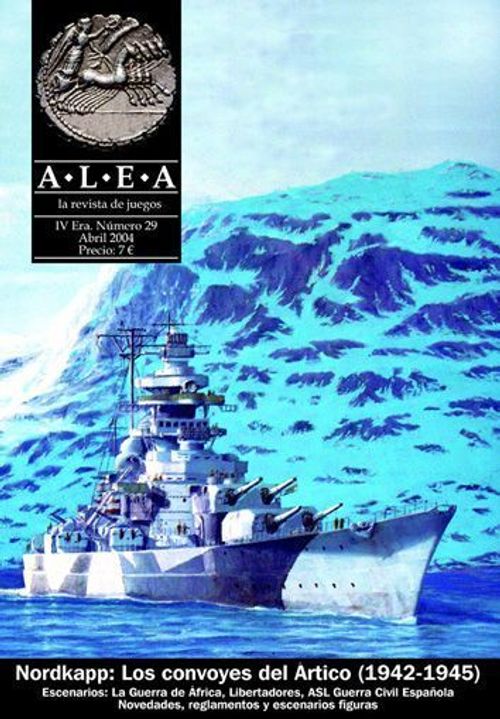
Nordkapp: Los Convoyes del Artico (1942-1945)
Nordkapp: Los Convoyes del Artico (1942-1945) Rulebook
Table of Contents
Table of Contents
- Abbreviations
- Game Components
- 1. The Map
- 2. Units
- 3. Game Scale
- 4. Sequence of Play
- 5. Movement
- 6. Reconnaissance
- 7. Submarines
- 8. Surface Combat
- 9. Air Units
- 10. Markers
- 11. Winning
- 12. Optional Rules
- 13. Scenarios
- 13.1 "Unternehmen Sportspalast" The First Combat Sortie of the Tirpitz, March 1942
- 13.2 Enter the Luftwaffe
- 13.3 "Convoy is to scatter" The slaughter of convoy PQ-17, July 1942
- 13.4 Arctic Convoy: The Battle for Convoy PQ.18, September 1942
- 13.5 "To the Sound of the Guns" The Battle of the Barents Sea, December 1942
- 13.6 "Admiralty appreciates that Scharnhorst is now at sea" The Battle of the North Cape, 15 December 1943
- 13.7 "It looks remarkably like one of ours." The battle of Convoy PQ-13, March 1942
- 13.7 (second scenario in the source) "The German Destroyers Intervene" The Battle of QP 11, April-May 1942
- Play Aid Tables
Abbreviations
- AA: Anti Aircraft
- ASW: Anti Submarine Warfare.
- CAP: Combat Air Patrol. Air units in escort mission, either ASW or AA.
- Recon: Reconnaissance.
- Un/s.: Unit/s.
- CV: Aircraft Carrier.
- BB: Battleship.
- BC: Battlecruiser.
- CA: Cruiser.
- DD: 1 or 2 Destroyers.
- Sub: Submarine.
- Merc: Merchant.
- E: 2 o 3 minor escorts (corvettes, armed trawlers)
- 1D6: 1 six-sided die.
- 1D10: 1 10-sided die.
- W, E, N, S: West, East, North, South.
Game Components
Nordkapp includes 2 DIN A3 maps and some 240 units and markers. Players will need one D6 and one D10 (not included with the game) to resolve certain game functions.
1. The Map
The two maps show the area of the Arctic Ocean North of Norway and Russia where the battles were fought, roughly between the latitudes of Tromso and Murmansk.
Polar Ice. The white lines printed on the map show the limit of the polar ice pack in several different seasons of the year. The instructions for each scenario specify the exact limit of the ice pack. Ships are not allowed to navigate north of the polar ice limit specified for the scenarios. Also, to navigate within two hexes of the polar ice is possible but risky because of the danger due to collision with growlers and icebergs (see the special rules).
2. Units
Combat units in Nordkapp represent individual ships (BBs, BCs, CVs, CAs, submarines, merchants), groups of 2-3 destroyers or minor escorts such as frigates, corvettes, armed trawlers, etc) and aircraft squadrons of 20-25 planes.
3. Game Scale
Each game turn represents 8 hours. Each hex represents 40 km (some 22 Nautical miles).
4. Sequence of Play
Each scenario of Nordkapp is further subdivided in a series of turns. Players must carry out each function of the game in a strict order.
4 A. Initial Deployment of Pre-Turn Phase.
- a.1. Determine Sea State. One of the players rolls 1D6 and consults the Weather Table. The "Weather" marker must be placed in the corresponding box (Fair, Bad, Fog, Storm) of the Weather Track.
- a.2. Air Mission Determination. Both sides assign secretly gives recon missions to recon planes to one or more hexes. Both players assign CAP missions to one more aircraft units.
4 B. Movement Phase. Both players move secretly the map hex where each naval unit must move.
4 C. Recon Phase. Both players (the German First) announce the hexes they want to recon. Both players announce if the enemy has sighted naval units.
4 D. Submarine Attack Phase
- d.1. Germans. The German subs located in the same hex as a convoy can try to infiltrate inside the convoy and attack the enemy merchants. German subs located in hexes of merchants navigating alone and/or combat surface units not navigating under a "convoy" marker may attack these units without rolling first for infiltration.
- d.2. Allies. Allied subs may attack enemy units located in their hex.
4 E. Surface Combat Phase (Mutual). Surface units of both sides located in the same hex may engage in surface combat.
4 F. Air Raid Phase. Both sides (the German player first) may launch air raids.
4 G. End of Turn. Roll for possible contact loss (see rule 7.2. Shadowing). Move the turn marker 1 space in the Turn Record Track and start another game turn. Air units in the Not Available box are placed in the Available box. Air units which flew missions during this turn are placed in the Not Available box of their Air bases. If it is the last turn, examine victory conditions and determine who wins the scenario.
Note: the printed text refers to "rule 7.2. Shadowing" here and in 5.1. The shadowing rule is numbered 7.4 in this text (7.2 is Operating Surfaced/submerged). Kept as printed.
5. Movement
5.1 Ship Movement. During Phase B of the Sequence of Play, both players move secretly their naval units on the map (exception: see 7.2. Shadowing). The Movement Table shows the maximum number of hexes that each unit may move each turn.
5.2 Convoy Movement. A one-merchant unit may not abandon a convoy unless because of a storm (see 12.4) or because it is damaged and "left behind" The speed of one damaged merchant is 1 hex per turn and the speed of a convoy is 2 hexes per turn.
6. Reconnaissance
6.1 Air Reconnaissance. During the Recon Phase, both players may assign (secretly) air units of the AT or R types to fly recon missions to hexes within its operational range. That is, if the range of one air unit is 16 hexes, this unit may perform recon of hexes placed within 16 hexes of its base/CV. Attack units (AT) may be assigned to recon units, but no more than 2 such units per turn. If weather is "fair" a single recon air unit may recon up to TWO adjacent hexes per turn.
Procedure. Each player announces in what hexes they will perform recon. If there is an enemy unit in that hex, the enemy player must announce it.
If there is one or more merchant (up to nine), the Allied player must say that in this hex there are "merchants". The German player will place a "Enemy Merchants sighted" marker in its map.
If there are 10 or more merchants in this hex, the Allied player must say "Convoy sighted" and the German player may place a "Convoy Sighted" marker in its map.
If there are only surface combatants in the hex, the Allied player must say "surface units" and the German player may place a "Surface units sighted" in its map. The same procedure is used if the Allies sight German surface ships. If the Allies sight a German submarine, the Allied player may use a "Submarine Sighting" marker.
Example. The German player has two BV 138 recon units available. He assigns one to hex 1305 and another unit to hex 1605. If there are enemy naval units in those hexes, the Allied player must announce it during phase C of the Sequence of Play. If weather if "fair" the unit in 1305 can explore hexes 1305 and any other adjacent hex, for instance hex 1304.
Note: the official Ludopress Alea #29 text of this procedure reads "the German player must say that in this hex there are 'merchants'" and "the Allied player will place" the marker, the reverse of the sides given here. Kept as the community translation prints it.
6.2 Naval Recon. Surface and submarine units may perform recon of the hexes they are in, although it is not mandatory. Both players (German player first) announce in what hexes they are going to perform naval recon. If there are enemy units in the hex, the enemy player must announce it, using the same procedure used for air recon.
6.3 The Norwegian Coast. If an Allied, non-submarine naval unit enters a hex that includes part of the Norwegian coast, the Allied player must announce immediately to the enemy player. The Allied player must specify the number and type of ships and the hex they are in.
7. Submarines
7.1. Submarine Attack
7.1.1. Infiltration. During the Submarine Attack Phase, the subs which try to attack enemy naval units placed in the same hex and that include at least one unit with ASW capability must try first to infiltrate. Both the subs trying to infiltrate and the Allied ships are placed within sight of both players in the Combat Box. The infiltrating player rolls 1D6, applies die roll modifiers and consults the Infiltration Table. If there are more than one sub trying to infiltrate, roll 1D6 for each sub trying to infiltrate.
7.1.2. Attack. The subs that manage to infiltrate the convoy may attack to surface units and/or merchants inside the convoy.
7.1.3. Escort Reaction. Roll 1D6 if in the hex under attack there are units with ASW capability. Consult the ASW Table and apply any results.
7.2. Operating Surfaced/submerged. Before moving, and also before trying to infiltrate a convoy, the subs may choose between operating on the surface or submerged. Place a "submerged submarine" marker over the submarines moving and/or infiltrating while submerged, otherwise the submarine is considered to be surfaced.
7.3. Event Chits. At the beginning of each scenario, each side will place the Events chits specified by the scenario instructions in an opaque container (one for the Allies, one for the Germans).
Every time a German submarine tries to infiltrate a convoy or attack surface units with ASW escort, both players must pick one Event Chit from its container. These Event Chits may be used during the infiltration, submarine attack, or ASW reaction phases. Each player will keep the obtained chits hidden and will reveal them only in the indicated moment by the chit's instructions (See Events Table). Once the infiltration attempt and/or the submarine attack are resolved, the Event Chits used by the players are returned to their respective containers before moving on to another infiltration and/or submarine attack.
For completeness, and to include descriptions of the event chits added in Alea #30, the event chits are described here as well as on the Events Table.
Allied Chits
- Smoke Screen: +1 to submarine attack die rolls
- Convoy Bearing Change: -1 to submarine attack die rolls.
- Escort Coordination: -1 to Infiltration Attempt die rolls.
- Victoria Cross: -2 to ASW Damage Control die rolls.
- Flares (i.e., star shells): -1 die roll modification to ASW table rolls if the attack is a night surface attack.
- Creeping Attack: -2 die roll modification to ASW table rolls; -1 to the submarine attack die roll.
- No Effect: no effect.
Errata (Ludopress Alea #29 and #30 errata): the Creeping Attack effect is -1 to Allied ASW Table die rolls. The description published in Alea #29 is correct; the Alea #30 description printed above is not.
German Chits
- Ritterkreuz: +2 die roll modifier on the submarine attack die roll.
- Gulf Stream: +2 die roll modifier on the ASW table die roll
- ASDIC/RADAR failure: -1 die roll modifier on the ASW table die roll, +2 on the Infiltration Attempt die roll
- Bold: +2 die roll modifier on the ASW Table
- F.A.T. Torpedo: A submarine using a FAT torpedo does not need to roll on the Infiltration Table, but cannot choose the target at which it shoots. Its firing factor is always considered to be 4, with a modifier of +1, even if the printed factor is greater. If a hit is obtained, choose the target at random from among the attacked ships. The Allied player may do ASW against the FAT firing submarine only if the FAT torpedo hits a target.
- Effects of the T-5 Zäukonig Acoustic Torpedo: -1 drm on the Submarine Attack Table.
- The Creeping Attack causes a -1 die roll modification to ASW table rolls.
- No Effect: no effect.
7.4. Shadowing. After solving the infiltration, attack, and ASW reaction phases, the German player rolls 1D6 for each sub which is in the same hex as other enemy units and didn't try to infiltrate or attack during the last turn. The sub "maintains contact" with the enemy on a roll of 4, 5 or 6. If the sea state is "fog" there is a -1 drm, -2 if sea state is bad or stormy. If the German player "maintains contact" with the enemy, the Allied player must tell the German to what hex he will move these ships during the next turn. If the units move to different hexes, the Allied player must tell the German only one of those hexes.
8. Surface Combat
During the Surface Combat Phase, the surface units of both sides may attack other enemy surface units in the same hex.
8.1 Surface Combat Procedure. Follow the steps listed below to resolve surface combat between opposing ships.
- Put the Allied surface units in the "Long distance" box of the Surface Combat Box, and the German units in the "Long Distance" box of the Surface Combat Box.
- First Combat Round. Each ship chooses one target. Each player rolls 1D10 for each firing ship and compares the result with the Firing Table. Results are applied simultaneously.
- After solving the first combat round, each player notes secretly what maneuver will be done for the next combat round: close with the enemy, disengage, or flee.
- If none of the players manages to flee, resolve subsequent combat rounds until one of the players disengages or one of the players losses all of his ships.
8.2 Firing Ranges. Only BB and BC type units may fire from the Long Range box. From Medium Range only BC, BB and CA type units may fire. From Short Range only BB, BC, CA and DD type units may fire (DD type units may use only their gunnery factor). From Torpedo Range all units types may fire as well as DDs using their torpedo factor.
BB or BC units firing from Long Range have a -2 drm, and a -1 drm if firing from Medium Range. CA type units have a -1 drm if firing from Medium Range.
8.3 Maneuvers. The following manuevers govern movement during surface combat.
- 8.3.1 Close: units moving closer to the enemy move to the box closer to the enemy (units in long distance box move to medium distance box, and so on).
- 8.3.2 Disengage: Units move to the box farthest from the enemy. That is, units in the medium distance box move to the long distance box, and so on.
- 8.3.3 Flight. The side trying to flee rolls 1D6. Add +1 to the die roll if all units trying to disengage have a movement factor of 1. -1 drm if there are merchants among the units trying to flee. On a die roll of 4 to 6 this side manages to disengage and surface combat ends. Add +1 drm if there is "fog" or "bad" weather.
Units may try to disengage from any box of the Surface Combat Box. Units trying to flee from the Torpedo or short distance boxes have an additional -1 drm.
9. Air Units
Both sides have air units of three types: recon, attack (bombers and torpedo bombers) and fighters. Air units may perform several different missions. Air units may not fly missions on stormy weather turns. They may only fly during day turns.
9.1 Air Search Missions. Air units with recon capability (R and AT type units) may be assigned to search hexes during the Air Recon Phase.
9.1.1 Air Shadowing. One Recon unit of the Fw 200 or Bv 138 type may "shadow" a convoy just like a submarine. During the End of Turn Phase, roll 1D6 for each Fw 200 or Bv 138 which has sighted a convoy or a group of enemy ships. On a die roll of 4-6, the Allied player must tell to what hex is going to move this group of ships during the following movement phase.
Die Roll Modifiers: -1 if weather is fog, -2 if it is bad/stormy.
9.2 CAP Missions. Air units with ASW capability and Fighter units ("C") may be assigned to patrol hexes with friendly ships and/or bases. They must remain with these ships, accompanying the escorted units during all the turn.
9.3 Attack Missions. Aircraft can perform a number of missions, limited by aircraft type.
9.3.1 Air Attack/AA Fire. During the Air Attack Phase, the "available" air units of both sides (German first, Allied second) may attack units within its range. Each air units have a range expressed in hexes.
Example. A He111 unit has a range of 12 hexes (counting the target hex). Therefore, the unit can only attack hexes within 12 hexes of its base.
9.3.2 Air Attack Resolution. Both players must place its air units and the attacked naval units in the Combat Box.
- a) Fighter Defensive Fire. If there are fighter units flying CAP missions over the attacked hex, the fighters may fire against the attacking planes. Procedure: roll 1d10 for each defending fighter and check the Fire Table. Apply any results before passing to the following sub phase.
- b) Anti-Aircraft (AA) Fire. Naval units under attack may fire against the attacking planes. Roll 1d10 for each unit with AA capability and compare the result with the AA factor of the firing unit. Apply results of the Fire Table before passing to the following sub phase.
- c) Anti-Ship (AS) Attack. Attacking air units which survived AA and fighter fire may attack enemy ships. Procedure: each attacking air unit may choose a target and rolls 1d10. Compare the Anti Ship factor of the attacking plane with the die roll. Apply any results. Results are expressed as Damage Points, see the Fire Table.
9.4 German Air Bases. German Air bases have an intrinsic AA factor of 6.
9.5 AA Artillery of Merchants in Convoy. For every 5 merchants navigating under a Convoy marker, the Allied player may roll 1d10 as if there were a 2-AA factor naval unit. Fractions below 5 are ignored (That is, if in a convoy there are 23 merchants, the Allied player may fire 4 x D10 (5x4=20). The three remaining merchants are ignored.
AA ships count as surface combatants when firing against enemy aircraft.
10. Markers
A number of marker units are used to record unit status and game events.
10.1 Force Markers. At the beginning of each scenario, players have available several Force Markers. To avoid unmanageable stacks on map, players may move on map the Force marker while the ships forming this force are placed in the box corresponding to that force.
10.2 Convoy Markers. Convoy markers are considered force markers.
Merchant ships attached to a convoy marker per scenario instructions must remain with the convoy unless:
- It is damaged and becomes a straggler (they can't keep with the rest of the ships), or
- It is scattered by a storm, or
- The "convoy is to scatter" order is received from the Admiralty (see PQ-17 scenario rules).
Escorts attached to a convoy (E, DD, CA type units) may leave and rejoin the convoy freely.
10.3 Damage Markers. Any one surface/air/merchant or submarine unit receiving a damage marker have its movement and combat/fire factors halved. Round down remainders (Example: 5/2=2.5, rounded down to 2).
10.4 Armor Protection. The Armor factor of some surface units indicates the number of "hits" or Damage Points that this ship may endure before sinking. One surface unit which has received one or more Damage Points has its movement and fire factors halved. Any subsequent hits received do not decrease further its combat/movement factors.
All naval and air units have a default armor factor of 2. Naval units (BB, BC for the most part) with a higher armor factor have it indicated in the upper left side of the counter.
11. Winning
Victory conditions are defined in each scenario instructions. In general, both players add Victory Points (VP) for sinking or damaging enemy ships.
11.1 German VP.
- 1 VP for each merchant sunk from a PQ convoy.
- ½ VP for each merchant sunk from a QP convoy, or for each Damage Point inflicted on a submarine, CA, DD or E type naval unit.
- 2 VP for each Damage Point inflicted on each Allied CV, BB or BC.
11.2 Allied VP.
- 1 VP for every German U-boat sunk.
- 3 VP for each German BB, BC or CA sunk.
- ½ VP for each damage point inflicted on a German BB, BC or CA or U-boat.
- 2 VP for every German DD unit sunk.
12. Optional Rules
The following rules are to increase the historical realism of the game as well as to aid in play balance between opponents of differing abilities.
12.1. Aces. In certain scenarios the German player must place under one of its submarines an "Ace" counter. (Aces are just that, submarine commanders that were outstanding in the amount of shipping they and their crews sank). The Ace counter must remain with the same submarine for the entire scenario.
12.1.1 Effects of Aces. A submarine stacking with an ace counter may choose two Event chits instead of one before trying to infiltrate a convoy.
12.2. Arctic Ice Pack (Growlers). At the end of the Movement Phase, the Allied player must roll 1D6 every time that one convoy marker moves adjacent to one hex within two hexes of the Ice Pack. On a die roll of 1-3, nothing happens. On a die roll of 4-5, one merchant is damaged. On a die roll of 6, two merchants are damaged. (Choose the damaged merchants at random).
12.3. HF/DF Detection. During the Recon Phase, the Allied player may use the HF/DF to detect enemy subs. The Allied player rolls 1D6. On a die roll of 4-5, the German player must reveal the position (hex placement) of one of its subs. On a die roll of 6, it must reveal the position of two of its submarines. The German player will decide randomly which of its subs (die roll, flip a coin, etc) is detected.
12.3.1 Opportunity Attack. If there is any one air or surface unit with ASW capability within two hexes or less of the detected sub, the unit may move to that hex and launch an attack using the ASW Table. The unit (or units) must return to its original hex after solving the ASW Attack. Subs navigating submerged during the Movement Phase may not suffer opportunity attack.
12.4. Storms. If sea state is "stormy", roll 1D6 for each convoy unit before moving. Consult the Convoy Dispersion Table and apply results.
12.5. Convoy Reorganization. If one or more merchants became "stragglers" and were separated from its convoy, during the following turn these ships may re-enter the convoy hex but during this turn' movement phase the convoy marker will be able to move only 1 hex instead of 2.
12.6. Surface combat event chits. ALL the Surface Combat Event Chits (SCEC) are placed in a SINGLE opaque container.
At the beginning of each surface battle, after placing their ships in Surface Combat Box but before solving firings, both sides (the German first) randomly draw a Surface Combat Event Chit.
In case that there is more than one combat during Phase E (Surface Combat), these are resolved one by one, and deciding the outcome of each battle the event chits are returned to the container so that it is always full at the beginning of each combat.
The results of the SCECs must be implemented as called for in the descriptions below, usually during the first round of combat or when the player who has drawn the chit wishes (for example, the "radar tracking" chit can be used when a player tries to finalize a combat). It is obligatory to use the FECS. (Sic: the source writes "FECS" here; the chits are named SCEC above.)
Use of the FECS.
- Surprise Sighting. The first round of combat happens at shorter range, according to weather: short range in bad weather or storm, medium range in fog. Also, the first round is not simultaneous: the side with the chit shoots first and any resulting damage is applied immediately, after which the other side shoots and resulting damage is applied.
- Friendly Weapon Malfunction. During the first combat round, the gun factor of one of the ships on the side that drew this chit is reduced to half. Round fractions downward. If there is more than one ship, choose at random.
- Enemy Weapon Malfunction. This chit can be used during any round. The gunnery factor of an enemy ship is reduced to half. Round fractions downward. If there is more than one ship, choose at random.
- Erratic Torpedoes. When the enemy announces that he is going to shoot torpedoes from one of his ships, roll 1D6. With a result of 6, the torpedoes shot by the enemy hit one of his own vessels. If there is more than one ship, choose at random.
- Ice Accumulation. Subtract 1 from each die roll (including Flight) of one of the affected ships. The player who drew this chit chooses at random which of his vessels undergoes the effect.
- Radar Warning. This chit negates "Surprise Sighting". This chit only can be used by the British/American player. If it is is drawn by the Soviet or German player, treat is as "No Effect."
- Radar Shadowing. The enemy player must indicate the hex to which he is moving in Flight from combat. This chit only can be used by the British/American player. If it is is drawn by the Soviet or German player, treat is as "No Effect."
- Lucky Hit. Adds a damage point to the result of the firing of any of one's own ships. This chit can be used only once per combat, and its use must be announced before the die is rolled.
- No Effect: no effect.
Original chit count, as printed by the designer: 2x Surprise Sighting, 3x Friendly Weapon Malfunction, 2x Enemy Weapon Malfunction, 2x Erratic Torpedoes, 3x Icing, 2x Radar Warning, Radar Shadowing, 2x Lucky hit, 2x No Effect.
13. Scenarios
13.1 "Unternehmen Sportspalast" The First Combat Sortie of the Tirpitz, March 1942
Operation Sportspalast was the first serious attempt by the Germans at intercepting an Arctic convoy. Having received information that a Murmansk-bound convoy had been sighted, the German High Command ordered the Tirpitz to intercept it. The battleship left Trondheim on March 6th escorted by 3 destroyers. The final results of the battle were indecisive: the Germans sank a single merchant, the Soviet Izhora, while British torpedo bombers let the Tirpitz escape unharmed.
Scenario Length. 15 turns (5 days, from the 0000-0800 turn of 6/03/42 to the 1600-2400 turn of 10/03/42).
Initial Deployment.
Allied Player.
- Convoy 1 (PQ.12) 15 merchants, 1 DD, 1 E, 1 CA. Enters on turn 00-08 h. of day 1 at any of the following hexes 1501-2601. Convoy 1 will exit the map at hexes 1020 to 1015 before the end of the scenario. If the convoy is still in the map at the end of the scenario the German players gets an automatic operational victory.
- Convoy 2 (QP.8) 15 merchants and 2 E. Local Escort East: 1 Soviet DD) enter on turn 00-08 h. of day 1 across any of the following hexes: 1020-1018. They must exit the map across hexes 1501 to 2601 before the end of the scenario. If the convoy is still in the map at the end of the scenario the German players gets an automatic operational victory.
- Home Fleet. 2 BB (King George V, Duke of York), 1 BC (Renown), 1 CV (Victorious with 2 x AT, 1 x Cz Fulmar), 2 CA, 5 DD, enters on turn 1 across any hex between hex columns 21XX to 26XX.
- 2 British subs in any sea hex of the map.
German Player.
- 1 BB (Tirpitz) and 2 DDs. These ships enter the map at any hex of the southern limit of the map at 1001 to 1005 one turn after either of the convoys is detected.
- 4 U-boats randomly selected in any sea hex West of XX08. (historically, the boats deployed were the U-134, U-377, U-403 and U-584).
- 1 He 115 in any Norwegian airbase.
Victory Conditions. Both players add their VP and then subtract the Allied total from the German total.
- +6 or more German VPs: German operational victory.
- +2 to +5 German VP: German tactical victory.
- +1 to +0 German VP: Allied tactical victory.
- +1 to +3 VP Allied: Allied victory.
Allied Event Chits. 2 x Smoke screen, 1 x Victoria Cross, 1 x Escort coordination, 2 x Flares, 2 x Convoy Bearing Change, 2 x No Effect.
German Event Chits. 1 x No Effect, 1x Ritterkreuz, 2 x Radar failure, 2 x Gulf Stream.
Scenario Rules.
- Local Escort East may not move West of hex-row XX14 (30º W).
- Players use the winter ice pack limit line.
- The 0900-1700 turn of each day is considered a daylight one, all the rest of the turns are night.
- The Allied player may perform up to three air search missions in hexes west of the XX08 hex-row.
- Special rule 12.3.1 (Opportunity Attack) may not be used.
Cruiser Notes. With PQ 12, HMS Kenya. The Home Fleet force really only had one cruiser, HMS Berwick; the other cruiser is HMS Nigeria, with the Home Fleet for game purposes but in actuality separated from QP 8, by having left a day late. (Kemp, page 30.) It might be reasonable to let the Allied player made a die roll by which Nigeria could be part of QP 8.
Historical U-boats, skippers, and months of experience as of this scenario
| DF Roll | Boat | Commanding Officer | Months |
|---|---|---|---|
| 1 | U-134 | Rudolf Schendel | 5 |
| 2 | U-377 | Otto Köhler | 1 |
| 3 | U-403 | Heinz-Ehlert Clausen | 1 |
| 4 | U-584 | Joachim Deecke | 5 |
All of these were Type VIIcs. DF rolls are done with a D4 in this scenario.
13.2 Enter the Luftwaffe
The Battle for Convoy PQ.16, May 1942.
The battle for PQ-16 was perhaps the greatest success of the Luftwaffe against the Arctic convoys. Between the 25 and 27 May, the Ju 88s and He 111s of Geschwaders 26 and 30 managed to sink 7 merchant ships and damaged another three.
Scenario Length. 18 turns (6 days, from 00-08 hours of 25 May 1942 to turn 16-24 hours of 30 May 1942).
Initial Deployment.
Allied Player.
- Convoy 1 (PQ.16) 35 merchants, 1 AA ship, 4 DD, 2 E, enters on turn 1 at any hexes of the W limit of the map north of 1301. Convoy PQ.16 must exit the map at the Southern edge of the map between 1020 and 1018 before the end of turn 18. If the convoy is still in the map at the end of the scenario the German players gets an automatic operational victory.
- Cruiser Force. 4 CA.
- Battle Fleet. 2 BB (Washington, Duke of York), 1 CV (Victorious, with 2 AT, 1 Cz), 2 CA (1 Brit., 1 US), 5 DD Brit., 2 DD US. The Battle Fleet enters at any hex of the Western map edge located North of hex-row 23XX.
- Convoy 2 (QP.12), 17 merchant ships, 3 DD, 1 AA, 2 E, and Local Escort East (2 DD Soviet, 1 E) enter on turn 1 between 1020 and 1017. Convoy QP.12 must exit the map at the Western edge of the map between hexes 1501 to 2601 before the end of the scenario. If the convoy is still in the map at the end of the scenario the German players gets an automatic operational victory.
- 5 British subs in any sea map hex West of XX05.
- 3 Soviet subs East of hex 1210.
German Player.
- 6 U-boats in any sea hex East of XX05 (choose them at random: historically, the boats deployed for this battle were the U-703, U-436, U-591, U-251, U-377 and U-586). All were Type VIIc's.
- In the Norwegian air bases (maximum of 3 units/base): 2 Bv 138, 4 Ju88, 3 He 111, 1 He 115, 1 Ju87, 1 Fw 200, 2 Me109.
- 2 BC (Scheer, Lutzow) and 1 DD. These units may enter at the southern edge of the map between hexes 1001 y 1005 one turn after one of the convoys had been sighted.
Victory Conditions. Both players add their VP and then subtract the Allied total from the German total.
- +24 or more German VPs: German operational victory.
- +23 to +10 German VP: German tactical victory.
- +9 to +0 German VP: Allied tactical victory.
- +1 to +10 VP Allied: Allied victory.
Allied Event Chits. 2 x Smoke screen, 1 x Victoria Cross, 1 x Escort coordination, 1 x Flares, 2 x Convoy Bearing Change, 2 x No Effect.
German Event Chits. 2 x No Effect, 1x Ritterkreuz, 1 x Radar/ Asdic failure, 2 x Gulf Stream.
Scenario Rules.
- The Local Escort East may not move West of the XX14 hex row (30º W).
- The Cruiser Force may not move East of the XX10 hex-row.
- All turns are considered daylight turns.
- The ice pack limit is considered to be 2 hexes south of the summer ice pack limit.
- The Allied player may perform up to three air searches in hexes west of XX08.
- Special rule 12.3.1 (Opportunity Attack) may not be used.
Cruiser Notes. The Cruiser Force is Kent, Liverpool, Nigeria, and Norfolk. The cruisers with the Battle Fleet are HMS London and USS Wichita.
Historical U-boats, skippers, and months of experience as of this scenario
| DF Roll | Boat | Commanding Officer | Months |
|---|---|---|---|
| 1 | U-703 | Heinz Bielfeld | 2 |
| 2 | U-436 | Günther Seibecke | 3 |
| 3 | U-591 | Hans-Jürgen Zetzsche | 5 |
| 4 | U-251 | Heinrich Timm | 2 |
| 5 | U-377 | Otto Köhler | 4 |
| 6 | U-586 | Dietrich von der Esch | 5 |
All of these were Type VIIcs. DF rolls are done using a D6 in this scenario.
13.3 "Convoy is to scatter" The slaughter of convoy PQ-17, July 1942
The Soviet Union seemed on the verge of collapse during the summer of 1942. The need to send help required sending a convoy in the midst of the Arctic summer, with 24 hours of daylight. The menace of the Tirpitz coming out compelled the Admiralty to scatter the convoy, leaving them at the mercy of the U-boats and the Luftwaffe. 24 merchants were lost, and the convoys were suspended, at least until the end of the midnight sun season.
Scenario Length. 21 turns (8 days, from turn 00-08 hours of 2 July 1942 to turn 16-24 hours of 9 July 42).
Initial Deployment.
Allied Player.
- Convoy 1 (PQ.17) 35 merchants, 2 E, 3 DD, 2 sub, 2 AA) enters on turn 1 at any western map edge hex north of the 15XX hex-row. It must leave the map at the southern map edge before the end of turn 21 between hexes 1020 and 1018. If the convoy is still in the map at the end of the scenario the German players gets an automatic operational victory.
- Cruiser Force: 2 CA US, 2 CA British, 1 DD US, 1 DD British, enter at any western edge map hex within 4 or less hexes of the entry hex of convoy 1 (PQ 17).
- Battle Fleet: 2 BB (Duke of York, USS Washington), 1 CV (Victorious, with 2 xAT, 1 Cz), 2 CA, 7 DD. Enters on turn 4 at any western edge map hex.
- Convoy 2 (QP.13). 35 merchants, 3 DD, 1 AA, 3 E) enter on turn 1 between hexes 1020 and 1017. They must leave the map at any western edge map hex before the end of turn 21. If the convoy is still in the map at the end of the scenario the German players gets an automatic operational victory.
- 3 British subs. In any hex West of XX05 hex-row.
- 2 Soviet subs E of 1210.
German Player.
- 11 U-boats chosen randomly in hexes East of XX05. (Historically, the boats deployed were the U-88, U-255, U-456, U-703, U-408, U-334, U-457, U-657, U-251, U-376 and U-355). One of the U-Boats (U-255) must stack with an "ace" counter if optional rule 12.1 is used.
- In any of the Norwegian air bases (maximum of 3 units per base): 2 Bv 138, 4 Ju88, 4 He 111, 1 He 115, 1 Ju87, 1 Fw 200.
Victory Conditions. Both players add their VP and then subtract the Allied total from the German total.
-
- 25 or more German VPs: German operational victory.
- +24 to +15 German VP: German tactical victory.
- +14 to +0 German VP: Allied tactical victory.
- +1 VP Allied: Allied operational victory.
Allied Event Chits. 2 x Smoke screen, 1 x Victoria Cross, 1 x Escort coordination, 1 x Flares, 2 x Convoy Bearing Change, 2 x No Effect
German Events Chits. 2 x No Effect, 1x Ritterkreuz, 2 x Radar/ Asdic failure, 2 x Gulf Stream.
Scenario Rules.
- All turn are treated as daylight turns.
- Use the summer ice pack limit.
- The Cruiser Force may not move East of XX10 hex-row.
- The Allied player may perform up to three air searches in hexes west of XX08.
- Special rule 12.3.1 (Opportunity Attack) may not be used.
Operation Rosselsprung. Three turns after the detection of any one of the Allied convoys, the German player may enter the following units at the southern map edge hexes between 1001 and 1005: BB Tirpitz, BC Lutzow, CA Hipper y 2 DD.
Example: On turn 09-17h. of day 2 an Allied convoy is sighted. The German ships may enter during the movement phase of turn 09-1700 hours of day 4 of during the movement phase of any later turn.
"Convoy is to Scatter". If the Allied player detects one or more German ships of CA, BC or BB type within 7 or less hexes of a convoy marker, he rolls 1d6. On a die roll of 1 to 5, the Admiralty orders the convoy to scatter.
Effects. During the following movement phase, all the merchants forming this convoy must be placed on the map. Before moving each of the merchant units forming this convoy, the Allied player rolls 1d6 and consults the Storm Scatter Diagram to determine the bearing of the ship. The bearing of each ship must be determined ship by ship. It is forbidden to form a convoy again. During the movement phases of subsequent turns, all merchants must move at maximum possible speed to the southern map edge (between hexes 1020 and 1018) and exit the map.
The Escorts (DD, E, CA type units) included in the convoy must move at maximum speed (using its full movement allowance) towards hex-row XX24 during at least the movement phase of the three following turns.
Cruiser Notes. The Cruiser Force is HMS London, HMS Norfolk, USS Tuscaloosa, and USS Wichita. The cruisers with the Battle Fleet are HMS Cumberland and HMS Nigeria.
Submarine Notes. Historical U-boats, skippers, and months of experience as of this scenario
| DF Roll | Boat | Commanding Officer | Months |
|---|---|---|---|
| 1 | U-88 | Heino Bohman | 2 |
| 2 | U-255 | Reinhardt Reche | 1 |
| 3 | U-456 | Max-Martin Teichart | 6 |
| 4 | U-703 | Heinz Bielfeld | 4 |
| 5 | U-408 | Reinhardt von Hymen | 2 |
| 6 | U-334 | Hilmar Siemon | 4 |
| 7 | U-457 | Karl Brandenburg | 1 |
| 8 | U-657 | Heinrich Göllintz | 4 |
| 9 | U-251 | Heinrich Timm | 3 |
| 10 | U-376 | Friedrich-Karl Marks | 4 |
| 11 | U-355 | Günter la Baume | 1 |
All of these were Type VIIcs. DF rolls are done using a D12 in this scenario; on a 12, roll again.
In Reche's case, the Ace counter should really be a "Luke Skywalker" counter—it was Reche's first combat, but he was the most successful of the U-boat skippers in this battle, sinking 4 freighters (one abandoned after an air attack), totaling about 25,600 tons. (Blair, volume 1, page 644.)
13.4 Arctic Convoy: The Battle for Convoy PQ.18, September 1942
The battle of PQ-18 marked a turning point in the battle of the Arctic. Although German airpower was able to sink several ships, the presence of an escort carrier, Avenger, and therefore the fact that the convoy had aerial cover throughout the passage, caused the price in lost submarines and airplanes paid by the Germans for each destroyed merchant vessel to increase.
Scenario Length. 18 turns (6 days, from 00-08 hours of 12 September 1942 to turn 16-24 hours of 17 September 1942).
Initial Deployment.
Allied Player.
- Convoy 1 (PQ.18) 40 merchants, 2 DD, 2 AA ship, and 4 E-type minor escort ships, and the Carrier Force consisting of 1 CVE (Avenger with 1 Hurricane fighter counter and 1 Swordfish torpedo-plane counter), enters on turn 1 on any hex on the W edge of the map north of hex 1301. Convoy PQ.18 must exit the Southern edge of the map between hex 1020 and hex 1018 before the end of turn 18. If the convoy is still in the map at the end of the scenario the German players gets an automatic operational victory.
- Fighting Destroyer Escort. 1 CA, 8 DD. The FDE enters on turn 1 on any hex on the W edge of the map north of hex 1301.
- Cruiser Covering Force. 3 CA, 1 DD. The CCF enters on turn 3 on any hex on the W edge of the map north of hex 1301.
- Battle Fleet. 2 BB (Anson, Duke of York), 1 CA, 3 DD. The Battle Fleet enters any time starting on turn 3 any hex of the Western map edge located North of hex-row 23XX.
- Four British submarines. Any sea hex.
German Player.
- 1 BC (Scheer), 2 CA and 3 DD in Alten Fjord (hex 1220).
- 12 U-Boats, placed in any sea hexes West of the hex-column XX08. (Historically, the U-boats were U-88, U-255, U-377, U-378, U-403, U-405, U-408, U-435, U-457, U-589, U-592, and U-703, composing the wolf-pack "Ice Palace.")
- U-255 must stack with an "ace" counter if optional rule 12.1 is being used.
- In any of the Norwegian air bases (maximum of 3 units per base): 2 BV 138, 4 Ju88, 4 He 111, 1 He 115, 1 Ju87, 1 FW 200.
Victory Conditions. Both players add their VP and then subtract the Allied total from the German total.
- +24 or more German VPs: German operational victory.
- +23 to +10 German VP: German tactical victory.
- +9 to +0 German VP: Allied tactical victory.
- +1 or more VP Allied: Allied victory.
Allied Event Chits. 2 x Smoke screen, 1 x Victoria Cross, 1 x Escort coordination, 1 x Flares, 2 x Convoy Bearing Change, 2 x No Effect
German Events Chits. 2 x No Effect, 1x Ritterkreuz, 1 x Radar/ Asdic failure, 2 x Gulf Stream.
Scenario Rules.
- The ice pack limit is considered to be 2 hexes north of the summer ice pack limit marked on the map.
- All turns are considered daylight turns (the Midnight Sun.)
- The Allied player may perform up to three air searches in hexes west of XX08.
- Force FDE must enter for same hex that the convoy PQ18. The Allied player may separate it from the convoy if a German force that includes at least one CA, BC, or BB is sighted within 8 hexes of convoy PQ18.
Counters. For the "Cruiser Covering Force," use the "Cruiser Force" included in the original game.
Cruiser Notes. The cruiser leading the Fighting Destroyer Escort is HMS Scylla. The three cruisers of the Cruiser Covering Force are Norfolk, Suffolk, and London. The cruiser with the Battle Fleet is Jamaica (a CL, really). The cruisers with Scheer are Hipper and Köln.
Submarine Notes. The British submarines included P614 and P615.
Historical U-boats, skippers, and months of experience as of this scenario
| DF Roll | Boat | Commanding Officer | Months |
|---|---|---|---|
| 1 | U-88 | Heino Bohman | 5 |
| 2 | U-255 | Reinhardt Reche | 3 |
| 3 | U-377 | Otto Köhler | 7 |
| 4 | U-378 | Alfred Hoschatt | 6 |
| 5 | U-403 | Heinz-Ehlert Clausen | 6 |
| 6 | U-405 | Rolf-Heinrich Hopmann | 4 |
| 7 | U-408 | Reinhardt von Hymen | 4 |
| 8 | U-435 | Siegfried Strelow | 7 |
| 9 | U-457 | Karl Brandenburg | 3 |
| 10 | U-589 | Hans-Joachim Horrer | 7 |
| 11 | U-592 | Karl Borm | * |
| 12 | U-703 | Heinz Bielfeld | 6 |
All of these were Type VIIcs. DF rolls are done on a D12 in this scenario.
* Blair lists Borm's U-592 as having left the theater by the time of this battle.
Additional Forces. Not in this scenario, but conducting rescue operations near Spitzbergen and therefor said by Edwards to be "on call," were Cumberland, Sheffield, and 4 DDs.
Not in this scenario, but very much involved in the historical events, was the returning convoy PQ-14, with 15 merchant vessels. It sails on the 00-08 turn of the 13th (Turn 4). If it is added to the scenario, the Allies get an Eastern Local Escort of 2 DDs and 2 Sovbiet DDs, an Ocean Escort force of 1 DD, 6E, 2 AA, and 1 Catalina based in Kola Inlet (just off the board, 1 hex South of hex 1018).
A Catalina's counter values are those of a BV 138.
13.5 "To the Sound of the Guns" The Battle of the Barents Sea, December 1942
The action in the Barents Sea, in which passionate defense by 6 British destroyers managed to prevent a German force composed of one battlecruiser, one heavy cruiser and six large destroyers from sinking even a single merchant vessel of convoy JW51B, "had consequences out of all proportion to the forces involved or to the actual results," (one destroyer sunk on each side).
Scenario Length. 24 turns (8 days, from 00-08 hours of 28 December 1942 to turn 16-24 hours of 4 January 1943).
Initial Deployment.
Allied Player.
- Convoy 1 (JW51B) with 12 merchant vessels, 2 E-type minor escorts, and 3 DD, enters on turn 1 on any hex on the W edge of the map north of hex 1301. Convoy JW51B must exit the Southern edge of the map between hex 1020 and hex 1018 before the end of turn 24. If the convoy is still in the map at the end of the scenario the German players gets an automatic operational victory.
- Cruiser Force (Force "R"), 2 CA, 1 DD. Enters on turn 1 on any hex on the West edge of the map north of hex 1301.
- Convoy 2 (RA.51) with 14 Merchants, 3 DD and 2 E-type small escorts. Enters on the South edge of the map between hexes 1020 and 1018 anytime starting on Turn 8 (1600-2400 of 29 December 1942). It must leave the South edge of the map before Turn 24. If it does not, the German player gets an automatic operational victory.
- The Battleship Covering Force, with BB Anson, CA, and 2 DD, can enter anytime starting on turn 3 via any hex on the West edge of the map North of 23XX.
- Two British submarines and one Soviet submarine may start on any hex of the board.
German Player.
- 1 BC (Lutzow) and 1 CA (Hipper) and 4 DD in AltenFjord (hex 1210).
- In the Norway bases, with a maximum of 3 units per base, 2 BV 138, 1 Ju88, 1 Ju 87, 1 He 115, 1 FW 200, and 2 Me 109.
- Six U-boats in any sea hexes of the map West of the XX08 column of hexes. (Historically, these were U-212, U-354, U-622, U-625, U-629, and U-703.)
Victory Conditions. Both players add their VP and then subtract the Allied total from the German total.
- 10 or more VP in favor German s: German operational victory.
- 4 to 9 VP in favor of the Germans: German tactical victory.
- 0 to 3 VP in favor of the Germans: Allied tactical victory.
- 1 to 3 VP in favor of the Allies: Allied operational victory.
Allied Event Chits. 2 x Smoke screen, 1 x Victoria Cross, 1 x Escort coordination, 1 x Flares, 2 x Convoy Bearing Change, 2 x No Effect
German Event Chits. 2 x No Effect, 1x Ritterkreuz, 1 x Radar/ Asdic failure, 2 x Gulf Stream.
Scenario Special Rules.
- Use the winter ice pack limit.
- All turns are considered night-time turns (the Arctic night) except for the 0900-1700 turn, which is considered daytime.
- The Allied player may perform up to three air searches in hexes west of XX08.
Counters. For Force R, use the Cruiser Force included in the original game. For the Battleship Covering Force, use the Home/Battle Fleet counter.
Cruiser Notes. The cruisers of Force R are Sheffield and Jamaica. The cruiser in the Battleship Covering Force is Cumberland.
Historical U-boats, skippers, and months of experience as of this scenario
| DF Roll | Boat | Commanding Officer | Months |
|---|---|---|---|
| 1 | U-212 | Helmut Vogler | 3 |
| 2 | U-354 | Hilmar Siemon | 9 |
| 3 | U-622 | Horst-Thilo Queck | 3 |
| 4 | U-625 | Hans Becker | 3 |
| 5 | U-629 | Hans-Helmut Bugs | 1 |
| 6 | U-703 | Heinz Bielfeld | 6 |
All of these were Type VIIcs. DF rolls are done on a D6 in this scenario.
Note: the printed scenario text for Force R contains a stray duplicated fragment, which is not transcribed here.
13.6 "Admiralty appreciates that Scharnhorst is now at sea" The Battle of the North Cape, 15 December 1943
Introduction. The destruction of Scharnhorst marked the end of an era in the Arctic war. With Scharnhorst at the bottom of the Barents Sea and Tirpitz hors de combat, the Kriegsmarine ceased to be a significant threat to the convoys, leaving the better part of the Allied fleet free to fight on other fronts.
Scenario Length. 18 turns (3 days, from 0000-0800 hours of 24 December 1943 to turn 1600-2400 hours of 29 December 1943).
Note: the Ludopress errata gives the end of the scenario as turn 16-00 hours of 29 December 1943.
Initial Set-Up.
Allies
- Convoy 1 (JW.55B): 18 merchant vessels, 4 DD, 2 E. Enter on Turn 1 via any hex on the Western edge of the map, North of hex 1301. Convoy JW.51B must exit the South edge of the map between hexes 1018 and 1020 before the end of turn 18 (1600-2400 hours, 29 December 1943). If it does not do so, the German player gets an automatic operational victory.
- Cruiser Force (Force One): 3CA. Can enter anytime starting on turn 2, by any hex on the Western edge of the map north of 23XX.
- Battle Fleet (Force Two): 1 BB (Duke of York), 1 CA, 2 DD. Can enter anytime starting on turn 3, by any hex on the Western edge of the map north of 23XX.
- Convoy 2: (RA.5A) 21 merchant vessels, 6 DD. Can enter via the South edge of the map between hexes 1018 and 1020, anytime starting on turn 1. Must exit by the West edge of the map before the end of turn 18. If it does not do so, the German player gets an automatic operational victory.
- Three British submarines, which may set up in any hex of the map.
- Two Soviet submarines, which may set up in any hex of the map.
Germans
- 1 BC (Scharnhorst) and 3 DD in Alten Fjord (hex 1210).
- Five U-boats, which may set up in any ocean hex West of the XX08 column of hexes. (Historically, these formed the wolfpack Eisenbar, and were U-601, U-716, U-277, U-387 and U-636.)
- In the Norway bases, with a maximum of 3 units per base, 2 BV 138, 1 Ju88, 1 He 115, 1 FW 200, and 2 Me 109.
Note: the source prints Convoy 2 as "RA.5A" (the Ludopress errata prints "RA55A"), and its Allied text names the convoy to exit the map as "JW.51B" (the errata prints the same). Both are kept as printed.
Victory Conditions. Both players add their VP and then subtract the Allied total from the German total.
- 10 or more VP in favor of the Germans: German operational victory.
- 4 to 9 VP in favor of the Germans: German tactical victory.
- 0 to 3 VP in favor of the Germans: Allied tactical victory.
- 1 to 6 VP in favor of the Allies: Allied victory.
- 7 to 10 VP in favor of the Allies: Allied strategic victory.
Allied Event Chits. 1 x Smoke screen, 1 x Victoria Cross, 1 x Escort coordination, 1 x Flares, 1 x Convoy Bearing Change, 2 x Creeping Attack, 1 x No Effect
German Event Chits. 2 x No Effect, 1x Ritterkreuz, 1 x Gulf Stream, 1 x Bold, 1x T-5 Acoustic Torpedo, 1 x FAT
Scenario Special Rules.
- Use the winter ice pack limit,
- All turns are considered night-time turns (the Arctic night) except for the 0900-1700 turn, which is considered daytime.
- The Allied player may perform up to three air searches in hexes west of XX08.
Counters. For "Force One," use the Cruiser Force counter. For "Force Two," use the Battle/Home Fleet counter.
Cruiser Notes. The three cruisers of Cruiser Force One are Sheffield, Belfast, and Norfolk.
The cruiser with Force Two is Jamaica.
Submarine Notes. Historical U-boats, skippers, and months of experience as of this scenario
| DF Roll | Boat | Commanding Officer | Months |
|---|---|---|---|
| 1 | U-277 | Robert Lübsen | 5 |
| 2 | U-387 | Rudolf Büchler | 6 |
| 3 | U-601 | Otto Hansen | 1 |
| 4 | U-636 | Hans Hildebrandt | 8 |
| 5 | U-716 | Hans Dunkelberg | 1 |
All of these were Type VIIcs. DF rolls are done on a D6 in this scenario; on a 6, roll again. Alternatively, use a D10, divide by 2 and round fractions up.
13.7 "It looks remarkably like one of ours." The battle of Convoy PQ-13, March 1942
After Unternehmen Sportspalast (scenario 1), the Germans intended to destroy the next convoy, PQ-13, using destroyers. The three assigned destroyers were not able to locate the convoy, but they were intercepted by the cruiser Trinidad and a destroyer. In the middle of a storm, the destroyer Z26 was fired upon point-blank and by surprise by the British ships; however, while trying to finish her off, Trinidad was hit by one of her own torpedoes. Aboard Trinidad, Captain Saunders saw the torpedo coming and spoke the memorable phrase "It looks remarkably like one of ours." The battle ended with the sinking of Z26 and the damaged Trinidad returning to her base at Murmansk.
Scenario Length. 15 turns (5 days, from 0000-0800 of 24 March 1942 to the 1700-2400 turn of the 28th.)
Initial Set-Up.
Allies
- Convoy 1 (PQ-13): 19 merchants, 2 DD, 1 E, 1 CA. Enters on the 0000-0800 turn of day 1 on any of the following hexes: 1501-2601. Convoy 1 must exit the map by hexes 1020-1015 before the end of the scenario. If the convoy is still on the map as of the end of the scenario, the German player gets an automatic operational victory.
- Convoy 2 (QP-9): 13 merchants, 3 DD 2 E, 1 CA. Eastern Local Escort: 1 Soviet DD. Enters on the 0000-0800 turn of day 1 on any of the following hexes: 1018-1024. Convoy 2 must exit the map by hexes 1501-2601 before the end of the scenario. If the convoy is still on the map as of the end of the scenario, the German player gets an automatic operational victory.
- Home Fleet: 2 BB (King George V, Duke of York), 1 BC (Renown), 1 CV (Victorious, with 2 x AT and 1 x Cz Fulmar), 2 CA, 6 DD. Enters on Turn 1 on any hex located between the 21xx and 26xx columns.
- Two British submarines, which may start in any hex on the board.
Germans
- 2 DDs in Kirkennes (hex 1112); may leave port the first turn after the one in which the convoys of the other side are detected.
- 5 U-boats starting in randomly-chosen hexes of the map.
- In Norwegian air bases (no more than 3 units per base): 1 Bv 138, 1 Ju 88, 1 He 115.
Victory Conditions. Both players add their VP and then subtract the Allied total from the German total.
- 8 or more VP in favor of the Germans: German operational victory.
- 3 to 7 VP in favor of the Germans: German tactical victory.
- 0 to 2 VP in favor of the Germans: Allied tactical victory.
- 1 to 3 VP in favor of the Allies: Allied operational victory.
Allied Event Chits. 2 x Smoke screen, 1 x Victoria Cross, 1 x Escort coordination, 2 x Flares, 2 x Convoy Bearing Change, 2 x No Effect
German Event Chits. 2 x Smoke screen, 1 x Ritterkreuz, 2 Radar Failure, 2 x Gulf Stream.
Note: "2 x Smoke screen" is printed under the German chits in this scenario. Smoke Screen is an Allied chit everywhere else in the source, so this may be a misprint; it is kept as printed.
Scenario Rules.
- The Local Escort East may not move West of the XX14 hex row (30º W).
- Use the Winter ice limit.
- The 0900-1700 turn is considered a Day turn; the rest are considered Night turns.
- The Allied player may perform up to three air searches in hexes west of XX08.
- Special rule 12.3.1 (Opportunity Attack) may not be used.
Submarine Notes. Historical U-boats, skippers, and months of experience as of this scenario
| DF Roll | Boat | Commanding Officer | Months |
|---|---|---|---|
| 1 | U-376 | Friedrich-Karl Marks | 4 |
| 2 | U-378 | Alfred Hoschatt | 1 |
| 3 | U-435 | Siegfried Strelow | 2 |
| 4 | U-436 | Günther Seibecke | 2 |
| 5 | U-655 | Otto Dumrese | 0 |
All of these were Type VIIcs. DF rolls are done on a D 6 in this scenario; on a 6, roll again. Alternatively, use a D10, divide by 2 and round fractions up.
Cruiser Notes. PQ 13's cruisers is Trinidad; QP-9's is Nigeria. The Home Fleet's are Kent and Edinburgh.
13.7 (second scenario in the source) "The German Destroyers Intervene" The Battle of QP 11, April-May 1942
Note: the source numbers this scenario "13.7" as well, after the PQ-13 scenario above. The numbering is kept as printed.
Introduction. The British cruiser Edinburgh had been torpedoed by the U-456 (Teichert) while escorting convoy QP11 on its return to Great Britain. The German Northern Waters Command was reluctant to send destroyer to also intercept both convoys due to the shortage of fuel and to the lack of support on the part of the "big" ships, but after U-456 sent word of its success, three destroyers (Hermann Schoemann, Z24, Z25) weighed anchor in Kirkenes on 1 May of 1942 with the mission of destroying the damaged cruiser. They were able to locate Edinburgh and to score a hit with another torpedo but not before the British cruiser fatally damaged Schoeman; in the same action the British destroyer Foresight took serious damage when trying to protect Edinburgh. The remaining German ships retired towards Kirkenes after rescuing the survivors of Schoeman, while Foresight scuttled Edinburgh with her last torpedo when the cruiser proved too damaged to towing. With the Edinburgh 10 sank tons of gold sent by the Soviet government a payment for Allied aid.
Scenario Length. 15 turns (5 days, from 0000-0800 of 28 April 1942 to the 1700-2400 turn of the 2 May.)
Initial Set-Up.
Allies
- Convoy 1 (PQ-15) 25 merchants, 4 DD, 1 E, 1 AA craft, 2 CA, 2 submarine. Enters on the 0000-0800 turn of Day 1 by any of the following hexes: 1501-2602. Convoy 1 must exit the map by hexes 1020-1015 before the end of the scenario. If the convoy is still on the map as of the end of the scenario, the German player gets an automatic operational victory.
- Convoy 2 (QP-11): 13 merchants, 3 DD, 2 E, 1 CA. Local Escort East: 1 Soviet DD. Enters on the 0000-0080 turn of Day 1 by any of the following hexes: 1018-1024. Convoy 2 must exit the map by hexes 1501-2601 before the end of the scenario. If the convoy is still on the map as of the end of the scenario, the German player gets an automatic operational victory.
- Home Fleet. 2 BB (King George V, Washington) 1 CV (Victorious, with 2 x AT, 1 x Cz Fulmar), 3 CA (1 British, 2 US). 5 DD (3 British, 2 US). Enters on turn 2 by any of the hexes in the column 21XX-26XX.
- Two British submarines, which start in any hexes of the map. One Soviet submarine, which may start in any hex of the map.
Germans
- Two DD in Kirkenes (hex 1112). These may leave port on the first turn after one of the two convoys has been detected.
- Seven U-boats, placed at random in any sea hex. (Historically, these were U-88, U-251, U-405, U-436, U-456, U-589, and U-703, comprising wolfpack Strauchritter.) One of the U-boats (historically, Teichert's U- 456) is stacked with an "Ace" counter if optional rule 12.1 is being used.
- In the Norwegian air bases (maximum of 3 units per base): 2 Bv138, 2 Ju88, 1 He 111, 1 He 115.
Victory Conditions. Both players add their VP and then subtract the Allied total from the German total.
- 9 or more VP in favor of the Germans: German operational victory.
- 3 to 6 VP in favor of the Germans: German tactical victory.
- 0 to 1 VP in favor of the Germans: Allied tactical victory.
- 1 to 3 VP in favor of the Allies: Allied operational victory.
Allied Event Chits. 2 x Smoke screen, 1 x Victoria Cross, 1 x Escort coordination, 2 x Flares, 2 x Convoy Bearing Change, 2 x No Effect
German Event Chits. 2 x Smoke screen, 1 x Ritterkreuz, 2 Radar Failure, 2 x Gulf Stream.
Note: "2 x Smoke screen" is printed under the German chits here as well; kept as printed (see the PQ-13 note above).
Scenario Rules.
- The Local Escort East may not move West of the XX14 hex row (30º W).
- All turns are considered day turns.
- Use the Summer polar ice limit.
- Special rule 12.3.1 (Opportunity Attack) may not be used.
Submarine Notes. Historical U-boats, skippers, and months of experience as of this scenario:
| DF Roll | Boat | Commanding Officer | Months |
|---|---|---|---|
| 1 | U-88 | Heino Bohmann | 0 |
| 2 | U-251 | Heinrich Timm | 0 |
| 3 | U-405 | Rolf-Heinrich Hopmann | 2 |
| 4 | U-436 | Günther Siebicke | 2 |
| 5 | U-456 | Max Martin Teichert | 3 |
| 6 | U-589 | Hans-Joachim Horrer | 2 |
| 7 | U-703 | Heinz Bielfeld | 1 |
All of these were Type VIIcs. DF rolls are done on a D8 in this scenario; on an 8, roll again.
The two British submarines are Sturgeon and Truant.
Cruiser Notes. PQ-15's cruisers are London and Nigeria. QP-11's is Edinburgh.
Play Aid Tables
The tables below are from the "Nordkapp 1942 Tables and Play Aids" sheet (English, three pages) that accompanies the community translation. The rule text above refers to these tables but does not print their contents. Where a table's heading and its rows disagree, the rows are kept as printed and noted.
Weather Table (headed 1D6; rows 1-8 are printed). Results: B = Fair, N = Fog, M = Bad, T = Storm.
| Die | Result |
|---|---|
| 1 | B |
| 2 | B |
| 3 | B |
| 4 | N |
| 5 | N |
| 6 | M |
| 7 | M |
| 8 | T |
Die roll modifiers: +2 in winter; +1 in spring and autumn; -1 in summer.
Movement Table (maximum hexes per turn).
| Unit type | Max. hexes x turn |
|---|---|
| DD | 4 |
| BB, CA, CV | 3 |
| Sub (Surface) | 4 |
| Sub (Submerged) | 2 |
| Convoy | 2 |
| Merchant | 3 |
Infiltration Table (headed 1D6; rows 1-8 are printed). Results: A = Abort, nothing happens, the sub does not infiltrate. I = Infiltration, the submarine manages to infiltrate. C = Combat, the submarine fires against any one escort unit; it may not attack other units this turn.
| Die | Result |
|---|---|
| 1 | A |
| 2 | A |
| 3 | A |
| 4 | C |
| 5 | I |
| 6 | I |
| 7 | I |
| 8 | I |
Die roll modifiers: -1 if there are two or more ASW units in the infiltrated hex; -1 if there is one or more ASW air units flying CAP over the convoy; +2 if the sub navigates on the surface and it is a night turn.
ASW Table (headed 1D6; rows 1-10 are printed). Results: H = Sunk submarine. D = Damaged submarine. P = Submarine Hunt, roll the die again. E = Escape, the sub escapes.
| Die | Result |
|---|---|
| 1 | H |
| 2 | D |
| 3 | P |
| 4 | E |
| 5 | E |
| 6 | E |
| 7 | E |
| 8 | E |
| 9 | E |
| 10 | E |
Die roll modifiers: +2 if there are only Soviet ASW units firing; -1 if there are 3 or more ASW units in the hex.
Fire Table (1D10). Rows are the firing factor (1 to 7); columns are the modified die roll (-1 to 9). Results: "-" = nothing happens; 1 to 5 = number of Damage Points inflicted. If several damage points are inflicted, they must be distributed among the enemy units in the same hex. For example, if firing against a merchant a sub scores 4 damage points, the damage points must be distributed as follows: 2 for the target merchant (which it is sunk) and the other two to any other merchant (German player's choice) thus sinking it. Following with the same example, it would not be allowed to distribute the remaining Damage Pts. among any two enemy merchants (thus leaving two damaged "stragglers" behind).
| Firing factor | -1 | 0 | 1 | 2 | 3 | 4 | 5 | 6 | 7 | 8 | 9 |
|---|---|---|---|---|---|---|---|---|---|---|---|
| 7 | 5 | 4 | 4 | 3 | 3 | 2 | 1 | 1 | - | - | - |
| 6 | 5 | 4 | 4 | 3 | 2 | 1 | 1 | - | - | - | - |
| 5 | 4 | 4 | 3 | 2 | 1 | 1 | - | - | - | - | - |
| 4 | 3 | 3 | 2 | 2 | 1 | 1 | - | - | - | - | - |
| 3 | 3 | 2 | 1 | 1 | 1 | - | - | - | - | - | - |
| 2 | 2 | 1 | 1 | 1 | - | - | - | - | - | - | - |
| 1 | 1 | 1 | - | - | - | - | - | - | - | - | - |
Convoy Scatter Table (optional rule 12.4). Results 0, 1, 2 and 3 are the number of merchants scattered by the storm. Roll 1D6 for each merchant and consult the Convoy Scatter Diagram.
| Die | Merchants scattered |
|---|---|
| 1 | 3 |
| 2 | 2 |
| 3 | 2 |
| 4 | 1 |
| 5 | 1 |
| 6 | 0 |
Convoy Scatter Diagram (bearing for each merchant, 1D6). 1 = upper right; 2 = right; 3 = lower right; 4 = lower left; 5 = left; 6 = upper left.
Surface Combat Box. Two mirrored halves, one for each side, each with a Long range box, a Medium range box, a Short range box and a Torpedo range box, as in rule 8.2. The Long range box is at the outer edge of each half.
Combat Box. Three areas: Convoy (merchants); Allies (escorts, surface combatants, aircraft); Germans (submarines, surface combatants, air units).
Combat Chits Explanation. The chits are summarised on the play aid as follows.
- Germans: Ritterkreuz: +2 drm on Submarine attack die rolls. Gulf Stream: +2 to the ASW Table die roll. Asdic/Radar Failure: -1 drm to the ASW Table die roll or +2 drm during Infiltration attempts. Sin Efecto: No effect.
- Allies: Smoke Screen: +1 drm to Submarine Attack die rolls. Escort Co-ordination: -1 drm to Infiltration attempt die rolls. Victoria Cross: -2 drm to ASW Table die rolls. Convoy Bearing Change: -1 drm to submarine attack rolls. Flares (Star Shell): -1 drm to ASW Table rolls if the sub is navigating on surface AND it is a night turn. Sin Efecto: No effect.
Note: "Sin Efecto" is Spanish for "No Effect" and is printed on the play aid as such.