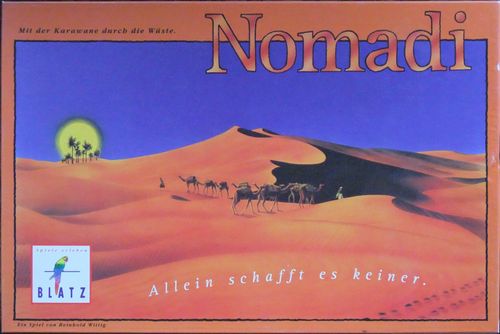
Nomadi
Nomadi Rulebook
Table of Contents
Table of Contents
Components
The following is needed for the journey through the desert:
- these rules
- the desert game board
- 6 dice
- 28 playing stones in 5 colours (8 blue and 8 yellow, 5 red, 4 green and 3 black)
- 18 desert cards with different values (four each of +1, +2 and +3, and three each of −1 and −2)
- 50 desert coins (35 worth 1 and 15 worth 5, for exchanging)
- a movable oasis (used only if you want to shorten the game)
Setup
Preparation:
- Lay out the game board.
- Each player receives a coloured playing stone.
- With 2 players, each player gets 8 stones.
- With 3 players, each player gets 5 stones.
- With 4 players, each player gets 4 stones.
- With 5 players, each player gets 3 stones.
The remaining stones stay in the box.
- On first use, detach the oasis, the desert cards and the coins from their sprues.
- Place one desert card face down on each water source.
- The other cards are also placed face down on random fields.
- One of the players looks after the bank's coins during the game. He gives each player 5 coins.
- The player who explained the game to all the others may, as a reward, begin the game.
Playing the Game: Through the Desert
The caravan takes shape. The starting player begins, and play continues clockwise around the table.
Players take turns placing one of their stones on a random field within the starting zone. When all stones have been placed, the caravan departs.
Each die has its own effect. The player whose turn it is throws all 6 dice once. Then the moving begins. This may be done with random playing stones; they do not have to be your own stones.
The basic rules for moving are:
- The playing stones must always remain connected to each other. No stone may stand alone. There must be at least one playing stone on a directly adjoining field. Diagonal connections do not count.
- Only stones that have at least one free side may be moved. So all stones that border a neighbouring field (or the edge of the board) on which no stone stands are eligible. (This is not very difficult; pages 10–15 of the original contain several examples.)
Each rolled number moves one playing stone (you may also move the same stone several times).
In this way the caravan is guided through the desert. It is important that no stone leaves the path. All stones must therefore, as described above, always remain connected to one another in some way. This happens by contact at the sides, not only diagonally.
The dice determine how far a move reaches, but you still have control over it. The playing stones may be moved in any direction. For each rolled number you have the following options:
- With a one, you may slide the playing stone one field only, in a straight line or diagonally, but always in contact with another stone.
- With a two, three or four, you jump over other playing stones:
- With a two, over one playing stone.
- With a three, over two playing stones.
- With a four, over three playing stones.
These jumps must always be made in a straight line, not diagonally.
With a five or a six you jump over 4 or 5 stones respectively. During this move you may turn 90° once.
Note: you may only jump over unbroken rows of playing stones, so not over empty fields that lie between them.
Each die throw may be used only once.
If you have thrown the same number twice (or more), you may not move one and the same stone back and forth with it.
Choosing the right order of moves is decisive. (Two examples of a good order can be found on page 14 of the original.)
If you cannot use all of your dice throws, you pay 1 coin to the bank for each unused throw.
If you cannot move anything at all, you may throw again.
It can happen that a player has no desert coins left. The bank then generously grants interest-free credit, which of course must be repaid at the end of the game.
Tip from an experienced caravan leader: once you have moved a stone, pass the corresponding die to the next player.
Desert Storm
Special rules:
The tents are taken down. Playing stones that have left the starting place may not be placed back on it. They may, however, cross the starting place.
The player whose playing stone last leaves the starting place receives 5 coins from the bank. (This is therefore not necessarily the person who moved that stone.)
Desert Cards
In the desert even the smallest things can affect life. A small change in wind direction can bring on a sandstorm, and a small leak in the water jug is a catastrophe. The positive or negative values on the desert cards represent these events. You will probably think of other ones as well.
The values of the desert cards are counted in the final scoring.
When a stone of another player lands on a field with a desert card, it is inspected. This is done in such a way that the other players cannot see the value of the card. The card is offered to the owner of the stone that reached the desert card. If the person asked wants to see it, he receives it; otherwise you keep it yourself.
"The best thing about trading is haggling," says an old caravan leader — wisdom.
Depending on the value of the card, you can make the buyer more or less keen when offering it.
Throwing sand in someone's eyes is of course also allowed. Only at the end does the desert card count for whoever holds it.
If you land with one of your own stones on a desert card, you add it to your own supply without comment.
Important: in both cases you receive 1 coin from the bank.
Since you may always move six times, you have the chance to reach several desert cards, and you are rewarded with as many desert coins.
No Water Far and Wide
If you discover a water source beneath the desert cards, you play as described above, but you receive 2 desert coins from the bank.
The Chasm
The player who first places a playing stone over the chasm, in the middle of the game board, receives 5 coins from the bank, regardless of whom the stone belongs to. Once a playing stone is over the chasm, it may no longer be moved or placed back across the chasm.
The player who last moves a playing stone across the chasm pays 5 coins to the bank.
Note: it often happens that the game ends before all stones have been placed across the chasm. In that case nobody has to pay anything.
Ending the Game: A Mirage
Finally, the saving oasis. The first stone to reach the goal receives 8 coins from the bank. For the second, 6; and for the third, 4.
These coins the player whose turn it was must share with the owner of the stone. If you yourself are the owner, all the coins are for you.
A playing stone that has reached the goal may no longer be moved. The third playing stone to reach the goal ends the game, whether those stones belong to the same or to different players.
Did the Long Journey Pay Off? (Scoring)
The values on the desert cards and the coins determine the points. Each player calculates his own points.
Desert cards with a positive value are added together with the value of the coins. Desert cards with a negative value are subtracted.
The player with the highest number of points is the winner of Nomadi.
Have lots of fun.
Nomadi Tips: Desert Fever
- Nobody can do it alone, so helping is allowed. In this way more experienced Nomadi players can explain to less experienced ones how to move the stones even better.
- Protect the desert cards and coins from overly curious eyes.
- When you all agree, you can shorten the game. At the start of the game, place the movable oasis on a random spot behind the chasm, so that it can be reached more quickly.
- For caravan leaders who want to make a few good transactions along the way, the following variant applies. Play as described. At the same time, you may negotiate with the other players. For example, a player whose turn it is may, with a few coins from his own supply, "encourage" you to place the stones in a way that seems better for you. In this way, for example, you may leave the starting place last and receive 5 coins for it.