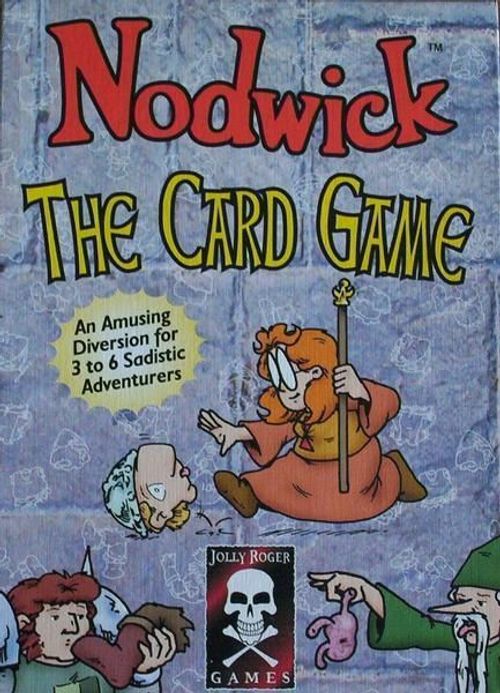
Nodwick: The Card Game
Nodwick: The Card Game Rulebook
Table of Contents
Table of Contents
Game Components
- 48 "Henchman Part" cards: eight different henchmen, each cut into six parts: a head, a torso, legs, arms, a spleen, and, most importantly, the soul.
- 57 "Piffany" cards: the small items needed to assemble the henchman. They are divided into six kinds:
- 12 Tape
- 11 Rose-Tinted Glasses
- 10 Happy Thoughts
- 9 Life-Force Kickstarters
- 8 Staves of Harmony
- 7 Power of the Gods
The number of each kind is printed in the lower left corner of each "Piffany" card.
- 1 hourglass (60 seconds)
Setup
Shuffle all the cards and deal 6 cards to each player. Place the hourglass in front of the person who can carry the greatest weight. Place the remaining cards face down in the middle of the table as the draw pile. The player with the hourglass turns it over and so starts the game.
Game Principle
In "Nodwick: Handlanger-Spiele" all players act at the same time. There are no rounds. Each player tries to carry out the following actions as quickly as possible, in any order.
Healing Your Henchman
To heal your own henchman, play a "Henchman Part" card face up in front of you and place the "Piffany" cards shown as required on that card onto the discard pile, which is formed in the middle of the table. You keep the "Henchman Part" card until the end of the round.
The player then immediately takes two cards from the draw pile.
Note on healing your henchman: A complete henchman consists of one each of the six different body-part cards. You may NOT add a body part to a henchman that already has one of that kind. (Piffany does not like the idea of a two-headed henchman, or a henchman with three arms.)
"Henchman Part" cards from different henchmen may be mixed freely and completely (but note the scoring below).
You may add a new body part to your henchman at any time. As a reminder, there is no fixed order.
Trading with Other Players
Players may freely trade "Henchman Part" cards and "Piffany" cards with one another. A trade may be negotiated completely freely between players. For example, you may simply exchange two cards face down, or trade several "Piffany" cards for one special, useful "Henchman Part".
Players must never lie while trading, but they do not have to disclose all information. (For a "Henchman Part" card, for example, you may reveal its colour but not the "Piffany" cards needed to play it.)
Discarding Cards
A pair of identical "Piffany" cards, or two cards from the same henchman, may be discarded. The player may immediately draw ONE new card from the draw pile in exchange.
Passing the Hourglass and Drawing a Card
This is the part of the game that is played in rounds. Only the player seated in front of the hourglass may draw a card from the draw pile. To do so, they pass the hourglass to the left, to the next player, and then draw a card.
When the hourglass is passed on, the player does not turn it over. As soon as a player receives the hourglass, they have the choice of turning it over, which may give them more time to trade. The hourglass may only be turned over at the moment it is received.
When the hourglass runs out in front of a player: Each player may now call "Time". The hourglass is turned over immediately and given to the next person. The player in front of whom the hourglass ran out may NOT draw a new card.
The player must be given at least five seconds to decide to turn the hourglass over (especially if it has run very far down or is even empty). When you receive the hourglass, you should always check its state. It is occasionally good tactics to pass on an empty hourglass in the hope that the next player does not notice this state, so as to forbid them from drawing a card. (The player who passes the hourglass on may, of course, draw a card.)
When the draw pile is empty: The player who takes the last card from the draw pile MUST immediately turn the discard pile over and thereby form a new draw pile. Shuffling is not necessary. (Normally the discard pile is a large, untidy heap of face-up cards. Simply make a large, untidy heap of face-down cards from it.)
Completing a Henchman
As soon as a player completes their henchman, they turn their "Henchman Part" cards face down and may no longer trade cards.
End of the Game
The game ends as soon as 2 players (in a 4-player game) or 3 players (in a 5- or 6-player game) have successfully completed their henchman.
Once the required number of players have finished their henchman, the game continues until the hourglass has completely run out. The players may no longer turn the hourglass over or draw cards, but may continue to trade desperately in order to complete their henchman.
Scoring
Players count the points for their henchmen. Each Piffany on a healed "Henchman Part" card is worth one point. In addition, the quick players who completed their henchman early receive bonus points according to the table below. All players also receive bonus points for henchmen that are as single-coloured as possible. Add one bonus point for each card of the colour that occurs most often in your henchman.
Examples: Liz has 5 blue and 1 orange card in her henchman. She receives 5 bonus points for the blue cards.
Aaron has 2 white, 2 green and 1 orange card in his henchman. He receives two points for the white (or green) cards.
If there is a tie in points, the player with the most cards in hand wins.
Bonus Points:
- x according to the number of cards of the colour that makes up most of the henchman.
The game ends when a certain number of players have completed their henchman. The players with a completed henchman receive bonus points as follows:
| Players | # of completed henchmen at game end | BP for first | Second | Third |
|---|---|---|---|---|
| [Table values are missing from the source text: only the column headers are printed in the German rules. No values have been supplied.] |
(BP = Bonus Points.)
Close Finish
If two or more players complete their henchman within five seconds of one another, they are considered to have finished at the same time.
If several players finish at the same time, they all receive the higher bonus-point value. If, in a 6-player game, two players finish first, both receive 2 points and the third player receives 0 points.
Variant
Piffany prefers the rule that players who let the hourglass run out may also draw a card. She is just that nice.
Credits
(Credits omitted from this transcription.)