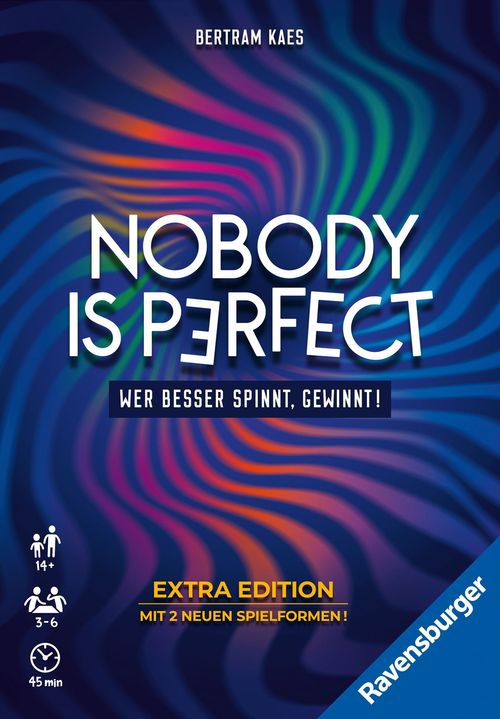
Nobody is Perfect: Extra Edition
Nobody is Perfect: Extra Edition Rulebook
Table of Contents
Table of Contents
Contents
- 1 game board
- 6 pawns
- 6 tip chips (Tippsteine)
- 100 cards: "Kuriositäten" (blue, "Curiosities"), "Begriffe" (pink, "Terms"), "Zitate" (yellow, "Quotes"), "Andersherum" (orange, "The Other Way Round")
- 1 decoder (Dekodierer)
- Pen and a sheet of paper for each player (not included)
Players: 3 to 6, ages 14 and up.
Setup
Place the game board on the table. In the middle it shows answer spaces with the letters A to F, for up to 6 different answers. Along the edge of the board is the track (Laufleiste), on which each player moves their pawn according to their points.
Each player chooses a colour and places their pawn on the blue start/finish space.
Each player receives:
- 1 pawn
- 1 tip chip
- 1 pen
- 1 sheet of paper
Place your tip chip in front of you. Each player also writes their name on their sheet of paper. Sort all cards by the 4 colours and place the 4 stacks next to the board together with the decoder.
Flow of Play
Play proceeds clockwise. Whoever has not been entirely truthful today begins. This player is the game leader (Spielleiter) in the first round and receives the decoder.
The game leader always reads out the current question and later also the answers. Except for the orange questions, the game leader does not play along. For the next question, the left-hand neighbour becomes the new game leader, receives the decoder, reads out the question, and so on until the game ends.
The spaces of the track show the same 4 colours as the cards. The current game leader looks at which coloured space their pawn stands on, draws the top card from the stack of that colour, and turns it over.
If the game leader's pawn stands on a multicoloured joker space, they may choose any card colour.
Which question should it be?
Each card has 3 questions per side, numbered 1 to 3. Before each game, agree on one number (1, 2 or 3). This number applies for the whole game for all players, and only the questions with this number are read out.
Example: You have agreed on the number 2 before the game begins. If you as game leader stand on a blue space, you take the top blue "Kuriositäten" card, turn it over, and read the question numbered 2 aloud.
Blue, Pink and Yellow Cards
Procedure for blue, pink and yellow cards
First, the game leader reads out the question – on request, also a second time. Everyone except the game leader now invents an answer and writes it legibly on their sheet. Caution: do not let your fellow players see what you are writing!
Now your creativity is in demand! For the blue cards ("Kuriositäten") invent answers that are as creative as possible. For the pink cards ("Begriffe"), try to phrase your invented answer as if it came from an encyclopedia or dictionary. For the yellow cards ("Zitate"), slip into the role of the author and complete the quotes creatively, but of course freely invented. The more convincing your answer, the more fellow players will fall for it.
Important: if by exception you know the correct answer, you still write down a made-up tale – and hope to lead your fellow players onto thin ice.
Meanwhile, the game leader decodes the correct answer. To do this, they place the decoder on the card. Then they write this answer on their sheet.
Afterwards, each player hands their sheet face down to the game leader. The game leader shuffles all sheets (together with their own). Then they read the answers one after another, first silently to themselves and then aloud to the other players. In doing so, they assign each answer a letter (A, B, C and so on).
Example: The question is: Who knows what a "Volte" is?
The game leader reads the question together with the answers, including the correct one:
The Volte is:
- A: A tool for making bass flutes
- B: An unsaturated carboxylic acid
- C: A sleight of hand in card games
- D: …
Afterwards, the game leader repeats the answers (in the same order and together with the answer letters) a second time, in a shorter form:
- A: Tool for bass flutes
- B: Carboxylic acid
- C: Card trick
- D: …
Each player now decides on the answer they consider to be correct. On the game leader's command, all players except the game leader simultaneously place their tip chip on the answer space with the corresponding letter in the middle of the board. You must not bet on your own invented answer.
Once all players have tipped, the game leader reveals the correct answer (in the example above, answer C). Now there are points:
- Correct tip: All players who tipped the correct answer move their pawn forward 2 spaces.
- Well spun: For each tip someone placed on the (freely invented) answer of a fellow player, the inventor of that answer moves their pawn forward 3 spaces.
So if someone falls for your answer and you also bet on the correct answer, you score multiple times. Only those who neither convincingly fibbed nor bet on the correct answer come away empty-handed. The game leader also receives no points in this round.
Example: Charlie tipped the correct answer and at the same time led two fellow players onto thin ice with her invented answer. For this she receives 2 + 3 + 3 = 8 points and moves her pawn forward on the track accordingly.
After the points are awarded, all players receive their sheet and their tip chip back. The game leader returns the card to the box. Their left-hand neighbour becomes the new game leader. They look at which colour their pawn stands on, draw a card from the corresponding stack, turn it over and read the next question, and so on.
Orange Cards
Procedure for orange cards
With "Andersherum" (orange cards), the game leader also plays along, because here the aim is to find out which statement comes from them. First, the game leader decodes the question on the orange card with the decoder and reads it out.
Then all players, including the game leader, think up a question or a saying and write it on their sheet. The game leader collects all sheets as usual, shuffles them together with their own, assigns letters and reads them out.
Example: The question is: "Four"
The game leader reads the question together with all the answers, including their own:
- A: I still need paper. One? No! …
- B: What is 71 minus 67?
- C: How many corners does my hat have?
- D: …
Afterwards, the game leader repeats the answers a second time, in the same order, in a shorter form.
Now everyone (except the game leader, of course) tips on which answer probably comes from the game leader.
- Correct tip: All players who tipped the game leader's invented answer move their pawn forward 2 spaces.
- Well spun: Whoever has led a fellow player onto thin ice moves 3 spaces per fooled fellow player towards the finish.
- Game leader: They may move as many spaces as there are tip chips on their answer.
End of the Game
As soon as, after the points have been awarded, at least one pawn has reached or passed the start/finish space, the game ends immediately. The player who is furthest ahead wins. If the pawns of several players are furthest ahead, those players share the victory.
Further Important Rules
The last shall be first
Once you have awarded all points for the current question and moved your pawns accordingly, check whether the pawn now standing in the last place on the track has just jumped over a number sign (these are always located between 2 spaces). If so, the player may move their pawn an additional number of spaces as shown on the sign. If several pawns are standing together in the last place and have just jumped over a number sign, all of them may move forward accordingly.
Double lie
If several of you write down a very similar invented answer, the game leader reads it out only once and assigns only one letter to it. However, all those who submitted it receive the possible points for this answer.
Lucky hit
If you write down an answer that largely corresponds to the correct answer, you are unlucky: the game leader also reads out the correct answer only once in this case and assigns only one letter. Whoever then tips on it still receives 2 points as usual – but whoever wrote down the correct answer goes away empty-handed! Because only the one who spins properly wins!
Tip: For even more variety, you can also use the pink and blue cards of "Nobody is perfect Original" and "Nobody is perfect Mini Edition" for this game.