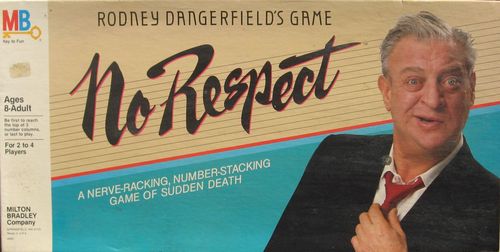
No Respect: Rodney Dangerfield's Game
No Respect: Rodney Dangerfield's Game Rulebook
Table of Contents
Table of Contents
Object
Be first to reach the top of 3 number columns, or last to play a number tile.
Contents
- 1 gameboard
- 80 number tiles (10 each, numbered from 1 to 8)
- 1 instruction sheet
Game Setup
-
Unfold the gameboard and place it on a flat surface easily accessible to all players.
-
Carefully remove the 80 number tiles from the 5 plastic runners, and discard the empty runners.
-
Place all the number tiles facedown in the center of the gameboard, within the black border.
-
Each player takes a seat behind one of the corners of the gameboard, where the individual playing areas are (the three columns of circles).
Game Play
1. Your corner of the gameboard: Once you're seated behind your corner of the gameboard, you'll notice three columns of circles staring up at you (see Figure 1). On these columns, the respect of your opponents will be gained or lost.
Each of your number columns has four circles in it, each circle containing a diamond. The circles containing a diamond are the spaces on which you try to play number tiles drawn from the center of the gameboard.
The white circle below each of your three number columns is a discard circle. Discard circles are reserved for number tiles you can't play anywhere else.
Because strategy is so important in this game of numerous options, we've added a quick sample game on the reverse side of the instruction sheet, which should tell you everything you need to know about No Respect strategy.
Figure 1: Your corner of the gameboard. Labels: Number Columns and Discard Circles.
2. Who goes first? The player who commands the least respect should probably get a break in this game by going first. But to avoid arguments and humiliation, do it this way: each player draws a number tile at random from the center of the gameboard, and looks at it. The player who picks the highest number (from 1 to 8) gets to go first. In case of a tie, the tying players draw again until there's a clear winner.
When you've decided who will go first, throw the tiles you just drew facedown into the center again, and mix them up.
After the first player's turn, game play continues to the left in a clockwise direction. But before you draw your first number tile, read on to find out what you do on your turn.
3. What do you do on your turn? On your turn, you draw a number tile at random from the center of the gameboard, and play it somewhere (no passing allowed!). Play the number tile in any one of the three following ways, which are explained in more detail in Steps 4, 5 and 6:
A. Play it on one of your number columns;
B. Stack or cap an opponent's tile, or one of your own;
C. Play it on one of your discard circles.
4. Building your number columns: Build your number columns from the bottom up, in descending order from the highest number tile (on the bottom circle) to the lowest number tile (on the top circle). It's best to start with a high number tile on the bottom circle—an 8, a 7, or a 6—but you can live a little more dangerously and start with a 5, or even a 4.
The numbers you play on your columns don't necessarily have to be in sequence (8, 7, 6, 5, etc.), although they can be played that way; they just have to go progressively from highest to lowest number tile. You can play a 7, then a 4, then a 3, then a 1, for example. Figure 2 shows some typical number column arrangements in a 4-player game.
5. Stacking and capping: Stacking and capping are done by placing a number tile on top of a tile of the same number (a 3 on a 3, an 8 on an 8, etc.). When you place a tile on top of another tile, that's stacking; when you place a tile on top of two tiles, that's capping. Figure 3 shows how stacking and capping are done. The stacking and capping options allow you to try to stop your opponent's progress to the top of a number column. They also give you an alternative to discarding tiles you can't play on your own columns.
Figure 2: Typical number column arrangements. Labels: A Complete Number Column and A Discarded Number Tile.
Figure 3: Stacking and capping options. Labels: CAP and STACK.
Stacking: When you play a number tile on an opponent's column, you don't play it above the tile, as you build your number columns; you play it on top of the top tile in the column.
You can only stack a number tile on top of an opponent's top tile in a column. As long as the tile is the same number as the tile you stack it on (an 8 on an 8, a 3 on a 3, etc.), it can be stacked on any top tile in the column (even if it's the first tile played).
A stacked column can still be built on. If an opponent stacks a tile on one of your columns, you can play a number above it to continue your climb to the top. But if another tile of the same number is played on a stack before you get a chance to play a tile above it, the column is capped and out of play!
Capping: No matter who stacked the first number tile on top of an opponent's tile on a column, if you stack a second tile of a matching number (a 6 on two 6's, a 1 on two 1's, etc.), to make a pile of three tiles, you've capped the column and stopped your opponent from building on it.
Like stacking, capping can only be done on the top tile of a column. A player can continue to build a number column above a two-tile stack; and if he or she has done that, the stack is no longer at the top of the column—so it can't be capped.
The only exception to stopping an opponent by capping is when you cap a column that's been completed: when you cap a column that your opponent has built to the top, he or she still gets credit for having completed the column.
A three-high tile stack is the highest allowed in this game. Once a column is capped, no further plays can be made on it.
You can stack or cap the top tile on one of your own columns, but it can be dangerous. If you stack a tile on top of one of your own tiles, an opponent can cap it; and if you cap a column (to avoid being eliminated from the game), you can't build it to the top.
6. Discarding a tile: Your third and last option is to play the tile on one of your three white discard circles below your number columns.
If you draw a number tile and can't play it on one of your columns, or on any of your opponents' columns, you must play it on one of your discard circles. If you use your three discard circles, you're still in the game—but a fourth unplayable number tile puts you out!
Your discard circles are reserved for your use only—and you're not allowed to play a number tile on any of your opponents' discard circles.
7. Eliminating yourself from the game: If you draw a number tile and have no options available, and you've already played a number tile on each of your three discard circles, then you're out of the game! Leave your columns just as they are until the game is over. After you've eliminated yourself, your columns are dead—no one can make any plays on them.
How to Win
There are two ways to win No Respect. One way to win is to build all three of your number columns to the top. But because so little respect is given this goal by your opponents, it is a rare occurence.
The more common way this game is won is by sheer survival in the face of the onslaught of your opponents. You win the game this way by being the last player able to play a number tile—even if it's on one of your discard circles.
A Game Variation
Here's a game variation for players that want a second chance at building their columns to the top. In this game, number columns are built the same way, and both stacking and capping features are included; but a capped column is thrown back into the center of the gameboard, and the player can begin building the column again. This feature changes the object, of course. It's no longer a survival game; it's a game of ups and downs, and the first to the top is the winner!
Transcription note: the printed sheet reads "the first to" at the foot of one column and "the top is the winner!" at the head of the next, with no words between them. The words are reproduced as printed; the omission appears to be in the original printing.
Object: Be the first player to build your three number columns to the top.
Rule Variations
1. Stacking and capping: When one of your columns is capped—either by an opponent, or by yourself—remove all the number tiles from that column and place them facedown in the center of the gameboard. You can then begin building the column again.
This rule will change your strategy considerably, especially at the beginning of a game. If you draw a low number tile, you can still begin a column with it (rather than having to play it on one of your discard circles), then cap it if you have a chance, and begin again.
In this variation, it's not always a good idea to stack or cap an opponent's tile. Unless you have no other option but to play a tile on one of your own discard circles, you should never help your opponent by stacking or capping a tile on a column he or she wants to lose.
2. Your discard circles: Whenever you remove a capped column, remove the tile in the discard circle just below it, if you've played one there. This rule allows you a new strategy option: if you have to discard a number tile, place it below a column you feel is in danger of being capped. Then you can get rid of it when you remove the column.
If your three discard circles are filled and you have to discard a fourth tile, you're still out of the game. But in this variation, you remove all the tiles from your columns and discard circles, place them facedown in the center of the gameboard for the other players to draw and mix them up before the next player's turn.
3. How to win: In this game variation, it's not unusual that all players remain in the game until the bitter end. The winner is the first to build three number columns all the way to the top.
A Quick Sample Game
Round One
In this sample 3-player game, the highest tile drawn for first "go" was a 6. The tiles were replaced facedown in the center of the gameboard, and Player 1 took her first turn. She drew a 5, and started a number column with it.
Player 2 drew a 1. Because a 4 is the lowest tile a complete number column can begin with, Player 2 was forced to play the tile on one of his discard circles.
Player 3 drew a 5. More cautious than Player 1, she preferred to stack the 5 on Player 1's 5.
Round Two
In Round Two, Player 1 drew a 4. She took the opportunity to play it above her stacked 5's before anyone could cap the column by adding another 5 to the stack.
Player 2 drew an 8, the best tile to start a column—and that's what he did.
Player 3 drew a 2, and was forced to play it on a discard circle.
The game continued as shown in the figures below, each player drawing a tile in turn and playing it.
Round Three
Player 1 drew a 6, and started a column.
Player 2 drew a 7, and started a column.
Player 3 drew a 6, and started a column.
Round Four
Player 1 drew a 2, and played it above the 4.
Player 2 drew a 3, and played it above the 8.
Player 3 drew a 3, and stacked Player 2's 3.
Round Five
Player 1 drew a 3, and capped Player 2's 3, eliminating the column from play.
Player 2 drew a 4, and played it above the 7.
Player 3 drew an 8, and started a column.
Round Six
Player 1 drew a 5, and played it above the 6.
Player 2 drew an 8, and started a column.
Player 3 drew a 2, and stacked Player's 1's 2.
Rounds Seven Through Sixteen
The game continued, each player drawing a tile in turn and playing it. In Round 14, Player 3 drew a 7. Since she couldn't play the tile on her column or any opponent's column, and since her three discard circles were filled, she was eliminated from the game.
Round Seventeen
In Round 17, Player 1 drew a 6, and like Player 3 in Round 14, didn't have anyplace to play it. She was also eliminated from the game.
Because Player 2 was the only one able to play after Round 17, he won the game.