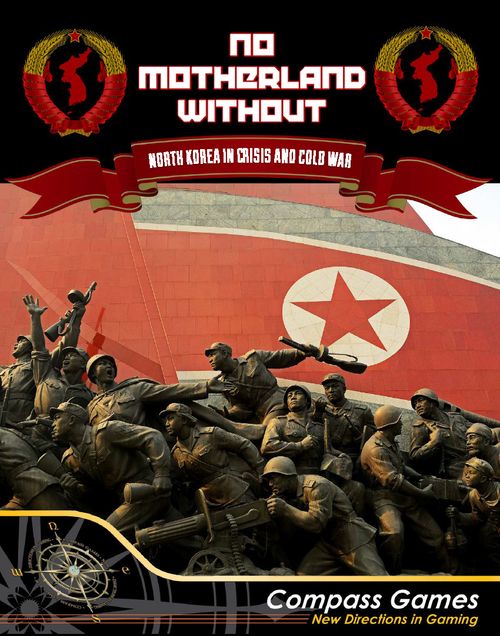
No Motherland Without: North Korea in Crisis and Cold War
No Motherland Without: North Korea in Crisis and Cold War Rulebook
Table of Contents
Table of Contents
- 2.0 Objective
- 3.0 Components
- 4.0 Maps and Board Layout
- 5.0 Setup
- 6.0 Generation Map
- 7.0 Game Sequence
- 8.0 Event Cards
- 9.0 Missile Test Events
- 10.0 Using Cards to Invest
- 11.0 Aid Cards
- 12.0 Activities
- 13.0 Global Opinion
- 14.0 Game End and Final Scoring
- 15.0 Example of Play
- Solitaire Scenario
- Card Notes
- Event Card Index
2.0 Objective
Victory will be determined either by prestige or by final score. Prestige reflects the standing of the Kim regime. The West will try to lower DPRK prestige and topple the regime, while the DPRK will aim to raise its prestige. If there is ever a successful missile test event when prestige is in "HIGH" status, the DPRK will immediately win the game. If neither player wins the game by the final turn, victory is determined by points earned from infrastructure (DPRK) or defectors and dissidents (West).
3.0 Components
Game components for No Motherland Without: North Korea in Crisis and Cold War include:
- One Mounted Game Map
- 130 Counters
- Two Six-Sided Dice
- 52 Juche Cards (Black)
- 77 Songun Cards (White)
- One Rules Booklet
First, second, and third level infrastructure improvements (14 each), active dissident marker (8), imprisonment marker, outage marker (14), red and blue defector route markers (9 total), deceased marker, elite marker (6), defector marker (18), defector en route marker (2).
4.0 Maps and Board Layout
The game includes a mounted game map depicting the DPRK's provinces and special cities, a Generation Map tracking the three generations of DPRK citizens, and a Defector Map showing the routes defectors travel from the DPRK through China, Thailand, Mongolia and beyond.
5.0 Setup
Begin the game with the Juche deck (black cards) for Turns 1-3 and the Songun deck (white cards) for the remainder of the game. Use cards #1-120 for your first two-player game (no optional cards).
- Place the Rations Marker on the corresponding track in the topmost space.
- Place the Turn Marker in the first turn space.
- Place the Prestige Marker in the space marked "Low."
- Place the Global Opinion Marker on the center space of the Global Opinion track.
- Place the DPRK and West Reserves markers in the zero space of their respective tracks. At the start of the game, there should be no other pieces or tokens currently on the map.
- Place the Aid from Beijing and Aid from the Kremlin cards face up in front of the DPRK player.
6.0 Generation Map
6.1 The Generation Map is divided into three generations of DPRK citizens for different eras of the game. The first generation (outlined in blue) is active during the Juche era (Turns 1-3). The orange outlined citizens are active for the Songun era until the final turn. The yellow outlined citizens are active the turn following the second play of the No Motherland Without You event card or Turn 7 (whichever occurs first).
6.2 Unless stated otherwise, events can target unmarked citizens in a previous or active generation. Marked citizens (elites, imprisoned, dissidents, defectors, or a defector en route) may only be targeted by events that specify their type.
6.3 Events and activities that promote unmarked citizens to elites must promote male citizens (those with white stars) from the active generation (if available) before female citizens may be promoted.
6.4 Defect activities must target unmarked female citizens (those without white stars) from an active generation before males (10.9.1), but events that mark citizens as defectors do not share this restriction.
6.5 Imprisoned citizens lose all markers unless an event specifically states otherwise.
6.6 If an event would affect unmarked citizens in the active or previous generation, but there are none, the event will have no effect on the Generation Map.
6.7 Only the Three Generations of Punishment Legacy Event will mark citizens in future generations.
Key Terms and Concepts
Active Generation - Are those citizens on the Generation Map that are highlighted for the current turn. The blue outlined citizens are active for the Juche era (Turns 1-3). The orange outlined citizens are active for the Songun era until the final turn. The yellow outlined citizens are active the turn following the second play of the No Motherland Without You event card or Turn 7 (whichever occurs first).
AP - Players use Activity Points (AP) to conduct activities during the Action Phase.
Ballistic Missile Research (BMR) - BMR refers to the status of the DPRK nuclear program. Unlike other statuses in the game, the BMR is only known to the DPRK player. The level is indicated along the left side of the game board by placing cards facedown under numbered areas.
Defector - Any citizen marked with a defector marker is a defector and is considered to have left the DPRK.
Defector en route - Any citizen marked with a defector en route marker and traveling on the defector map.
Dissident - Any citizen marked with an Active Dissident Marker. Dissidents are placed with events.
Elite - Any citizen marked with an Elite Marker.
Global Opinion - Status is affected by specific events and the West's Appeal to Global Community activity.
Imprisoned - Citizens who are marked as active dissidents or defectors en route may be subject to being imprisoned by events or activities.
Outage Markers - Areas containing Outage Markers cannot receive standard of living improvements from activities or events.
Prestige - DPRK reflects the current standing of the Kim regime. It may be adjusted by the play of events or during the Resolution Phase of each turn.
Rations - The Rations Track is adjusted only by the play of events such as floods, famines, and other hardships.
Standard of Living Threshold - The numerical track located beneath the Turn Track designates the minimum number of infrastructure improvements and elites in the active generation that the DPRK must have to prevent a loss of prestige each turn.
Special City - One of the three DPRK areas on the map marked in orange: Pyongyang, Rason and Kaesong.
7.0 Game Sequence
7.1 No Motherland Without has up to seven turns. The first three turns will be played with the Juche event deck (black) and represent the events of Kim Il Sung's reign of the DPRK. The remaining turns are played with the Songun event deck (white) and will include events from both Kim Jong Il and Kim Jong Un's rule.
7.2 When the Juche deck (black) is exhausted, players should draw from the Songun era deck (white) until each player has a hand of eight cards.
7.3 Turn Sequence
Each turn in No Motherland Without adheres to the following sequence:
- Draw Phase
- Action Phase
- Resolution Phase
- Cleanup Phase
7.3.1 Draw Phase: Both players draw until they have a hand of eight cards.
7.3.2 Action Phase: Each Action Phase is comprised of alternating action rounds. At the start of the Action Phase, the West player will decide whether to go first or second. During each action round, players will alternate playing a card for activities, investment, or an event until both players have exhausted all cards in hand.
7.3.3 Resolution Phase: The DPRK player must compare the value of all infrastructure improvements plus all elites in the active generation to the standard of living threshold for a given turn (printed below the Turn Track). Each improvement level contributes a value of one (regardless of its AP cost). Additionally, each marked elite in the active generation contributes a value of one. If the sum of improvements and active elites meets or exceeds the standard of living threshold for the turn, no change occurs. If the sum of the improvements and active elites does not meet the standard of living threshold, lower DPRK prestige by one level. If prestige is below "Critical" status at the end of the Resolution Phase, the game immediately ends with a West victory.
7.3.4 Cleanup Phase: All Outage Markers are removed from the map. Any event cards with "remainder of turn" effects are placed in the discard pile. Remove markers from "Sunshine Policy Used This Turn", "Cult of Personality Used This Turn" and "The West Has Passed" events in play spaces. Advance the Turn Marker to the next space unless it is the end of the final turn.
7.3.5 Final Scoring: At the end of the final turn, if the West has not achieved victory by prestige, perform final scoring as per 14.2.
8.0 Event Cards
8.1 During the Action Phase, cards may be played either as events, activities or invested (12.0). A player may use a card for its event if the event either belongs to the active player's faction (red for the DPRK or blue for the West) or is unassociated (gray band with two flag icons). Events aligned with an opponent occur prior to the active player conducting activities or investment.
8.2.1 Event effects that cancel another event remove the cancelled card from play to the discard pile. Event effects that block another event prevent the targeted event from being played in a future action round, but do not removed the blocked event if it is already in play. Blocked event cards may only be played for activities and/or investment.
8.2.2 If an event has no eligible targets for an effect, the event effect does not occur.
8.2.3 If only some parts of an event would have an effect, fulfill only those parts of the event.
Example: Kim Yo-jon Appointed to Politburo (#82) states "Remove an elite marker from the previous generation. Promote one citizen without a white star to elite." If there were no elite in the previous generation, the DPRK would only place a new Elite Marker.
8.2.4 If an event card contradicts a stated rule, the card supersedes the rule. If an event requires pieces to be placed or removed, but does not specify which player decides, the player aligned with the event chooses. If such an event is unassociated, the active player chooses.
8.3 Enduring Events are cards with effects that will impact the game as long as the event card occupies any space on the Enduring Events Track. When played, Enduring Events are placed in the first space of the Enduring Events Track. Each subsequent play of an Enduring Event by either player will push cards on the track to the next space, and in the case of the third card, to the discard pile.
8.4 Legacy Events are events that will become permanent for the remainder of the game. Many of these events have powerful effects that will either add a potential activity for a player or change the game state.
8.5 Cards that are not Enduring or Legacy Events are placed in the discard pile after use.
9.0 Missile Test Events
9.1.1 Missile Test Events are special events in the Songun era deck require a level of Ballistic Missile Research (BMR) to trigger the event's effect.
9.1.2 The BMR is advanced by the DPRK as an activity. During their action round, the DPRK player can place a DPRK or unassociated event card along the left side of the game board, partially tucked in the numbered position that corresponds to the total number of third-level improvements on the map. This means that, although the value of the card placed on the track will be known only to the DPRK, both players can verify that the card advancing the BMR is in the correct numbered position.
9.2.1 The BMR level will determine if a Missile Test Event can be triggered. There are two considerations when determining the BMR level. First, a card played to advance BMR will not contribute a value greater than the numbered position where it is tucked.
Example 1: The DPRK has used two cards to advance BMR in earlier rounds. These cards would normally be face down to be kept secret from the West, but they are face up to show the values only for this example. The Chulsin-Songbun event card has a value of three, but it was used to advance BMR when only two third-level improvements were on the map. As a result, the card will only contribute two points to BMR.
9.2.2 The second consideration when determining BMR level is that the total level of the tucked cards will never be greater than the highest numbered position holding a tucked card.
Example 2: In this instance, the Chulsin-Songbun event card was used to advance BMR when three third-level improvements were on the map. As a result, the card will contribute its full value of three toward BMR. The Minders event was tucked when there were four third-level improvements on the map. However, now there are a total of five points tucked in position four or lower. The total BMR level cannot exceed the highest position of tucked cards, so the BMR level would be four.
9.3.1 When a Missile Test Event card is played for its event, then the DPRK player may reveal the cards on the BMR track. If the DPRK player reveals the level of research needed, the DPRK gains prestige and Global Opinion is shifted toward the West. The Missile Test Event and all BMR cards are placed in the discard pile. If the DPRK prestige is "High" when a Missile Test Event is triggered, the DPRK immediately wins.
Example 1: The West has played the Test of Three-Stage Rocket card. The DPRK decides to reveal its BMR cards. It has met the required level for this event. The DPRK raises prestige, shifts the Global Opinion one space toward the West, and discards all cards tucked in the Ballistic Missile Research edge of the board. The West would then resume its action round and conduct activities with the value of the card.
9.3.2 If the level of Ballistic Missile Research is not met, cards on the BMR Track remain facedown. The Missile Test Event is not triggered and Global Opinion is not changed. Do not discard the event. Instead, tuck it face down in the BMR space corresponding with the current number of third-level improvements. Missile Test Events played by the DPRK for activities and/or investment are not placed on the BMR Track.
Example 2: The West has played the Test of Three-Stage Rocket card to conduct activities. The DPRK obviously will not meet the required BMR of 4. The Missile Test Event does not trigger. Instead, the card is tucked in level 5 of the BMR Track, because there are currently a total of five third-level improvements on the map. The West then conducts 3 AP of activities.
10.0 Using Cards to Invest
The value of a card (upper right corner) may be partially or completely invested in the player's reserves. Reserves can hold a maximum of three points to be used to conduct activities in a future action round. These points can be stored from round to round and turn to turn, but they are vulnerable to loss from the play of events. Any points invested cannot be spent to conduct activities in the same action round.
11.0 Aid Cards
11.1 The Aid from the Kremlin and Aid from Beijing cards begin the game available (face up) in front of the DPRK player. Aid cards are used during a DPRK action round in lieu of playing an event card. To use an aid card, an event card must be discarded to conduct 3 AP of activities/investment. Use of an aid card allows the DPRK player to discard an event associated with the West without triggering its effect.
11.2 Because Aid from Beijing and Aid from the Kremlin do not have a value, the 3 AP are not modified by events such as Sea of Blood or Korean Broadcasting System.
11.3 Once used, an aid card is placed face down (unavailable). Only events can make unavailable aid cards available again. After Turn 3, the Soviet Union will collapse, and the Aid from the Kremlin card is removed from the game.
12.0 Activities
A card may be used to conduct activities with the total value of APs noted in the upper right corner of the card plus any points from the player's reserves. APs can be split to perform different activity types, or excess APs from cards may be invested. The activities a player may conduct are unique to each player. Exception: APs used to conduct the special activities Advance Ballistic Missile Research or Appeal to Global Community may never be split or used in conjunction with reserves. The value of cards used to conduct special activities is never modified by events in play.
DPRK Activities
Improve infrastructure (One AP per level of improvement).
12.1.1 Place infrastructure improvements in a province or special city on the map. No more than three improvements may be stacked in a single area.
12.1.2 When placed with activities, improvements may only be built in an area adjacent to an area containing improvements, an area already possessing an improvement or in a special city (Pyongyang, Rason or Kaesong). Improvements may not be placed in an area containing an Outage Marker.
12.1.3 The three levels of improvements each have different AP costs. Level 1 improvements cost 1 AP. Level 2 improvements cost 2 AP. Level 3 improvements cost 3 AP. There is no limit to the number of levels that may be placed in a single area within an action round other than the stacking limit of three total. Higher-level improvements may not be placed before lower-level ones in any area.
Imprison a defector (Three AP).
12.2 Remove a defector en route in a red location on the Defector Map and mark them as imprisoned.
Uncover defector route (Two AP).
12.3 Remove the closest red route marker to the DPRK from the Defector Map. If two markers are equidistant, DPRK chooses.
Purge an elite (One AP).
12.4 Mark an elite as deceased, then place the elite marker on an unmarked citizen in the active generation. Male citizens (white star) must be promoted as elites before female citizens if available. If there are no unmarked citizens in the active generation, an elite may not be purged. Only one elite may be purged per action round.
Advance Ballistic Missile Research* (Special Activity).
12.5 Only a DPRK or unassociated event card may be used. Along the left side of the board are numbered BMR spaces. Do not reveal the card being played for this activity. The DPRK will tuck event cards partially under the board. Each card used for this activity is tucked face down in the numbered space corresponding with the current number of third-level infrastructure improvements on the DPRK map (See 9.2). Each numbered space may hold multiple cards.
West Activities
Place outage marker (One AP).
12.6 Outage Markers prevent the DPRK from placing infrastructure improvements in an area. Outage Markers can be placed anywhere on the map, but an Outage Marker may only be placed in Pyongyang if all other areas already contain an Outage Marker.
Appeal to Global Community* (Special Activity).
12.7 Discard one West event to attempt to shift Global Opinion toward the West. Adding the value of the card, roll a die and shift Global Opinion on a modified roll of 6 or more. Reserves may not be applied to this activity.
Place defector route (One AP).
12.8 Place a Route Marker on the Defector Map to enable defectors to travel. Arrows indicate the paths traveled by defectors. Paths vary in length and stretch from the DPRK through China, Thailand, Mongolia and beyond. Along each path are circular areas for the defector en route marker and spaces for placement of Route Markers. Each Route Marker must match the color of the route on which it will be placed. Routes that are red indicate paths where defectors are vulnerable to repatriation and imprisonment. These Route Markers are also vulnerable to removal by DPRK activities and events. Blue Route Markers are not vulnerable to removal. Special: The yellow arrow connecting Mongolia to South Korea does not require a Route Marker.
Example: The West chooses to play a 2-value card to place defector routes. Because defectors will not be able to travel on the Defector Map until routes are placed, the West places two red route markers in China over the first two route spaces, so they can begin defect activities in a future round for 1 AP each.
Defect (Base cost: One AP per route marker crossed).
12.9.1 Only one defection can be in progress at any time. Mark a citizen chosen to defect with a Defector En Route Marker. Defectors must be chosen from the active generation if possible. Unmarked female citizens (those with no markers) in the active generation must defect before male citizens can be chosen for this activity. The second a Defector En Route Marker is placed on the Defector Map in circular areas along the path that they are traveling.
12.9.2 There is no limit to the distance a single defector can travel if the West player has the APs available (including reserves) to pay the cost.
12.9.3 For each adjacent elite to the citizen defecting on the Generation Map, the total cost to travel is increased by one AP (not increased by one per segment traveled).
12.9.4 For each adjacent active dissident to the citizen defecting, the total cost to travel is reduced by one AP to a minimum of one AP.
12.9.5 The West will have additional AP available each action round for defect activities awarded according to the rations status. In order to receive the rations bonus, the West must spend a minimum of 1 AP from either a card or the West reserves to conduct defect activities.
12.9.6 When a defector has reached South Korea, replace the Defector En Route Marker on the Generation Map with a Defector Marker. Players may find it helpful to use a die to keep track of AP spent from cards and rations bonuses when conducting defect activities.
Example 1: The West chooses to play a 2-value card for a defect activity and add two AP from the West reserves. First, the West chooses a citizen to defect and marks the citizen with a defector en route marker. The citizen chosen is adjacent to an elite citizen, so the first move will cost an additional point to advance along the route. The subsequent moves cost only one AP each.
Example 2: The West chooses to play a 3-value card for a defect activity. First, the West chooses to advance a defector currently en route across the last blue Route Marker to South Korea. Because the citizen is adjacent to an elite, the activity costs one additional AP to the base cost of one AP for moving across a single Route Marker. The West marks the defector as complete and selects a second citizen to defect with the remaining one AP. Because the second defector selected is adjacent to two elites, the cost to advance the first space is increased by two AP for a total of three AP. Because the West only has one AP left, it would not be able to move this citizen with a defect activity. Instead, the West could select an eligible citizen that is not adjacent to an elite to spend the final one AP of their card.
12.9.7 Defectors traveling across the Gobi Desert into the Mongolia space must roll a die to determine if they arrive safely. On a 5 or more, they progress as normal, but on a 1-4, the defector en route marker is removed and the citizen is marked deceased.
13.0 Global Opinion
13.1 Global Opinion status is modified by the play of events and West activities. Events will move the Global Opinion status one space in favor of the DPRK or the West. Some events are not inherently favorable to either faction, and will move the Global Opinion marker toward the center of the track.
13.2 Events that are not triggered do not alter Global Opinion. Missile Test Events that are played without meeting the Ballistic Missile Research requirement do not change the Global Opinion status.
13.3 Some events will only change the Global Opinion status if specified conditions are met. Always consult the text of the card before changing the Global Opinion.
13.4 Beneath each status space on the Global Opinion Track, aside from the neutral space, one player will receive an advantage. Advantages are cumulative. For example: if Global Opinion is in the farthest space, favoring the West, the West player would add +1 to all rolls, may pass one action round per turn and would have the option of investing the last card in hand without triggering the event.
14.0 Game End and Final Scoring
14.1.1 No Motherland Without You is a special unassociated event. This event is automatically triggered, even when discarded, by either player. Unless discarded, the active player may conduct activities or invest using the value of the card, before the event is triggered.
14.1.2 There are two cards representing the No Motherland Without You event (card #71 and #112). The first time the event is played, the card is placed in its holding box on the board. On the second play of the card, the next turn will be the final turn of the game. The earliest this event can end the game is Turn 5 and the latest is on Turn 7.
14.1.3 Because the No Motherland Without You event is unassociated, it may be used by the DPRK player to advance Ballistic Missile Research (see 10.5.1). Under this circumstance, the event effect would not be triggered until it was removed from the BMR.
14.1.4 (Optional) If players choose, they may elect to use card #124, which is an alternate version of the No Motherland Without You event card and remove cards #71 and #112. With this option, a single play of the No Motherland Without You event will end the game no later than the end of the following turn. Note: This option will often favor the DPRK, but if the DPRK player is less experienced or both players enjoy greater uncertainty, this can provide a more tense alternative to the standard game.
14.2 After the Resolution Phase of the final turn, each player will total their final score. The DPRK player's score is equal to the total infrastructure improvements on the map (one point per improvement). The West player receives three points for each defector and five points for each dissident. Imprisoned citizens are worth no points to either player, regardless of any additional markers. In the event of a tied score, the winner is the player with greater reserves. If both players are still tied, the DPRK claims victory.
14.3 Stalemate. During any point in a turn, if all citizens in the active generation are either deceased, imprisoned or defectors, then the game ends immediately in a draw.
14.4 (Optional) Optional cards #121, 122, 126 & 127 may be added or withheld to balance play with an inexperienced opponent or add variety to the base game. Optional #28 may also be substituted for Card #28.
15.0 Example of Play
To ease new players into the design, it may be helpful to read the following playthrough of a two-player game proceeding through a complete turn. We will begin on Turn 1. Erin will be taking on the role of the West, and Nirav will be playing as the DPRK. The players begin the first turn with the Draw Phase. Each player receives a hand of eight cards. The players now proceed to the Action Phase.
As the West player, Erin will decide whether she would prefer to play first or second (Rule 7.3.2). The West will decide the turn order each turn. Erin reviews her hand and has the following cards: Kim Tu Bong (5), 1955 Food Crisis (22), Soviet Koreans (9), Soviets Send Emergency Aid (23), EC-121 Shot Down (30), Kijong-dong, Peace Village (43), Team Spirit (2), and Buffer Year (34).
Round 1:
The West chooses to act first and plays Soviets Send Emergency Aid. Before she can conduct activities or invest, the DPRK event is triggered (Rule 8.1). Because the Aid from the Kremlin card is available, the event has no effect. Erin decides to place Outage Markers in Rason and Kaesong for one AP each (Rule 12.6).
The DPRK hand consists of Three Generations of Punishment (11), Collectivization (15), Seven Year Plan (18), Production Targets Inflated (25), Yun Kong-hum (27), Mass Mobilization (31), Red Cross Meetings (32) and Acclaimed Actress and Director Kidnapped (41).
The DPRK chooses to play Production Targets Inflated, because this event would normally remove improvements from the map, but there are currently none. The event has no effect. Nirav places one improvement in Pyongyang (Rule 12.1.2) and (with one AP left) invests in DPRK reserves (Rule 10.0).
Round 2:
Erin plays the West event Team Spirit, which increases the West reserves to 3.
The DPRK sees an opportunity to place improvements and would like to use an aid card to discard a very bad West event without triggering it (Rule 11.1). Nirav uses Aid from Beijing to discard Three Generations of Punishment. He now has three AP for investment and activities.
Because the DPRK already has one improvement in Pyongyang, he places one level-one improvement in South Pyongan (one AP), another level-one improvement in North Hwanghae (one AP) and invests the last one AP in reserves because there are no legal places to place another level-one improvement (Rule 12.1.2).
Round 3:
The West decides now is a good time to play 1955 Food Crisis. Erin reduces the Rations Track one level and removes the improvements from South Pyongan and North Hwanghae.
The DPRK plays Mass Mobilization, but instead of triggering the event, Nirav uses the card to conduct activities. He places a level-one improvement in South Pyongan 1AP, another level-one improvement in North Hwanghae 1AP and invests the remaining 1 AP.
Round 4:
The West plays Kim Tu Bong for activities. She places a single Outage Marker in Kangwon. Because she is conducting activities, she decides to use the three points in the West reserves (Rule 10.0) to place Outage Markers in South Hamgyong, Chagang and North Pyongan.
The DPRK is concerned that there won't be enough improvements and elites to meet the standard of living threshold at the end of the turn. Nirav plays the event Acclaimed Actress and Director Kidnapped to prevent Prestige in the DPRK from being lowered during the Resolution Phase this turn.
Round 5:
In light of the DPRK's recent event, the West decides it can be less aggressive placing Outage Markers for the remainder of the turn. Erin plays Kijong-dong, Peace Village. The DPRK event triggers first, reducing the value of the card to zero AP for West activities this round, so Erin invests the card for one AP in the West reserves.
The DPRK responds by playing Collectivization. Nirav can place two levels of improvements anywhere that currently has none. Because this is an event, he can ignore adjacency (Rule 12.1.2). Nirav places a level-one and level-two improvement in Ryanggang.
Round 6:
The West plays the enduring event Buffer Year. It has no immediate effect, but Erin places it on the Enduring Events Track (Rule 8.3).
The DPRK plays Red Cross Meeting. Nirav would like to use the event, but he is worried that Erin is holding one of his legacy events and doesn't want to risk her discarding it. He conducts activities instead, placing a level-one improvement in North Hamgyong and another in South Hwanghae.
Round 7:
It turns out that the West is holding a great DPRK event. The West plays EC-121 Shot Down. The event forces the West to discard a random card. However, she only has one card in hand. She discards Soviet Koreans. With her two AP, she establishes defector routes from DPRK to Mongolia at one AP each. (Rule 12.8)
Nirav sees that Erin has no more cards in hand, so the DPRK can safely play Yun Kong-hum for two AP and place a level-two improvement in Pyongyang (Rule 12.1.3)
Round 8:
The West has no more cards, so Erin must pass.
The DPRK plays his last card in hand, Seven Year Plan. Nirav has no more cards in hand, so the event has no effect. He conducts the uncover defector route activity and removes the Route Marker closest to the DPRK for two AP (Rule 12.3).
Because both players have no more cards, the Buffer Year Enduring Event played earlier in the turn takes effect. This event allows the West to conduct three AP of activities and investment.
Erin places one Route Marker from DPRK for 1 AP. Erin then selects an eligible citizen in the active generation for a defect activity, placing one defector en route marker on the corresponding portrait on the Generation Map. The other defector en route marker is placed on the Defector Map and moves across the established routes to Mongolia at a cost of 1 AP for each Route Marker crossed (Rule 12.9.1). When the defector en route marker crosses into Mongolia, a roll must be made to see if the defector en route survives (Rule 12.9.7). Fortunately, Erin rolls a five. Each route marker the defector en route crosses will remain in place on the Defector Map (only removed by DPRK activities and events).
Due to the rations status, Erin has 1 AP she can add to a defect activity (Rule 12.9.5). She moves across the last route and marks her defection complete by swapping the Defector En Route Marker on the Generation Map for a Defector Marker (Rule 12.9.6).
Solitaire Scenario
In the solitaire scenario, players will assume control of the Kim regime, playing as the DPRK against the West. The West action rounds will be directed by the chart on the next page. Many of the same rules apply as in the two-player game, with some very important exceptions.
- Prepare each deck by replacing card 28 and 32 with Optional 28 and Optional 32. Remove card 92.
- After dealing cards to both the DPRK and the West during the Draw Phase each turn, do not examine the West hand.
- When DPRK events are played from the West hand, events are not triggered unless the DPRK spends three points from its reserves. Missile Test Events do not require the DPRK to spend three points from reserves to be triggered if BMR is met or would be tucked on the BMR Track.
- When unassociated events are played from the West hand, consult the Unassociated Event Card diagram for instructions.
Guiding Principles When Executing Events and Conducting Activities as the West
- When removing infrastructure improvements from the map, the West will always remove the highest level improvements first. If the West has multiple targets, first select those in areas with Outage Markers before consulting the map above to identify priority of areas.
- When conducting defect activities and there is no defector en route, the West will select an eligible citizen that is adjacent to active dissidents and not adjacent to elites if possible.
- If eliminating elites, the West targets elites that are adjacent to the most unmarked citizens.
- If marking citizens imprisoned due to the Three Generations of Punishment Legacy Event, the West will select male citizens adjacent to unmarked female citizens before other targets.
- If marking citizens deceased or imprisoned and Forced Marriages & Human Trafficking is in play, the West will target female citizens (those adjacent to elites first).
- The West events that shift Global Opinion toward the West will be played for event if the West can be shifted. If no further shift is possible, then conduct activities instead.
- The West will pass on the action round prior to the play of their final card each turn if Global Opinion allows.
- The West will place outages to hinder DPRK access to empty map areas. The highest priority outage placement will be the areas that seal off access to the largest quantity of areas without improvements.
Example: The West has 2 AP to place outages. Placing outages in areas 3 and 4 on the priority map (South Pyongan and Kangwon) eliminates adjacency to the most areas without improvements. If the West had only 1 AP, the outage would be placed in South Pyongan, because it would cut off North Pyongan, South Hamgyong and Chagang.
For a less challenging game, players should begin play with 3 points of reserves and add cards #124 and #126 to the Songun deck and remove #71 and #112.
For a more challenging solitaire game, add card #126. When the West conducts Appeal to Global Community, do not roll a die (automatically succeeds). DPRK can only achieve a Missile Test victory.
West Solitaire Decision Tree
Initiative: The West will choose to act first until the final turn. On the final turn, the West will act second if the Kaechon Internment Camp Legacy Event is in play.
Is the card a West event?
- If the event is unassociated: consult the Unassociated Events Table.
- If the event would have effect: does Global Opinion favor DPRK? If not, play the event.
Can the West place outages to prevent DPRK from placing improvements in empty areas outside of Pyongyang with activities?
- If YES: conduct Appeal to Global Community special activity.
- If NO: place Outage Markers among empty areas adjacent to improvements & empty special cities with the following priority (use reserves if available): 1) Areas that would cut off maximum number of spaces; 2) Lowest numbered areas according to the map.
Can the West advance a defector a minimum of one space on the Defector Map?
Can the West establish defector routes?
- Conduct defect activity. Travel via Mongolia only if Global Opinion favors the West. Use reserves only if it will allow defector to reach a blue location. On final turn: regardless of Global Opinion, defect through Mongolia if possible.
- Establish routes by the priority below: 1) Blue routes; 2) To Mongolia if Global Opinion favors the West; 3) Toward/through Thailand; 4) Around Thailand if #3 is prevented by event.
- If neither is possible: invest AP in reserves.
If Anti-Government Leaflets event is in play and Kaechon Internment Camp is not, spend 4 AP to create a dissident. If the above is true but 4 AP is not available, then invest AP.
Unassociated Events Table for Solitaire Scenario
Kim Tu Bong (#5) - Ignore event and conduct activities.
Pyongyang Speed (#19) - Trigger event. If no effect, conduct activities.
Red Cross Meetings (#32) - Substitute Optional 32 for Card 32 in solitaire scenario.
Flower of Unification (#48) - Trigger event.
Korean Armistice Agreement Ends (#55) - Trigger event to remove event from play with the following priority: 1) Kaechon Internment Camp, 2) Cult of Personality, 3) DPRK Enduring Event farthest from discard.
Sinking of ROKS Cheonan (#58) - Trigger event.
Ryungyong Hotel (#72) - Trigger event.
State Television/Western Media Bias (#75) - Place face up in West play area and conduct activities. The next DPRK event played by West is ignored and discarded. Conduct activities with its value.
Balloon Campaign (#80) - Trigger event if DPRK has only one card remaining. Otherwise, ignore event and conduct activities.
ROK & Japan Offer Aid (#88) - Trigger event if condition on card is met. Otherwise, conduct activities.
Revisionism (#90) - Ignore event and conduct activities.
Kim Jong Nam Assassinated (#114) - Trigger event if condition on card is met. Otherwise, conduct activities.
Strategic Patience (#119) - If it is the final turn or Prestige is Critical, conduct activities. Otherwise, trigger event and spend all West reserves to modify roll.
Card Notes
Chollima Movement (#1): The Thousand Li Horse was the symbol of the Age of Chollima, where workers were rallied toward the industrialization and rebuild of the DPRK from the late 1950s to early 1960s. Workers were sometimes referred to as "Chollima Riders" and glorified in propaganda, but this socialist movement arose as an effort to nationalize both agriculture and industry during the era of Kim Il Sung's first Five Year Plan. While the riders and movement achieved iconic status, the high labor output and strain on resources eventually proved unsustainable.
Team Spirit (#2): Combined field maneuver exercises held annually between 1976-1993 by South Korea and US forces. These exercises involved 200,000 combined personnel and were coordinated in the wake of the Axe Murder Incident to ensure defensive readiness of US-ROK forces on the peninsula. Exercises from 1994 to 1996 were cancelled in a negotiating effort to sustain talks with the DPRK regarding its nuclear program.
August Faction Incident (#3): Soviet Korean and Yan'an factions (supported by China and the USSR) attempted to remove Kim Il Sung from power during the Second Plenary Session of the Third Central Committee in 1956. Kim Il Sung was able to delay the plenum until committee members could be bribed and coerced, giving Kim the narrow support needed to hold power. Eventually, he purged many of his more powerful critics like Yun Kong-hum and Kim Tu Bong. By 1961, the Soviet Korean and Yan'an factions were effectively dismantled and power had been consolidated under Kim Il Sung's own guerrilla faction.
Ho Kai-I (#4): Ho Kai-I was a leader of the Soviet Korean faction in 1949-1953. He was replaced as second vice chairman by Pak Chang-ok before later being purged (though his death had been officially reported as a suicide). When Ho Kai-I had been Inspection Committee Chair, he oversaw indiscriminate purges of low-ranking party members during the Korean War. It was thought that these purges were an effort to build an elite, Soviet-modeled Communist Party, but Kim Il Sung's preferred model was one that expelled foreign influences.
Kim Tu Bong (#5): Originally a member of the March 1st Movement, an early demonstration against the Japanese occupation, Kim Tu Bong fled to China and became a prominent leader in the Yan'an faction and founding member of the government-in-exile. Upon his return, he was made the first head of state in North Korea from 1948 until 1957, when he was purged.
Capture of USS Pueblo (#6): The Pueblo incident marked the capture of a US Navy spy ship. The surveillance vessel was surrendered in January 1968 in international waters off of the port of Wonsan. The crew of eighty officers and two civilians were captured and brought to Wonsan where they were imprisoned, tortured and starved over eleven months. The US government negotiated the release of the crew in exchange for signing an admission that the USS Pueblo had violated DPRK territorial waters in order to spy and would not do so again. The statement was later repudiated.
Kaechon Internment Camp (#7): The Kaechon Internment Camp was created in 1959 in South Pyongan, north of the Taedong River. The camp holds about 15,000 prisoners, comprised of suspected political dissidents, those critical of the regime and relatives of such individuals.
Cult of Personality (#8): In 1967, the cult of personality surrounding the Kim regime arose as we know it. Many aspects ascribed to the cult of Stalin were on display, but the cult of the Kim regime also co-opted Confucianism and removed some spiritual components to invoke a familialism where the regime served as the top of the hierarchy: Kim Il Sung as the highest ranking paternal figure and (later) Kim Jong Il as a nurturing maternal figure.
Soviet Koreans (#9): Soviet Koreans were led by Ho Kai-I and comprised of ethnic Koreans raised in Russia that had returned to Korea to form the Communist Party in the DPRK. Many among those purged by the Kim regime to consolidate power in 1956-1957 were accused of acting as Soviet operatives.
Chulsin-Songbun (#10): Songbun is a caste system based on the social, economic and ethnic background of an individual's direct ancestors. Songbun determines one's career opportunities, access to education, housing, and security clearance. Individuals are divided between the Hostile Class (subversive elements tracing relations to the Japanese, lawyers, ministers or landlords), the Wavering Class (approximately 40% of citizens) and the Core Class (loyalists). There is very little upward caste mobility.
Three Generations of Punishment (#11): The kwan-li-so are labor penal camps where political prisoners and their families are sent to serve time without due process. These camps at their peak once held 150,000-200,000 prisoners. Under Kim Jong Un the labor colonies have seen a sharp decline. It is believed that the "family responsibility principle" has been largely abandoned in DPRK.
Sea of Blood (#12): Released both as an opera and as a film (Pibada, 1969), the story follows the hardships faced by heroine Sun-Nyo during the 1930s over the course of the Japanese occupation of Korea. Considered one of the five great revolutionary operas in the DPRK, it was credited to Kim Il Sung.
Korean Broadcast System (#13): The DPRK jams shortwave radio broadcasts it believes target the regime. This practice began with jamming of Korean Broadcast System (KBS) transmissions, but grew to encompass Free North Korea Radio and Voice of America. Though the DPRK doesn't typically jam medium-wave transmissions, North Korean radios are fix-tuned to state frequencies. Despite the availability of other radios on the black market, such devices are illegal.
Korean Air Flight 858 (#14): On November 29, 1987, DPRK agents hid a bomb on a South Korean airliner. The terrorist attack killed all 115 passengers on board. It was intended to intimidate participants in the upcoming Seoul Olympics, after negotiations to hold games jointly between the DPRK and South Korea deteriorated.
Collectivization (#15): In the years immediately following the war, individual farm holdings transitioned to complete socialist cooperatives where all land and farm implements are nominally owned by the members. Cooperatives were steadily consolidated through the end of the 1950s. Local party committees would supervise the management of the cooperative: auditing yields, maintaining farm accounts, paying wages and making deliveries to the public distribution system.
West Sea Barrage (#16): Also known as the Nampho Dam, the West Sea Barrage was finished in 1986, dividing the Taedong River from the Yellow Sea to preserve a supply of fresh water, expand the arable region surrounding the river and generate hydroelectric power.
North Surpasses South in Trade (#17): In the wake of the Korean War, the DPRK was quick to rebuild with investment from both China and the Soviet Union, but its economy was further bolstered by active trade from the vast network of other communist countries. This catapulted the DPRK ahead of their rivals to the south through much of the 1960s and was sustained by establishing trade ties with Japan. In the early 1970s, cold war hostilities had eased and allowed the DPRK to engage in wider trade with non-communist nations without need to make significant internal reforms.
Seven Year Plan (#18): Despite an emphasis on rapid economic development, much of the industrial capability had not been restored to pre-war output as of 1961. The first Seven Year Plan was a push to improve the standard of living and expand industry. The plan was extended three years, due to a slower rate of growth than projected, reductions in aid, drought and high investment in defense.
Pyongyang Speed (#19): "Pyongyang Speed" was a term associated with the reconstruction of Pyongyang in the wake of the devastation from the Korean War. Critics contended that the quality of infrastructure was frequently compromised in an effort to complete construction projects quickly while mobilizing a large workforce that varied widely in skill.
Hydroelectric Energy Generation (#20): Though power generation is something associated with the DPRK in a modern context, many hydroelectric plants were constructed during the Japanese occupation on the Yalu River. Though these plants supplied nearly 85% of power prior to the war, only 52% is generated at present, due to age, irregular maintenance, and growth of energy consumption. These plants met many of the DPRK's energy needs until energy shortages became more widespread in the 1970s.
Khrushchev's Secret Speech (#21): Khrushchev's criticism of Stalin's purges and cult of personality to the 20th Congress of the Communist Party in 1956 sent shockwaves rippling through the Kremlin and its relations with both China and the DPRK. Signaling de-Stalinization and a realignment closer to Leninism alienated allies who saw relaxation of censorship, commuted sentences of political prisoners, and abandonment of the cult of personality in opposition to their means of consolidating power.
1955 Food Crisis (#22): Drought and labor shortages created a food crisis that staggered the nascent DPRK. The previous year's harvest was considerably less than had been reported. As the crisis escalated, the Soviets grew more critical of DPRK leadership. Concern grew that projections of agricultural output were impossible to attain (the grain crop target for 1955 was double that of 1954) and reported production was routinely inflated. Agricultural techniques were labor intensive and not automated. Draft animals were scarce and expensive. Many of the regime's policies such as eradication of private grain trade, continued reliance on agricultural taxes to support urban development, and uninterrupted grain deliveries to the urban population at the cost of a rural famine had aggravated the ongoing crisis.
Soviets Send Emergency Aid (#23): N/A
China Sends Emergency Aid (#24): N/A
Production Targets Inflated (#25): In fear of punishment, many foremen, managers, and even cabinet members were pressured to report inflated yields and production volume to meet or exceed targets. This led to a myriad of undiagnosed problems like high agricultural tax rates, peasant debt, insufficient import of raw materials required for production of certain goods, and much more.
Brezhnev (#26): During the closing years of Brezhnev's leadership (1978-82), Deng Xiaoping's movement toward creating a capitalist oligarchy in China swayed the DPRK to favor the Soviet Union for the first time since the advent of the Sino-Soviet split.
Yun Kong-hum (#27): Yun Kong-hum was a prominent member of the Yan'an faction that condemned Kim Il Sung's personality cult and police regime during the pivotal August plenum aimed at removing Kim Il Sung from power. Yun Kong Hum was expelled from the party and Central Committee. He and his family were purged in the wake of the August Faction incident.
Kissinger Visits Beijing (#28): Henry Kissinger's 1971 visit to Beijing launched a tilt of balance away from the Soviet Union. The DPRK saw the pressure being exerted on the provisional Chinese aid to North Vietnam and feared it augured something similar from their biggest patron. After Nixon's visit to China, the shift in priority by China and the Soviet Union to improve bilateral relations with the United States was a great cause of unease for the Kim regime.
Pak Hon Yong Purged (#29): Pak Hon Yong was the founder of the Korean Communist Party in 1926, and, as such, had the unfortunate distinction of possessing more indigenous communist bona fides than Kim Il Sung. The August plenum in 1953 sought to have Pak Hon Yong replace Kim, but instead Kim had him arrested on charges of spying on behalf of the United States.
EC-121 Shot Down (#30): An EC-121 reconnaissance aircraft was shot down by a North Korean MiG-21 on April 15, 1969, crashing 167 km off of the coast of Kangwon. The recon aircraft was part of the Beggar Shadow program, collecting transmissions between Eastern Bloc countries while flying routes over international waters. Thirty-one Americans were killed. The Nixon administration responded with the activation of a naval show of force in the Sea of Japan.
Mass Mobilization (#31): The DPRK has estimated that damage inflicted by the war had been about 430 billion won. Among the losses were 60% of industrial output, 75% of homes and hundreds of thousands of acres of farmland destroyed. In addition to the role played by foreign aid, imported materials and free labor, North Korea's economic recovery relied heavily on the regime's ability to mobilize the population. This mobilized effort reduced the state revenue from foreign assistance from 33% in 1954 to 2.6% by 1960. The distinction between military and civilian workforce was often blurred as KPA draftees were retained for factory labor and active KPA troops routinely contributed to civilian reconstruction projects.
Red Cross Meetings (#32): As the Nixon administration made efforts to normalize relations with China, the two Koreas engaged in direct negotiations in 1971-1972 to preempt potential isolation or abandonment from one of their biggest patrons. It was the first time postwar that the two Koreas had acknowledged recognition of the other, but the bilateral delegations failed to yield progress on potential reunification.
The People's Capital (#33): Prior to 1972, Pyongyang had only served as a provisional capital while North Korea's official capital remained Seoul. Without a foreseeable development in the ongoing occupation of Seoul and need for global recognition of the DPRK's legitimacy, the capital was officially moved to Pyongyang.
Buffer Year (#34): Declaration of a buffer year during one of the DPRK's ambitious economic plans was often used to restructure or postpone loan repayments and allow added time to fulfill benchmarks outlined in the plan. These were often viewed as a failure of economic planning (or unwillingness to admit failure), but some obstacles likely stemmed from the regime's insistence on developing of industries they lacked (machine tools for example) at the expense of potential profit from mining and agriculture.
The Blue House Raid (#35): In January 1968, DPRK commandos attempted to assassinate South Korean (ROK) President, Park Chung-hee in an effort to destabilize the government. Commandos infiltrated the grounds and approached the presidential compound before being apprehended by ROK security forces.
Korean DMZ Conflict (#36): US introduction of nuclear weapons to South Korea in the late 1950s violated a mandate in the Korean Armistice Agreement that either side could introduce new weapons (only replacement of equipment). When the DPRK sought nuclear arms from China and the USSR, they were refused. What ensued was an escalation of militarization and tensions between North and South.
Rangoon Bombing (#37): On October 9, 1983, a bomb at the Martyr's Mausoleum in Rangoon killed 21 people. Among them were senior South Korean politicians, journalists, and security personnel. President Chun Doo-hwan was saved because the bomb had been detonated early when a bugle meant to signal President Chun's arrival was blown by mistake, ahead of schedule. China condemned the attack in state media and did not meet or correspond with DPRK officials in the immediate aftermath.
Students Defect to the West (#38): During the 1956 Hungarian Revolution, students from the DPRK, many of whom had battle experience from the Korean War, helped train Hungarian students to use firearms and mortars against Soviet armed forces. After the failed revolution, DPRK students were recalled for fear that the political climate in Hungary may have an influence over their students. Koreans that had married abroad were ordered back, their marriages forcibly broken up by administrative means by the regime and not permitted to enter the DPRK with their spouses. Though most returned, a handful of students took the opportunity to emigrate to the West.
Non-Aligned Movement (#39): The DPRK's admission to the non-aligned movement in 1975 was significant, since it was the only member in East Asia. By joining the movement, it was able to better position itself to satisfy foreign policy objectives and leverage its patronage of other independent states into heightened international recognition.
Axe Murder Incident (#40): In 1976, two unarmed US army officers were murdered by DPRK security on the DMZ while attempting to remove a poplar tree that obscured line of sight between a checkpoint and an observation post in the Joint Security Area, near the Bridge of No Return. DPRK state media had stated it was provoked by the US within hours of the incident. The US responded three days later with Operation Paul Bunyan, bringing a convoy of 23 vehicles and over 800 men to remove what remained of the poplar tree. The incident prompted separation of personnel from both sides in the Joint Security Area and concrete barriers were placed in the road near the checkpoint to make vehicle passage impossible.
Acclaimed Actress and Director Kidnapped (#41): Kim Jong Il orchestrated the abduction of South Korean film director Shin Sang-ok and South Korean actress Choi Eun-hee in 1978 in Hong Kong. Kim Jong Il had served as the director of the Motion Picture and Arts Division of the Propaganda and Agitation Department since 1966. He had ambitions of elevating the DPRK's film quality and sought international recognition of his nation's film industry. During Shin and Choi's tenure in the DPRK, they made six films prior to their escape in 1986, when they fled to the US Embassy for asylum while promoting one of their films in Vienna.
Arming the Entire People (#42): After the initial postwar reconstruction push, the DPRK renewed military build up under the slogan chonmin mujanghwa (arming the entire people). The investment of economic resources into the military coincided with conclusion of assistance from the Eastern Bloc and had the adverse effect of creating labor and consumer good shortages. The military buildup that began in 1962 has often been assumed to be part of a potential armed unification strategy.
Kijong-dong, Peace Village (#43): By official DPRK accounts, Kijong-dong is a 200-family collective farm, but the village is largely uninhabited facades with glass-less windows, empty walkways and electricity. Aside from serving as a propaganda tool to encourage South Koreans to defect to DPRK, it has also served to provide housing for troops stationed at artillery positions and command-and-control bunkers surrounding the border zone.
Factionalism (#44): The Yan'an and Soviet Korean factions had essentially been the Korean government in exile formed in China and the Soviet Union during the Japanese occupation of Korea. The "guerrilla elites" were individuals that had served with Kim Il Sung in Manchuria during the war. As early as the 1945 liberation, Kim Il Sung had begun eliminating potential rivals within the domestic factions (those whom were part of the Communist movement throughout the colonial period). Kim Il Sung was unable to begin eliminating rivals from the Yan'an and Soviet factions until the Korean War (for fear of courting intervention from China or the Soviet Union) but had managed to consolidate power by first expelling domestic elements and eventually conducting several targeted purges while replacing many in the party with his loyal guerilla elites.
Hamhung Nuclear Power Plant (#45): East German engineers and laborers were essential to the reconstruction of the city of Hamhung, the DPRK's industrial hub in the postwar era. It was here that the DPRK sought assistance from the Soviets in building a nuclear power plant to bolster its energy security and alleviate its reliance on hydropower facilities, which made up over 50% of the nation's energy. The Kremlin was unwilling to oblige the request because it was suspect of the Kim regime's intentions for the requested VVER reactors in the 1960s and 1970s, concerned over potential launch of substandard and poorly tested reactors, and perceived a lack of control over DPRK.
East Berlin Spy Incident (#46): South Korean agents illegally kidnapped thirty South Koreans living abroad and brought them to South Korea by order of the Park Chung-hee administration in May 1967. The individuals had been targeted for either visiting East Berlin or North Korea in violation of national security law. The best known of these individuals was the composer Isang Yun, accused of being a spy for visiting the DPRK and accepting a total of $5,000 for performances there. About half of the suspects had alleged they were beaten and tortured with electricity and water. The incident did little to dispel critics' accusations that the newly re-elected Park Chung-hee administration had descended into authoritarian rule.
Seoul Olympic Games (#47): The International Olympic Committee was worried that there would be another boycott by the Eastern Bloc and other socialist countries after Seoul had been voted to host the 1988 games. Delegations from DPRK and South Korea negotiated the possibility of holding the games jointly, but the negotiations stalled when the DPRK delegation insisted on hosting 11 of the 23 games and hosting an opening ceremony and the closing ceremony. The DPRK withdrew and boycotted the 1988 Olympic Games, instead choosing to host their own event, the Thirteenth World Festival of Youth and Students in Pyongyang in 1989.
The Flower of Unification (#48): Lim Su-kyung was given the nickname "Flower of Unification" after her illegal visit to Pyongyang to attend the Thirteenth World Festival of Youth and Students in 1989. After making international headlines for her visit to the DPRK, she was arrested upon her return to South Korea for violating the National Security Act and eventually served only half of her five-year prison sentence. In 2012, she was elected to the South Korean National Assembly.
Test of Hwasong-14 (#49): Hwasong-14 was first tested on July 4, 2017. It was a two-stage missile. Analysis of the launch by the Bulletin of Atomic Scientists concluded that this missile would not have been capable of delivering to the lower 48 states and was unlikely to deliver a warhead to Anchorage, AK. The missile engine was believed to be of Soviet origin. Both Ukraine and Russia have claimed that the other was responsible for DPRK acquiring it.
Test of Taepodong-2 (#50): Taepodong-2 was test-fired in 2006. It was thought to be a long range three-stage missile intended to launch satellites. The missile failed in mid-flight forty seconds after initial launch.
Test of Three-Stage Rocket (#51): Development of three-stage rockets has long been a pursuit of the DPRK. This pursuit culminated in the success of Hwasong-14 (and the many failures of the UNHA-3 rockets and many other tests) in creating a ICBM with potential to strike the continental United States.
Launch of Kwangmyongsong Satellites (#52): The Kwangmyongsong satellite program was part of the DPRK space program. The program attempted a total of five launches between 1998 and 2016. Only two of the launches were successful.
Launch of Pukguksong Missiles (#53): The significance of the Pukguksong missiles was that flight tests of these ballistics would provide the DPRK with an intermediate-range weapon that could be fueled by solid propellants. Unlike liquid fuel, solid propellants when cast into the casing enable a missile to be moved into position and launched with less time and warning while allowing them to be stored in a fueled state longer.
Resolution 2087 (#54): The unanimous passage of UN Resolution 2087 in December 2012 imposed new (or expanded) sanctions in response to ballistic missile tests and continued pursuit of related technology. This amounted to greater restrictions on vessels and broader license for inspection, asset freeze of national organizations conducting research and development of advanced weapon systems, and travel restrictions for individuals thought to be associated with export or manufacture of arms and goods related to ballistic missiles and conventional weapons. Additionally, the Security Council called for six-party talks to resume, but such requests did not bear fruit.
Korean Armistice Agreement Ends (#55): The Korean Armistice Agreement was originally intended to cease hostilities until a political conference could be held to peacefully settle the Korean question. Nine months passed before parties convened at the Geneva Conference. No agreement was made. In 1956, the United States made its intentions known to introduce nuclear weapons to the peninsula, in abrogation of paragraph 13(d) of the Armistice Agreement mandate. Since 1994, the DPRK has announced on multiple occasions that it would no longer abide by the armistice, stating that the United States had already violated the terms. In 2013, DPRK closed the border and direct phone line between the two Koreas while issuing a statement that it was scrapping all non-aggression pacts with South Korea and would be within its rights to make a preemptive nuclear attack.
Foal Eagle (#56): The Foal Eagle series of annual joint drills between South Korean and US combined troops (290,000 ROK and 10,000 US in 2017) have been conducted since 2007 to replace Team Spirit. These drills focus primarily on counter-infiltration exercises in which troops defend against invasion, special forces, or sabotage operations in critical rear-area targets.
Kaesong Industrial Zone (#57): The Kaesong Industrial Zone was formed in 2002 as an economic development project in collaboration with South Korea to employ inexpensive labor while providing the DPRK with foreign currency despite active sanctions. Prior to 2013, companies in the park employed over 50,000 workers from the DPRK and paid wages of about $90 million directly to the DPRK government. The final phase of the project was intended to employ 700,000. Its closure in 2016 was in response to the Kwangmyosong 4 rocket test, and it has not reopened since, though it had been a topic of discussion at the Inter-Korean Summit in September 2018.
Sinking of ROKS Cheonan (#58): In March 2010, the South Korean Navy corvette, Cheonan was sunk by a DPRK torpedo in the Yellow Sea, south of the disputed Northern Limit Line near Baengyeong Island. Forty-six were killed in the attack. Despite many theories, the motivation was likely hardline posturing to circumvent internal leadership turmoil within Pyongyang. Tensions in the disputed West Sea area had increased since November 2009, which coincided with Kim Jong Il's diminished health and naming of Kim Jong Un as successor in June 2009.
Bombardment of Yeonpyeong (#59): DPRK has disputed the Northern Limit Line maritime boundary since the UN changed the Exclusive Economic Zone (area where states have special rights regarding fishing, marine resources, exploration, and energy production) from three nautical miles to twelve in 1982. DPRK drew their own maritime boundary, the West Sea Military Demarcation Line, which curves around South Korean islands, but stretches farther south to valuable fishing grounds. DPRK's West Sea Line is not accepted by South Korea or the United Nations Command. The South Korean military was conducting an artillery exercise in November 2010, firing into disputed territorial waters when the DPRK responded by firing 170 shells on the island of Yeongpyeong. South Korean casualties included two marines and two civilians, but the DPRK casualties resulting from the response fire from South Korean howitzers is unknown.
Minders (#60): A staple for westerners traveling within the DPRK, minders supervise journalists, tourists, and visiting dignitaries to ensure limited contact with locals and exert control over what is filmed, photographed, and recorded. No access is granted without the supervision of minders.
An Era of Corruption (#61): The rise of bribe-taking and corruption began to manifest as the DPRK distribution system became less comprehensive in the early 1990s. Junior-level officials could no longer be assured access to high-quality goods and privileges once given as rewards by the state. They sought favors and bribes to fill in the gap, and (during the famines) to survive.
Arduous March (#62): The Arduous March was coined in 1993 in state media for the famine facing the DPRK. Many in the country had already faced some degree of malnutrition prior to the famine, but the nation had become devastated by floods that had destroyed arable land, harvests, and infrastructure in 1995. The famine was further exacerbated by the collapse of the public distribution system under the strain. Over half of the DPRK population had relied entirely on the system for food. The system supported only 6% by 1997.
Eat Two Meals a Day Campaign (#63): Austerity measures, such as the "Let's eat only two meals a day" campaign, failed to curb the impact of the mid-1990's famine. Use of the words "hunger" and "famine" were banned because they alluded to government failure and culpability.
China Reduces Aid (#64): Since 1995, aid from China to the DPRK has been reduced periodically due to pressure imposed by the global community, such as curbing refined oil exports in 2017 or by an impending crisis like the Amnok River flood which affected both countries with the flooding of arable lands and dramatic impact on domestic food production. Additionally, China has also cut back on aid to retain more currency in reserve in an effort to influence the value depending upon interest rates and level of inflation.
Amnok River Flood (#65): The Amnok River (also called the Yalu River) forms the border between DPRK and China across the northern edge of North Pyongan, Changang, and Ryangang provinces. In the summer of 1995, intense rains flooded the riverlands with 4.8 billion tons of water, destroying crops and grain reserves which had been stored underground. Along with the loss of grain production, an estimated 85% of power generation was affected by damage to existing hydropower plants and coal mines in the surrounding areas.
Black Markets (#66): Black markets served a couple of vital functions in the DPRK. It is the primary means by which most people in the DPRK acquire consumer goods. More importantly, it is the primary source of household income. Men are employed/enlisted by the state, but women have the opportunity to operate stalls and engage in black market activity to supplement household income. The average salary in 2011 was estimated around $2 USD, but the actual income per household was $15 USD (or 2,000 won). The regime has been inconsistent with sanctions given to vendors and restrictions it has imposed on the market.
Sunshine Policy (#67): South Korean President Kim Dae-jung created the Sunshine Policy in 1998 with the aim of loosening containment of the DPRK. The hope was that active economic interactions like the formation of the Kaesong Industrial Zone and improved relations would benefit both countries by reducing hostilities, providing shared economic benefits, and creating stability in the region. Critics of the policy argued that the economic benefits the DPRK enjoyed were invested in the their nuclear program and defense spending instead of humanitarian purposes. The policy was also regarded as a wedge issue in US-South Korea relations during the Bush presidency. Though South Korea suspended aid in 2006, the policy was abandoned in 2008 with the election of Lee Myung-bak.
Eclipse (#68): Bush officials were skeptical of the benefits of the Sunshine Policy, and opposed to authorizing aid to the DPRK because of its history of sponsoring terrorism, expelling IAEA inspectors and human rights abuses. The aid cuts (320,000 tons of food in 2001 to 28,000 in 2005) and labeling of the DPRK as part of an "Axis of Evil" were initiatives driven by Bush's National Security Council instead of through the State Department in coordination with allies. As a result, the policy hawks within the administration were unable to garner much traction with South Korea (or Russia and China) on an agreed upon engagement plan.
World Food Programme (#69): The World Food Programme (WFP) has provided assistance to the DPRK since the 1990s during the height of the Arduous March. Despite the relative growth of the DPRK economy, food security has not been within reach for nearly 40% of Koreans living there, particularly with droughts as recent as 2015 and the lack of mechanized agriculture and equitable distribution. Unfortunately, one of the main criticisms of emergency food aid provided by bodies like the WFP is that relief is controlled by state-approved bodies in a manner that does not address those individuals failed by a state's current distribution system.
Lee Soon-ok (#70): Author Lee Soon-ok wrote Eyes of the Tailless Animals: Prison Memoirs of a North Korean Woman about what she witnessed in the six years she was imprisoned in Kaechon Concentration Camp. Her camp held an estimated 6,000 political prisoners kept in inhumane conditions and subjected to heavy labor, torture, malnutrition, rape, and public executions. When Lee was released from prison, she found that her husband had disappeared while she had been incarcerated. She defected to South Korea via China in 1995 and has been an outspoken advocate for human rights.
No Motherland Without You (#71): Kim Jong Il's rise to heir apparent was formalized (in public) as early as 1980. He assumed control of the military in 1990, four years before Kim Il Sung's death. The succession of Kim Jong Un did not have the benefit of a 14-year transition. Speculation about Kim Jong Il's deteriorating health began surfacing in 2008, which likely accelerated the naming of Kim Jong Un as successor in June of 2009, but it is likely that there was hope of a longer transition. "No Motherland Without You" is the title of a song eulogizing Kim Jong Il.
Ryugyong Hotel (#72): Construction began in 1987 but was halted in 1992 during the deepening economic crisis of the Arduous March. Construction resumed in 2008 and the exterior was finished in 2011. The Ryugyong Hotel was never opened, making the 105-story skyscraper the world's tallest unoccupied building.
Trafficking (#73): Drug trafficking has become a growing business for the DPRK since the 1990s. Access to international ports is limited and increased scrutiny since the 2003 seizure of the North Korean cargo ship, Pong Su, in Australian waters in which the ship was found with 125 kg of heroin. The economic conditions of the DPRK are such that many of its criminal enterprises are driven by the need for hard currency.
Jang Sung-Taek (#74): Jang Sung Taek was considered by many outsiders to be the second most powerful man in the DPRK. It is believed by many observers that Jang had been elevated to vice-chairman of the National Defence Commission during Kim Jong Il's declining health to ease the transition of power to Kim Jong Un. Jang's purge in 2013 was likely in anticipation of a factionalist threat from a rival appointed by his father.
State Television/Western Media Bias (#75): N/A
Involuntary Repatriation (#76): China has had a standing policy of forcible repatriation of North Koreans seeking asylum within its borders. By conservative estimates, there are about 50,000 North Koreans living there. Some are defectors harbored by missionaries or relatives. The less fortunate find themselves forced into marriages and trafficked. When found, North Koreans are often denied asylum recognized by China as migrants seeking work instead of as refugees. Avoiding repatriation requires outside help and fluency in Chinese, neither of which are especially common.
Escape Brokers (#77): Security along DPRK's border has tightened since 2011, causing defections to be reduced to nearly half the rate of a decade earlier. Many defections now are assisted by family living abroad who hire escape brokers to issue bribes and ferry defectors over the border. With higher risk comes increased cost. Escape brokers a decade ago could have been hired for $3,000 USD, but with current scrutiny and surveillance, the cost has risen to as high as $14,000 USD. These "chain defections" require a broker in the DPRK, another on the Chinese side of the border, others to escort them through China (many defectors do not speak Chinese well enough to evade detection, arrest, or repatriation) and other brokers through Thailand (most common), Laos, or Vietnam.
Mongolia Improves Diplomatic Relations with DPRK (#78): In 2005, Mongolia and South Korean non-profit organizations collaborated to create a refugee camp outside of Ulaanbaatar for North Korean defectors. By fall of 2006, Mongolia denied the existence of such camps. Despite ongoing rumors of hundreds of defectors reaching Mongolia each year and public sympathies of the Mongolian government, the status of North Korean defectors has been uncertain. Both migrant workers from the DPRK and oil exports have expanded while border patrol agents have had a heightened presence in recent years.
Revaluation of the Won (#79): The revaluation of the won in 2009 gave citizens one week to exchange a maximum of 100,000 won (approximately $690 USD) in 1,000 won notes for the new 10 won notes. This angered many people and effectively destroyed the savings of anyone trading on the DPRK's black market, which would be at the most conservative estimate, roughly 5 million of the DPRK's 23 million people. An eruption of protests and defaced currency alarmed the regime and forced the state to place some areas under curfew. Limits per individual were walked back to an increase to 150,000 won (and 300,000 in bank savings) and the execution of the alleged Worker's Party scapegoat, Park Nam-ki. Since then, the value of the won has been more closely tied to value of goods it can command on the black market than the official exchange rate at any given time.
Balloon Campaign (#80): The roots of the balloon campaigns on the Korean peninsula date back to the Korean War when both North and South spread leaflets and billions of propaganda leaflets were dropped by all sides. In post war Korea, balloon campaigns were used to distribute religious leaflets, food, US currency, radios, and banned media content. The balloon campaigns are predominantly associated with the South since the war, but the DPRK also has a history of conducting counter-campaigns. Both countries agreed to cease balloon propaganda during the May 2018 inter-Korean Summit.
Taedong River Contaminated (#81): DPRK's Taedong River is the second longest river and primary source of drinking water for roughly 20% of the population. In addition to the pollution collected from the DPRK's two largest coal-fired electrical plants, the West Sea Barrage has slowed the flow of water in the river to the point that it cannot effectively carry sediment, which leads to sand buildup and impedes the estuary's ability to naturally cleanse pollutants.
Kim Yo Jong Appointed to Politburo (#82): The appointment of Kim Yo-jong to the politburo as an alternate member was part of her quick ascent within the Workers Party, She is the younger sister to Kim Jong Un and has been dispatched as a special envoy or accompanied Kim Jong Un during the 2018 Singapore Summit and 2018 summit in Hanoi.
Anti-Government Leaflets (#83): Historically, the primary source of anti-government leaflets appearing in North Korea had originated from the South in the form of air drops from balloon campaigns, but occasionally instances like the revaluation of currency in late 2009 sparked defacement of money, anti-regime pamphlets, and dissent to extent that it forced the government to respond by executing a senior official, Pak Nam-gi, for the currency reforms and increasing the limit on savings that individuals could convert to the new banknotes.
Kang Chol-Hwan (#84): Kang Chol-Hwan spent ten years in the Yodok Concentration Camp with his family until his release at age 19. He is a journalist, author of The Aquariums of Pyongyang and the founder of the North Korea Strategy Center.
Second Battle of Yeongpyeong (#85): In June of 2002, a North Korean patrol breached the northern limit maritime boundary. A South Korean patrol issued a warning before the Northern patrol opened fire. Within minutes, South Korean reinforcements arrived and returned fire, forcing the North Korean vessels to retreat. In the aftermath of the exchange the damaged South Korean patrol boat was towed back to port.
Supernotes (#86): DPRK was responsible for circulating very sophisticated counterfeit $100 and $50 American bills, or "supernotes". These forgeries successfully duplicated the color shift from different vantages and slightly rough texture of genuine bills, which made it very unlikely that a criminal organization would have the resources or means of producing them. The US Secret Service has not made public any discoveries of counterfeit American currency (involving DPRK officials) since 2008.
Missile Test Failure (#87): See card #50.
ROK & Japan Offer Aid (#88): N/A
Mayumi: Virgin Terrorist (#89): A South Korean film directed by Shin Sang-ok (once kidnapped by the DPRK) about Kim Hyon Hui, one of the agents who carried out the terrorist attack on Korean Air Flight 858 in 1987. She was apprehended in Qatar and interrogated before she had the opportunity to take her cyanide capsule.
Revisionism (#90): N/A
Forced Marriages & Human Trafficking (#91): The unfortunate fate of many women defecting to China from DPRK is forced marriage and human trafficking. For those women, their pursuit of freedom ends in an illegal marriage network or being funneled to red light districts where they are sold many times over. The DPRK government has made little effort to combat trafficking networks within its side of the border.
Defector Intel (#92): Much of what is known about the DPRK's illicit activities, ranking officials, underground infrastructure, arms and capabilities is owed to defector intel. Though valuable defectors from within the military or ruling elite are rare, for an isolated state, there is a bigger picture of daily life in the North that relies on the insights of defectors from all walks of life.
China Grants Emergency Aid (#93): N/A
Defectors Detention (#94): Hanawon is a South Korean facility where North Korean defectors are detained for three months before being released into society. Hanawon is emphasized as a resettlement program where defectors can be educated, receive medical attention and counseling before being eased into the impending culture shock of life in the South.
Double Defector (#95): Defectors face discrimination, separation from family, a competitive job market, and culture that isolates them. In both North and South, some high profile defectors like Jon Hye Song and Kim Ryon Hui have made a media spectacle of returning or wanting to return. The South Korea Unification Ministry only acknowledges that 13 have returned to the DPRK, but over 800 defectors are presently unaccounted for.
Crossing the Yalu River (#96): Though open for trade, the Yalu River comprises the natural border between China and the DPRK provinces of North Pyongan and Chagang, stretching 500 miles. The depth and strength of its current combined with the dense Chinese population settled on the other side make passage extremely difficult.
Heightened Surveillance (#97): The level of surveillance has continued to expand in the digital age. The DPRK's Red Star operating system scans text documents for targeted words or phrases and deletes them. The state network Koryolink rolls out regular updates for tablets and mobile devices to target illegal media files. CCTV cameras monitor public squares, classrooms, and even foreign-owned industries operating in the DPRK. Additionally, minders and the Iminban (neighborhood networks) maintain an eye on citizens and enable social control.
THAAD (#98): Terminal High Altitude Area Defense (THAAD) anti-ballistic missile defense systems were deployed in South Korea in Seongju. The contentious installation of a permanent system came amidst clashes with protesters and considerable tension with China, viewing it as a threat to their national security. Despite the THAAD agreement being made by South Korean President Moon's predecessor, the controversy complicated his agenda of improving inter-Korean relations and economic growth in the face of potential Chinese retaliation.
Energy Shortage (#99): Ten years ago, the energy consumption of the DPRK's entire population was the equivalent to that of Washington DC. Aside from hydropower and coal, the DPRK relies on imported oil. Despite its robust nuclear weapons program, the DPRK does not have nuclear reactors for energy production. The DPRK's reliance on petroleum imports is particularly important to sustaining its air force and navy, which is why the UN and US have targeted these shipments with sanctions. Electricity is inextricably woven into the modern lives of most people in the industrialized world. Inaccessibility to energy affects quality of medicine, standard of living, transport of food, education, and touches on every element of life.
Tourism (#100): The regime's investment in tourism has long been emphasized in an effort to shore up foreign currency without the constraints placed on it by ongoing sanctions. Shortly after the Trump-Kim summit in June of 2018, the regime had announced that it would be investing over seven billion dollars in an effort to attract one million foreign tourists. The Wonsan-Kalma coastal tourist zone has been the focus of such investment, including the use of Kalma airport for commercial flights and partnership with Beijing-based Koryo Tours. Chinese partial bans of tours had been lifted in summer of 2018 and sparked an immediate surge of Chinese tourism to the region. The DPRK only receives about 5,000 western tourists annually.
Thailand Tightens Border (#101): Since the mid-2000s Thailand has been a major hub through which DPRK defectors travel. Generally, the border is porous when crossing the Mekong River when compared to stricter border patrols in Myanmar and Laos. Many defectors will turn themselves into authorities or venture directly to Bangkok to expedite their time in the Immigration Detention Centre before they can be resettled in a third country. Because Thailand never signed the 1951 Geneva Convention on Refugees, it does not recognize defectors as refugees but as illegal immigrants. Due to the surge in defector traffic since 2010, the facilities have been at as much as four times capacity, which effectively equates to indefinite detention in an overcrowded prison. As relations have thawed in recent years between the DPRK and Thailand, the Thai government has had to balance policies between those that would threaten DPRK and policies toward defectors that might anger South Korea and the larger international community.
Non-Proliferation Treaty (#102): In 2003, DPRK became the first nation to withdrawal from the Nuclear Nonproliferation Treaty. The official statement cited US threats and hostile policy to the DPRK. This came after the collapse of the Agreed Framework negotiations to halt nuclear activities in exchange for two light water reactors and oil to the DPRK.
Battle of Daechong (#103): In November 2009, a DPRK naval patrol crossed a disputed maritime boundary. After receiving three warnings, South Korean patrols fired a warning shot, prompting the North patrol to open fire. The South Korean patrol sustained minor damage. The North's vessel was partially destroyed and ten sailors were killed.
Six Party Talks Stall (#104): Multilateral negotiations between China, Japan, DPRK, Russia, South Korea, and the US were held from 2003 to 2009. Despite DPRK pledges to abandon its nuclear weapons and its program in 2005, steps were never fully realized. Failure to agree upon a verifiable inspection system, outline of capabilities and US unwillingness to form a non-aggression pact prevented a substantive agreement from being reached.
Operations Plan 5030 (#105): US military commanders drafted plan 5030 with the intention of routing RC-135 surveillance aircraft near DPRK airspace, forcing the DPRK to scramble aircraft and burn scarce jet fuel. Additionally, the Pentagon examined a range of irregular tactical operations intended to disrupt financial networks and sow disinformation.
Rason (#106): The Rason Special Economic Zone borders both China and Russia. As such, it has become an important port that has been a site for growing foreign investment over the past 25 years.
Data Smuggling (#107): The availability of South Korean television, Hollywood films, and Korean-language versions of Wikipedia are dependent on the distribution of flash drives via many of the same channels as contraband and black market goods. In much of the Songun era, starvation was a driving force for defection, but in recent years, the growing awareness of the gulf between the standard of living in the DPRK and that beyond its border has become more significant.
Breakdown of Agreed Framework (#108): The 1994 Agreed Framework signaled a freeze of DPRK's nuclear program to normalize relations with the US. More specifically, it entailed the construction of two light water reactors to offset the reported loss of nuclear power and 500,000 tons of heavy fuel exports each year. Despite compliance by the DPRK, the reactors were never built and congressional Republicans declined to fulfill the agreement. Only a portion of the sanctions were eased in 2000, six years later than pledged. The final breakdown of the agreement coincided with the DPRK being labeled part of an "Axis of Evil" in 2002 and DPRK withdrawal from the Nonproliferation Treaty in 2003.
Nordpolitik (#109): South Korean President Roh Tae-woo's policy of rapprochement with longstanding allies of the DPRK began in earnest in the summer of 1988 as a means of forging a path for communist countries to participate in the Seoul Olympic Games. President Roh insisted after the fall of the Berlin Wall that the goal of Nordpolitik policies was to thaw Cold War postures and induce engagement with the DPRK.
American Journalists Returned (#110): In 2009, journalists Euna Lee and Laura Ling were arrested after they crossed the Tumen River from China. They were found guilty and sentenced to twelve years of hard labor. Former US President Bill Clinton met with Kim Jong Il in Pyongyang to negotiate the reporters' release. Pastor Chun Ki-won, an aid worker interviewed by Ling and Lee, had assisted with the coordination of their trip to China, but after their arrest, Chun was deported and his five safe houses for refugees were closed by Chinese authorities.
Now On My Way to Meet You (#111): Now On My Way to Meet You debuted on South Korean television in 2011 as a variety television show highlighting the lives of defectors from the DPRK. The program was very popular, offering an insight into the struggles defectors had faced both in their homeland, in integrating into South Korean society, and in reuniting defectors with family members who had previously emigrated. The program's success eventually launched a series of other reality television programs about the lives of DPRK defectors.
No Motherland Without You (#112): Same as card #71.
Mother of All Bombs (#113): The Trump Administration's decision to drop America's most powerful conventional bomb (GBU-43) on Isis targets in Afghanistan in 2017 was thought to be a threat to the DPRK as it demonstrated the capacity for penetrating underground infrastructure during a period of heightened tensions between the United States and the DPRK.
Kim Jong Nam Assassinated (#114): Kim Jong Un's half-brother, Kim Jong Nam was assassinated in a Macau airport in 2017 by DPRK operatives with VX nerve agent. The US relisted DPRK as a state sponsor of terror. Relations between DPRK and Malaysia deteriorated until the 2018 North Korea-US Summit. Kim Jong Nam was likely eliminated to prevent political opponents of Kim Jong Un from attempting to replace him with a potential coup of the Kim line. Kim Jong Nam had lived abroad for years, suspected of laundering money on behalf of the regime.
Labor Camps (#115): DPRK prison camp facilities are distinguished as internment camps for political prisoners (Kwan-li-so) or reeducation camps (Kyo-hwa-so). The total prison population in DPRK is estimated to be 150,000-200,000 nationwide. Details of life inside of camps comes from defector accounts such as those of Kang Cheol-hwan and Lee Soon-Ok (see card #71).
Moon Jae In Wins Election (#116): Moon Jae-in served as a senior official in former President Roh Moo-huyn's administration during the end of the Sunshine Policy, but when Moon was elected President in South Korea in 2017, many observers thought it signaled reengagement with the DPRK and potential Sunshine Policy 2.0.
Underground (#117): After the discovery of the first tunnels buried 250 feet beneath the DMZ in the mid 1970s, there has been heavy speculation of the magnitude of DPRK's underground infrastructure. Some intel from defectors and satellite photographs have estimated over 80 tunnels, underground bunkers along the DMZ, and as many as 20 nuclear facilities.
Eyes on the People (#118): Mass surveillance is a part of everyday life in DPRK. From monitoring of phone calls and internet activity by DPRK state security groups like Bureau 27 to the Ministry of Public Security's estimated 140,000 personnel and 200,000 informers, North Koreans are vulnerable to imprisonment for perceived infractions and questionable loyalty to the party and regime. Survival for many in the DPRK walks a tightrope requiring access to the black market while under the watchful eye of the state.
Strategic Patience (#119): "Strategic patience" was the Obama Administration's policy, demanding a change of behavior and good faith as a prerequisite for further negotiation. Continued provocations throughout Obama's tenure and criticism that the policy was too passive led the Trump Administration to break from it, instead engaging with DPRK by maximum pressure via sanctions and direct negotiation without good faith in hope of denuclearizing the Kim regime.
Byungjin Line (#120): Byungjin Line is the DPRK's dual pursuit of economic and nuclear development (first announced by Kim Jong Un in March 2013). Although the DPRK's limited resources have led critics to urge a "strategic choice" of denuclearization, many observers have witnessed decades of successful sabre rattling for appeasement and aid.
Note: The three AP activity occurs for the DPRK player regardless of how the Missile Test Event card is used. Only if the Missile Test Event were cancelled (THAAD) would the activity not occur.
Event Card Index
| # | Card | # | Card | # | Card | ||
|---|---|---|---|---|---|---|---|
| 1 | Chollima Movement | 53 | Launch of Pukguksong Missiles | 106 | Rason Zone | ||
| 2 | Team Spirit | 54 | Resolution 2087 | 107 | Data Smuggling | ||
| 3 | August Faction Incident | 55 | Korean Armistice Agreement Ends | 108 | Breakdown of the Agreed Framework | ||
| 4 | Ho Kai-I | 56 | Foal Eagle | 109 | Nordpolitik | ||
| 5 | Kim Tu Bong | 57 | Kaesong Industrial Park | 110 | American Journalists Returned | ||
| 6 | Capture of USS Pueblo | 58 | Sinking of ROKS Cheonan | 111 | Now On My Way to Meet You | ||
| 7 | Kaechon Internment Camp | 59 | Bombardment of Yeonpyeong | 112 | No Motherland Without You | ||
| 8 | Cult of Personality | 60 | Minders | 113 | Mother of All Bombs | ||
| 9 | Soviet Koreans | 61 | An Era of Corruption | 114 | Kim Jong Nam Assassinated | ||
| 10 | Chulsin-Songbun | 62 | Arduous March | 115 | Labor Camps | ||
| 11 | Three Generations of Punishment | 63 | Eat Two Meals a Day Campaign | 116 | Moon Jae In Wins Election | ||
| 12 | Sea of Blood | 64 | China Reduces Aid | 117 | Underground | ||
| 13 | Korean Broadcasting System | 65 | Amnok River Flood | 118 | Eyes on the People | ||
| 14 | Korean Air Flight 858 | 66 |
For more information on the subject, a handful of texts proved invaluable during the design of the game. The first group of texts provide historical context of the DPRK since the Korean War. The second group are memoirs that offer a glimpse into life inside the DPRK and the journeys that defectors have made.
- Lankov, Andrei. The Real North Korea: Life and Politics in the Failed Stalinist Utopia. Oxford UP, 2014.
- Lankov, Andrei. The Dawn of Modern Korea. EunHaeng NaMu, 2004.
- Szalontai, Balazs. Kim Il Sung in the Khrushchev Era. Stanford UP, 2006.
- Cha, Victor. The Impossible State: North Korea, Past and Future. Ecco, 2013.
- Park, Yeonmi. In Order to Live: A North Korean Girl's Journey to Freedom. Penguin Books, 2015.
- Chol-Hwan, Kang. The Aquariums of Pyongyang: Ten Years in the North Korean Gulag. Basic Books, 2005.
- Lee, Hyeonseo. The Girl with Seven Names. William Collins, 2015.