Nmbrs!
Nmbrs! Rulebook
Table of Contents
Table of Contents
Quick Start
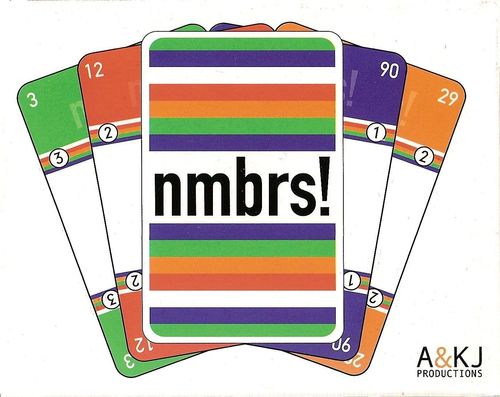
- Nmbrs! includes 104 playing cards colored red, green, blue and orange: 100 cards numbered 1-100 plus 4 jokers (figure 1). The jokers may be used for all numbers 1-100.
- Each card has a value of 1, 2 or 3 points, depending on the difficulty of the card. The value is circled on the card (figure 2). The jokers have the value 0.
- Nmbrs! can be played with 2 to 8 players. Each player starts with a total of 50 points.
- The game has one or more rounds. At the beginning of each round, shuffle all cards and deal each player 7 cards (two players: 9 cards).
- The remaining cards in the deck are placed face down in the center of the table. Then turn over the top card and place it face up beside this deck.
- The turns continue in a clockwise direction.
- To begin your turn, take the top card from either the face up or the face down deck. If, at the beginning of your turn, you don't want to take the top card from the face up deck, the players after you may (clockwise) decide if they want to take this card. The player who wants the card has to take an additional card from the face down deck too. Afterwards the player who was on the turn still has to take a card; you may choose if you take the new top card from either the face up or the face down deck.
- Try to form logical sequences with the cards you have in your hand. A sequence consists of 3 or more cards. If you have such a sequence, you may play it now if you wish. Examples of valid sequences: see figure 3.
- Once you have played a complete sequence, then in this or any subsequent turn you may add cards to existing sequences, also to sequences from other players. You may place a card at the beginning or the end of a sequence (figure 4) or insert cards (figure 5). You may also place cards crosswise onto a sequence creating a new sequence (figure 6) or link sequences with your cards (figure 7). Sequences must consist of at least 3 cards in all directions!
- Each time you create or add to a sequence, you calculate the score based on the values of the cards you played; the score is added to your total on the score-card. The cards already on the table are not added to your score!
- Your score is doubled when all the cards in the sequence are the same color or all the cards are a different color. This rule applies also to the cards that you add to existing sequences.
Advanced Rules
For experienced players some additional rules apply concerning the validity of sequences.
A. A valid sequence must exactly start at "0" when you count the sequence "backwards". The sequence 10-20-30 (figure 3) is an example of such a sequence: counting back you have 30-20-10-0. All common multiplication tables apply to this rule: see the sequences in figures 3-7. But the sequence 14-20-26 in figure 3 is not valid: counting back this sequence starts at "2": 26-20-14-8-2.
B. A valid sequence may also start at "1" when you count the sequence backwards. Examples of sequences starting at "1" are given in figure 8, like 11-16-21: counting back you have 21-16-11-6-1. The sequence of odd numbers (1-3-5-7-...) is also an example applying to this rule. The sequence 14-20-26 (figure 3) doesn't apply to this rule, so it is not a valid sequence.
Simplified Version of Nmbrs!
The simplified version of Nmbrs! may be used by young players who just start learning the multiplication tables and who cannot calculate up to 100 very well. Starting with the rules 1-15 the following rules apply:
a. Only the cards 1 t/m 50 and the 4 jokers are used.
b. Each player starts with 20 points instead of 50 (rule 3).
c. Each player gets 5 cards instead of 7 (rule 4); with two players each gets 7 cards.
d. If you calculate the score you don't count the values of the cards (rule 10) but only the number of cards you played. Similar or different colors (rule 11) still are doubled.
e. You don't have to discard your very last card (rule 13) on the face up deck!