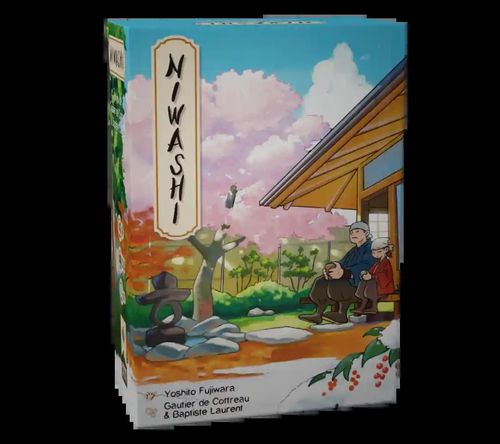
Niwashi
Niwashi Rulebook
Table of Contents
Table of Contents
Concept
During a game of Niwashi, the two Partners (the players) work together to build a Garden, aiming to complete as many Objectives as possible.
Taking turns, and respecting the tranquility of the place, place a Garden tile or give hints to your Partner using the Lantern. Direct communication is not allowed.
Will you be able to communicate differently to bring your Garden to life over the years?
Matériel
- 62 Garden Tiles featuring 3 Colored Plots (Winter, Autumn, Spring, Summer) and Sand
- 2 Reference cards
- 24 Objective Tiles
- 1 Rulebook
- 1 Travel Guide
- 1 Lantern Token (tōrō)
Mise en Place
Make sure to leave enough space for your Garden to expand freely from the central tile in all directions.
- Shuffle the Garden tiles, return 15 to the box, then form a draw pile with the remaining 47 Garden tiles to the side of the play area.
- Place the first Garden tile from the draw pile face up in the center of the play area to start the Garden.
- Each player draws 3 Garden tiles to make up their starting hand.
- Draw 3 Garden tiles face up next to the draw pile to form the River.
- Set up a Discard area next to the River.
- Place the Lantern and the two Reference cards behind the draw pile.
- Shuffle the Objective tiles and deal 10 to you and your Partner. Return the remaining 4 back in the box without looking at them.
- Each player forms a personal draw pile with the Objective tiles they received, and adds the first 2 tiles to their hand.
- Invite your Partner to start the game.
Common Language
In this game, you are not allowed to share information with your Partner (either verbally or through gestures) about the Objective tiles in your hand. However, it is your Partner's responsibility to complete the patterns shown on your Objective tiles.
Under these conditions, it may seem (very) difficult to make yourself understood, and therefore, to play! That's perfectly normal: throughout your games, you will develop a Common Language together.
To convey the Objective tiles you have to your Partner, you will need to use all the elements of the game: the way you place your Garden tiles, the Colors, the tiles in the River, and most importantly, the Lantern.
Game Progression
During a game of Niwashi, you will play in silence, taking turns. The game ends as soon as one of the Partners can no longer place a tile (see End of Game).
Turn Structure
- Validate one or more Objectives (optional).
- Place a Garden tile OR Move the Lantern.
- Complete your hand.
- You will need to wait several turns for your Garden to expand and for you to be able to validate one of your Objectives.
1. Validate Objectives
Once your Garden has reached a sufficient size, colored shapes will begin to appear. You will then be able to validate the associated Objectives.
For an Objective tile to be validated, it must meet the following conditions:
- Its Pattern (Shape + Color) must be visible in the Garden.
- The last Garden tile placed by your Partner must have at least one Plot in common with the Pattern visible in the Garden.
Once validated, place the Objective tiles face up next to each other.
If there are any Objective tiles left in your personal draw pile, immediately draw a new one to have up to 2 in hand.
As long as the conditions are met, you can continue to reveal Objective tiles from your hand before moving on to the next phase.
- The shape of the Objective tile can be oriented in any direction within the Garden.
- If multiple Objective tiles are valid simultaneously, you must reveal all matching tiles one by one.
- The pattern of the completed Objective tile does not need to be "isolated": the Color of the surrounding Plots does not matter.
- If the Objective tile you draw immediately after revealing an Objective also meets its conditions, you can reveal it immediately.
- Sand Color Plots do not contribute to the patterns of the Objective tiles; they are not "Wilds."
2. Place a Garden Tile OR move the Lantern
If you have at least one Garden tile in hand, you must place one in the Garden or move the Lantern. If you no longer have any Garden tiles in hand at the beginning of your turn, the game ends immediately (see End of Game).
2.a. Place a Garden Tile
Place a Garden tile from your hand into the Garden, while respecting the following constraints:
- Tiles must be placed orthogonally to each other.
- The placed tile must cover 1 or 2 Plots of one or more already placed Garden tiles.
Once the Garden tile is placed, move on to the next step.
- You cannot place a tile that would only touch others without covering them.
- You cannot place a tile that would cover 3 Plots.
2.b. Move the Lantern
Instead of placing a Garden tile, you can choose to move the Lantern to guide your Partner.
Take the Lantern and place it wherever you want in your shared play area.
Then, discard all Garden tiles from your hand face up in any order of your choice onto the Discard pile.
At any time, if the Lantern hinders you from placing a tile or performing any other game action, you may move it behind the Draw pile.
- The Lantern can be placed on a shape, a Color, a tile in the River, or indicate a direction...
- The Lantern can be oriented in any direction you choose.
- It is up to you to decide where your play area ends...
- This communication mechanic is essential to the success of your games.
3. Complete Your Hand
At the end of your turn, you must complete your hand so that it contains up to 3 Garden tiles:
- If you placed a Garden tile without activating the Special Case → choose a tile from the River.
- If you activated the Special Case → choose a tile from the River or draw the top tile from the Discard pile.
- If you moved the Lantern → take the 3 Garden tiles from the River.
Special Case
If, by placing a Garden tile, you cover at least one Plot with a Plot of the same Color, you gain access to the Discard pile in addition to the River to complete your hand.
- All colors matter, seasons or sand.
- If the Discard pile is empty, you only have access to the River.
Once your hand is complete, fill the River, if possible, up to 3 tiles using the Garden tiles from the Draw pile.
- If the Discard pile is empty, you only have access to the River.
- Once the Draw pile is emptied, the River no longer fills up, but the Partners can continue the game and take Garden tiles from it.
- Once the River is emptied, you can continue to draw tiles from the Discard pile, but only if you have activated the Special Case.
End of Game
The game ends when one of the Partners has no more Garden tiles in hand at the beginning of its turn. It also ends when all Objective tiles have been validated.
Your score is equal to the number of validated Objective tiles by both Partners. Try to improve your score by playing with the same Partner again.
- For a first game with a new Partner, a score of 6 to 10 validated tiles is already respectable.
- Exceeding 15 validated tiles is a real challenge.
- It is possible to validate all the tiles!
Additional Tips
Here are some tips to help you build a Common Language during your first games.
- The Lantern allows you to give your Partner a clue about what you would like them to play: a Garden Plot, a Color, a Pattern, an orientation, a location...
- Don't forget that the Lantern can be placed however and wherever you want—create your own language.
- You will have to both start your own Patterns and then try to complete those of your Partner. "Speak" by placing your tiles, and "listen" to what your Partner places.
- Discarding your hand doesn't necessarily bring you closer to the end of the game: under certain conditions, the Garden tiles in the Discard pile remain accessible for completing your hand.
- Sand-colored Plots can also carry meaning: perhaps it's up to your Partner to place the Plot you need, or it could mean your Pattern may not continue in this direction... Invent your own language!