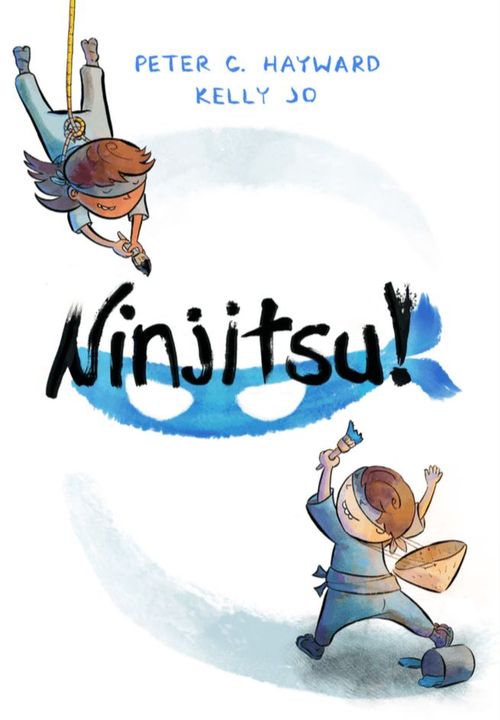
Ninjitsu!
Ninjitsu! Rulebook
Table of Contents
Table of Contents
Your Mission
You are the head of a noble Ninja House, competing to collect great treasures and hide valuable secrets.
Components
- 41 cards
- Rulebook
Setup
Shuffle the cards together to form the deck. Do not include any expansions for your first few games.
Deal 4 cards to each player, then place the deck in the middle of the table.
The player wearing the darkest clothing takes the first turn and play continues clockwise.
Gameplay Basics
The first player with 21 or more points (17 or more points in a 5-player game) at the start of their turn is the winner!
On their turn, players must do one of the following:
- DRAW 2 cards from the deck
- PLAY a card from their hand, either:
- for its Action, into the discard pile
- as a Secret, face-down into their collection
- as a Treasure, face-up into their collection
- STEAL a secret from another player's collection
(The example game-in-progress diagram shows the deck, discard pile, and each player's hand and collection.)
Cards
- The card's point value. This adds to your point total while the card is in your collection.
- Cards without a number (King, Queen, Jack, Ace, Joker) have no point value.
- The card's effect. Cards with lightning bolts are action cards. Their effect only applies when they are played into the discard pile. Cards with gear icons have ongoing effects. Their text tells you when they apply. They must be played as secrets or treasures.
- (Effect text, see 3.)
- The card's suit and art. These have no in-game significance.
Gameplay
Each turn, you must either Draw, Play, or Steal.
Draw: The Top 2 Cards from the Deck
There is no hand limit. If the deck is empty, shuffle the discard pile to form a new deck.
Play: A Card from Your Hand
Cards can be played in one of three different ways:
1. For Their Action
Cards with lightning bolts can be played straight into the discard pile for their action. When you use a card this way, ignore its points.
If you can't complete a card's entire action, do as much as you're able to. For example, if your hand is empty, ignore any part of an action that lets you play a card.
2. As a Treasure
Cards which have a point value can be played face-up into your collection as treasures. When you play a card this way, ignore its action.
Cards with the treasure chest icon have an ongoing effect as long as they are face-up as treasures in your collection.
Cards with no point value (Ace, King, Queen, Jack, Joker) may not be played as treasures.
3. As a Secret
All cards, even those without a point value, can be played face-down into your collection as secrets. When you play a card this way, ignore its action.
Every face-down card in your collection is a secret, regardless of how it was turned face-down.
When a secret is turned face-up, it becomes a treasure. If it has no point value, discard it. While face-down, secrets are not treasures. They can only be affected by cards which specifically target secrets.
Cards with the key icon have an altered point value while they are face-down as secrets in your collection. If they are turned face-up, this effect no longer applies.
You may look at or rearrange your secrets at any time, but not the secrets of other players.
Steal: A Secret from an Opponent
Steal an opponent's secret by moving it into your play area and turning it face-up.
Only secrets may be stolen this way.
If a stolen card has no point value (Ace, King, Queen, Jack, Joker), discard it after resolving any traps. Otherwise, it remains in your play area as a treasure, even if it was trapped.
Cards with the bomb icon are trapped. When they are stolen by an opponent, that player must immediately resolve the card's effect.
Cards without a bomb icon have no effect when stolen. When a trapped card is affected in any other way (discarded, moved, or swapped) its effect does not trigger.
Traps trigger when stolen by any method, on any player's turn.
TIP: New players often underestimate the power of stealing secrets from an opponent. After stealing a secret, you get to keep it as a face-up treasure, contributing towards your points.
Winning the Game
If you have 21 or more points (17 or more in a 5-player game) in your collection at the start of your turn, you win!
Points on both treasures and secrets count towards your total.
If you miscount and incorrectly declare that you've won, turn all of your secrets face-up and skip your turn.
Playing with Other Treasure Hunters Games
Ninjitsu! can be played with other games in the Treasure Hunters series. Shuffle them into the Ninjitsu! deck and play by the rules of Ninjitsu!
Traps apply whenever a trapped card is stolen, whether it is a secret or a treasure at the time.
Non-Ninjitsu! cards played as secrets are worth their printed value. Their effects do not apply while they are face-down. Secrets in play cannot be affected by any non-Ninjitsu! cards (they're too secret!).
When the term destroyed appears on a card, it means discarded from play.
When a card is protected, it cannot be stolen, discarded, moved, or swapped. Secrets can never be protected.
Whenever a card refers to cards in front of a player, treat it to mean in that player's collection.
Permanents do not count as treasures. When a secret is turned face-up, it always becomes a treasure or gets discarded; it never becomes a permanent.
Sample Gameplay
Kelly plays a Bo Staff face-down into her collection as a secret. It has a printed value of 4, and also gives her +2 for every secret she has in play.
Peter draws 2 cards.
Roxy plays Explosives face-down into his collection as a secret. It has a printed value of 2.
At the start of Kelly's second turn, she has 6 points in her collection, although no one knows this. Not enough to win! She decides to steal a secret. She steals Roxy's secret without knowing what it is. Kelly moves it into her collection and turns it face-up. It's Explosives, and it's trapped!
The trap means that Kelly must discard her hand. She keeps the Explosives she stole as a face-up treasure.
At the start of Peter's second turn, he has 0 points in his collection. He plays a Katana into the discard pile for its action. It allows him to discard an opponent's treasure from play and then play another card. He discards Kelly's face-up Explosives, and then plays another Katana as a treasure, giving him 6 points.
Glossary
- Cards with lightning bolts can be played for their action, which triggers immediately.
- Cards with a gear icon have an ongoing effect, and cannot be played to the discard pile for their action.
- Whenever a card is discarded, move it face-up to the top of the discard pile.
- When cards are discarded from play, the current player chooses which cards are discarded.
- When cards are discarded from your hand, you choose which cards to discard.
- Effects which say "any" card can target cards belonging to anyone, even yourself.
- A player's collection consists of the treasures and secrets they have in front of them.
- All cards in players' collections are in play. Cards in the discard pile or players' hands are not in play.
Quick Reference Guide
Setup: Shuffle all the cards together to form the deck. Deal 4 cards to each player.
Each turn, either:
- Draw 2 cards from the deck
- or Play a card from your hand
- or Steal a face-down secret from another player
Cards can be played:
- for their Action, into the discard pile
- or as a Secret, face-down into your collection
- or as a Treasure, face-up into your collection
Winning: If your collection has 21 or more points (17 or more when playing with 5 players) worth of secrets and treasures at the start of your turn, you win!