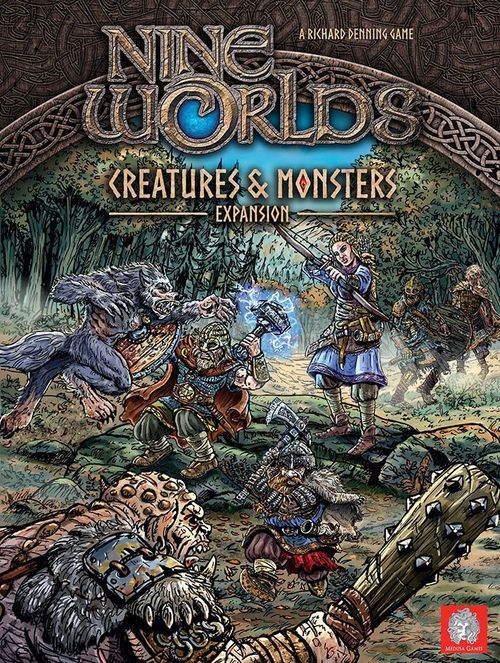
Nine Worlds: Creatures and Monsters
Official rulebook: Medusa Games · PDF
Nine Worlds: Creatures and Monsters Rulebook
Table of Contents
Table of Contents
- Overview of Play
- Contents
- Setup
- Monster Cards
- Turn Sequence
- Battles and World Powers Phase
- Valhalla Phase
- Scoring Phase
- Turn End Phase
- Rules for Playing Game Variants
- Avatar Powers
- The Long Game
- Sagas and Treasures Expansion
Overview of Play
The aim of the Nineworlds base game is to achieve domination by controlling as many of the individual worlds, and their world powers, as possible.
The Nineworlds: Creatures and Monsters expansion introduces a new dimension where players divert some of their player stones to the fight against the monsters, with the relevant stones eventually returning from that battle to a variety of locations including Valhalla, the player cards and even Helheim!
Defeat of the monsters will yield rewards in terms of victory points, bonus tokens and possibly monster powers which players can use to enhance their strategies. Failure to tackle the monsters means that various players will suffer penalties with the least courageous, who have done the least to fight the monsters, treated harshly by the norns who govern the fates of all.
The key to this expansion is balancing the division of the action points between actions in the Nineworlds and engaging the monsters.
Contents
- 16 Monster Cards, divided into Class I and Class II
- 1 Summary Card
- 1 Warriors' Hall Card
- 19 Class I Bonus Tokens
- 31 Class II Bonus Tokens
- 8 Starting Battle Tokens
- 1 Lycanthrope Token
Setup
Lay out the Nineworlds base game in the usual way.
-
In a 3 or 4 player game give each player 2 Starting Battle Tokens. In a 5 or 6 player game give each player 1 Starting Battle Token.
-
Sort the Class I and Class II Monster Cards into two separate decks. Shuffle each deck and lay them face down near to the Nineworlds board. Depending on the number of players, deal out Class I Monster Cards.
| Players | Monster Cards |
|---|---|
| 3 | 2 |
| 4 | 3 |
| 5 | 4 |
| 6 | 5 |
-
A. Place the Monster Cards in a vertical line. B. At the end of the line place the Warriors' Hall Card.
-
A. Sort the Bonus Tokens into two sets (Class I and Class II). B. Now place one face up Class I Bonus Token next to each bonus slot on the face up Monster Cards. The colour of the slots matches the colour on the back of the tokens.
-
Place the Lycanthrope token on the table near the board. You are now ready to play.
These rules explain how to use the expansion as part of a 3 to 6 player standard game of 6 turns. Additional notes on avatar powers, the long game (9 turns in all) and the Sagas and Treasures expansion as well as the 2 player game can be found at the end of these rules.
Monster Cards
There are 16 Monster Cards in Nineworlds: Creatures and Monsters. There are 8 Class I monsters which are used in the first three turns of the game (Era I) and 8 Class II monsters used in the last three turns (Era II).
Each Monster card has a standard layout as shown on this example.
- Monster Points: This is how many Monster points the card is worth. Monster points equate to victory points scored in a scoring phase. In each scoring phase, whoever has the most Monster points will score additional bonus points.
- Title: The name of the monster in English and German.
- Monster Power: If the monster has a power it is shown here.
- Bonus Slot: Bonus tokens are placed here. Bonus Slots are either yellow for Class I tokens or blue for Class II tokens.
- Penalty Icons: These are the penalties that may be suffered.
- Stone Spots: Players will move their stones to these locations in the Monster Sub-Phase. The icon on each Stone Spot determines to where a stone placed on that Stone Spot will move if the monster is defeated. The Monster Card itself will be won by the player with the most stones on that card or, if there is a tie, the tied player whose stone is furthest to the left of the top row of Stone Spots.
- Penalty Box: This contains two numbers separated by a forward slash (/). The first is the minimum number of stones that a player must have placed on that Monster Card to avoid suffering a penalty should this monster remain undefeated during a scoring phase. The second number indicates how many penalties will be suffered (either alone by the player who wins the card if the monster is defeated or by each player who is un-protected (i.e. who has not contributed sufficient stones to that fight) should the monster remain undefeated during a scoring phase).
Turn Sequence
Game-play in Nineworlds: Creatures and Monsters follows the same rules as the base game with these exceptions:
Player Order Phase
After player order has been determined, each player is asked if they wish to play a Change Player Order Token.
Action Points Phase
This phase is unchanged.
Actions and Monster Phase
The Action Phase is now divided into two Sub-Phases: the Action Sub-Phase and the Monster Sub-Phase.
Action Sub-Phase
In addition to the standard actions, players may spend one or more action points to move one or more stones from their reserve, player card or any world to the Warriors' Hall Card. After every player has spent all their action points each player, in player order, may choose to spend one or more Action Point Tokens in order to obtain additional action points which they then spend immediately.
Monster Sub-Phase
This consists of several activities completed in the order shown below.
Placing Stones: In player order players now move one of their stones from the Warriors' Hall Card to any empty Stone Spot on any Monster Card. Repeat this until all stones on the Warriors' Hall Card have been placed. Placement is compulsory. If all available Stone Spots are full, any surplus stones remain on the Warriors' Hall Card for placement in later turns unless this is the last turn of the game in which case they are returned to player's reserves.
Battle Token: If any Stone Spots remain unoccupied at this stage, each player is asked (starting with first player and proceeding in player order) if they wish to play a Battle Token. Players continue taking it in turns to spend Battle Tokens in this manner until they either run out or pass or when all the Stone Spots are occupied.
Resolve Monster Cards
This is done either if all the Stone Spots on a card are full or if it is a scoring phase. Monster Cards are resolved one by one starting with the card nearest the draw pile, completing all the following steps before moving to the next Monster Card.
Stone Spots: Determine if all of the Stone Spots are full. If so, the monster has been defeated.
Stones: Determine how much each player has contributed to the defeat of that monster. The player with the most stones on the card is the winner and will take the Monster Card. In the event of a tie, the tied player who has a stone furthest to the left on the top row of Stone Spots wins the card.
Second Place: Determine which player came second etc in the same way.
Example: The yellow and blue player are tied. Yellow wins because they have a stone furthest to the left on the top row of Stone Spots.
Allocate Bonus Tokens
The player who won the card gets first choice of bonus token. Now the player who came second chooses a bonus token and so on, continuing to rotate through players until all the tokens have been taken. The chart shows in which phase each bonus and penalty token may be played and the effect of that token.
Bonus and Penalty Token Chart
The chart lists each token with the phase in which it may be played and its effect.
Phase 1
- Change Player Order: After the player order has been determined in the usual way, playing this token allows the player to alter the player order by moving the player's marker up to two spots in either direction.
Phase 3
- Action Point: This may be played after all players have used all their action points to allow an additional action point to be spent.
- Battle: This may be played after all player stones in the Warriors' Hall have been placed to allow a player to move a stone from that player's reserve, card or any of the 9 worlds to any empty Stone Spot on any Monster Card.
- Victory point: Immediately score 2 victory points and discard.
- Victory point: Immediately score 3 victory points and discard.
Phase 4
- World Power: May be played in world number order immediately before the normal World Powers' phase to use a World Power. See main game rules for power effects.
- Temporary Stone: At the start of the Battles and World Powers phase play to add one Temporary Stone to any world.
Phase 6
- Bonus Victory Point: Discard in any scoring phase of Era II to score 2 points for any world you have a stone upon. Maximum bonus score 10 points.
- Bonus Victory Point: Discard in any scoring phase of Era II to score 2 points for any world you control and 2 points for any world you share control of. Maximum bonus score 10 points.
- Bonus Victory Point: Discard in any scoring phase of Era II to score 4/6/8 or 10 points for having 8/10/14 or 18 stones in the Nineworlds.
- Bonus Victory Point: Discard in any scoring phase of Era II to score 4/6/8 or 10 points for owning 5/8/10 or 12 points worth of monsters.
- Bonus Victory Point: Discard in any scoring phase of Era II to score 1 point for each stone you have on your player card. Maximum bonus score 10 points.
- Bonus Victory Point: Discard in any scoring phase of Era II to score 2 points for every stone belonging to any player in Helheim. Maximum bonus score 10 points.
Allocate Penalty Tokens
If the monster is defeated, then the player who won the card will suffer 0, 1 or 2 penalties of their choice dependant on the number indicated in the Penalty Box on the card (see Monster Cards section above). The player can only choose each penalty once.
If the monster is not defeated, and it is not a scoring phase, no further action is taken. Proceed to resolve the next Monster Card.
If the monster is not defeated and it is a scoring phase you now allocate penalty tokens to players (except with some Phase I monsters which have no penalties). Unprotected players must take 1 or 2 penalty tokens as shown by the number in the Penalty Box on the Monster Card. They each take it in turns to pick a token, starting with the player who has placed the most stones on the card of those who must take a penalty. In the event of a tie it is the tied player who has a stone nearest to the left of the first row of Stone Spots who chooses first. If still tied choose in player order. Resolve the effect of the token immediately before proceeding to the next player. Note that some penalties have numbers on (4, 5 or 6) which show there are only used in games with that many players. If the number in the Penalty Box is a 1 then each penalty may only be selected once. If it is a 2 then penalties may be selected by 2 players. You may wish to use spare stones to indicate which penalties are chosen.
Penalties
- Move the avatar: The player to your right moves your avatar to any adjacent world.
- Move a stone: The player to your right moves any one of your stones to any adjacent world.
- Spend a point: The player to your right will undertake a 1 point action affecting your stones or your avatar. This means they can choose from the above two options.
- Destroy: Choose any one of your stones and place it in your reserve.
- Banish: Choose any one of your stones and place it in Helheim.
- Return: Choose any one of your stones and return it to your player card.
- Diminish: Lose 1 or 2 victory point.
Return of Stones
Starting with the stone on the Stone Spot at the left of the top row, and proceeding along the rest of the top row, then through each row below (always going from left to right) each stone is removed from the card as follows:
If the monster was defeated the icons under the stone indicate the location to which the stone must now be moved to.
- Valhalla
- Helheim
- The owning player's Reserve
- The owning player's Player Card
- Any of the Nine Worlds of the owning player's choice
- The owning player's home world
If the monster was undefeated all stones are sent to the player's reserve.
The winning player now takes the Monster Card and places it face up near their character card. If no player owns the card discard the card. Do not replace it yet.
Use Monster Powers
Each player in turn order may now activate any or all monster powers on monsters they have. The following table on the next page explains what the power is and how it works.
Monster powers are a new type of effect and are not Actions or World Powers. Thus effects which prevent or affect Actions or World Powers have no effect on Monster Powers.
Monster Powers Used in Monsters Sub-Phase
- Attract: Once per turn in the use monster powers step of the Monsters sub phase, you can move any single stone (belonging to any player) from a single world adjacent to your avatar into the world your avatar is on.
- Repel: Once per turn in the use monster powers step of the Monsters sub phase, you can move any stone from a world your avatar is on into an adjacent world.
- Destroy: Once per turn in the use monster powers step of the Monsters sub phase, you can return any one stone belonging to any player to the owning player's reserve.
- Return: Once per turn in the use monster powers step of the Monsters sub phase, you can return any one stone belonging to any player to the owning player's card.
- Power: Once per turn in the use monster powers step of the Monsters sub phase, you can duplicate any single world power. Note that using the Asgard power will affect the use of all world powers (both from tokens and from worlds) in the subsequent world powers phase.
- Change: Once per turn in the use monster powers step of the Monsters sub phase, place the lycanthrope marker beneath any other player's stone in a world where you also have a stone. Until the end of the subsequent Battles and World Powers phase that stone is considered to belong to you and is included in the assessment of who controls the world for world powers' purposes. In the event of the controlling player losing a stone in battle, this stone may not be selected unless it is the player's last stone in that world. This stone will never go to Valhalla. After the world powers have been resolved it will return to the control of the original player and the marker is removed and placed back on the Werewolf card.
Printed text: "placed back on the Werewolf card", as it appears in the source. The marker is the Lycanthrope token from Setup.
Situational Monster Powers
- Choose: This power activates in the Valhalla phase. Once per turn you score 3 points rather than 2 for one of your Valhalla stones which you return to your home world. Alternatively, you can score just 2 points and move that stone to any other world.
- Regenerate: Once per turn whenever one of your stones is moved from any of the Nineworlds to your reserve for any reason you may return it to the world it came from. If this occurs in a battle it happens after the battle is resolved and does not change the control of the world for world powers' purposes. You can rotate the card to show the power is used. Reset the card in the turn end phase.
Battles and World Powers Phase
This consists of several activities completed in the order shown below.
At the Start of This Phase
Each player, starting with the first player and proceeding in player order, is asked if they wish to play a Temporary Stone Token. If they do, place the token in any world and place upon it one stone from the player's reserve (a 'Temporary Stone'). Players continue taking turns to place Temporary Stones in this manner until they either run out or pass. Until the end of the Battles and World Powers phase that Temporary Stone is considered to belong to the player and counts towards the stones needed to control the world so as to have access to its World Power. During a battle this Temporary Stone is not removed unless it is the last stone that a player has on that world. A Temporary Stone never goes to Valhalla.
After Battles and Determining the Control of World Powers
Each player must decide whether to use any World Power Tokens they possess. These are resolved in the same order that world powers are resolved, starting with Asgard. Playing any of these tokens has exactly the same power and effect as playing a world power. If a player decides not to use a token they keep the token for use in future turns. If several players all wish to use a token giving access to the same world power, then they each use the power in player order.
After Power Tokens Have Been Used
Once players have used as many world power tokens as they wish the World Powers themselves are activated in the normal way.
Ending the World Powers Phase
At the end of the world power phase any stone on a Temporary Stone Token is returned to the relevant player's reserve and the Temporary Stone Marker is discarded. The lycanthrope marker is returned to the Werewolf card, but the stone it previously affected is left in play, coming once more under the control of the owning player.
Valhalla Phase
This phase is unchanged, although the Valkyrie monster power (if in play) will also occur in this phase.
Scoring Phase
When scoring in a scoring turn (turn 3 and turn 6), monster points are added to the player's score track. The player who scored the most monster points will earn an additional 5 victory points. If there is a tie for the most monster points all the tied players earn 3 victory points each. In any scoring phase in Era II, players may optionally score and then discard any of the Bonus Victory Point tokens. Note that any unused bonus tokens at the end of the game are worth 1 victory point each.
Printed scoring summary card: "Turn 3 + 6 — Most Monsters Points — +5 points (+3 each if tied)".
Turn End Phase
The Draugar monster power is refreshed (turn the card upright to show the power is available). Check to see if there are any Monster Card spaces unfilled and deal out new Monster Cards starting with the space nearest to the draw pile. Ensure the Monster Cards dealt out at the end of turns 1 and 2 are Class I monsters (so if 6 monsters have already been defeated by the end of turn 2, only 2 Monster Cards will be dealt out to be faced in turn 3). Similarly ensure that from turn 3 onwards only Monster Cards representing Class II monsters are dealt out. Add bonus tokens to these new Monster Cards.
Printed turn card: "Turn 1 + 2: Class I" and "Turn 3+: Class II".
Rules for Playing Game Variants
Team Play
If playing in teams using the Pacts option, then players' stones from the same team are considered separately when determining which player wins the Monster Card and suffers any associated penalty. Rules for the allocation of penalties for undefeated monsters follow the normal pattern.
If the Alliance option is used, then stones from a team are added together and treated as one for determining which team wins the Monster Card. The winning team may decide which of that team's players keeps the Monster Card, and which of them will suffer any penalty. Similarly, each team may choose to re-allocate penalties from undefeated monsters between team members.
Two Player Games
A two player game is played in the same way as the base game with each player controlling two Avatars and starting worlds with associated stones. The setup of this expansion follows a 4-player game and thus you will deal out 3 Monster Cards. Give each Avatar 2 Starting Battle Tokens. Each world's stones are considered independently when determining who wins the Monster Card, to which home world a stone will return and in which order bonuses are chosen.
Any bonuses won are placed on the Character Card for the Avatar of the same colour as the relevant stone. Bonus Tokens used by a player are always considered to have been played by the Avatar from which the relevant Bonus Token is moved when resolving effects. Similarly, when a Monster Card is won it is placed next to the Character Card for the Avatar of the same colour as that of the majority of stones on the relevant Monster Card, and any relevant monster powers are always considered to have been played by that Avatar when resolving effects. Only the top 4 penalties on any Monster Card are used, ignoring any penalties marked 5 or 6. Monster points are scored separately for each Avatar, as are additional points for having the most monster points.
The Full Game
The Sagas and Treasures expansion may be combined with the Creatures and Monsters Expansion, Avatar powers and the base game for an advanced and complex game. The combined game would be expected to last 3+ hours or even longer if the players elect to play the long game. Game play follows the normal rules for the individual elements as modified by notes on this page.
Avatar Powers
When using the Ullr Avatar power and electing to bring a stone from Valhalla to the world your Avatar is on you may score 3 points if you also use the Valkyrie monster power, just as if it were a home world.
The Long Game
In the long version of the game, 9 turns are played with a scoring phase at the end of turns 3, 6 and 9. In the turn end phase of turn 6 take any Monster Cards (whether of Class I or Class II monsters) which have not so far been used in the game. Shuffle them together along with any monsters that were undefeated when discarded. Use this combined deck to deal out and maintain the relevant number of Monster Cards for the number of players. Play the game as normal. All Monster Cards in play must be resolved in the scoring phase of turn 9 unless they have already been defeated. The six variable score bonus tokens may be resolved in the scoring turns of turns 4, 5, 6, 7, 8 or 9.
Sagas and Treasures Expansion
Adding the Nineworlds: Sagas and Treasures expansion to a Nineworlds: Creatures and Monsters game does not require any changes apart from the following:
- Players must choose whether to play a Temporary Stone Token before players announce they are using any treasures that have an effect at the start of the Battle Phase (i.e. Gambentain, Gjallarhorn, Gungnir.)
- Stones placed on Saetimnir are not considered Valhalla stones and are not affected by the Valkyrie monster power.