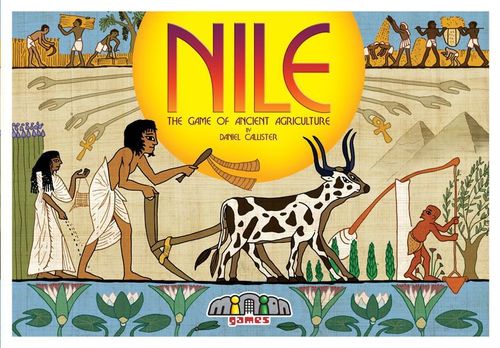
Nile
Nile Rulebook
Table of Contents
Table of Contents
Setup
There are five different crops, each represented by its own color: Papyrus (Red), Wheat (Yellow), Lettuce (Green), Castor (Brown), and Flax (Lavender), as well as several Speculation cards. Place the Flood card face-up in the middle of the table and set the Plague of Locusts card aside. Shuffle the remaining cards well and deal each player five cards. Mix in the Plague card randomly with the rest of the cards and place the deck face down as a draw pile. Select a starting player by any fair method.
Steps in Each Turn
- Flood
- Harvest
- Trade
- Plant or Speculate
- Draw
1) Flood
The top-most card in the draw deck is turned face up and placed on top of the Flood card. This card determines what fields will harvest (see Harvest) and what cards may not be played this turn (see Plant or Speculate). Speculation cards are also resolved during this step (see Speculation Cards).
2) Harvest
What crops may be harvested are based on the current Flood card. Each time a new Flood card is turned over, any player who has that crop currently planted (regardless of whose turn it is) removes the top card in that crop's field and places it face down into their individual storage pile.
Your storage pile is a collection of all of your harvested crops. Besides serving as your score and determining the winner, it may be inventoried and traded from throughout the game. Keep the contents of your storage pile secret from the other players!
If the Flood card is a Speculation card, it will show multiple crops. When this happens, all shown crops are then harvested. If the Plague of Locusts card is drawn as the Flood card, it is immediately resolved and discarded (see Plague of Locusts). A new card is then drawn in its place to serve as the Flood card.
3) Trade
Trading allows you to discard two old cards in order to receive a single new card. There are two options for trading:
Market – Discard any two cards (Crop and/or Speculation) from your hand and/or storage pile and draw one card from the draw pile. Add this to your hand.
Offering to Hapi – Discard any two cards (Crop and/or Speculation) from your hand and/or storage pile and replace the current Flood card with a new one from the top of the draw pile. This new Flood card acts as any other Flood card, thus causing a new Harvest and preventing certain cards from being played. Continue as if it's Step 2) Harvest again.
Players need not trade at all during their turn. Players may trade using both options in any order, any number of times per turn. All cards traded away are discarded. Players may not trade with each other, nor can planted cards be traded.
4) Plant or Speculate
The Plant or Speculate step is regulated by the Flood card. Any cards showing crop types that are currently flooded may not be played during this step.
Plant – To plant you must place crops from your hand face up in front of you, forming a field. While a field of a given crop type is in play, no one else may create a field using the same crop. As such, there are never more than five fields in play at any time.
When planting a new field, players may:
- Plant at least two cards of all the same crop type.
- Plant exactly two cards of differing crops (one of which may be planted into an existing field).
- Plant any number of crops to any number of fields that already exist in front of you.
A player may not plant a new field if another player currently has a field of that crop type in front of them, unless the new field will contain more cards than the existing field. When this happens, all cards in the other player's field of that crop type must be discarded immediately.
Speculate – Instead of planting, the active player may play one or two Speculation cards. These are cards with two crop types represented on them. When successful, a Speculation card allows that player to immediately draw three (3) cards into their hand. As with planting, Speculation cards showing crops currently flooded may not be played. To play Speculation cards, simply place them face-up in your play area.
Speculation cards are successful when they have at least one crop type in common with the next Flood card revealed. The game pauses and the player who played the Speculation card(s) immediately draws three (one card matched) or six (both cards matched) cards into their hand from the draw pile. All Speculation cards (successful and not) are then discarded and the game continues.
5) Draw
To end a turn, the active player draws the top two (2) cards from the draw pile and adds them to their hand. Once the active player has drawn their cards, their turn is over. The next player moving clockwise starts their turn as the active player. When the draw pile is exhausted, reshuffle the Flood stack, the Plague card, and all discarded cards to create a new draw pile.
Plague of Locusts
When the Plague of Locusts card is drawn it must be announced immediately. The player who drew the card sets it aside face up. If it is the Flood Card, flip another card to replace it. If you are drawing cards, finish doing so. The Plague card does not count as one of the drawn cards. Afterwards, determine which field has the most cards. All of the cards in this field are then discarded. If there is a tie, cards from all of these fields are discarded.
End of the Game
Play through the draw pile a number of times equal to the number of players (i.e. twice with two players, three times with three players, etc.). Once the final draw pile is exhausted the game ends. It helps to remember how many times the Plague of Locusts has come up to track the number of times you've played through the deck, or just use any marker or write it down.
Scoring
Individually, players separate the cards in their storage piles by crop type and then line them up in five piles from left to right, starting with the crop type of which they had the least cards (even if it's zero) and ending with the crop type of which they had the most. Players then start comparing their piles. Whichever player has the most cards in their left-most pile (the crop type with the least cards) is the winner. If there is a tie, the tied players compare their next pile and so on. In the event of an exact tie for all five piles… play again!
Optional Rules
To make the game go faster for 2 players, remove two crop cards of each type along with five randomly chosen Speculation cards. For 3 players you may want to remove 1 of each resource card.