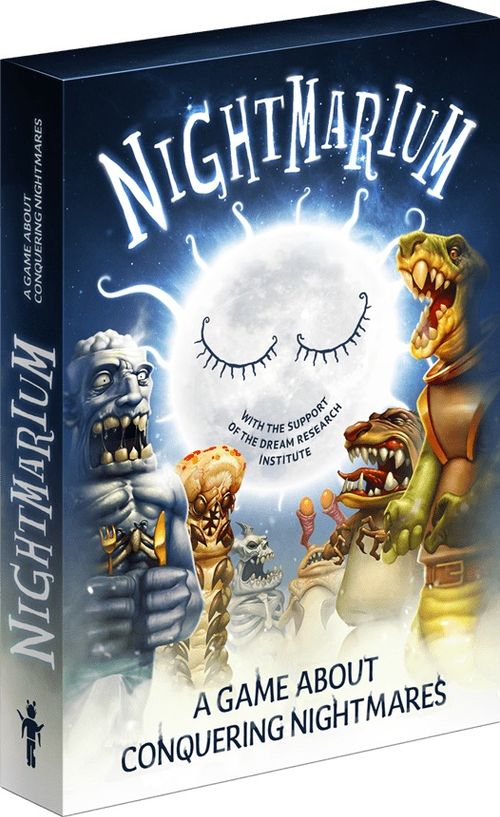
Nightmarium
Nightmarium Rulebook
Table of Contents
Table of Contents
Components
2–5 players, ages 10 and up, about 20 minutes.
- 108 Night Fear cards
- 1 "Secret" leaflet
- Rules (which you are holding now)
The Nightmarium box contains 108 Night Fear cards, which players weave together into Creatures. A completed Creature is made of three parts: legs, body, and head. The right edge of each card shows which body part that Night Fear can become. Most cards are usable for only one specific body part, but some Night Fears can be used as two, or even all three, of the body parts.
In addition, every Night Fear belongs to one of four Legions of Horror: Necromunculus, Constrict, Chimerid, or Manster. A card's background color shows its Legion: blue for Necromunculus, brown for Constrict, green for Chimerid, and red for Manster. A Creature can be made of Night Fears from any Legions, but it is more advantageous for players to weave Creatures whose cards all belong to the same Legion. The upper right corner of most cards shows a special ability, which triggers when a player completes that Creature. There are six such abilities, all described in detail below.
Setup and Turn Order
At the start of the game, shuffle the deck of Night Fears and deal 5 cards from it to each player. Players hold their cards in hand without showing them to their opponents. Place the deck face down in the middle of the table, leaving room next to it for a discard pile. If the deck ever runs out of cards during the game, shuffle the discard pile and place it face down as the new deck.
Players take turns clockwise, starting with whoever most recently had a nightmare. The game continues until one of the players completes five Creatures — that player immediately wins. If you wish, you may agree to play to a larger number of Creatures — six or even seven — but in that case you will need a fairly large table, especially with many players.
On your turn you perform two actions, then pass the turn to the player on your left. You may choose any two of the three possible actions below (or perform the same action twice).
Possible Actions
A) Draw a card from the deck B) Discard any number of cards from your hand and draw half as many cards from the deck C) Play a card from your hand and resolve the Creature's abilities (if it was thereby completed)
A) Draw a card from the deck
Simply take the top card of the deck into your hand without showing it to your opponents. You may hold as many cards in hand as you like.
B) Discard cards from your hand and draw cards from the deck
Discard any number of cards from your hand, then draw one card from the deck for every two cards discarded. For example, if you discard five cards, draw two cards; if you discard six, draw three. Place the discarded cards face up on the discard pile next to the deck.
C) Play a card from your hand
This is the main action of the game, the one you use to weave Creatures out of Night Fears. Choose one card from your hand and place it in front of you as part of one of your Creatures. When you do, you must follow these rules:
- A card can only be placed into the position (head, body, or legs) shown at its right edge.
- A head can only be added to a Creature that already has legs and a body.
- A body can only be added to a Creature that already has legs.
- Legs can simply be placed down (starting a new Creature). In other words, you always build a Creature from the bottom up.
- You are not required to fully complete one Creature before starting another. However, you may never have more Creatures in progress than are needed to win (usually five). For example, in a game played to five Creatures, if you have already laid down five sets of legs, you may not lay down a sixth.
- If your first action this turn was to play a card of a particular Legion, then your second action may only be to play a card of that same Legion (or you may choose a different type of action instead). This restriction does not apply when card abilities are being resolved (see below).
Resolving Abilities
As soon as you complete a Creature (by adding a head to its legs and body), resolve all of its abilities from top to bottom: first the head's ability, then the body's, and finally the legs'. Abilities are resolved one at a time, strictly in that order. You may not decline to resolve an ability.
If one of a completed Creature's abilities cannot be resolved because there is no valid target for it, then resolution of that Creature's abilities stops there — do not resolve that ability or any of the ones after it. In addition, resolution of a Creature's abilities also stops immediately if another completed Creature appears on the table while you are still resolving the first one (see the example below).
If a completed Creature is made entirely of Night Fears from the same Legion (in other words, all three of its cards share the same background color), then before resolving its abilities, each of your opponents must discard one card of that same Legion from their hand. If an opponent has no such card, they must discard two cards of their choice instead.
Creature Abilities
- Songbird — reveal two cards from the deck. Play them in front of you following the normal rules for playing a card, if you are able to. Discard any of these cards that you cannot play.
- Mourner — draw two cards from the deck into your hand.
- Mockingbird — play one card from your hand following the normal rules for playing a card.
- Executioner — take the top card of any opponent's Creature into your hand.
- Scavenger — discard any opponent's incomplete Creature.
- Devourer — discard the top card of any of your own Creatures other than this one.
By weaving Creatures with well-planned chains of abilities, you can seriously improve your chances of winning. For example, a Creature with the Executioner and Scavenger abilities can behead an opponent's completed Creature (leaving it incomplete), and then send it straight to the discard pile. Likewise, a chain of Devourer and Mockingbird lets you remove the head from your own Creature, attach a new one, and resolve its abilities all over again.
It can happen that, while resolving a Songbird or Mockingbird ability, you complete yet another Creature. In that case, stop resolving the abilities of the first Creature and move immediately to resolving the abilities of the new Creature (including having opponents discard cards, if all of its parts belong to the same Legion).
Example of Resolving Abilities
By playing a card, you add a head to Creature #1, completing it. The head and legs of this Creature both have the Mockingbird ability, so you must play one card from your hand, twice in a row.
Playing those two cards completes Creature #4, so you must now resolve its abilities in order: Devourer, Mourner, and Songbird.
With the Devourer you discard the head from your own Creature #2. With the Mourner you draw two cards from the deck. Then, with the Songbird, you reveal two more cards from the deck.
One of those two revealed cards turns out to be a head, and using the Songbird ability you immediately attach it to that same Creature #2 — the one you had just removed a head from.
Creature #2 is complete once again, so you resolve its abilities: Mockingbird, Songbird, and Devourer. With the Mockingbird you add a body to Creature #3. Then with the Songbird you reveal two cards from the deck — and one of them is again a head, which completes Creature #3.
Creature #2 never gets to resolve its Devourer ability, because another Creature has just been completed on the table, so you move on to resolving that Creature's abilities instead. First, you point out to your opponents that you have completed a pure Necromunculus (all three parts of the same Legion), so each of them must discard either one Necromunculus card or two cards of their choice. Then you resolve the two Scavenger abilities of Creature #3: you destroy an opponent's incomplete Creature, but you cannot find a second valid target, so your turn ends.