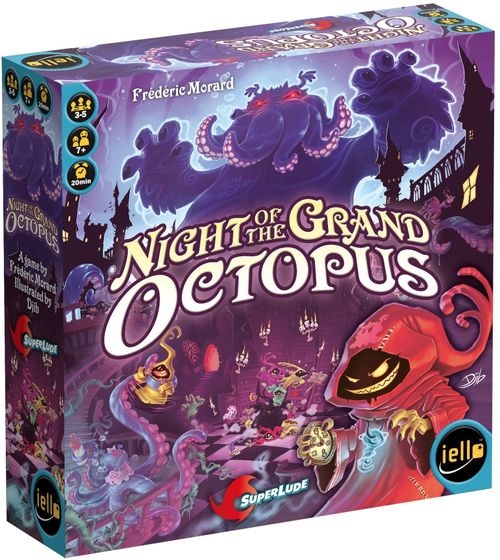
Night of the Grand Octopus
Night of the Grand Octopus Rulebook
Table of Contents
Table of Contents
Contents
In addition to these rules, you will find the following in this game:
- 1 gameboard representing the six principal Locations of the university: the library, the museum, the crypt, the laboratory, the observatory, and the botanical garden. Each of these Locations is numbered from 1 to 6.
- 1 Dagger of Power indicating the strength of each cult on a scale from 7 to 1.
- 2 two-sided boards, each side bearing a seventh Location that is situated outside the university (an Exterior Location): the Dimension of Dreams, Agoba Marsh, Colony of the Moon Men, and the Lost City.
- For each of the 5 cults: 1 Cultists pawn (representing the head of the cult, as well as its other members), 1 Offspring pawn (representing a monstrous creature, born of The Grand Octopus, and invoked by the cultists), 1 Cult Power marker, 1 Command Clock.
- 4 tokens for each type of Component (the objects necessary for completion of the ritual): grimoires, stone idols, skulls, potions, star charts, plants, silver keys.
Overview
Each player is the head of a cult dedicated to the Grand Octopus. Each group of cultists must scour the university in search of the four components necessary to complete the ritual that will allow Him to return to Earth. The first to succeed will invoke the Grand Octopus and thus have His favor.
Setup
- Place the gameboard in the middle of the table.
- Choose one of the four Exterior Locations, and place it beside the gameboard.
- Place the Dagger of Power near the gameboard.
- Each player chooses a cult color, and gathers his cult's material (2 pawns, 1 marker, 1 Clock).
- Carefully apply the stickers for the Cultists pawns and the Offspring pawns, making sure that each one gets a front sticker and a back sticker.
- Place all the Cult Power markers on the Dagger of Power. Place them on the space equal to the number of players plus one.
- Place all the Cultists pawns on the library, the central Location on the gameboard.
- Each player keeps his Offspring pawn nearby.
- Place a number of Component tokens on each Location, equal to the number of players minus one:
- Grimoires go in the library (1).
- Stone idols go in the museum (2).
- Skulls go in the crypt (3).
- Potions go in the laboratory (4).
- Star charts go in the observatory (5).
- Plants go in the botanical garden (6).
- Silver keys go in the Exterior Location.
Gameplay
The game is divided into a series of identical turns, during which all players play simultaneously. Each turn comprises a sequence of phases that you will resolve in the following order:
-
Choice Phase: Set your Command Clock to secretly select the Location to which you will send your Offspring (by pointing the tentacle on the large disc at the corresponding number), and the Location to which you will send your Cultists (by pointing the dagger on the small disc at the corresponding number).
You cannot send your Offspring and Cultists to the same Location.
The Offspring can always go anywhere on the central board. The Cultists, on the other hand, can only stay where they are, or move to an adjacent Location by following the stairs that connect to it. So, for example, it is impossible to go directly from the library to the botanical garden.
-
Revelation Phase: Once everyone is ready, everyone reveals their choices. Move your Cultist and Offspring pawns according to your choices.
-
Conflict Resolution Phase: During this phase, you will resolve conflicts by Location number (i.e. starting with the library, and ending with the Exterior Location). Several cases are possible:
-
The Location has only one cult (represented by their Cultists pawn) in it: This cult can gather one of the Components that is in this Location.
Note: Each cult can only have one Component of each type.
We declare that this cult dominates this Location. Place the gathered Component token face-up and prominently in front of the cult's leader (the player).
-
The Location has one or more Offspring, but there are no Cultists in it: Nothing happens… well, nothing that concerns us….
-
The Location has one or more cults (represented by their Cultists pawns), as well as one or more Offspring: Nobody can gather anything, and each cult loses 1 point of Cult Power, due to the inevitable battle between them and the opposing Offspring! (Move their Cult Power markers down accordingly.)
-
Variants
- 3-player or quick game: If you have only three players, or you wish to play more quickly (10–20 minutes), you can choose to play without Exterior Locations. In this case, use the following two rules:
- Pointing the Command Clock's discs in the same direction is considered an error setting your Command Clock (it is both an error commanding the Cultists, and an error commanding the Offspring).
- You only need three different Components (instead of four) in order to win.
- Variant for more experienced players: When you gather a Component, place the corresponding token in front of you face-down. Thus, the other players must remember your actions in order to foil your plans.
Exterior Locations
Exterior Locations, as their name suggests, are the Locations that are not inside the university, but rather beyond, on other planets, in parallel dimensions, or even other points in time. All of them obey a few general rules, and each has its own specific rules, too. The common rules are as follows:
- Visiting an Exterior Location: The Command Clock does not allow you to directly designate an Exterior Location. In order to get there, you must point the tentacle and dagger in the same direction on your Clock — it doesn't matter where they point. By doing this, the cultists perform the ritual that allows them to visit this Exterior Location, but as a result, they are not available to invoke the Offspring this turn. When you wish to send your Cultists pawn to the Exterior Location, you cannot use your Offspring pawn that turn.
- Conflict resolution: Resolve conflicts in the Exterior Location as usual. Therefore, it's possible to gather a silver key Component there.
- Leaving an Exterior Location: In order to leave an Exterior Location, simply select two different locations with the tentacle and the dagger, as usual (the cultists can reappear in any university location, and invoke the Offspring at the same time). You could instead choose to remain in the Exterior Location by once again pointing the tentacle and dagger in the same direction.
Talking, Whispering, and Betrayals
You are completely allowed to talk during the game in order to communicate intentions, or to formulate an evil scheme to disrupt the plans of a cult that has gotten a bit too far ahead.
HOWEVER, YOU ARE NOT ALLOWED TO…
- …whisper to one or more players. All discussions must be audible to all players. Similarly, you are not allowed to use secret codes or signs to communicate.
- …directly show the position of the discs on your Command Clock without changing them thereafter. Nobody should have any certainty about other players' choices.
On the other hand, you are completely allowed to lie, betray, and generally not keep your promises….
Errors Setting Your Clock
If you make a mistake setting your Command Clock, by indicating a Location your Cultists cannot reach, or by pointing the dagger "on the line" between two Locations, your Cultists pawn will not move during the Revelation Phase. However, the confusion caused by your command mistake has two consequences (lay the Cultists pawn down to remind you):
- You lose 1 point of Cult Power. Perhaps the cult leader has lost faith… or his mind?
- During the Conflict Resolution Phase, treat the Cultist pawn as if it is not in the location where it lies (the cultists are busy searching for the exit). This means that the cult cannot gather a Component this turn, cannot prevent another cult from doing so, and cannot participate in any negotiations. On the upside, the cult cannot suffer any further damage this turn (from Offspring or other cults).
Note that this is the only way that your Cultists pawn and Offspring pawn can end up in the same place. If this happens you must separate your Cultists and Offspring next turn.
If the tentacle is badly positioned ("on the line" between Locations), the cult cannot invoke the Offspring this turn (you cannot place your Offspring on the board). If you point both discs to the same Location, then conform to the rules for moving to the Exterior Location.
The Different Exterior Locations
Dimension of Dreams
The Dimension of Dreams is a parallel dimension you can enter through dreaming, or through one of the rare physical passages that are found in unexpected places. Although these lands can be dangerous for the inexperienced traveler, they offer numerous opportunities for those who know how to make the most of the situation. Thus, any good cult leader would take advantage of his stay to recruit a few additional members to ensure the longevity of his cult.
- If your Cultists pawn is in the Dimension of Dreams at the end of the Conflict Resolution Phase, you can gain 1 point of Cult Power (up to a maximum of 7); however, this is impossible if you lost a point of Cult Power (due to a conflict), or if you gathered a silver key this turn (if you dominated the Location, you must choose between gaining a cultist or gathering this Component).
The Dimension of Dreams allows for slightly longer games, and a little more tactics. By recruiting cultists, players can prolong the game, and avoid direct elimination. …but be careful not to fall too far behind while you daydream…
Agoba Marsh
Agoba Marsh is a place whose exact location remains a mystery. Many travelers claim they've encountered it in different parts of the world, or on other planets, or even in other dimensions. One possible explanation is that the Agoba Marsh lies at the junction between worlds, everywhere and nowhere at the same time.
- If you dominate this Location, regardless of whether you gathered a silver key, you may exchange one of your Components for one belonging to another cult. The end result must respect the rules: Neither cult can end up with two copies of the same Component.
Although the effects of Agoba Marsh are subtle and do not significantly affect the game length, they do promote interaction with the leading players, and thus infuse more twists into the game.
Colony of the Moon Men
Although the surface of the Moon has long kept no more secrets from Mankind, the same is not true for what goes on below the surface. Indeed a race of extraterrestrials has established a colony to monitor the human race, and to be able to acquire fresh specimens for their terrifying experiments. A cult leader would not hesitate to sacrifice one of his followers in exchange for a few favors….
- If you dominate this Location, and you forgo gathering a silver key, you may sacrifice one of your cultists (lose 1 point of Cult Power) in order to designate another cult for the extraterrestrials to target. That player must immediately discard one of his Components (of his choice), returning it to its original Location.
Controlling the Colony of the Moon Men offers a very important advantage over all the other cults, and allows rebalancing a game in which one of the other cults would have taken a decisive lead. Warning! Although games using this location become very tactical, they also promise to be long and full of twists and turns!
Lost City
A mysterious island, engulfed by waves, the Lost City is nothing other than the dwelling of the Grand Octopus Himself. Normally, the mere sight of its non-Euclidean architecture would be enough to drive a many completely mad. (Printed as "a many" in the source.) Tonight, the consequences could be even more disastrous….
- During the Conflict Resolution Phase, just before determining what happens in the Lost City, each cult in this cursed place loses 1 point of Cult Power. Then finish this phase as usual.
Unlike the other Exterior Locations, the Lost City is dangerous, but yields no benefit to the cults that dare venture there (other than to provide a silver key). This increases the likelihood that most cults will remain in the university, which will make the conflicts there more intense.