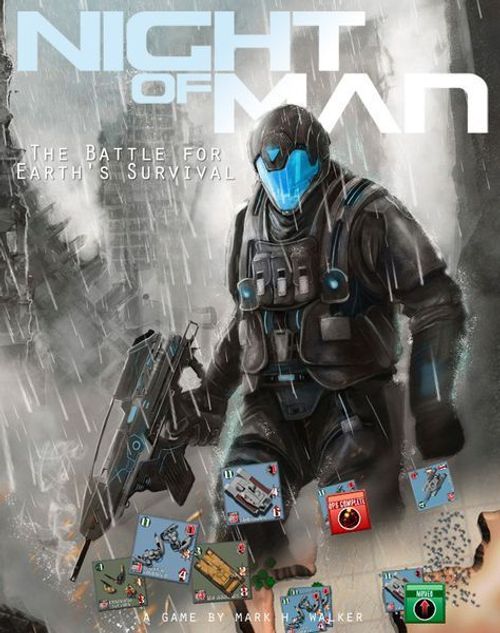
Night of Man
Night of Man Rulebook
Table of Contents
Table of Contents
- Introduction
- 1. Components
- 2. Terms
- 3. Scale
- 4. Sequence of Play
- 5. The Player Impulse
- 6.0 Movement
- 7.0 Stacking
- 8.0 Combat
- 9.0 Assault Combat
- 10. Soft Target Combat Results
- 11.0 Rally
- 12.0 Line of Sight
- 13.0 Vehicle Combat
- 14.0 Walkers and Kaiju
- 15.0 Card Actions
- 16.0 Abilities
- 17.0 Powers
- Official FAQ (3/7/17)
Introduction
Night of Man (NoM) is a card-driven game that recreates humanity's battles against the invading aliens, the Killers. These are version 2 of the rules. There are numerous small corrections, significant changes are indicated by red font. These are the living rules and do not include the scenarios or skirmish game that are part of the actual rule book.
1. Components
Each copy of NoM includes the following components:
- Four Maps. These regulate movement and give you and your friends something to fight over.
- Five Counter Sheets. Counters representing the alien Killers and humans fighting them. Also included are administrative markers used for signifying actions taken, combat results, and other functions.
- 54 Playing Cards. These cards activate the Killer and Human units in the game.
- Player's Aid Card (PAC). Provides various information used to play the game.
- Rulebook. It's in your hands right now.
- Eight scenarios. (Part of the rulebook).
2. Terms
The following terms are used throughout the rules.
a. Unit. Units are the fighters in NoM. For example, the human's Abrams tank, the Killer's MECA infantry, the Handler, and Jack. In short, any counter placed on the board and used to fight against the enemy. The numbers and icons on a unit represent the following. Note that with all these numbers, larger numbers represent a greater proficiency.
b. Hard Target: Any unit with an Armor Factor (AF), even a negative AF. These are almost always vehicles or Walkers. Hard Targets normally have one step. The flip side of the counter displays a vehicle wreck.
c. Soft Target: Any unit with an asterisk for an AF. Note that although trucks are vehicles, they are also soft targets. Infantry are the predominant form of Soft Targets. The term Infantry is frequently used in the rules and scenarios. The terms Infantry and Leg (6.1) units are used interchangeably throughout the rules. They are:
- Units that depict, in an overhead view, soldiers or civilians (including the Killers' MECA).
- A Character. A unit whose portrait is on the counter.
- A Leg movement class. At least so far.
- Infantry normally have two steps, the side of the counter with a gray band is the reduced unit.
c. Targeting Modifier: The top left. This number represents the unit's Ability to target vehicles with armor piercing (AP) ammunition.
d. Armor Factor (AF): The bottom left. This number represents the unit's Ability to survive a hit by AP ammunition. An asterisk indicates that the unit is a soft target and cannot be targeted by AP ammunition.
e. Armor Piercing Factor (APF): The top right. The APF factor represents the unit's Ability to destroy vehicles with Armor Piercing (AP) ammunition.
f. High Explosive Factor (HEF): The middle right. Represents the unit's Ability to damage enemy units that do not have armor. These are referred to as soft targets.
g. Movement Factor (MF): Represents the number of movement points the unit is allocated per impulse.
h. Powers and Abilities. In addition to the above factors, some units may have Powers and Abilities.
- Powers: This is located in the bottom center of the counter. May be activated when a card which reads "Power" is played by the unit's owner. Whenever a unit uses a Power, it is marked Ops Complete.
- Abilities: Located along the left side of a unit. Most abilities are always on, but a handful, such as Suppression or the Spiderbots' Combined Fire, may be used at the owner's discretion.
Mark says: Powers do not always represent special Powers, but rather a capAbility that the unit possesses. For example, a unit with the Explosive Rounds Power has the capAbility to fire explosive rounds that are more effective against soft targets. With tanks, this might represent high explosive rounds; with infantry, this might represent rifle grenades.
i. Characters: Characters are units, but they are much more. They represent special heroes, Mentals (humans with enhanced abilities), or individuals that can turn the tide of battle. A character is represented with a portrait on the counter. For example, Larkin or the Handler.
j. Cover Factor (CF): Most of the terrain has a Cover Factor that represents the amount of protection that the terrain offers. This CF is found on the Terrain Effects Chart (TEC).
k. Impulse. The playing of card or cards to activate unit or units to perform actions. Players alternate impulses until the turn ends.
l. Phasing Player. The player whose impulse it is.
m. Turn. A turn consists of numerous impulses and ends when the scenario-designated number of End Turn cards are drawn (Usually three).
n. Markers. These are the administrative markers that assist in tracking game functions and signifying the status of units. Examples are the Turn marker, Fired Marker, Moved marker, etc.
o. Cards. These are the playing cards used to activate a player's units, enhance their abilities, or disrupt an opponent's actions. Each card has the following components:
- Upper and lower Action Blocks: These contain the text and denote actions that your units may take or enhancements to actions taken. Three colors code these actions: green, yellow, and red.
- The green blocks denote an action only played in the player's impulse. Unless modified by the text on a card, only one action may be played in the player's impulse. For example, a player may play a card with a Move action in the lower Action Block, to move one unit.
- The red blocks denote an action to be played during the opposing player's turn, in reaction to an action that he has taken. For example, a Glancing Shot may be played in reaction to a Fire Action that results in a hit.
- Yellow blocks support an Action. For example, a player could play Bullet Storm to support, i.e. enhance, an attack on an enemy soft target.
- If the block contains the word "Power," the selected unit may activate a Power in addition to firing or in lieu of firing.
p. Targeting Number (TN). This is located in the lower left block and this number (-2 to 10 and Miss) is used to determine whether or not the target of Armor Piercing (AP) fire is hit. There are also three other pieces of information sometimes found in this block.
- Turret Hit: This means that the vehicle's turret, or heavily armored section, has been hit, increasing the targeted unit's AF by one.
- MF: When this card is drawn, a vehicle using moving fire automatically misses its target.
- Miss: The shot misses its intended target.
q. APF Bonus: This number is added to the attacking unit's APF and compared to the target's AF to determine if the target is destroyed. This number is either the sole number in the lower right block or the number in the lower half of the block. There are four other results located in the APF Bonus block. They are either located in the lower half of the block or are the sole result in the block. Shake, Dud, and Destroy apply to the targeted Hard Target. Hit or *Hit applies to a Soft Target.
- Shake!: The target is shaken.
- Dud!: There is no effect on the target.
- Destroy!: The target is destroyed.
- Hit or *Hit: See below.
r. HE Result: This is located in the top half of the lower right block. If the word "Hit" is present, the target suffers a hit (see Combat). If the Hit is preceded by an asterisk, the result only applies in Assault Combat (9.0).
s. Pass. When a player doesn't draw, play, or discard a card, he has passed. If both players pass consecutively, the turn moves to the Reserve Phase.
3. Scale
Units represent individual tanks, walkers, heroes, and infantry teams, such as squads or gun teams. The squares are approximately 50 meters wide and each turn represents a few minutes of time.
4. Sequence of Play
- Deal Cards. At the beginning of each turn, each player receives up to four cards. A player may not possess more than four cards in his hand at any given time.
- Determine Initiative. Do this at the beginning of each turn. Each player selects a card and places it face down in front of himself. The players reveal the cards and compare the TN. The player with the higher number gains the initiative for the turn, and discards his card. The player that loses the initiative returns his card to his hand. A word, such as "Miss" in the TN box is less than any, even a negative, number. If the Targeting Numbers tie, refer to the Armor Piercing Factor Bonus (APFB). The player with the higher APFB wins. If even those numbers tie (a rare occurrence, really) the players must choose and reveal another card from their hand. In this event the winner must only discard one card (his choice), the loser keeps both.
- Beginning with the player who won the initiative, the player's alternate impulses. In each impulse, a player may draw cards, play cards, activate units, discard, or the player can do nothing and pass. See 5.0 the Player Impulse for details.
When the scenario-prescribed number of End Turn cards have been laid down or when both players pass consecutively, the turn moves to the Reserve Phase. If the final End Turn is drawn while resolving combat (8.0), complete the resolution before moving to the Reserve Phase.
- Reserve Phase. The player with the turn initiative moves first in the reserve phase. a. In the Reserve Phase, the player with the initiative moves all his units, and then the other player moves all of hers. b. Only Eligible (5.1) units may move in the Reserve Phase. This includes units not currently on the map. c. Eligible units that begin the Reserve Phase four or more squares (count the enemy unit's square, but not your own) from to an enemy unit may move as follows: Armored units may expend three movement points, infantry units may expend two, but both types of units must stop immediately upon entering a square within three squares of an enemy unit. Shaken units may only spend 1/2 of this movement allowance, fractions rounded down. d. Eligible units that begin the Reserve Phase within three squares (inclusive) of an enemy unit, may move one square, but may not enter an enemy unit's square. Shaken units that begin the Reserve Phase within three squares (inclusive) of an enemy unit may not move.
- Clean Up Phase. After the Reserve Phase is over, the players remove all markers except Damage and Shaken Markers and discard all but one card from their hand. Begin again as per step 4.1 (Deal Cards) by dealing cards.
5. The Player Impulse
The player draws up to four cards. During each impulse, the player can play one action card and an appropriate supporting card to go with it.
Once the card is played, the owner designates the unit the card will activate. For example, the Militia player could play a card with the Fire action on it to activate an eligible Abrams to fire or play a Rally Action to remove a Shaken Marker or bolster a reduced unit.
The player may also play one supporting card that modifies his current action. For example, a Fire Action is supported by an Aimed Shot.
Some cards do not activate a unit. For example, discarding a Command Ops card allows the player to take two additional actions, Artillery executes an artillery strike, and Reinforcements allow a player to discard the card in order to draw another.
Some cards activate more than one unit. For example, Let's Get 'Em allows the player to move two infantry units.
5.1 Units Eligible for Activation
Any unit not marked with a Fire, Ops Complete, or Moved Marker is eligible for activation. Such units are Eligible Units (EU). Two exceptions are the Reload/Fire and Second Wind Actions. Units marked Fired may use the Reload/Fire card, and units marked Fired or Moved may use the Second Wind action.
5.2 Discarding
At the end of their impulse, a player may discard up to two cards. Discarding a card with a Reinforcements or Command Ops action earlier in your impulse does not count against this end-of-impulse two card limit.
6.0 Movement
To move, an EU must be activated by a Move, Fast Move, Let's Get 'Em card, or be activated in the Reserve Phase. Units move square to square paying the movement costs delineated on the Terrain Effects Chart to enter the terrain. Units may move orthogonally or diagonally. The movement costs are the same.
Units may pass through another friendly unit's square, but cannot violate stacking limitations (7.0). Units may enter an enemy unit's square but must conduct assault combat as described under 9.0 Assault Combat.
6.1 Movement Classes
There are six movement classes in Night of Man, and each has its designation letter next to its movement factor on the counter.
- Leg (L). Units that use their legs for propulsion.
- Wheel (W). Units that use wheels for propulsion.
- Off-road (O). Wheeled vehicles specifically designed for off-road movement. None in NOM base game.
- Tracked (T). Units that commonly use tracks for propulsion.
- Hover (H). Units that ride on air cushions.
- Walker (K). The big, biped weapon platform method of locomotion.
6.2 Transporting Units
Units with a circled MF can transport Leg movement class units. The unit transporting the Leg class unit is called the carrier. The transported unit is called the passenger. When halving MF always round up in instances cited in 6.2.
- If the carrier and passenger begin an impulse in separate squares, the owning player can play a Move action to move either 1/2 of its MF into the other's square and load.
- If both the passenger and carrier begin their impulse in the same square, but unloaded, the owning player can play a Move action to load the passenger and then move the two units 1/2 of the carrier's MF.
- If carrier and passenger begin their impulse loaded they may either: a. Move 1/2 the carrier's MF and unload. b. Move the carrier's entire MF. c. Unload and each move 1/2 of their MF.
- Place a loaded passenger underneath its carrier.
- Passengers unload into the same square as the carrier.
- A loaded carrier may fire normally. The passenger may not fire.
- If a carrier is destroyed while loaded, Inflict two hits on the passenger. If the carrier is destroyed in Assault, surviving passengers retreat to an adjacent square.
- If a carrier is Shaken, so is its passenger. If a Shaken vehicle is rallied, so is the passenger.
- Shaken passengers may unload, but neither passenger nor carrier can do more in the same impulse.
- A Shaken carrier or passenger cannot load.
- In all instances, if either passenger or carrier is activated by a Fast Move Action, the extra 2 MPs are added to the total MP available before halving due to loading or unloading.
- A Let's Get 'em Action may be played to move and load up to two passengers, move two loaded passengers and their carriers, or move and then unload two passengers from their carriers.
6.3 Reverse Movement
Vehicles and Walkers face a square's vertices, as described in 13.3. The corner of the vehicle or Walker counter containing the TM is considered the front of the vehicle or Walker. These types of units may only move into their frontal squares (see 13.3). It costs them 1 MP for each vertex pivoted. They may however reverse into their flank squares. See 13.3 for a complete explanation.
6.4 Minimum Movement
An EU given a Move action may always move at least 1 square, unless the movement would be into prohibited terrain.
7.0 Stacking
Up to two units per side may stack in a square. Stacking limitations apply at all times.
8.0 Combat
There are two types of combat in the Night of Man, ranged combat and assault combat. Ranged combat occurs when one unit attacks another that isn't in its square. Assault combat occurs when a unit moves into an enemy unit's square and conducts combat. Below we will cover non-vehicular combat. We cover vehicle combat in a later section.
Mark says: Night of Man isn't a complex game, but I still want to prune the rules until we get to the minimum number needed to throw the counters on the board and get playing. We can learn about the vehicles later.
8.1 Ranged Combat
To conduct ranged combat, an EU (5.1) must have a Line of Sight (LOS) (12.0) to its target, and the owning player must play a card that allows the unit to fire (Fire, Reload/Fire, or in some cases, First Fire).
8.1.1 Fire against Soft Targets
Soft targets are targets that have an asterisk for an AF (2.d). Typically, these are units such as the Earth Militia Infantry, MG, and Dragon, the Killers MECA, as well as Characters, and belong to the Leg movement class (6.1). Use the following procedure to resolve fire against soft targets.
Mark says: The Killers Mechanically Enhanced Combat Armor (MECA) soldiers are wearing exoskeleton suits. Those suits do provide some protection and additional strength, which allows the Killers infantry to carry larger caliber weapons than their Earth counterparts, but the suits do not have enough armor to be categorized as armored. They do get the Difficult Target Ability, which in their case, represents the difficulty in hitting a vulnerable area of the armor.
- Designate the firing unit and the target.
- Play an appropriate card. For example, Fire.
- Calculate the HEF firing, and modify as appropriate.
- Execute the attack, by drawing the number of cards equal to the modified HEF calculated in step 3, and consulting the HE Result (2.r).
To designate the target the attacking player chooses an enemy in the LOS and range of the firing unit. For HE attacks see the HE Range Modifiers table for limits on range. Count the square the target is in, but not the square that the firer occupies. It makes no difference if you trace the range orthogonally, diagonally or both.
Example: The range from 4C3 to 4D5 is 2.
Play a Fire, Move and Fire, First Fire (in reaction to an enemy attack on a Hard Target only), or Reload/Fire Action.
To calculate the HEF, take the firing unit's HEF, modify it by any appropriate Powers, range, abilities, and the CF of the square the target occupies as described on the Player Aid Card (PAC). This is the number of cards the attacker player draws. On each card drawn, the player consults the box in the lower right of the card. If the word "Hit" appears (not *Hit), a hit has been inflicted on the target. If the target is eliminated before all cards have been drawn (see Soft Target Combat Results 11.0), stop drawing.
Example: The Militia player plays a Fire Action, designates the Militia Infantry unit in square 2B7 as the firing unit and the Killers MECA in 2D6 as the target. The LOS is clear, and the range is 2 squares. The Militia HEF is 1, add 1 for the range (see the HE Range Modifiers table), and subtract 1 for the MECA's Difficult Target Ability. The clear terrain has no CF, so the final HEF is 1. The Militia player draws a card and consults the lower right box, this called the Damage Draw. Regardless of the result, the Militia player discards both the Fire action card used to initiate the attack and the card drawn to resolve the attack. Mark the firing unit with a Fired marker.
Example 2: This is the same situation, but this time the Militia player plays a card with the word "Power" written in the upper box, invoking the Militia unit's Explosive Rounds Power. This Power lets the Militia unit fire Powerful explosive rounds that add two to its HEF. The Power also functions as a Fire Action. Everything else remains the same, so now the final HEF is 3. The Militia player draws 3 cards and consults the lower right box in each. Regardless of the result, the Militia player discards both the card used to initiate the attack and the cards drawn to resolve the attack. Because the Militia Infantry used a Power, it is marked with an Ops Complete marker.
8.1.2 Multiple Targets in a Square
If there is more than one target in a square, the attacking player may choose the target (Exception: Artillery 8.2). Characters, however, cannot be targeted by direct fire if there is another possible target in the square. Stop drawing cards whenever a target is destroyed.
Mark Says: Yep, this is a simplification, but one that is well worth it. Without this rule players would do nothing but target the Characters, drastically reducing their effectiveness.
8.1.3 Multiple Attackers
As many units as are eligible can mass their HEF to attack, using a single Fire (only) Action. The attacking player designates one unit as the lead unit. All modifiers apply to this unit only, any other Eligible Units add their unmodified HEF only. They need only meet range and LOS requirements.
Example: The Militia player plays a Fire Action, designates the Militia Infantry unit in square 4B7 as the lead firing unit, the Militia Infantry unit in 4B6 as an additional unit and the Killers MECA in 4D6 as the target. The LOS is clear, and the range is 2 squares. The Militia HEF is 1, add 1 for the range (see the HE Range Modifiers table), another 1 for the additional unit in B6 (Since it is not the lead unit, it doesn't receive a range bonus.), subtract 1 for the MECA's Difficult Target Ability. The clear terrain has no CF, so the final HEF is 2. The Militia player draws two cards and consults the cards' lower right box. Regardless of the result, the Militia player discards both the Fire Action card used to initiate the attack and the cards drawn to resolve the attack. Mark all firing units with Fired markers.
A Reload and Fire card only activates one unit from the previous attack.
If the target of Multiple Attackers would receive a Cover Factor benefit from one of the attackers, but not another, the target receives no benefit at all.
Only Soft Targets may be the target of multiple unit attacks (Exception: Combined Attack Ability (16.0).
8.1.4 Opportunity Fire
Opportunity Fire is a special type of attack that occurs during your opponent's impulse. If your opponent expends movement points within the LOS and range of a friendly Eligible Unit (5.1), and you have a card with a Fire action, you may halt the opponent in the square that meets the above requirements and fire on them. If more than one unit is in the square, one that is moving, and one that is not, the Opportunity Fire targets the moving unit.
Opportunity Fire cannot be used against a unit entering your square, but you may Opportunity Fire against a jointly occupied square. This might happen if an enemy unit moves into Assault Combat while simultaneously meeting the requirements for Opportunity Fire. Every "Hit" affects the target enemy unit. Every "*Hit" affects a randomly determined friendly unit in the target square. Resolve the Opportunity Fire before the Assault Combat.
Resolve Opportunity Fire as you would any other Range Combat attack, with the following exception. If the target unit suffers at least one hit, it must stop moving, place an Ops Complete marker on the target. Mark the attacker with a Fired marker.
Units with Powers may use the Power in an Opportunity Fire attack, if they play the appropriate card.
8.2 Artillery
Artillery is most often called as a result of a card draw and subsequent play. Artillery attacks the target square and two squares adjacent to the target square. Attack each square with the designated APF or HEF (usually 3). To call an artillery strike, a friendly unit must have a LOS to the targeted square. The player draws the number of cards indicated on the artillery card and consults the HE Result (10) against Soft Targets. Resolve hits normally, although if there is more than one Soft Target in a square, draw an additional card for the HE resolution. When attacking a square consisting on all Soft Targets, hits must be distributed evenly. In other words, all units receive one hit before any receive a second.
If one of each (Soft and Hard) occupy a square, attack each with the appropriate printed HEF (Soft) or APF (Hard). Hits against Hard Targets are resolved by comparing the artillery's APF plus a drawn card's APF Bonus to the AF of the vehicle. Equal to or greater is a hit. Artillery hits against a Hard Target Shake the target but never eliminate it.
9.0 Assault Combat
To conduct Assault Combat, an Eligible Unit (5.1) must play a Move, Fast Move, Let's Get 'Em or other card-driven action to enter an enemy unit's square. Only units with the Assault or Assault + abilities can initiate Assault. Those without the Ability may defend with a HEF of 1. A square can be the target of multiple assaults in a turn. Assault Combat occurs as the last action in the player's impulse. Hence, it is possible that the phasing player can move more than one unit into the opposing unit's square. The attacker is the player who moved units into the square. The defender is the player who occupied the square. Assault Combat is simultaneous (Exception: Shaken units 10.2), except where altered by card play.
To resolve Assault Combat total the HEF of the attacking units. These factors are NOT modified by range or the terrain in the defender's square. They can be modified by abilities, Powers, and/or Supporting Cards. The attacker pulls a number of cards equal to the sum of the attacker's HEF, minus any defender abilities, as discussed in the previous sentence, and consults the HE Result (10). Every "Hit" or "*Hit" inflicts a hit. Do not apply the results. The defender now fires on the attacker, using the same procedure. Now the results are applied.
If there are two units in the square, both must be Shaken before either is reduced and both must be reduced before either is eliminated. The first hit against a vehicle Shakes it, the second destroys it (NOT Walkers and Kaiju 14.0).
If one side (i.e. the attacker or defender) is eliminated, the other side remains in the square. If neither side is eliminated, the side suffering the most hits must retreat from the square. If both sides received an equal number of hits, the attackers' units retreat from the square.
Assault Combat against Shaken units is not simultaneous. The hits are applied against Shaken units before they counterattack.
10. Soft Target Combat Results
There are three possible results when firing on a soft target: Hit, *Hit, and no result.
- Hit: When the Damage Draw reveals a Hit in the lower right box, the target is hit.
- *Hit: When the damage draw reveals a *Hit in the lower right box, the target is only hit if involved in assault combat.
- No Result: If neither Hit nor *Hit are in the box, the soft target isn't hit, regardless of the number or word displayed.
10.1 Effects of a Hit
The first hit Shakes the target. Place a Shaken Marker on the unit. A hit on a Shaken unit flips the unit to its reduced side. A hit on a Shaken and reduced unit eliminates the unit.
10.2 Shaken
A Shaken unit's MF is halved, rounding fractions down, after any other modifiers, such as Fast Move are applied.
For example, a Shaken Earth Militia Infantry unit given a Fast Move order would have a MF of 2 (3+2/2 = 2.5 rounded down to 2).
A Shaken unit cannot fire, may not initiate Assault combat, but may counterattack in Assault combat. Assault combat against a Shaken unit is not simultaneous. The units initiating the combat inflict their hits, and then the Shaken unit counterattacks.
For example, a Militia Infantry unit assaults a Shaken MECA unit. The Militia unit pulls two cards, resulting in 1 Hit. This reduces the MECA unit, which reduces its HEF to 1. The MECA unit counterattacks with a HEF of 1.
A Shaken Unit may be rallied (see 11.0).
10.3 Retreat
A unit required to retreat after assault combat must vacate its current square and retreat one square. If the unit was the attacker, it must return to the square from which it entered the assault square. If the unit was the defender, it must attempt to retreat directly away from the square from which the attacker entered. If the attackers entered from multiple squares, the defender must attempt to retreat in the general direction away from the attack. If the attack originated from opposite edges or vertices of the defender's square, randomly determine the square to which the defender retreats. The retreating unit cannot retreat into an enemy occupied square. The retreating unit cannot enter a square if it would overstack the square. A retreating unit cannot retreat off the game map or into prohibited terrain. If a unit required to retreat cannot do so, it is eliminated instead.
11.0 Rally
By rallying a unit, a player may eliminate, or at least mitigate, the effects of enemy fire. To rally a unit, play a Rally or Bloodlust Action and declare that you are rallying the unit. You may only rally an Eligible Unit (5.1). If the unit is Shaken, replace the Shaken marker with an Ops Complete marker.
11.1 Reconstitute
If a reduced, unshaken, Eligible Unit (5.1) is not in the LOS (12.0) of an enemy unit, you may use a Rally or Bloodlust action on the unit to reconstitute the unit. Play the action, designate the unit, and flip the unit to its full strength side. Mark the unit with an Ops Complete Marker if a Rally Action was used. Do not mark the unit if a Bloodlust Action was used. You cannot use the same Rally or Bloodlust action to remove a Shaken marker and reconstitute a unit. It takes two, separate actions.
12.0 Line of Sight
To shoot at a unit, you must be able to see or trace a Line of Sight (LOS) to the unit. You can always see an adjacent unit.
If both the firing unit and its target are on the same level (12.1), determine if you have a clear LOS to a target by tracing a line from the center of your square to the center of the target's square. If this line crosses a red square border that is not part of your square or the defending unit's square, the LOS is blocked and you cannot fire. Other units do not block LOS.
For example: LOS from 4A5 to 4D5 is blocked because the red border doesn't form a part of either unit's square. However, LOS from 4B6 to 4A4 is clear (consider this a warehouse).
12.1 Multi-level Line of Sight
If the firing unit occupies a hill square, it can fire over all terrain squares except other hills. Hence, when firing from a hill square to a ground-level square, only red lines surrounding other hills block a hill units LOS. Woods and building squares do create a one square shadow that blocks the LOS to the square immediately behind the woods or a building square.
For example: A unit on 2F4 can see a unit in 2D4 and 2B4, but not 2C4.
When firing from one hill square to another, for example 3G6 to 3A10, LOS is not blocked by intervening hill squares (it is a plateau), but would be blocked by woods squares located on a hill, for example 3C2 to 3C4 is blocked by 3C3.
13.0 Vehicle Combat
The movement classes W, O, T, H, and K comprise vehicles. Walkers are considered vehicles, although they do have specific rules (14.0). Vehicle combat in Night of Man is a two-step process. The firing unit must first hit the target, and then the shot must penetrate the target's armor.
13.1 Hitting the Target
To attack a target, the player must play a Fire, Reload/Fire or First Fire Action and designate the firing unit and the target. To fire on a target, it must be in the LOS of the firing unit. Count the number of squares from the firer to the target. Count the target's square, but not the firer's. This is the base to hit number. Modify the number by subtracting the firing unit's Targeting Modifier (Remember that subtracting a negative number is the same as adding the number.), and then adding the Cover Factor of the target's terrain. This is the modified to hit number.
Draw a card. If the Targeting Number (the number in the lower left block) is equal to or greater than the modified to hit number, the target is hit. If the card's Targeting Number also reads Moving Fire and the firing unit is conducting Moving Fire, the shot automatically misses. If the Targeting Number reads Turret, the shot hits the target's turret (or other heavily armored portion of the vehicle) and 1 is added to the target's armor factor in the next step.
13.2 Destroying the Target
To determine if the target is destroyed draw a card and add the APF Bonus in the lower right block to the firing unit's APF, modified by the AP Range Modifiers table, to obtain the modified APF. If the modified APF is greater than or equal to the target unit's AF, the target is destroyed (Exception: Walker (14.0)). Flip the target unit to its wreck side.
The lower right block might also display several different words.
- If the lower right block displays the word "Shaken", the vehicle target unit is Shaken.
- If the block displays "Dud!" the shot has no effect.
- If the lower right block displays "Destroy!" the vehicle target is destroyed.
Ignore "Hit" or "*Hit" results, these only apply to HEF and Artillery combat against Soft Targets.
Example: The Killer player plays a Fire Action and declares that the Destroyer in square 2F10 will fire on the Militia Abrams in 2F4. The range is 6 and this becomes the base to hit number. Subtract the Destroyer's Targeting Modifier (4) and add the Cover Factor of a hill (1). The modified to hit number is 3. The Killer player pulls the top card from the deck and consults the Targeting Number in the lower left block. If that number is equal to or greater than 3, the Abrams is hit.
Let's pretend the Killer player drew a "4" and hit the Abrams. The Killer takes the Destroyer's APF (6), there are no AP Range Modifiers. The final modified APF is 6. The Killer player draws a card and adds the APF Bonus (lower right block). We'll say the number is -4. Yeah, there are negative numbers. So 6 + (-4) is 2. The number 2 is less than the Abrams AF of 4, so the shot caroms into the desert sand and the Abrams lives to fight again.
13.3 Target Facing
Soft Targets have no facing, but Hard Targets (which are usually vehicles and walkers) must face a square's vertex. The walker's or vehicle's front is defined as the corner of the counter nearest the vehicle's Targeting Modifier. It is also the direction in which the vehicle or Walker faces. Vehicles can only move into their front arc, as shown in the image in the rulebook. If they wish to move to a square outside of their frontal arc, they must first pivot to a new vertex. Pivoting to a new vertex costs 1 MP, regardless of the number of vertices pivoted.
A vehicle or walker may reverse directly into a one of the three squares opposite its front without pivoting by paying an additional MP for each such square entered. The unit retains its initial facing.
Unless a vehicle has the Fixed Weapon attribute, it can fire in a 360 degree arc. Units with the Fixed Weapon attribute can only fire through their front arc, unless they play a Move and Fire action, which lets them pivot in their current square.
If a shot strikes a vehicle in its flank armor, 1 is subtracted from their armor.
For example, an Abrams' flank armor's value is 3.
Mark says: Yes, the turret thing is a bit of a simplification. We did test the game with turrets, but felt that it was more trouble than it was worth. Certainly you may see a Night of Man variant in Yaah! magazine that provides turrets for all the tanks, and the rules to use them. For now we hope you are satisfied with our turret hit simplification.
14.0 Walkers and Kaiju
Not the dead come to life, nor our publisher's last name, walkers are the Killer's biped weapon platforms. Walkers are vehicles, but also use a salting of unique rules. Kaiju is the Japanese word for "strange creature," but in America the word has become synonymous with "giant monster," as in Godzilla. Our Kaiju is a huge, humanoid beast called Kedamono. He doesn't appear in any of the base game scenarios, but does play in some of the Kickstarter expansions, and may be chosen by the Militia player in the Skirmish game.
14.1 Constructing Walkers
In every scenario that uses a walker, gamers must construct their machine. Players receive 7 Construction Points (CP) when constructing heavy walkers, and 5 points for constructing light walkers. In the Night of Man base game, the Killer's Panther is a heavy walker, and their Cheetah is a light walker.
Use your points to purchase enhancements and add them to the base frame of the walker, by placing the Enhancement Markers over the appropriate icon on the walker. You may purchase less than your allotted CPs, but never more. For example, when equipping your Panther, you might purchase Laser Targeting (2CPs), Heavy Armor (2CPs), and an Autocannon (2CPs), this would leave you 1 remaining CP. You could purchase an Anti-Ballistic Coating (1CP), but not Thermal Imaging (2CPs). You cannot purchase two of the same counter.
Targeting
- Enhanced Optics (1CP). Adds 1 to your Targeting Modifier.
- Laser Targeting (2 CP). Adds 2 to your Targeting Modifier.
- Thermal Imaging (2 CP). Adds 1 to your Targeting Modifier and negates target terrain Cover Factor.
Armor
- Anti-Ballistic Coating (1 CP). Doesn't add to the walker's armor, but absorbs the first hit.
- Heavy Armor (2 CP). Adds 2 to the walker's Armor Factor.
- Shields (2 CP). If the walker is hit, flip the Shields Marker to the Charging side. If the walker is hit while the Shields Marker is on its Charging side remove the marker. At the end of the turn a Charging Marker is flipped to its Shields side.
- Cloaking (2 CP). Subtracts 3 from an attacking enemy's drawn to hit number (13.1).
Weapons
- Gauss Rifle (2 CP). APF 6, HEF 0.
- Autocannon (2 CP). APF 3, HEF 3.
- Heavy MG (1 CP). APF 0, HEF 2.
Mobility
- Lightened Chassis (1 CP). +2 MF.
- Reinforced Legs (+2). +2 AF.
14.2 Walkers in Combat
Except as described below, walkers are vehicles that engage in combat just as described in 8.0, 9.0, and 13.0. When walkers attack, they may fire all their weapons. Each weapon may fire at the same or a different target. Keep in mind that although walker's Weapon Markers have both an APF and a HEF factor, they may only use one in a given attack.
For example, a Panther equipped with an Autocannon and a Gauss Rifle could fire the Autocannon at a Militia infantry unit and the Gauss Rifle at an Abrams in the same impulse.
- When walkers are hit by APF the attacker's modified APF is compared to the total AF of all the AF enhancements currently placed on the walker. If the modified APF equals or exceeds this number the walker takes a hit.
For example, a Panther with both Heavy Armor and Reinforced legs would have an AF of 4.
- If a walker takes a hit that would destroy a normal vehicle, such as an Abrams tank (13.2) remove the top Enhancement Marker that displays an armor bonus. The exception is the Shield as described above. Cloaking is considered an armor enhancement for the purpose of this rule. If a walker without armor enhancements takes a hit, it is destroyed.
- The first hit on a walker in Assault Combat Shakes it, the second removes an armor bonus (as described above), or flips/removes the shields or, if there are no armor bonuses remaining, destroys the walker.
14.3 Kedamono
Kedamono is a 15-meter tall Kaiju. He does not shake. Every hit against Kedamono either removes a wound maker or if he no longer has a wound marker on his counter, flips Kedamono to his reduced side. If already reduced, Kedamono is eliminated. Kedamono's wound markers are purchased during skirmish games or assigned during scenarios. Kedamono uses the same facing rules as walkers and vehicles. Kaiju will be featured in expansions as more of the Night of Man story unfolds.
15.0 Card Actions
Unless otherwise stated on the card, all Actions, Supports, and Reactions apply to only one unit.
- Bloodlust. This action allows you to rally (11.0) or reconstitute (11.1) one EU (5.1). Do not mark the unit with an Ops Complete Marker.
- Fire. Allows you to fire with an EU (5.1) or group of units (8.1.3). Mark all firing units with a Fired Marker.
- Rally. Remove a Shaken Marker from an EU (5.1). Place an Ops Complete Marker on the unit.
- Move and Fire. An EU may move up to one half its Movement Factor, with fractions rounded up. Unit may then fire. If the unit is firing at a vehicle, an MF on the targeting draw (in the Targeting Number block) is an automatic miss. If the unit is firing at a Soft Target, subtract 1 from the firer's HEF. Mark the unit Ops Complete. Opportunity Fire is executed before Moving Fire.
- Rally 2. Remove a Shaken marker from or reconstitute up to two EU (5.1). Place an Ops Complete marker on the units.
- Command Ops. Discard a Command Ops card to play up to two additional actions. For example, you may discard the Command Ops card and fire with one unit and move with another (You must also play the appropriate Action card, for example Fire and Move.). If turns ends during the execution of the first action, the second action is lost.
- Reinforcements! You may discard the card and immediately, draw another. This does not constitute playing an action, so you may then play another action, such as move. Does not count as a discard.
- Second Wind. Remove a Moved or Fired Marker from ONE unit.
- Fast Move. You may move an EU (5.1), adding 2 movement points to the unit's movement factor. Mark the unit with a Moved Marker.
- Let's Get 'Em! You may move up to 2 infantry (Soft Target and Leg) EU that start within 2 squares of each other. Mark both with a Moved Marker.
- Reload and Fire. One unit marked Fired may fire again at its original target. Add 1 to the unit's Targeting Modifier or HEF. Mark the unit Ops Complete.
- Artillery. Attacks target square and two adjacent squares to the target square. To call an artillery strike, a friendly unit must have a LOS to the targeted square. The player draws the number of cards indicated on the artillery card for each square and consults the HE Result (10) against Soft Targets. Resolve hits normally although if there is more than one Soft Target in a square, draw an additional card for the HE resolution. When attacking a square consisting on all Soft Targets, hits must be distributed evenly. In other words, all units receive one hit before any receive a second.
If one of each (Soft and Hard) occupy a square, attack each with the appropriate printed HEF (Soft) or APF (Hard). Hits against Hard Targets are resolved by comparing the artillery's APF plus a drawn card's APF Bonus. Artillery hits against a Hard Target Shake the target but never eliminate it.
(The rulebook shows examples of two possible artillery patterns: one target square plus two adjacent squares.)
15.1 Supports
- Bullet Storm. Add one to the HEF of an attacking infantry (any Soft Target) unit. May be used in either Ranged Combat (8.1) or Assault Combat (9.0).
- Ambush. The player's unit may fire first in Close Assault, even if the player's unit didn't initiate the assault, assessing all hits on the target before the target returns fire. May not be played on a unit that is Shaken, or a unit that does not possess the assault icon.
- Aimed Shot. Add 2 to a unit's Targeting Modifier when firing on a Hard Target. Must be played in addition to Fire only, not Reload and Fire or Moving Fire.
- Critical Hit. Add 2 to the firing unit's APF when targeting a Hard Target. Played after a hit but before the AP draw.
- Heavy Artillery. May only be played with the Artillery action. Adds one to both APF and HEF.
15.2 Reactions
- Glancing Shot. Subtract 2 from the firer's APF bonus draw. Play after the vehicle (Hard Target) is hit, but before the AP bonus draw.
- First Fire. Play after your opponent declares he is firing a vehicle at another vehicle. Both vehicles fire simultaneously and the results are assessed after. Walkers are considered vehicles for resolving this card. May only be played on an EU or a unit executing a Move and Fire action.
- Light Wounds. Infantry/Soft Target may ignore one Hit or *Hit result.
- Countermeasures. Subtract 2 from enemy's targeting draw or -1 from HEF. May be used in Assault Combat. Must be played before the drawing player pulls a card.
15.3 End Turn
When scenario's prescribed number of End Turns are drawn, the turn moves to the Reserve Phase.
16.0 Abilities
-
Assault. Unit may enter Assault Combat (9.0). Must have this Ability or Assault + to initiate assault, but may defend with 1 HEF regardless.
-
Assault +. Add 1 to HEF when Assaulting.
-
Inspirational. Add 1 to the Targeting Modifier or HEF (as appropriate) of all units within two squares. Includes any units participating in Assault Combat within two squares. Does not affect Telekinetic Blast. Does not affect the unit with the ability.
-
Command. Units stacked with or adjacent to this unit may discard any card to move or fire.
-
No Move and Fire. Unit cannot move and fire in the same impulse.
-
Difficult Target. Subtract 1 from the targeting draw or HEF of any unit attacking this unit with Ranged Combat (8.1) or Artillery (8.2), but not Assault Combat (9.0).
-
FireBreath. This unit's Ranged Combat attack consists of flames projected into the target's square. In addition to resolving the attack, place a Fire Marker in the target square. Any Soft Target that that occupies a square marked with a Fire Marker at the end of a turn takes one Hit. Any Hard Target is attacked with by a 3 APF attack. Remove all Fire Markers at the beginning of the turn.
-
Sniper. This unit receives no range bonuses or penalties.
-
Fixed Weapon. Unit may only fire through its front arc, unless it plays a Move and Fire card to pivot or moves to a new square.
-
Ricochet. This unit has two HEF/APF. The unit follows normal firing routines when targeting an enemy and utilizes the first of its factors. For example the 3 HEF on the Killer's Bouncer unit. After that combat is resolved, the ammunition ricochets into the nearest enemy target unit within two squares of the original, attacking that unit with the second factor. In the case of the Bouncer's HEF, this would be 2. If the second target was a Hard Target, the Bouncer would attack it with an APF of 2, automatically hitting it. The cover factors of the second target are assessed as if the fire was originating in the first target's square. There is, however, an exception, the attacker does not get any range benefits. If no target is within 2 squares of the first, the second attack isn't executed.
17.0 Powers
Units may not use Powers if they are Shaken. Mark a unit that uses a Power, Ops Complete.
- Confusion. Shake one unit within 3 squares. Need not have LOS to unit. Cannot shake Spiderbots.
- Hot Shot. Fire the unit. Attack one armored unit within LOS with an APF of 4. Need not draw a card to hit (13.1). Range does not reduce the APF.
- Telekinetic Blast. Attack one armored unit or one infantry unit within 6 squares with an APF or HEF of 3. Must have LOS. Need not draw a card to hit. Range does not reduce the APF or HEF.
- Spiderbot Handler. Either deploy, by placing in unoccupied adjacent squares, the two Spiderbots or activate them for Fire, Move, or Move and Fire (MF penalties apply). The Spiderbots may Fire, Move, or Move and Fire during the impulse that they are placed. Place an Ops Complete marker on the Spiderbots after they complete their action. Handler may also move or fire as part of the action. To perform the actions listed above, the Spiderbots must begin the impulse within two squares of the Handler. The first hit on a Spiderbot reduces it, the second eliminates it. Spiderbots cannot be Shaken except by a Shake! result in the APF Bonus block. When activated, a Shaken Spiderbot is automatically rallied. Place an Ops Complete marker on it. Spiderbots cannot move in the Reserve Phase, but the Handler can (if eligible 5.1). If the Handler is eliminated, the Spiderbots are removed from the map. The Handler may be Shaken.
- Explosive Rounds. Fire the unit. Add 2 to the unit's HEF.
- Hands of Time. When activated, the unit possessing this Power may remove all the administrative markers from one square.
- Warper. May move any one unit in line of sight to the nearest teleporter.
Official FAQ (3/7/17)
Miscellaneous
Q. Some Terrain has +1 for its CF. Is this added to the terrain type that that feature is in? (Rough terrain has a CF of 1, If a Junkyard (+1) is in rough the CF is 2?) A. Yes, it is. For example, if you have a wreck in a square and its +1 CF IS added to the terrain in the square.
Q. Stacking limit is 2. Do transported units count as 1 or 2 for stacking? (i.e. Does an M113 with transported infantry count as 1 or 2 units for stacking) A. When loaded, they count as 1. When unloaded 2.
Q. 50 cal unit info says it cannot move and fire during the same game turn. Is that really meaning during an action card phase or an entire game turn? A. During an impulse. In other words, you could move the .50 cal, then play a Second Wind on it the next impulse, and then fire it the next impulse (if you had the cards). OR... and this is fun... if you play a Command Ops, you could play a Move to move the .50, then play a Second Wind on it as you second action, and it would be ready to fire in the next friendly impulse.
Q. Once all the units for both sides have entered the board and are marked Moved, does the Turn end, or do you continue to draw cards until the 3 "End Turn" cards have been drawn? A. Yes, draw cards, unless both players declare a Pass consecutively (Pg 8).
Movement
Q. Militia building terrain move cost: How exactly this works? Can we have an example? A. Don't understand the confusion. Just do what the TEC says.
Q. Do multi-space buildings count as "a" building when entered for this rule or each of their squares counts independently thus the first square costs one MP and the rest cost two MPs even though the unit moves inside the same building? A. The latter.
Q. Moreover, what happens during the Reserve phase movement? Do we treat it exactly like an impulse movement for this purpose? A. Yes, but be careful to read the specifics of reserve movement. If you are within three squares you move one square. Period.
Q. If a unit moves and fires using the Move and Fire card does it get both a Moved and a Fired marker? A. Ops Complete. (Pg. 18)
Q. There is a sentence in the Assault combat section that states that only one assault combat can occur in a hex per turn. I just want to confirm that this limitation is really once per impulse. If it is once per turn, they you really need to get you ducks in a row better assaulting a critical location. A. It's once per impulse. My bad.
Q. Couldn't find anywhere how units that load or unload get marked. If a unit moves and loads, does the carrier get any administrative markers? Likewise, if a carrier moves and unloads does the passenger get any markers? Does this get resolved differently if they don't move at all and only just load/unload? A. In all cases mark moved.
Q. Transport capacity: How many units can a transport carry? A. One.
Q. Vehicle pivot: When a vehicle spends a movement point to pivot, is it allowed to pivot only ONE corner or as many corners as the player wants? A. As many as it wants.
Scenarios
Q. In Scenario 18.1, does the Militia need to merely pass through a single building square to claim it for their victory condition? A. Yes.
Q. (18.1) Do we count the whole building as one or each building square as a point toward their victory condition? A. Do what scenario says. If it says square it means each square.
Q. (18.1) When they reach the required four meca/captured buildings threshold, do they immediately win? A. No, I should have made that clear. Play the scenario to the end.
Cards
Q. When does the Action Deck get shuffled? When the deck runs out or after the prescribed number of End of Turn cards are drawn? A. In the two-player game the Action Deck is shuffled at the end of every turn. In the solo game, it is shuffled when there are no more End Turns in the deck.
Q. Does the Artillery card give you three HE cards per target space (nine total card pulls) or one per target space (for a total of three). A. Three HE against EACH square. This, however, can be modified by the CF of the square, the Difficult Target ability, and more than one unit in the square.
Q. Do the Turn End cards count whenever you draw them? Whether it's to refill your hand or during combat resolution? A. Whenever you draw them. However, I do have an alternate method that diminishes the randomness of the draw. Here it is. When you shuffle the deck, first divide the deck into four stacks (two with 13 cards and two with 14). Place an End Turn in each stack. Shuffle each stack. Place the stacks on top of each other, begin the turn.
Q. Ambush card: I can only use this card on my turn, right? When exactly is this card played? It matters because of possible opportunity fire. A. It's just played in Assault combat. Either side may play it.
Q. First Fire card: You don't fire first, do you? The manual says that the attacks are resolved simultaneously. Am I missing something here? A. Yes, simultaneously.
Q. Glancing Shot says to be played after hit but before AP draw, Critical Hit does not, should it? A. Yes, it should.
Powers and Abilities
Q. Inspirational Ability. Can this unit Inspire itself? A. No.
Q. Telekinetic Blast Does this automatically hit Hard Targets? A. Yes, it does.
Q. What modifiers DO affect Telekinetic Blast. Do we use AP Range modifiers for it? Can a player play Support cards to influence that attack at all? A. No, AP Range does not affect Telekinetic Blast. You can play/react with Countermeasures, Light Wounds, or Bullet Storm.
Q. Does Jack's Inspirational ability work when she is a passenger, therefore boosting the carrier's HEF/Targeting rating and all other units within two squares? A. Yes, it would.
Line of Sight
Q. Can LOS be traced through another unit or do friendly and enemy units block LOS? A. No they do not block LOS.
Q. Can you expand on the LOS explanations for Hills and Buildings? A. Hills. LOS is not blocked to another Hill square UNLESS the LOS passes through a Woods square on a Hill. For example, LOS from 3C3 to 3C10 is clear. LOS from 3C2 to 3C10 is blocked by the Woods in 3C3. Okay? A. Buildings. LOS from 4A5 to 4D5 is blocked because the red border doesn't form a part of either unit's square (see 12.0) However, LOS from 4B6 to 4A4 is clear (consider this a warehouse).
Q. Does going through 2 squares of wall give +2 CF? Does the wall cover the entire square side? A. You only get benefit for the wall if you are adjacent to it. Yes, the wall covers the entire square side.
Spiderbots
Q. Can a Spiderbot load on a carrier? A. Sure, why not? But unless the Handler is within two hexes of them when he employs the Spiderbot power, they can do nothing.
Q. Can a Spiderbot's LOS be used to execute an Artillery attack if it is the only unit that has LOS to the target square? A. Why not? It is a "friendly unit". Its optics would be feeding information to the Handler. This could be relayed to command or command could access the feed.
Q. Spiderbots defend with their Armor against Hard target attacks but (along with armored Walkers) are the only Hard target units that don't get immediately wrecked when first hit, right? They get reduced first. How is this explained from a fluff perspective? An Abrams gets wrecked in one shot and a Spiderbot needs two? Am I missing a rule here? A. Sometimes takes two for an Abrams also. Remember it CAN be Shaken before eliminated. Not common, but possible. Keep in mind that a Hard Target's destruction, such as a Destroyer, represents everything from a complete brew up to just mission damage, such as a damaged turret and crew abandonment. On the other hand, the Spiderbots are robotic. They fight until destroyed, or until the Handler is eliminated.
Q. Is a Spiderbot considered Infantry. Can I play Bulletstorm, which can only be played on Infantry units, on a Spiderbot's attack? A. Nope. Rules define Infantry as "any Soft Target" unit.
Q. Can the Handler play a POWER card, move first and deploy the Spiderbots after movement? A. Yes, he can move first, and yes, the Spiderbots can be a real pain in the neck. The Handler needs to be a priority target.
Walkers
Q. Do walkers' shields work in Assault Combat? A. Of course, but remember that the first hit on a walker in Assault Combat Shakes it.
Q. What exactly happens when walkers' shields get hit during opportunity fire? Does the walker stop and lose the rest of its activation? A. Yes.
Q. Can a walker taking a hit with his shields in their charging state choose to discard an armor chit instead of losing the shields? A. No.
Q. Can I buy two of the same counter with my construction points? A. No.
Q. Do I have to buy at least one counter from each construction category? If not, what's the difference between reinforced legs and heavy armor? A. No, you do not need to buy a counter from each construction category. You can't buy two Heavy Armor, but you can buy a Heavy Armor and a Reinforced Legs.